Yearly Archives: 2012

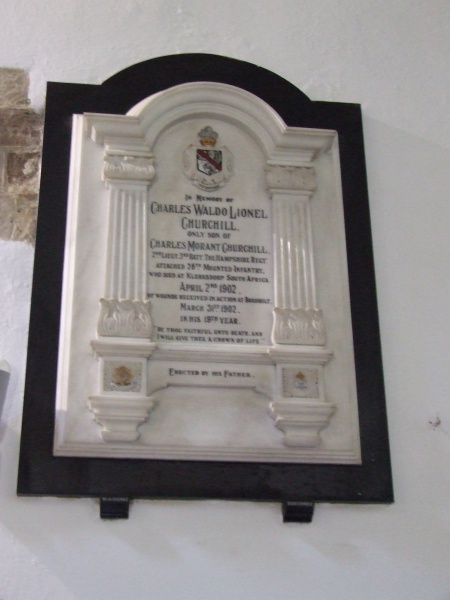
Charles Waldo Lionel Churchill

Charles Waldo Lionel Churchill was born on 16 May 1883, the son of Lt. Col. Charles Morant Churchill, JP (b 19 May 1842) and his wife Ellen Harriette Augusta Meade-Waldo (b 4 Nov 1856).

In the census of 1891 the family are living at Everton Grange, Milford, the family being : Charles Morant Churchill aged 48, Lt Col. Retired Pay, HMS, JP Dorset born in Dorset; Ellen Harriet A Churchill aged 34  born in Cork, Ireland ; Charles Waldo Lionel Churchill aged 7 born in Maidstone ; Frances C E Churchill aged 10 also born in Maidstone + Edmund Wm (?) Waldo father in law aged 61 late 1st Life Guards, JP Kent born in Dawlish, Devon ; Cicely E M Waldo mother in law aged 38 born in Derbyshire ; Margaret A M Waldo sister in law aged 9 born  in Rushall, Kent; Katherine A M Waldo sister in law born in Barmore Castle, Beal aged 7 and finally 10 servants – Daniel M Davis 29 Albert Henry Gregory 19 Charlotte Jane Brown 23 Annie Phillips 26 Mary Jane Fossey 26 Kate E Carpenter 26 Annie Saneroft 17 Emily Peters 16 Annie Palr  Htkins 49 Emma Pearson 38 all being born in Hampshire, London or Dorset.

2012 C Sklinar

Charles joined the 3rd Battn., Hampshire Regt., in June of 1900.  He had been with M.I. in South Africa from December 1901 with the rank of 2nd Lieut and was attached to the 28th Mounted Infantry.

On 31st March 1902 The Damant’s Horse, part of Lt. Col. Cookson’s column were along the Brak Spruit and came in contact with a convoy of burghers and followed in to Boschbult farm.  The superior Boer forces attacked the column who managed to entrench before nightfall and the Boers retired at nightfall.  Charles was wounded during the day and died of his wounds on 2nd April at Klerksdorp.  His final resting place in South Africa has not been determined, but some websites say that he rests in Wimbourne.  His memorial is however, on the wall of Wimborne Minster.

Officers died – South Africa 1899 – 1902

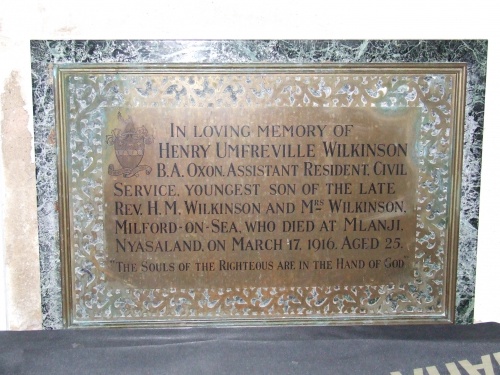
Henry Umfreville Wilkinson

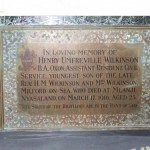
The memorial to Henry can be found inside the church at Milton on Sea, but who was Henry ?

Well, he was the son of Henry Marlow Wilkinson (b 4 Aug. 1827 Godshill, I.O.W d 9 Dec 1908, Milford-on-Sea ) and his wife Florence Amy Kemp-Welch (b 1852 in Brixton, Surrey, died on 5 Jun 1927 in Milford on Sea) who married in Christchurch in the winter of 1886.  Henry Marlow Wilkinson was a clergyman living with his wife, family and servants in Milford vicarage at the time of the 1901 census – Henry Umfreville was aged 10 and like his sister Marie he was not listed as a scholar. Henry Marlow was from a family of clergymen.

Ten years before in 1891, Henry Marlow Wilkinson was aged 63 while Florence his new wife was aged 38 and for children she had 3 under 5 – John, Cyril and Henry aged 10 months.

By the time of the 1911 census Florence was a widow and living at Milford Corner with her 4 children and 4 servants in a 17 roomed house.  Good news for family historians Florence added that she had had 7 children but had lost 3 by the time of the census.  Who were the other children ?  In 1911 John Rothes Marlow Wilkinson was 23 and a student ; Cyril Hacket Wilkinson was 22 and a student ; Henry Umfreville Wilkinson was 20 and a student  and finally, Marie Cecile Florence Wilkinson aged 17 and also a student.
2012 C Sklinar

From the memorial we know that Henry Umfreville was a student at Oxford and attained a B.A., he also was a member of the Civil Service and it was during this service in Mlanji, Nyasaland that he died on 17 March 1916 that he died aged 25. I’ve not found a lot about Henry but will his brother who was a soldier during the Great War be any different ?

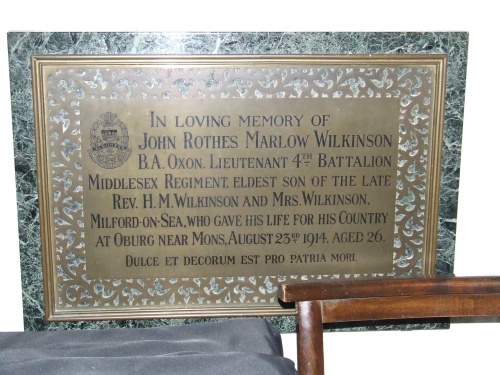
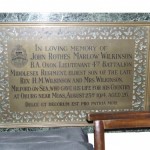
John Rothes Marlow Wilkinson, as we know he was the elder brother of Henry U but he has more of a story to tell.

In the London Gazette John is mentioned as to be a Second Lieutenant in the Territorials dated 17 December 1909.   Another mention gives information regarding Second Lieutenant Wilkinson being transferred from the 7th Bttn Hampshire Regt., to the Duke of Cambridge’s Own (Middlesex Regt.,) He was a University candidate on 24 March 1911but would not be getting pay of allowances prior to 7 February 1912.
2012 C Sklinar

Soldiers who Died in the Great War tells us information we have already gained from the London Gazette but that he was Killed in Action on 10th September 1914 near Mons.  But a look at De Ruvigny’s Roll of Honour gives an insight as to who the young man was.  He was a handsome young man, with I suppose you could say he had film star looks – well you could if this was the 1940’s or 50’s.  He had good strong features and a neat moustache.  His education was at Winchester College and Worcester College (1907-1911) and was Captain of the colleges boat club.  We know he was killed near Mons, but what happened ?  A Private from C Coy., 4th Middlesex Regt., wrote “On Sunday 23 August, we were entrenched in front of a convent, when Capt., …..gave Lieut. Wilkinson an order to take half his platoon (two sections) to reinforce A Coy.  The Coy. was at the left of our positions and was hard pressed.  We took up position under heavy fire at a group of houses.  Your son went into one of the houses, and was heard directing the fire of his two sections through the skylight of the root.  He directed his fire so well that he forced the Germans to retire from his front.  it was from this house that he was overwhelming numbers of Germans coming through the wood to his front.  The Germans came on again until they were within 200 yards.  Lieut. Wilkinson came out of the house into the trench.  It was here that he got the order to retire.  He got the order twice, but would not take it, as he thought it was not an official order.  Eventually he got the order from the G.O.C. to retire.  It was then I noticed he was limping.  To retire we had to go through barbed wire ; here we got separated owing to the heavy shell and rifle fire.  I am very sorry to say that I was not the only man of those two sections to get away from that place.  No officers could give me any information of Lieut. Wilkinson.  I reported to the C.O. what had happened and told him that Lieut. Wilkinson was a very brave man.  He replied, ‘Yes, I know that, and I am very sorry to have lost him’ … I must say your son was a man in very sense of the word.  I think he was as brave a gentleman as one could meet here.  I told this to Capt.,……. I think I have an idea of a brave officer, as I went through the South African War and have eight clasps to my medal”  Such sad news for a family to hear but good to know that a Private thought enough of his Lieutenant to write to his family and inform them what really happened.  So many other families could only wonder or imagine the fate of their loved one.

He was 26 years old when he was KIA and rests in St. Symphorien Military Cemetery, Hainaut, nr Mons, Belgium.

Within a two year period Florence  had lost another two of her boys but she did live on for another few years.

Papers of the Wilkinson of Milford  family can be found in the Bodleian Library

James Marlow Wilkinson was one of over 2000 people who corresponded with Darwin

Roll of honour of sons and daughters who gave their lives in the Great War

Naval Dockyard, Portsmouth

The Naval Dockyard is world famous as the home of Nelson’s flagship – HMS Victory, but the dockyards are also home to the Mary Rose and HMS Warrior.  Well, everyone talks about HMS Victory, so I shall give it a miss except to say that I am glad that I went on board and can appreciate the  every day conditions the men and boys had to endure – well I can imagine.  The conditions during a battle must have been horrendous – noise, the organised and well practised Battle Stations and the accidents of one mis-timed move, all this in cramped quarters with many men not being able to stand upright.

The crew would have consisted of over 800 men and boys – 11 Officers, 48 NCO’s, 80 Petty Officers, over 500 seaman and 40 boys plus approx., 150 Marines of various ranks.  I always thought the Marines were the extra military side of a battle – the sharp shooters and able to go from land to sea and just as capable on either.  But I was told that they were what you would call a peace keeping service – keeping peace between the seaman and the officers as unruly men could cause a great loss of life during a voyage.

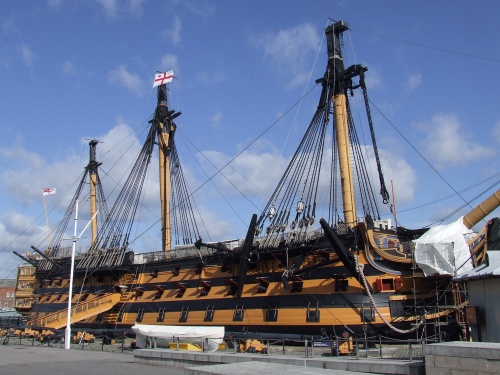
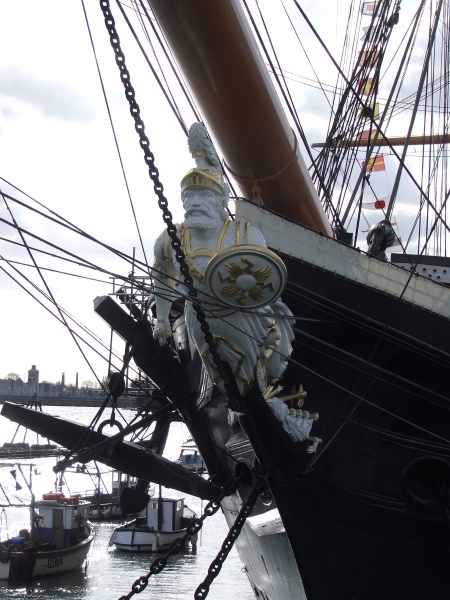
HMS Victory 2012 C Sklinar

So, here she is – at the moment her top masts have been removed for work to be carried out on them and part of her has an outer shell of scaffolding and part of the 150ft Bowspirit has been removed.  To make it easier for the Oldest Commissioned War Ship to survive the masts and the bowspirit are now hollow wrought-iron masts,  from a ship called the ‘Shah’ in the 1880’s. These are lighter than the original wooden masts and require less maintenance.  The original main mast would have been taken from a tree with a 3ft diameter fir, spruce or pine, such woods are known to be strong but flexible.   You can only go onboard with a guided tour but it is worth the wait for a tour to begin and there is lots to do while you wait.

HMS Warrior – The largest, most heavily armed and heavily armoured warship.  No opponent dated to challenge her. She was 418 ft in overall length (compared to HMS Victory 227ft) and the 60 years since HMS Victory showed in the technology.  She had at her centre an armour plated box to protect her guns and machinery and this was impenetrable at even close range with the latest guns. She had the recent innovation of watertight compartments only made possible by her iron construction.

HMS Warrior 2012 C Sklinar

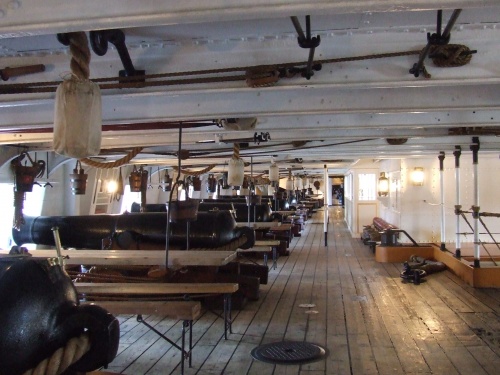
Not only was HMS Warrior feared for her guns but she was also fast, very fast – under sail she could reach 13.75 knots but she also had steam power made possible via her 10 boilers (each with 4 furnaces) and could reach 14.33 knots using these but using both steam and sail 17.5 knots could be made.  Her armament was also impressive. Warrior had the new breach-loading guns now firing shells – normal cannon balls bounced off ironclads.  Warrior unlike Victory had only one gun deck – she was longer but much more stable and able to carry heavier guns, with each gun having a crew of 18.

HMS Warrior 2012 C Sklinar

The crew of 705 men were made up of : 42 Officers and Midshipmen, 3 Warrant Officers an d 45 NCO’s, 401 seaman and boys + plus the engineering staff – 12 Chief Engineers and Engineers, 66 Stokers and Trimmers as well as 3 Rloyal Marine Officers and 24 NCO’s and Artilliary men.  Compared to Victory the decks were a lot more spacious and airyn and brighter. Also by now sailors weren’t ‘press ganged’ and volunteered.  After serving a set time they could achieve a pension

HMS Warrior was first of the Black Battle Fleet of the 1860’s and by 1875 Britain had built a further 22 armour-plated battleships.  The latter 22 had no sails but could steam 3 times further than Warrior without refuelling, but HMS Warrior never had to fire a shot in anger, surely that shows how successful she was – a real success story.

Along with the museum sections there is also a Harbour Tour a fantastic way to see H M Fleet and the harbour.  Sadly, Ark Royal, the one I wanted to see as my father had been a guest of honour on board her some years ago.  He received a cheque, the money raised by the crew to take a Normandy Veteran back to France and my father was chosen.  He had no idea he was going and didn’t normally go on the RNA trips but he did as he was told and turned up at the muster point all suited, booted and medalled.  The group were all on one of the decks ready to be photographed by a helicopter when his name was called out and the Captain presented him with a cheque – he was both emotional and honoured that his piers had chosen him.  Another honour came later that year when he again was one of three D-Day 1 vets to be invited to a Garden Party at Buckingham Palace.  Again he was overwhelmed when he mentioned the Garden Party to another member of the RE Association, who in turn told someone else, and dad ended up being chauffeur driven from home to the Palace – the two other vets had to catch a train, not fair I know but as it goes ‘it’s not what you know but who you know’.

So, needless to say I was disappointed at how much of the Ark I saw and sad that she rests in what is basically the Government version of ebay.

It is expensive to get in but entry allows you one visit to HMS Ark Royal, Harbour tour and Mary Rose Museum but unlimited access for 12 months to the other sections of the site – a good place to visit.

WW1 casualty remembered in Golcar Parish Church

Over the past weeks, I’ve been doing a family tree for a friend and yesterday after threatening to go and visit the area and a local museum, off I went.  It was a nice day albeit a little nippy – my hands were feeling the chill while taking photographs in the churchyard…. but you carry on for the cause!

So, it’s 12:15 and the museum opens at 2pm and my plan was to photograph the family headstones in the churchyard and then cross the road to the museum that was once the home of the family I’m delving into – the Pearson family.  I’m not going to go into the family here as I still have to add some photographs etc., but that churchyard is a family tree in itself as many of the names on the headstones tie in with the Pearson tree.

I digress, as I said the Pearson people are not the aim of this blog, the true star of these lines is a young man named John T Gledhill.

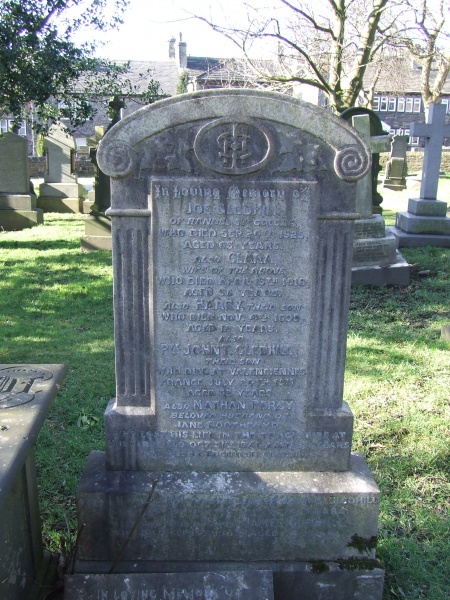
Gledhill headstone. Carol Sklinar 2012

Who was John Taylor Gledhill, well he was born the son of Joe and Clara Gledhill, and lived in 1901 at The Green, Golcar.  Joe was aged 43 in the census and worked as a woollen percher.  Clara nee Taylor was aged 43 and the mother of  3 children aged between 9 and 16 (Jane, James and John).   For those of you wishing to find the family in 1901 they have been transcribed as GLADHILL.

By the time of the 1911 census the family were living at 38 Knowl Bank, Golcar in a 5 roomed house.  The 3 children were still living at home and all working within the woollen industry, weaver, spinners and twisters.  The census tells that Clara had had in total 4 children but only three had survived to the census and the couple had been married 26 years (Sept Qtr 1885 in the Huddersfield Registration District).

John Taylor Gledhill joined the Northumberland Fusiliers in Huddersfield and became Pte., 290/706.  He was later transferred to the Prince of Wales’s Own (West Yorkshire Regt.,) 16th Battalion and changed his service number to 40858.  Soldiers at this time changed their service number when they changed Battalion or Regiment and Officers during this time had no service number.  During WW2 service men and women kept their number for the duration of service and now officers had service numbers.

The service records for John don’t seem to have survived but from Soldiers who Died in the Great War I have been able to glean that he Died on 24 July 1917 .  The Commonwealth War Graves Commission confirms his service number for the West Yorkshire Rgt. It also confirms his date of death but also tells us where he now rests – Valenciennes (St Roch) Communal Cemetery and the position within the cemetery, IV D 27 – relating to section, row and number within that row.  Each cemetery has a box within or near the entrance where you can find a plan to help pinpointing the grave.

Another source, The Medal Rolls Index told that John was eligible for the Victory and British Medals which would have been given to his next of kin.

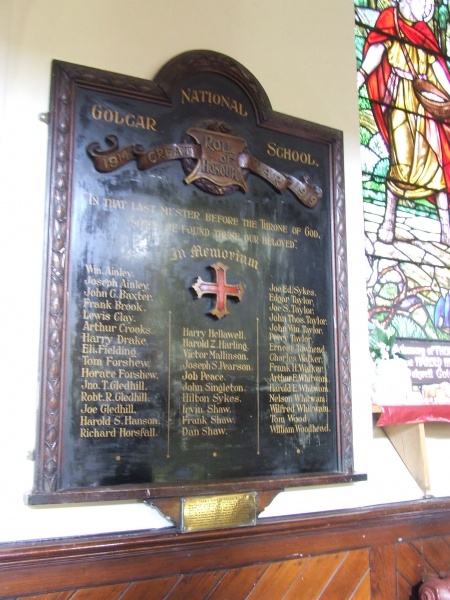
John is recorded on the War Memorial inside the church and also on the St John’s School  Memorial, also in the church.

St John's School Memorial. Carol Sklinar 2012

What did John look like ? How tall was he ? Did he have any scars or tattoos ? With the lack of his service record I may never know. Has John ever had a visitor to his resting place in France and how many people have strayed from the path and wondered among the many headstones and learnt of Johns fate – in modern times probably not many. But today John will have his name written once more and many will now know of this young man from Golcar.

Lest we Forget