Category Archives: General

Wakefield Express WW1 – George A Lister

Wakefield Express WW1 – George A Lister

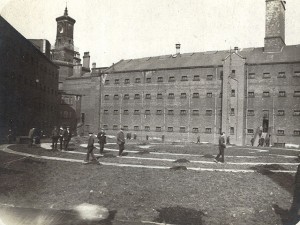
Wakefield prison c1916 possibly with CO's exercising

Wakefield prison c1916 possibly with CO’s exercising

George Arthur Lister.  He seems to have been born around 1879 in Wakefield, the son of Edward Lister. Edward earned his living as a prison warder and in the 1901 census he was with his wife Emily, sons Alfred, George A and Frederick along with Henry Taylor their grandson. Home was 4 Silcoates Street.  George at the time was 21 years old and employed as a postman.

By the time 1911 came around, George had married Mary Elizabeth, who had been transcribed as Amy Elizabeth by Ancestry.  The couple were living at 4 Amery Cottage, George Street, Sandal. George and Mary, who came from Thorne, had been married 5 years ad had one child, five year old Edward.  George now gave his occupation as tramway motor-man for the Electric Light Railway.

George had married Mary Elizabeth Yates on the 14th of August 1905 according to his service records with two children being named – Edward born on 24th of February 1906 in Wakefield and Dorothy born on the 4th of June 1914, also in Wakefield.  The couple according to the military paperwork seem to have married in Bolton, but Freebmd have a marriage for the Doncaster area, which ties in with Mary being from Thorne.

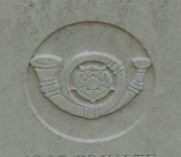
K.O.Y.L.I. © C Sklinar 2015

K.O.Y.L.I. © C Sklinar 2015

Twelve months after the census of 1911, on the 19th of March 1912,  George attested to the K.O.Y.L.I. Territorial Force (duplicate copy), giving his address as 4 George Street, Sandal (transcribed by Ancestry as Landal).  His service number became 1569 and his Medal Card tells he became a corporal on the 27th of March 1913.  His service records tell that he had done annual training, gained promotion to sergeant and during time in France  performed the duties of C.S.M. in 1917.  He was sent to France in April of 1915, coming home in December of the same year.  But, by the summer of 1916 he was back in France.

A description of George brings him to life – he was tall for a man of the time being 6′ tall.  He had a 39″ fully expanded chest, with good physical development and vision.

The original Attestation form confirms his address and occupation found earlier in the 1911 census.  George signed on the 12th of September 1914 to serve in any place outside the United Kingdom in the event of a National emergency.  By 1917, George had been transferred to the Loyal North Lancs. Regt., changing his  service number to 27281.

It seems that somewhere along the line Mary Elizabeth moved from number 4 George Street, Sandal to number 7.

Going through the service records it appears that ion 24th December 1915, George was admitted to hospital. Then being sent to England via a hospital ship – could this be the reason he was home, returning to France in the summer of 1916?  Shortly after returning to France, on the 21st of July 1916, his rank of Sergeant was confirmed.  He was granted leave to the U.K. on 22nd of March for one week.

On the  22nd of June, George was evacuated to a field ambulance and rejoined the regiment the next day.  By the 12th of July 1917 he was wounded on duty, but later on that month, the 31st, he was killed on duty.   He rests in Voormezeele Enclosure No 3, grave XV C 10, along with over 1000 other casualties of war.

The Wakefield Express for the 28th of August 1917 tells:-

Sandal Sergeant’s Death – Killed by a Sniper.  Another Sandal man has given his live for his King and Country.  We refer to Sergt. George Arthur Lister, of the Loyal North Lancashire Regiment, who lived at 7, George Street, Sandal.

In a sympathetic letter to the widow, Second Lieut. Barker states ‘It is with great regret that I have to inform you of the death in action of your husband, Sergt. Lister.  I feel his loss keenly, as he was an efficient N.C.O. and carried out all his duties punctiliously.  He was generally admired for the manner in which he braved the extremely rough work of the trenches. It may be some poor consolation for you to know that he died without pain, being killed instantaneously by a bullet from the rifle of a sniper during operations on July 31st.  Allow me, though a perfect stranger, to tender to you my sincere sympathy in your great bereavement.’

Mrs Lister has also received a letter from Q.M. S.T. O’Shaughnessy, who writing on behalf of the sergeant major and sergeants, says ‘I can assure you that your husband was well liked and respected by his colleagues and men alike.  I can only add that he died a noble death fighting for a righteous cause, and we trust that the thought of that will be a little comfort to you in your sad bereavement.’

Sergt. Lister, who was well known in the Sandal district, was an old Territorial,  being mobilised at the outbreak of war.  He was previous to the war a tram-car driver in the employ of the West Riding (Yorkshire) Electric Tramways company.  He leaves a widow and two children.

 A man who seems to have been well respected in his community and by those who fought by his side.

Wakefield Express – Flockton Soldier Missing

Wakefield Express – Flockton Soldier Missing

Flockton Soldier Missing – Believed to be a Prisoner of War

Wakefield Express 28 August 1917 – Mr and Mrs Walter Wilkinson, Council Buildings, Flockton, have received information from the War Office that their eldest son, Private Albert Wilkinson, R.A.M.C., is missing, and believed to be a prisoner of war.

Private Wilkinson enlisted on October 11th, 1915, and went out on January 1st, 1916.  He had had no leave since he joined. Prior to enlisting he worked at the Emley Moor Collieries.  In a letter to Mrs Allen Marsden, Flockton, Private G C Clark, of Fitzwilliam, writes and says he was a particular pal of Private  Wilkinson, and he has been missing since July 10th.  In describing the battle Pvte Clark said it was ‘hell on earth’. and everyone who got away was very lucky indeed.  The opinion of all after  the battle was that very few missing would be alive.  anyhow he hoped his pal was a prisoner of war.

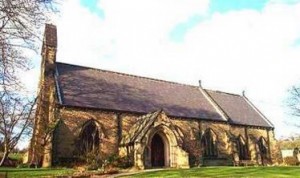
Flockton church

Flockton church

Walter and his wife Ann, were living at The Green, Flockton in 1901.  Walter, a coal miner, was a Flockton man and his wife Ann, was from near by Grange Moor.  Walter and Ann Hinchcliffe married on the 25th of November 1893 at St James’s Church, Flockton. Their family consisted of Mary, Edith, Albert and Annie E., and with the aid  of the census, it seems that Albert was born c.1897.

Ten years later, in 1911, the family had grown a little – Mary, Edith, Annie, Albert Freddie, Maggie and Willie.  The census has been amended a few times as whoever wrote the information used girl and boy instead of daughter and son.  Walter was now a night labourer, amended to Lamp Man (Colliery).  Albert now aged 14 was a Trammer mine, with the addition of Below Ground, Coal Mine.  His two older siblings, both girls, worked in a worsted factory. Home for the family of 9 was a five roomed house at Oaker Hill, Flockton.

The information from the small newspaper article tells his regiment and his rank.  Now comes the important question.  Did Albert come home to his family alive or was he one of the many who remain in a foreign land?

A search of service records and pension records came up with entries that gave no confirmation that the records were for Albert.  The Commonwealth War Graves Commission lists, again gave no clue in the additional information, as to parentage or home town.

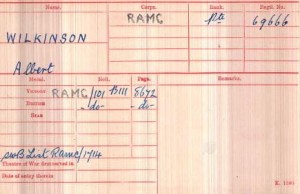
Pvte., Albert Wilkinson via Medal Card, Ancestry.co.uk

Pvte., Albert Wilkinson via Medal Card, Ancestry.co.uk

As yet  the service number for Albert is unknown, but a look at the Medal Card Index, gives two Albert Wilkinsons in the R.A.M.C. – not bad odds!  On opening one the rank is Corporal, while the other is for a Private Albert Wilkinson.  It is known that he was in a battle, so the Medal Card for Private, 69666, Albert Wilkinson, with the addition of a SWB (Silver War Badge), could be a winner!

Albert Wilkinson, Silver War Badge number B339193.  Albert enlisted on the 11th October 11915 and was discharged on the 28th of March 1919 after being sick for a time.  The document also confirms that Albert served abroad.

It looks like the important question can now be answered, YES, he did survive, and survive he did so until the 1970’s.

As to whether or not Albert was a prisoner of war, I don’t know………..but if you do, please let me know.

Wakefield Express – Wounded Soldiers 1918

Wakefield Express – Wounded Soldiers 1918

Another extract from the Wakefield Express this time for the 13th of April 1918.  A few young men are mentioned under this heading.  Who are they?

Wounded Soldiers – The following are among the soldiers who have been wounded in the recent fighting:- Pvte Wray Blythe, New Scarboro’, Netherton; Pvte Frank Earnshaw, son of Cr. and Mrs Reuben Earnshaw (Midgley), who is in a Brighton hospital suffering from shrapnel wounds in the knee and calf of the leg; Pvte W Frost, Sandy Lane, Middlestown, severely wounded in the shoulder; Pvte Cecil Marsden, Middlestown, reported wounded in last week’s “Express” is suffering from a shrapnel wound in the head.

 Working through the article, it seems that Pvte Wray Blythe comes first.  Who was he before he went to war and did he come home to his family after the war?

A quick look at the CWGC and the answer to the last questions seems to be a ‘yes’. But I will leave that answer with another question mark and return to that one later!

The Ancestry website has no entry for a Wray Blythe.  There are however, a few entries listed that are close.  One entry in the military section is for a Ray Blythe of the 1/4th Y.L.I., service number 205564 – could this be our man?  Taking a look at Ray’s medal card, this confirms his rank as that of Private and shows his award of two medals. On to the census. The 1901 has an entry for Ray Blythe born in 1889 in North Newbald, son of George and Mary Jane.  George worked as a grocer and Ray was the youngest of the family aged 12.

It appears that the newspaper incorrectly spelt Ray’s name, as according to the Freebmd site, there is a Ray Blythe born in the December Quarter of 1888 in the Beverley Registration District.  It just so happens that North Newbald falls within the Beverley area.  It looks like Wray is Ray!

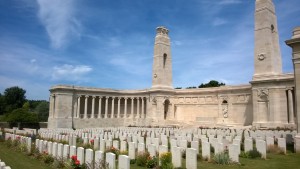
Vis-en-Artois Memorial via CWGC

Vis-en-Artois Memorial via CWGC

The newspaper has Wray wounded, but……..there are various entries for Pvte 205564.  One being in the Soldiers’ Effects, and you know what that means! Roy Blythe was Killed in Action in France on the 2nd of November 1918 and all his effects were to go to Mrs. Elizabeth A Heppleston.  Now another question arises………….who was Elizabeth?    If this is the correct Wray or Ray, he is remembered on the Vis-en-Artois Memorial with nearly 10,000 other casualties, which answers the earlier question about whether he came home or not.

Who is next? Pvte Frank Earnshaw.  There is no mistaking this soldier as his father is mentioned in the newspaper.  Frank is also a member of the local timber merchant family, that is still trading today.  In 1911 Reuben and his wife Eliza were living in Midgley with four children (two had died prior to the  census).  Reuben was aged 39 and had been married 14 years.  Frank was the eldest of the children.

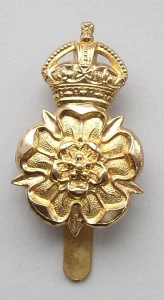
Queen's Own Yorkshire Dragoons cap badge

Queen’s Own Yorkshire Dragoons cap badge – source unknown.

Frank was born in 1898 and attested on the 21st September 1916 at Doncaster, joining the Queen’s Own Yorkshire Dragoons as Pvte 4234 .  He stated he was 18 years old, was living in Midgley, and was a Pupil of County A**l*st (?). Frank was 5′ 5″ tall wit a 34″ chest.  His service record tells that he served in the UK from enlistment to September 1917 when he was sent to France.  About six months later, as we know he was wounded, his records give the date of his injury as the 21st of March 1918. After various postings he was transferred to the Lancashire Fusiliers and his service number became 52461.  After other postings at home and in France in May of 1919 he appears to be in the Balkans and November of the same year he seems to be back home.

Turning the page of his service records another enlistment page is revealed and know Frank’s occupation is clear – Pupil County Analyst – well I was close!  Further pages reveal that on 2nd December 1919 Frank was a Class Z, Private.

Frank Earnshaw left the army in November 1919, and his Dispersal Certificate gives his address as Thrushnest, Midgley, Wakefield and that he would be proceeding to Horbury Railway Station after dispersal.  The certificate lists quite a few articles of equipment and Frank seems to have mislaid a few.  He was in possession of:- Rifle, complete equipment according to unit, entrenching implements, great coat, Army Book 64 and he signed to say that if he lost any of the items in the list he would be charged.  Frank seems to have lost his steel helmet somewhere…………I wonder if he was charged? Other information on the certificate duplicates things already known about him, but his occupation is now given as Chemist and his Medical Category is A.  He must have had a good recovery from the shrapnel wounds to his leg. Frank was also given a Protection Certificate and Certificate of Identity – basically, saying that he had served but was not remaining with the Colours.

It is a change to find someone who survived the war and came home to his family. Did he marry and start his own family, I don’t know, but there is an entry for a marriage in 1924 to a Martha Earnshaw – could this be a cousin?  Is it our Frank? There is a death entry for 1957 for a 58 year old Frank Earnshaw.  The years and ages fit……..you tell me.

Now it’s the turn of Pvte. W Frost of Middlestown, who seems to be a little left out when it comes to information.  A number of men with the initial W appear in military records and census but no information that could say ‘yes, this is the one’.

Finally, Pvte. Cecil Marsden.  There are four men by this name.  Two I have disregarded by birth year and the other one simply by where he was living.  That leaves Cecil Marsden born around 1891 in Flockton the son of Henry and Jane, who in 1911 were living in Middlestown.  Henry was a colliery deputy and Henry, the eldest child of three was an apprentice plumber.  Frank was 20, his sister Florence was 18 and brother Maurice was 1 – their parents being married 21 years and having 3 children and none dying.  I have a theory for that one but will keep quiet!

On the 13th of April 1914, Henry Marsden and his family set off for the Wesleyan Chapel, Wesley Street, Ossett to witness the marriage of Cecil and Eleanor Clarkson.  Cecil was living at Glen View, Old Road, Middlestown, while Eleanor was living at 13 Little Town End, Ossett.

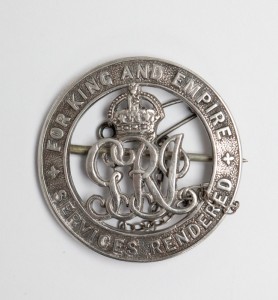
Silver War Badge

Silver War Badge

There is a Medal Card for a Cecil Marsden, which gives the Victory and British Medals for service in the Y & L R (Yorks and Lancs Regiment), Pvte 202794, but also tells that Cecil received a SWB (Silver War Badge).  We know that Cecil had received a shrapnel wound to the head and was therefore eligible for the SWB.  The Silver War Badge Records for Cecil tell that by now he was a Corporal and serving in the 4th Battalion from which he would be discharged.  He enlisted on the 13th of Marsh 1916 and was discharged on the 9th of November 1919 due to sickness aged 22 – there seems to be a bit of a miss match in ages as on his marriage certificate he is in his 20’s, years later he is still only 22!  Which age is correct?  His year of birth plus the 22 years of age on his SWB papers does not give 1920, but the entry below for a man aged 31 is nearer as he was 23 when he married.

Daisy K M Coles, Voluntary Aid Detachment

Daisy K M Coles, Voluntary Aid Detachment

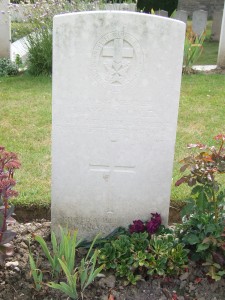
Daisy rests in Longuenesse Commonwealth War Graves cemetery, just outside St Omer, northern France, along with soldiers of various nations, non-combatants and non-war burials.

Daisy Kathleen Mary Coles was born in Scotland, the daughter of Mr and Mrs Walter Coles of Priorsford House, Peebles.

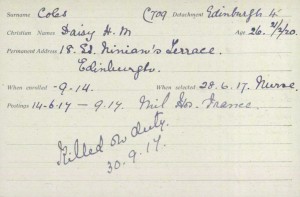
Red Cross VAD record card

Red Cross VAD record card

In September of 1914, Daisy, of 18 St Ninians Terrace, Edinburgh,  joined the Voluntary Aid Detachment and worked at the 2nd Scottish General Hospital.  Originally, Craig Leith Poorhouse, the 2nd Scottish General Hospital had 1032 beds.  In 1917 the hospital sent a detachment to St Omer as the 58 (Scottish) General Hospital.  It was here on the 30th of September 1917 that Daisy lost her life while on duty.

The Red Cross record card for Daisy has her listed as Daisy H M Coles, but her date of death matches the CWGC record and her headstone.  Her age, also differs on the card by two years. Daisy’s character and work were noted as being very good.  She was also Mentioned in Despatches.

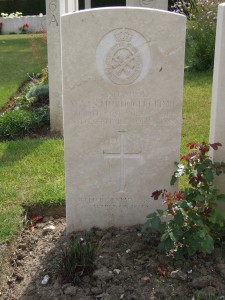
Daisy K M Coles, Longuenesse CWGC © C Sklinar 2015

Daisy K M Coles, Longuenesse CWGC © C Sklinar 2015

The headstone that marks her resting place has the usual information, name, date of death, age and service, but at the base the words ‘killed by enemy action while on duty’.

A few years after the war had ended her local church, Christ Church, Morningside, Edinburgh, unveiled their war memorial.  The Scotsman of Wednesday, 2nd of November 1921 recalls the occasion.

    CHRIST CHURCH, MORNINGSIDE, EDINBURGH – The war memorial, in the form of a bronze tablet, which has been placed in the east wall of the north transept. “To the honoured memory of those from Christ Church, Morningside, who gave their lives in defence of truth and freedom in the Great War, 1914-1919,” was unveiled yesterday, All Saints Day, by Mr James M. Watt, and dedicated by Bishop Walpole. The anthem sung by the choir immediately after the dedication of the memorial was “Blest are the departed,” by Spohr. The bishop preached the sermon. Twenty-five members of the congregation, including Miss Daisy K. M. Coles, who was killed in a bombing raid on the hospital where she was nursing in France, perished in the war. A bugler of the 1st Battalion The Highland Light Infantry, at the conclusion of the service, sounded the “Last Post” and the “Reveille.” The Bishop was assisted by the Rector, the Rev, Eric H, Brereton, O.B.E., Hon. Chaplain to the Forces, 3rd Class.


The extract from the war diary (below) tells what happened on the night of the 30th of September 1917 and that three nurses were killed.  Dairy was one of those, the others were Elizabeth Thomson, the other was Staff Nurse Agnes Murdoch Climie.

Elizabeth Thomson, volunteered in 1917 as a nurse, and gave her contact details as c/o R Thomson, Esq., St John Street, Creetown Kirkcudbright and like Daisy, she was also Mentioned in Despatches.

Agnes Murdoch Climie, Staff Nurse, Longuenesse CWGC © C Sklinar

Agnes Murdoch Climie, Staff Nurse, Longuenesse CWGC © C Sklinar

Agnes Murdoch Climie’s time in the war differed from that of Daisy and Elizabeth, as she was a professional nurse.

Agnes was the daughter of John and Isabella Climie.  After attending school she trained at the Royal Infirmary, Glasgow, later working on a maternity ward. In 1914 she joined the Territorial Force Nursing Service and by mid 1917 she was at the 58th (Scottish) General Hospital. Agnes was 32 when she was killed, her death being reported in the British Journal of Nursing on 10 November 1917.  Agnes was also Mentioned in Despatches for valuable service.  Her father wrote to the Matron in Chief  “I have heard from France of the wonderful bravery of the nurses. They gave their lives for patients whom they were dressing at the time.

From the War Diary of 58th (Scottish) General Hospital, St Omer tells the story of that fateful night.

1/10/17 During a hostile air raid on the night of 30/9/17 – 1/10/17, three bombs were dropped in the camp at 10.40 pm, ( 2 on Marquees for patients and 1 in the nurses compound). Of the 2 bombs which dropped on the marquees, 1 struck a marquee which was, fortunately unoccupied, the other struck a marquee occupied by patients and 2 nurses, who were on duty. The bomb which fell in the nurses compound struck a bell tent, which was unoccupied as the 2 nurses who sleep in the tent were on night duty. The casualties which have resulted are :- Nurses killed 3, wounded 3 ( 1 dangerously). Other ranks :- killed 16, wounded 60. Total killed 19, wounded 63. Of the other ranks wounded, 14 were transferred to other hospitals and one of these has since died. There has been much damage to canvas and equipment. 54 marquees (hospital, large) have been damaged (2 have been absolutely demolished, while the damage to the others varies from almost complete destruction to mere riddling). 21 bell tents have been damaged ( 1 was completely destroyed by a bomb and 20 have been riddled). Many pieces of iron pierced the new corrugated iron sleeping hut for sisters. 1 piece pierced iron and 3 pieces of asbestos boarding. Numerous panes of glass have been broken in the permanent buildings. One of the ablution houses has been damaged.

Surgeon General MacPherson, the ADMS and the Matron in Chief called today and it was arranged for the transfer of all lying cases to other hospitals so that at night the walking cases left in hospital might go to the cave in the public garden and sleep there. In the evening patients and unit moved to the cave in the public garden and only the police and a few orderlies were left in the camp. The 3 wounded nurses were transferred today to No 10 Stationary Hospital.

2/10/17 The 3 nurses (Sister Climie, Nurse Thompson and Nurse Coles) and the 16 other ranks killed by hostile aircraft on the night of 30/9/17-1/10/17 were buried today at 4:00 pm in the Souvenir Cemetery Longuenesse. Sister Milne, who was dangerously injured in the same air-raid died last night in No 10 Stationary Hospital. 2 other ranks who were wounded have died today, so that the statistics as a result of the raid are, to date :- Dead, nurses 4, other ranks 18. Wounded :- nurses 2, other ranks 58. Totals Dead 22, Wounded 60.

Staff Nurse Agnes Murdoch Climie was from Newlands, Glasgow.
VAD Daisy Kathleen Mary Coles was from Peebles/Edinburgh.
Sister Mabel Lee Milne – location unknown.
Mabel is named on the Perth Academy Memorial.

The graves of Staff Nurse Agnes Murdoch Climie and Sister Mabel Lee Milne of the Territorial Force Nursing Service, as well as Daisy Kathleen Mary Coles and Elizabeth Thomson of the Voluntary Aid Detachments, killed by enemy aircraft 30th September 1917, erected by officers and nursing staff of the No. 4 Stationary Hospital [or the 58th (Scottish) General Hospital] at Longuenesse in Gouvenir Cemetery.

White Feather Day – 2nd March 2016 – Guest Blogger Jane Ainsworth

White Feather Day – 2nd March 2016

I have learnt a lot about Quakers since I started helping out early 2015 at the Maurice Dobson Museum in Darfield, where Geoffrey and Elsie Hutchinson (Barnsley Local Meeting of Quakers) are very actively involved. We have enjoyed many discussions about the First World War and my interest in Conscientious Objectors has expanded, especially since it is relevant to several of the Old Boys of Barnsley Holgate Grammar School.

Geoffrey gave me a copy of Quaker News 94 – Winter/Spring 2016, which featured White Feather Day on the centenary of the introduction of conscription. This inspired me to do some more research so that I could promote this day more widely in a year that will commemorate a number of significant centenaries, including the Battle of the Somme from 1 July to 13 November 1916.

As voluntary enlistment failed to meet the needs of the Army for additional troops, the Military Service Act was passed in 1916. It came into effect on 2 March 1916, when conscription was introduced for all British men aged between 19 and 41, who were unmarried or widowed without dependent children. A list of exceptions included men who had come forward for enlistment but been rejected, those discharged from service because of ill health, Men in Holy Orders or regular ministers of any religious denomination and those with a Certificate of Exemption.

Men could apply for a Certificate of Exemption from a Local Tribunal and these could be granted on four grounds as either absolute, conditional or temporary: 1) it was expedient in the national interests that he should be engaged in other work, or, if he is being educated or trained for any other work, that he should continue; 2) serious hardship would ensue owing to his exceptional financial or business obligations or domestic position; 3) ill health or infirmity; or 4) conscientious objection to the undertaking of combatant service. There were also Appeals Tribunals.

However, ironically, the Act made it a duty for men to die for their country but gave them the right not to fight, but it would certainly not make it easy for men to refuse to take up arms and Tribunals in different areas interpreted the rules in various ways as they were not impartial.

In August 1914, Vice Admiral Charles Cooper Penrose-Fitzgerald, who had retired from the Royal Navy in 1901, had founded the Order of the White Feather with the support of author Mrs Humphrey Ward. Mrs Ward was born in 1851 as Mary Augusta Arnold to a prominent Australian family of intellectual writers and educationalists; her novels contained strict religious subjects promoting Victorian values and, although she established educational settlements with the declared aim of equalisation in society, she campaigned against women getting the vote.

The campaign began in Folkstone with a group of 30 women distributing white feathers to men not wearing uniforms. The white feather as a symbol of cowardice appears to have originated in the 18th Century from the idea that a white feather in the tail of a game bird denoted poor quality. The campaign grew and spread across the country – and even included Suffragettes such as the Pankhursts.

These women showed no discrimination about denigrating soldiers home on leave, men serving their country in other ways or those who had been discharged because they were wounded. They even presented a white feather to Seaman George Samson when he was wearing civilian clothes to attend a public reception in his honour, having been awarded the Victoria Cross for gallantry in the Gallipoli Campaign.
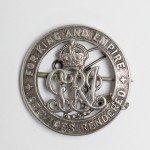
Silver War Badge

Silver War Badge

This led the Government to issue lapel badges reading ‘King and Country’ to employees in state industries and the introduction in September 1916 of the Silver War Badge for veterans honourably discharged due to wounds or sickness.

Conscientious Objectors (COs) were men who refused to fight on moral or religious grounds because their consciences would not allow them to kill. During the First World War there were about 16,000 such men, who showed great courage in standing up for their beliefs, particularly when some were treated more fairly than others.

The majority of COs given a conditional exemption agreed to work on the land in farming or forestry or in menial employment in hospitals or other institutions. Others decided to join the Royal Army Medical Corps as Stretcher-Bearers, who carried out the dangerous work of rescuing wounded soldiers from the battlefield.

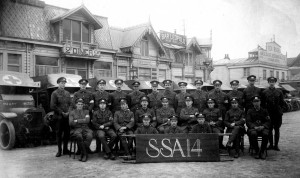
FAU Section Sanitaire Anglaise 14 at Dunkirk 1916 (Library reference: TEMP MSS 881/PHOT/SSA14/1/5) Quaker Library

FAU Section Sanitaire Anglaise 14 at Dunkirk 1916 Quaker Library

The Quakers established the Friends Ambulance Unit as they recognized from the outset of war the need for adequate medical support, although initially both the Red Cross and the Army were reluctant to involve a group of independent and pacifist volunteers. They provided diverse medical support and by the end of the war were staffing eight hospitals in France and Belgium.

The Commonwealth War Graves website (CWGC) lists more than 6,000 deaths of those serving in the Royal Army Medical Corps during the war, of whom many were Quakers believing that ‘to refuse to kill is a cause worth dying for’.

About 3,400 COs were allowed to join the Non-Combatant Corps established in March 1916, as Privates, who wore a uniform and were subjected to army discipline; they provided physical labour where needed but did not carry weapons or take part in battle. CWGC lists 26 casualties in the Non Combatant Corps from 1916 to the end of 1918.

Those who refused to serve or were unwilling to wear the uniform or to perform certain duties could be court martialled and subjected to severe punishments, Although 35 out of 50 men forcibly taken to France were sentenced to death for refusing to obey orders in a theatre of war, they were not shot but the sentences were commuted to 10 years penal servitude.

About 6,000 men were imprisoned, often in inhumane conditions, deprived of basic needs and bullied; many suffered mental breakdowns and physical illness because of their treatment and some died as a result. The scandal created by the numbers involved led to a new scheme whereby those imprisoned could be released to work in Work Centres or Camps, doing arduous work while wearing civilian clothes, but the conditions in the most notorious of these led to COs preferring to return to prison.

Felicity Goodall’s ‘We Will Not Go To War‘ presents some harrowing stories of COs in their own words while White Feather Diaries on the Quaker website provides details of Hilda Clerk, Bert Brocklesby, John Hoare, Howard Marten and Laurence Cadbury.

It is important that the bravery of these men is properly recognised as well as those who fought for their country. We should remember them all.

Thomas Corder Pettifor Catchpool  – (15 July 1883 – 16 September 1952, aged 69) helped set up the Friends Ambulance Unit in 1914 and worked with it voluntarily in France, being awarded the Mons Star. However, when conscription was introduced in 1916, Corder felt that he could no longer serve in any capacity that would aid the war so he returned to England. He became an ‘absolutist’ and suffered repeated trials, court martials and imprisonment, which damaged his health. After his release from prison in 1919, Corder worked with the Friends War Victims Relief Committee in Germany, having learnt German while in prison. He married Mary Gwendoline Southall in 1920 and they had four children.

Esther Pleasaunce (Pleas) Catchpool shared her father’s convictions. She got married in 1954 to John Holtom, a Mining Engineer who rose rapidly in the Mining Industry in South Yorkshire then the Energy Agency. John had been accepted into the Society of Friends after attending the Doncaster Meeting late 1940s; he met Pleas, who was on sabbatical as an Art Teacher at a London Girls’ School, at a Quaker Conference and she became an active member of the Barnsley Meeting. They had four children and lived in Wath-upon-Dearne for about 25 years before moving to Clopton in the 1980s for ten years. As this was close to the Molesworth missile base, they provided support to other pacifist demonstrators camping nearby.

Tribunals were set up following the introduction of the Military Service Act to consider requests for exemption or deferment from men or employers. In Barnsley, they comprised Lieutenant Colonel Hewitt, the military representative, a Solicitor by profession and the main interrogator, plus the Mayor as Chair, and other Aldermen; they were held in the Town Hall. About 210 cases were reported on the front page of Barnsley Chronicle on 4 and 25 March 1916 and in between were reports on applications to the separate Colliery Court. Men were not named but would have been easily recognisable from descriptions printed, the general tone of which is disapproving.

On 25 March 1916, the first 6 cases of conscientious objection were considered and most of these were refused but directed to the Non Combatant Corps. The first man was a Linen Drill Warper at Taylor’s factory who explained that he had consecrated his life to God, but he did not belong to any particular religious group. He was challenged by Colonel Hewitt and asked whether he would defend his mother if the Germans attacked her; his negative response elicited: “Then I submit this man has no conscience at all.” While one Councillor had objected to hypothetical questioning, another asked if the man had read any Shakespeare, “Well read it and you will find Shakespeare says ‘Conscience doth make cowards of us all’. It looks so in your case.”

A Clothing Manufacturer aged 33, who was a Congregationalist and had held for 15 to 18 years strong objections to anyone taking human life, was challenged by Colonel Hewitt as to whether a boy was capable of holding such views. The applicant was also asked about defending himself and directed to the NCC, but his request to join the Friends Ambulance Unit was agreed.

It took courage for Conscientious Objectors to attend these Tribunals, exposing themselves to the mockery and censure of those present as well as members of the public. They also risked retaliatory attacks on their person or property.

ACKNOWLEDGEMENTS

Geoffrey Hutchinson, Barnsley Local Meeting of Quakers
Various websites, including the Long Long Trail, Wikipedia, CWGC
Quaker News 94, quaker.org.uk and quakersintheworld.org
Felicity Goodall’s ‘We Will Not Go To War’ (The History Press 2010)
John Holtom’s ‘Living With Coal’ (self published in 2000)
Barnsley Chronicle
Quaker Library


Thomas Watson Cook – Rifle Brigade

Thomas Watson Cook – Rifle Brigade

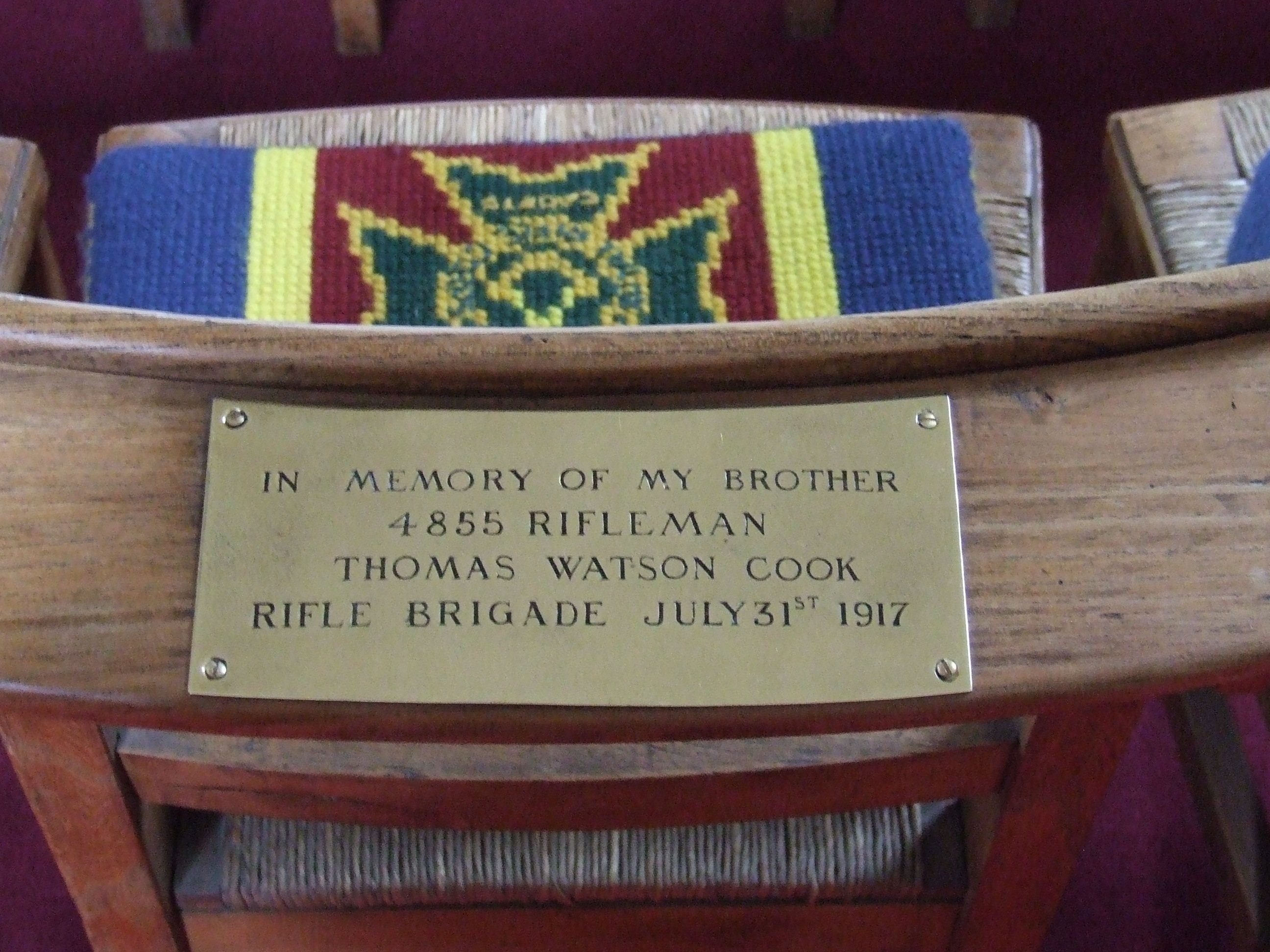
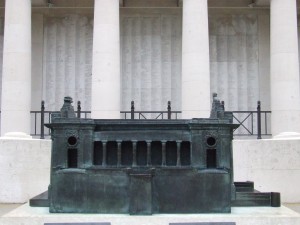
St George’s Chapel, Ypres, is a haven of solace just five minutes walk from the busy main street of the town where locals and visitors shop, or have a drink or a meal in one of the many cafe’s and bars.  It is here that we find the memorial to Thomas Watson Cook secured to the back of one of the chairs.  Thomas is one of many who are remembered either in brass or wood on the wall of the chapel or, as Thomas, on the back of one of the chairs.

St George’s Memorial Church, is an Anglican Church within the Church of England’s Diocese and falls under the care of the Lord Bishop of Gibraltar. The Chapel is visited by  thousands of people each year who are visiting the area for a holiday or military pilgrimage.

Thomas Watson Cook memorial chair in St George's Chapel , Ypres© Carol Sklinar 2014

Thomas Watson Cook memorial chair in St George’s Chapel , Ypres© Carol Sklinar 2014

Thomas’s plaque tells ” In Memory of My Brother 4855 Rifleman Thomas Watson Cook Rifle Brigade July 31st 1917″.  A simple memorial to his Thomas from his brother.  Who was the brother that thought so much of his sibling to have paid for the memorial within the walls of this special Chapel so far away from home?

Firstly, looking at the CWGC collection, in the hope of the parents and their address being recorded on the site.  Yes, parents are mention but sadly, only by initials – Mr W W and Mrs S A

Menin Gate, Ypres © Carol Sklinar 2014

Menin Gate, Ypres © Carol Sklinar 2014

Cook.  Also recorded is their address – Mill House, Hamptons, Tonbridge, Kent.  A good start so far!  I now also know his age and that he is remembered on the Menin Gate Memorial, just a short walk away from St. George’s Chapel.

The collection of records named Soldiers Who Died in the Great War, tell that Thomas was born in West Wickham, Kent. At the time of his enlistment in Maidstone, he was living in Hampton, Kent.

I seem to be going out of the order in which I research men and women in the hope of finding the names of Thomas’s parents.  The Register of Soldiers’ Effects helps in a little by having his mother, Sarah A, as his beneficiary.  Armed with this information the 1901 census would find fewer results.  It did.  William W Cook aged 47 was a foreman rag cutter in a paper mill living at Hamptons in West Peckham.  Sarah A is there along with Frances aged 11, Thomas aged 6, Minnie and a young man who has been transcribed as Vancouter.  I did think that this could be a mis-transcription and was proved correct when I input one word into Freebmd – Vancouver. Yes, Vancouver George Cook was born in the Malling Registration District in the March Quarter of 1892.  Just as an added extra, there were a few people with the same first name, our Vancouver died in 1946 aged 54.

Ten years later, Thomas now 16 years of age, is in London working as a servant in the home of Leopold Victor Swaine,  no occupation or other information given, aged 70 and his wife Charlotte Jane  aged 66 – the couple having been married two years.  Thomas was one of six servants in the house at 14 Queens Gate, London.  As a snippet of added information Mr Swaine was born in Germany and his wife came from Mauritius.

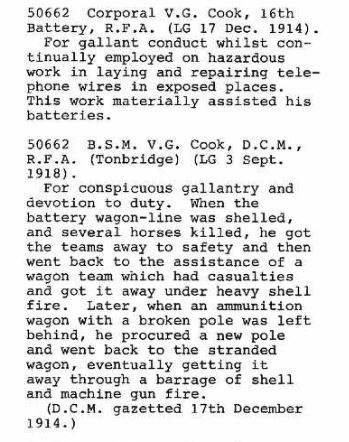
Still in 1911,Vancouver, was now 21 and serving in the 136th Battery, Royal Field Artillery based at Louisberg Barracks, Borden.  His Victory Medal Roll entry gives his service number as 50662

Vancouver Cook DCM Citations

Vancouver Cook DCM Citations

and rank as W.O.II.  His Medal Card gives a little more information – as W,O.I he served as 1029855.  Abbreviations on this card LS & GCM. AO 368. 1926 – GCM could be the abbreviations for General Court Martial, Army Order. Plus Col. Comdt Peshawar Dist – interesting, but not out main focus!  But saying that there is an entry for a Vancouver George Cook in the Probate Calendar, who has been awarded the D.C.M. and the M.B.E., he left over £2000 to his wife – are these two men the same?  Well, it looks like it according to the D.C.M. Citations having the same serial number as previous records. The next question and I am not going to answer this one, is, did he get the M.B.E. or have I led myself up a long garden path?

Back to the main man and who was the brother who had the inscription ” In Memory of My Brother 4855 Rifleman Thomas Watson Cook Rifle Brigade July 31st 1917″ placed in St George’s Church.  It seems that brother was none other than Vancouver George Cook.

History Wardrobe – Fairytale Fashion

History Wardrobe – an afternoon of Fairytale Fashion.

Bagshaw Museum

Bagshaw Museum

What better way to spend a chilly Saturday afternoon than listening to Lucy Addlington of History Wardrobe and her partner in costume Meredith (Merry) Towne.

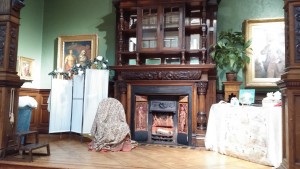
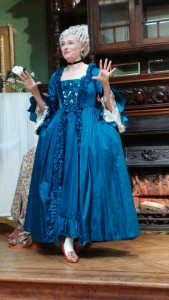
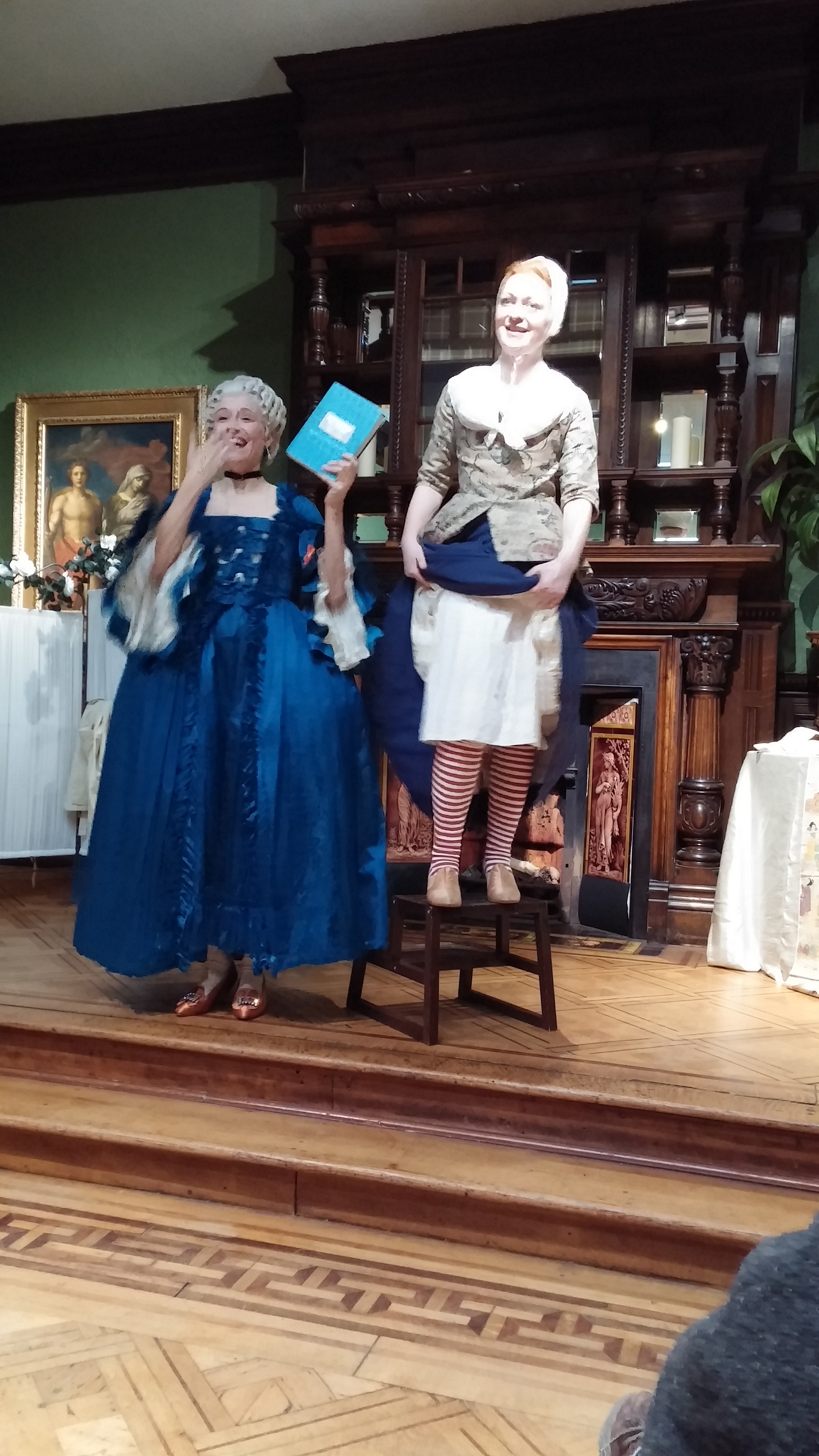
The afternoon started well with a cheeky glass of Cava.  I took my seat, the room within Bagshaw Museum started to fill. Lucy entered, wearing a kingfisher blue costume based on 18th century designs, to a full house.

Lucy Addlington of History Wardrobe

Lucy Addlington of History Wardrobe

Not only does the History Wardrobe brand delight with fashion in all its forms, but you, the audience, are given lessons in social and economic  history with the odd bit of political history thrown in if needed.

As it says in the title, we were entertained with fairytales – their beginnings, their formation, their development and how no matter in the world you are from, there is a similar story at the other side of the world.   Lucy passed on the results of her research by telling us that the tales were written by men from as far back as the 1600’s by Charles Perrault, The Brothers Grimm and Hans Christian Anderson (lift right leg, slap right thigh and say rhythmically ‘I’m Hans Christian Anderson, that’s me!).  But! who told these tales to the men? It was women – grandmothers, mothers, elder sisters, the ladies who gave solace and nursing care to the poor, needy and infirm.  Passed down the generations by word of mouth – no matter what your ethnic origin is, stories were always told.

What stories and tales saw no generation, gender or ethnic boundary?  Cinderella, Red Riding Hood, Raupunzel and Beauty and the Beast, they all appear in some variation or other……….So to the reason why we spent Saturday afternoon in Bagshaw Museum – the costumes.

20160213_141607

Lucy and Merry

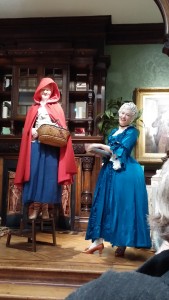
As I have said, Lucy entered wearing a kingfisher blue costume and then introduced Merry who was dressed as Little Red Riding Hood and the couple described Merry’s outfit, which apart from the cape, had been made by Merry, by hand.  The couple bounced witty jibes and comments to each other and it was soon time to see how the costumes were held together and held in place.  Well, it seems that for most of the time it is pins and drawstrings and laces.

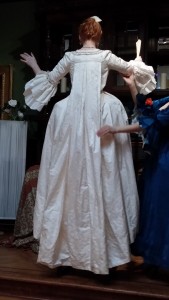
Although, each of Lucy’s talks has costume as it’s main theme, she also brings extra items of fashion and memorabilia that compliment the theme.  This talk was no different, so we had fairy tale books, pretty red dancing shoes, sequin shoes – just like Dorothy’s.  But the icing on the cake, and according to Lucy, she had mortgaged Merry’s house and sold her unborn children on ebay, to obtain a width of material that was approximately 200 years old.  The back of the material was beautiful but the front was 20160213_143625fantastic and had held on to its vibrant colours.

MerryMerry

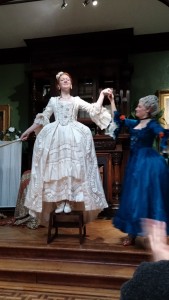
Lucy with Merry as Cinderella

Lucy with Merry as Cinderella

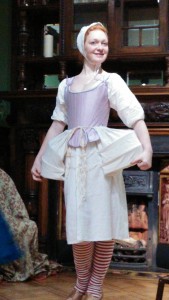
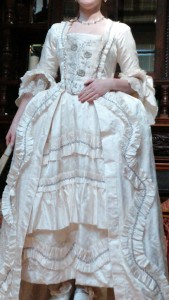
We had been given a clue as to the ‘Cinderella’ dress by being told that the dress would be white and silver, given the reasons for these colours and shown the ‘stomacher‘, which had been hand embroidered by a friend of the duo.

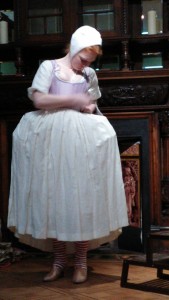
By now we were building up to the pièce de résistance –   Merry was taking the roll of Cinderella, and every good ball gown needs good foundation garments, including stays.  With her undergarments secure, Merry left us, while Lucy continued talking about costume, shoes and fairy tales.

Cinderella gown made by Merry

Cinderella gown made by Merry

Merry entered after being introduced by Lucy – the dress, also made by Merry,  was a work of art.  Further information was given about the dress and then all too soon the talk was over and it was time to go home or stay, look at the memorabilia and chat to Lucy and Merry.

20160213_152539

Now doesn’t that look like a work of art?

Lucy, on her own, or with other members of the History Wardrobe team, are invited and welcomed to treat groups and open audiences throughout the country, to the History Wardrobe brand of information and humour.  If History Wardrobe is in your area, you MUST make time to go – go on your own or take a friend, it doesn’t matter, you will be welcomed with open arms.

Dorothy Fox by Guest Blogger, Jane Ainsworth

DOROTHY FOX (1894 – 1918, aged 24) VAD IN THE FIRST WORLD WAR

When I started researching War Memorials in Barnsley in 2013 for my initiative to create a Barnsley Roll of Honour, Dorothy Fox was the only woman I came across.

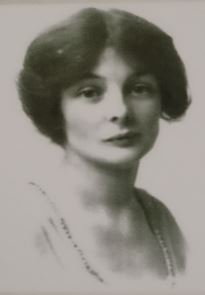
Dorothy Fox image Barnsley Archives

Dorothy Fox image Barnsley Archives

Dorothy was born on 26 September 1894 in Barnsley to Thomas Fox, Wine Merchant, and Mary Emily Tomlinson nee McLintock. Dorothy was the fifth of 8 children, 2 of whom had died by April 1911; her grandfathers were both businessmen: James Fox, Wine Merchant of Cockerham Hall and Harbrough Hill House, Barnsley, and Robert McLintock, Manufacturer / Linen Weaver of Barnsley.

Dorothy was well educated and supported by a well off family. On the 1911 Census, she was a student boarder at Malvern College for Girls in Worcestershire, while her parents had moved temporarily from Barnsley to Broadstairs, where her father was a Brewer Employer, and her brother Charles Fox, aged 18, was a Brewer at the Portland Hotel in Malvern. (Charles was Lieutenant Colonel in the 5th Battalion of the York  & Lancaster Regiment in the First World War).

The British Red Cross Personnel Record shows that Dorothy was engaged as a Nurse in the Voluntary Aid Detachment (VAD) on 1 July 1916, the first day of the Battle of the Somme. She served in Ipswich Hospital until 4 February 1917 then transferred to the 4th Northumberland V A Hospital at Corbridge from 27 April to 21 May 1917. Dorothy moved to the 2nd Western General Military Hospital in Manchester on 8 October 1917 and was there until she died of pneumonia on 3 November 1918, just days before the war ended. Dorothy probably died of infection in the influenza epidemic that ended up killing more people than the war itself had done.

(The British Red Cross and the Order of St John of Jerusalem were empowered to raise, train and supervise VADs to provide nursing support to qualified medical teams at the vast network of Military and Auxiliary Hospitals, established across the United Kingdom to deal with the huge number of casualties from various theatres of war. The 2nd Western General Military Hospital in Manchester with its Auxiliaries dealt with more casualties than any other in the country).

Dorothy’s death was reported in Barnsley Chronicle on 9 November 1918: ‘FOX: on November 3rd at 2nd Western General Hospital in Manchester, Dorothy, aged 24, dearly loved daughter of Thomas and Mary Fox, Hall Bank, Barnsley.’ She was buried in Barnsley Cemetery in an area that has several Fox graves with ornate monuments.

There are several memorials to Dorothy in the South Chapel of St Mary’s Church in Barnsley, where her parents had got married and she had been baptised. Her name is listed on the beautiful painted column War Memorial along with about 200 local men, who sacrificed their lives serving their country. Dorothy’s grieving parents paid for a stained glass window, representing St Elizabeth (mother of John the Baptist), St Mary (the mother of God) and St Helena (mother of Emperor Constantine the Great) to be erected in this chapel dedicated to their daughter by a plaque underneath.

To the Glory of God and in loving memory of DOROTHY FOX, Hall Bank, Barnsley, who died 3rd November 1918 aged 24 years, at the 2nd Western General Military Hospital, Manchester after over 3 years faithful and devoted service as a nurse in the Volunteer Aid Detachment of the Order of St John of Jerusalem during the Great War 1914 – 1918, this window, representing St Elizabeth, St Mary and St Helena was erected by her Father and Mother.

Dorothy Fox's memorials in St Mary's Church Barnsley.  Window o left with dedication plaque photo Jane Ainsworth

Dorothy Fox’s memorials in St Mary’s Church Barnsley. Window on left with dedication plaque. photo Jane Ainsworth

 Sources:  Ancestry, The Long Long Trail, CWGC, British Red Cross & Barnsley Archives

Western Front Association

Western Front Association meeting, having recently rejoined, I was looking forward to attend one of its talks.

A few years ago I joined the Western Front Association and alas, I never renewed my membership, that is until a few weeks ago.

Within a few days I received a quite heavy A4 envelope in the post, which included my welcome letter from Sarah Gunn, the Membership Administrator (she had found my old membership number), my membership card, an issue of the Bulletin and a Special Edition of Stand To!  Armed with a ‘cuppa’ I began to look at when the meetings were, and who was going to share their knowledge with the membership.

There was one talk that rapidly caught my attention, but I’ll come back to that shortly!   The second talk would mean taking a few hours holiday from work to venture down the M1.  The talk was about a man whom I had a particular interest in, as he was one of the 250 people I am researching – what a bonus. After contacting the Chair of that local group I was disappointed to learn that the talk had been cancelled but I was to be put in touch with the speaker who duly contacted me a few days later.

Back to the initial talk that caught my attention.  The talk was to be in Allerton Bywater – not a million miles away, and a quick look at Google Maps gave me the whereabouts of the meeting

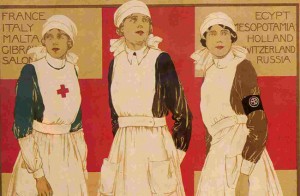
Red Cross Voluntary Aid Detachment

Red Cross Voluntary Aid Detachment

hall – quite a nice hall, small but warm, compared to some. After signing in and meeting a familiar face or two I sat down with a cuppa – you must think all I do is drink tea!

The talk was about the Voluntary Aid Detachment (V.A.D.), and given by Tim Lynch.  Tim is a former soldier, serving in the Falkland Islands and Ireland and is a military historian and photographer with numerous books under his belt.  The title of his talk was of interest, as I was researching a lady, who had served in the V.A.D., massing a total of over 8,000 hours over a four year period in a rather large house that was converted to a hospital.  Tim told that quite a few of these women

Tim started his 60ish minutes with how medical care and nursing care was given to military personnel prior to WW1.  Many volunteer groups were started being ‘staffed’ by both men and women.  The thousands who volunteered were self supporting – had their own private incomes or allowances.  The ladies uniform was similar to that of a nurses, and this did upset some nurses who had trained for years with very little remuneration.  The men, on the other hand had a uniform similar to that of a soldier but not in the khaki colour.

Recently decorated with the Order of Léopold: Lady Dorothie Feilding, from 'The Illustrated War News', 1915 via Wikepedia

Recently decorated with the Order of Léopold: Lady Dorothie Feilding, from ‘The Illustrated War News’, 1915 via Wikepedia

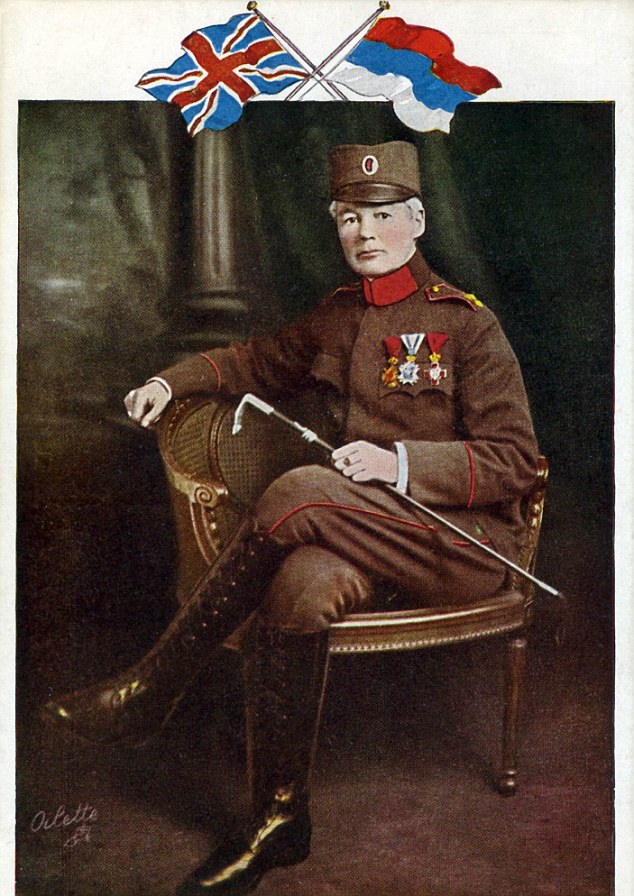
What did these volunteers do in their working day.  Well, basically, anything that needed doing, from making beds, washing, cleaning, driving, very basic nursing, entertaining patients, fundraising and reading and writing letters.  The women volunteers were titled gentry, daughters of the ‘well to do’, merchants, ministers of the church, industrialists and so on and included Nancy Frances Cave, the daughter of an Estate Agent for Lord Cadogan’s Chelsea; Isabel Emslie, a Scottish doctor who specialised in mental health and social work; Elsie Fenwick; Dorothy Fielding M.M. (the first Englishwoman to be awarded the Military Medal for Bravery in the Field; Elsie Knocker and her friend Mairi Chisholm to name a few. One I would like to mention on her own right, was Flora Sandes.  Tim gave a good insight into her service.  She began as a St John’s Ambulance volunteer, travelled to Serbia

Flora Sandes via Wikepedia

Flora Sandes via Wikepedia

where in the confusion of the was was enrolled in the Serbian army – went through the ranks and ending up as a Captain and became the only female on the front line during both World Wars. What fantastic stories these women have to tell.

Time was passing and Tim began to tell us about an autograph book he had found in a shop – it belonged originally to Nancy Frances Cave, one of the many V.A.D. ladies.  Working over 4,000 hours in Maidenhead Drill Hall Hospital, she collected the autographs of the men that she and the other volunteers cared for.  Tim is researching those that have written poems, included a ‘ditty’, drawn a picture or in one case embroidered ‘Nancy’ on a page.  Many remarked how cheerful Nancy was and how she brightened their day.  One photograph does remain a mystery though.  A handsome young man writes ‘Nancy’, the date and ‘Richmond’.  Is Richmond the mystery man’s first name?  Or is Richmond the place where he had been or was stationed.  I do hope that the mystery can be solved.

With the talk over, it was time to look at the items Tim had brought for us to look at, including Nancy’s autograph book and a copy of the ‘Richmond’ photograph.  Tim had also brought a selection of his books, of which I bought one and had it signed.

Did I enjoy my trip to Allerton Bywater…………..Yes, I did

Norse Placenames

Does your town or village name have its origins in Old Norse?

The British Museum in 2014 held an exhibition entitled Vikings life and legend, although, we are now two years on from then the, online information is still accessible.

The original exhibition and the existing information was gathered and organised by the British Museum, the National Museum of Denmark,  and the Museum für Vor- und Frühgeschichte, Staatliche Museen zu Berlin and sponsored by BP.

Discover Norse placenames near you

Find out whether the name of your village, town or city has its origins in Old Norse.

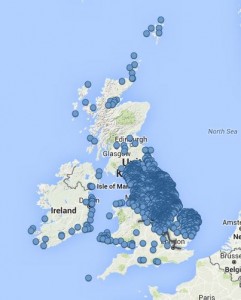
This map shows all English, Welsh, Irish and a selection of Scottish placenames with Old Norse origins. In England, these are more prevalent north of the line marked in black which represents the border described in a treaty between King Alfred and the Viking leader, Guthrum, made between AD 876 and 890.

This description – up the Thames, and then up the Lea, and along the Lea unto its source, then in a straight line to Bedford, then up on the Ouse to Watling Street – is traditionally thought to demarcate the southern boundary of the ‘Danelaw’ – the region where ‘Danish’ law was recognised. In reality it may have been more of a ‘legal fiction’ than a real border, but it does seem to roughly mark the southern limits of significant Scandinavian settlement in Britain.

extracted from the British Museum

Does your village or town name have its origins in Old Norse? The British Museum and Nottingham University interactive maps could help you find out!

Norse place name map via British Museum

The link to the British Museum online resource has a fascinating interactive map of the UK including the Scilly Isles.  Enlarge the map, home in on your part of the country and see how many places have a Norse link.

The British Museum online map gives basic information – the place name.

Does your village or town name have its origins in Old Norse? The British Museum and Nottingham University interactive maps could help you find out!

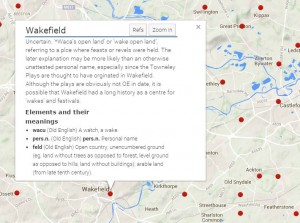
Nottingham University interactive map

There is however, a more up to date map that has been made possible by the University of Nottingham and is more informative – Key to English Place-Names. The Nottingham map has a search facility, an information window, plus a list of nearby places with Norse connections.  The  Key to English Place-Names is well worth a visit.

Local historians, as well as visiting the previous websites, you may also be interested in a University of Leicester project – The Impact of Diasporas.