Category Archives: General

Birth Certificates

Unwanted Birth Certificates.

A few years ago I was given three birth certificates to see if I could find anyone that had a connection to the people mentioned on the certified copies.

I think the reason I was given the certificates was twofold.  Firstly, I was Chair of a family history society at the time and would mention the excess certificates during my introduction at the meeting.  Secondly, I had family of the same surname as one of the certificates.

Whose birth certificates are they?

Born on 10th August 1896 at 1 West Street, Normanton.  Harry was the son of John William Wilkinson and his wife Elizabeth nee Sunderland.  John W was a Drayman working for the local Co-operative Society.  Elizabeth registered her son’s birth eight days later, on the 18th of August.

Were they mine?  Sadly, not.  I had in my tree the birth of one Harry born 1895, and a John William, but his wife did not match – his birth date also makes him too young to be Harry’s father.

The next certificate belongs to Hilda, born on the 13th of January 1899 at 14 Well House Square, Potter Newton at 11.00pm – yes she was a twin.  Walter Newill is noted as the father and Jane Newill formerly Hargrave, is her mother.  Walter worked as a bricklayers labourer.  Jane registered her daughter’s birth on the 8th of March 1899.

Hilda’s twin was called Walter, he was born 15 minutes later at 11.15pm.

What happened to the twins? Did they marry?  Did Walter fight in The Great War? Did they have long and happy lives?

Family history as we all have come to learn has its trials and tribulations.  Its highs and lows. Times of great joy and if you have great joy you must have times of sadness.

Walter and Jane had seen the birth of their twins shortly after the new year of 1899, so I went straight to look for a r marriage for Hilda – no marriage.  I then looked at the deaths and found she had died in the September quarter of her birth year, 1899.

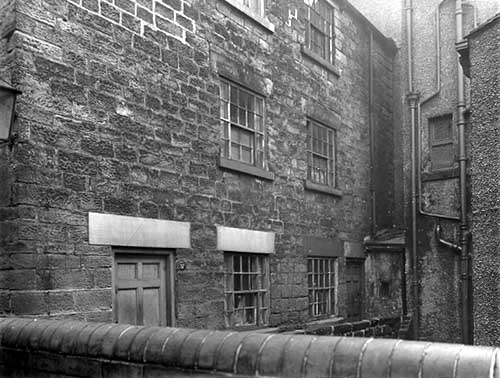
37-39 Potternewton Lane, via Leodis

37-39 Potternewton Lane, via Leodis

Walter however, is one of two Walter Newill’s living in Leeds, the other is his father!  Their rather smudged census sheet for 1911 has the family living at 39 Potternewton Lane, nr Leeds.  Walter is still a bricklayers labourer, while Jane is a charwoman.  Jane during her married life of 13 years, up to census time, she had given birth to seven children, of which, four had survived to be recorded in the census.

Walter jnr. fought in World War.  His Attestation Papers have been scanned and tell that Walter of 39 Potternewton Lane, was 17 years old and 59 days old and worked as a farmer. The first page of his papers is burnt, as is the rest of his paperwork, but Walter Newill is confirmed as being his father.  He was serving in the Leicester Regiment as Private 102121. Walter was 5′ 8″ in height and had a fully expanded chest of 36″.  As well as being burnt some of the papers have water damage – a result of enemy action during the next war.  But on the 12th of January 1918, Walter seems to have overstayed his leave until the 14th of January – he probably wanted to celebrate his birthday!  Anyway, he was punished by 7 days CB (confined to barracks) and deprived of 4 days pay.  While at Saltfleet on 24th of October of 1918, he again overstays his leave – returning on the 28th at 17.35hrs (4 days).  Punishment this time is 10 days C.B.

Further entries tell that Walter joined the army on the 3rd of April 1917.

Did Walter survive the war?  Yes, he did!  He married in the winter of 1920 Alice Craven in the Halifax area and seems to have gone on to have at least three children – his eldest being named John W in 1922.

Question ?  These certificates were all given to me by the same person, so is there a family link between the Wilkinson’s and the Newill’s, as they were all purchased on the same day?

Do these certificates form part of your research?  If they do let me know and I’ll send you some copies – if I send the originals, other relatives may miss out!

Norrieston Kirkyard, Thornhill

Norrieston Kirkyard, Thornhill, Stirlingshire

Having driven through Thornhill, Stirlingshire many, many times but never taking the time to stop and look around the kirkyard. Well, it was a beautiful sunny day in early November, so why not stop and pay a visit.

http://www.cwgc.org/find-a-cemetery/cemetery/25703/TORONTO%20CEMETERY,%20DEMUIN

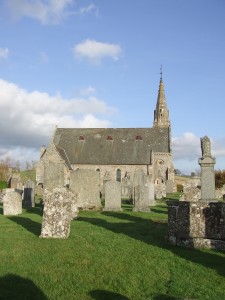
Norriston Kirk, Thornhill © Carol Sklinar 2015

I know the village is Thornhill as I photographed the war memorial years ago, but the sign on the kirk says Norrieston.  Anyway, the car was parked a short walk away.  I grabbed my bag and my camera, walked a few hundred yards and entered by a small gate.

As a family and local historian I have always taken great store in how much information can be gleaned from a piece of stone, granite or marble.  A small glimpse into the lives of those who have gone before, but whose names are still visible for those who pass by and care to look.   Whose name is foremost on the marker?  Who remembered that loved one?  When they were born, if you were lucky, but nearly always when they died.  Some tell of occupations, abodes, and how many children may have been lost in childhood.  While others remember loved ones who have died in foreign lands and others remember father’s, sons, brothers, daughters and sisters who fought in their own way for their country.

Many years ago, when I first started researching my family history, I could not understand why women in Scotland sometimes had two names.  I now know that in Scotland a woman ‘keeps her name from cradle to grave’, and are sometimes recorded with both names, how easy is that?  For example: In loving memory of John Riach and his wife Ann Hay.    A headstone will have a husbands name and a wife’s maiden name, making looking for a marriage that much easier. Resulting in a lot less time to search for the marriage. Initially, I thought how many people just did not marry.

Anyway, back to seeing who rests or is remembered within the boundary walls of this Scottish kirk.

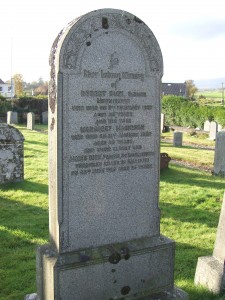
 In loving memory of Robert Dick, Farmer of Munnieston, who died on 3rd February 1937 aged 88 years.  And his wife Margaret Mackieson who died on 21st January 1940 aged 88 years.  And their eldest son James Dick Private, 8th Cameronians presumed killed in Gallipoli on 28th June 1915 aged 35 years.

http://www.cwgc.org/find-a-cemetery/cemetery/25703/TORONTO%20CEMETERY,%20DEMUIN

Dick family headstone © Carol Sklinar 2015

From this headstone we know  a little about Robert.  We know his wife’s maiden name. We know that James was their eldest son and he was presumed killed at Gallipoli – quite a bit of information for someone who may just beginning their family history research.

James Dick will be the main focus here. He lived at Thornhill, enlisting into the army in Glasgow.  He died on the 28th of June 1915 and the CWGC confirm this but also give details of his service number, 143, his rank of private and his place of remembrance, the Helles Memorial.  A look for James on the Army Register of Soldiers’ Effects, confirms the service number, regiment.  In addition to the already known information this web information details that James  died ‘on or since 28.6.15’ also Robert, his father, was the recipient of monies owed to his son.

Another resource available to researchers is the Medal Rolls Index Cards.  The card for J Dick, amended to James, gives details of his regiment, his rank, his qualifying service dates, theatre of war, how he ‘met his maker’ and a note for the disposal of his medals.  So, James entered the Balkans in mid June 1915 and had ‘died’  two short weeks later.

http://www.cwgc.org/find-a-cemetery/cemetery/25703/TORONTO%20CEMETERY,%20DEMUIN

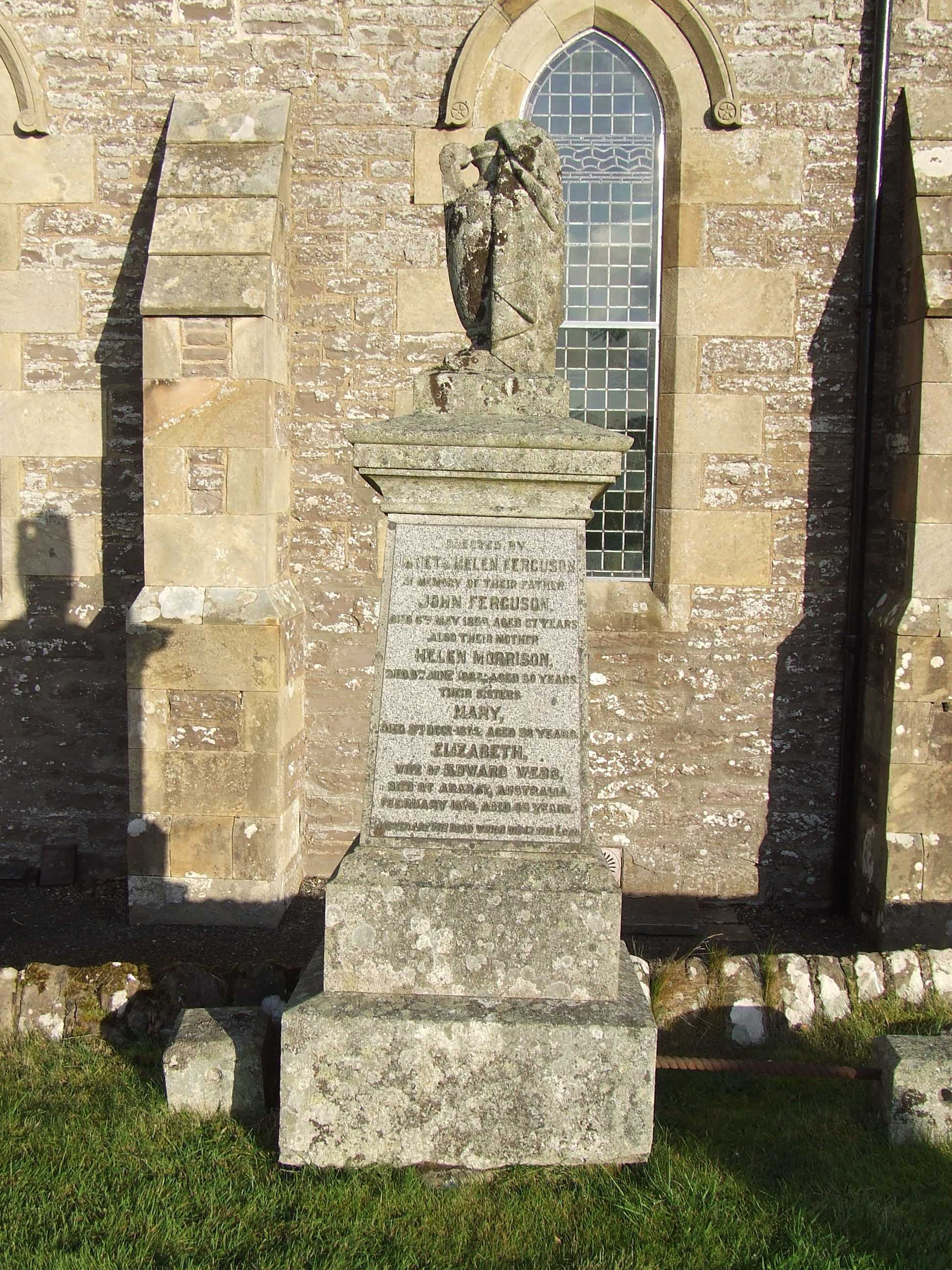
Ferguson family headstone © Carol Sklinar 2015

Have you ever ‘lost’ a relative during research, they simply disappear?  Then one day you visit the churchyard where the family rest and eureka! The headstone gives a clue as to why they disappeared.

Erected by Janet & Helen Ferguson in memory of their father, John Ferguson, died 6th May 1885(?) aged *7 years and their mother Helen Morrison, died 9th June 188* aged 80 years.  Their sisters, Mary, died 9th Decr 1878 aged 38 years.  Elizabeth wife of Edward Webb, died at Ararat, Australia, February 1879 aged 45 years.

 This headstone did  not only give Helen’s maiden name, it also told where one of her daughters lived and died.  Another family history box ticked

http://www.cwgc.org/find-a-cemetery/cemetery/25703/TORONTO%20CEMETERY,%20DEMUIN

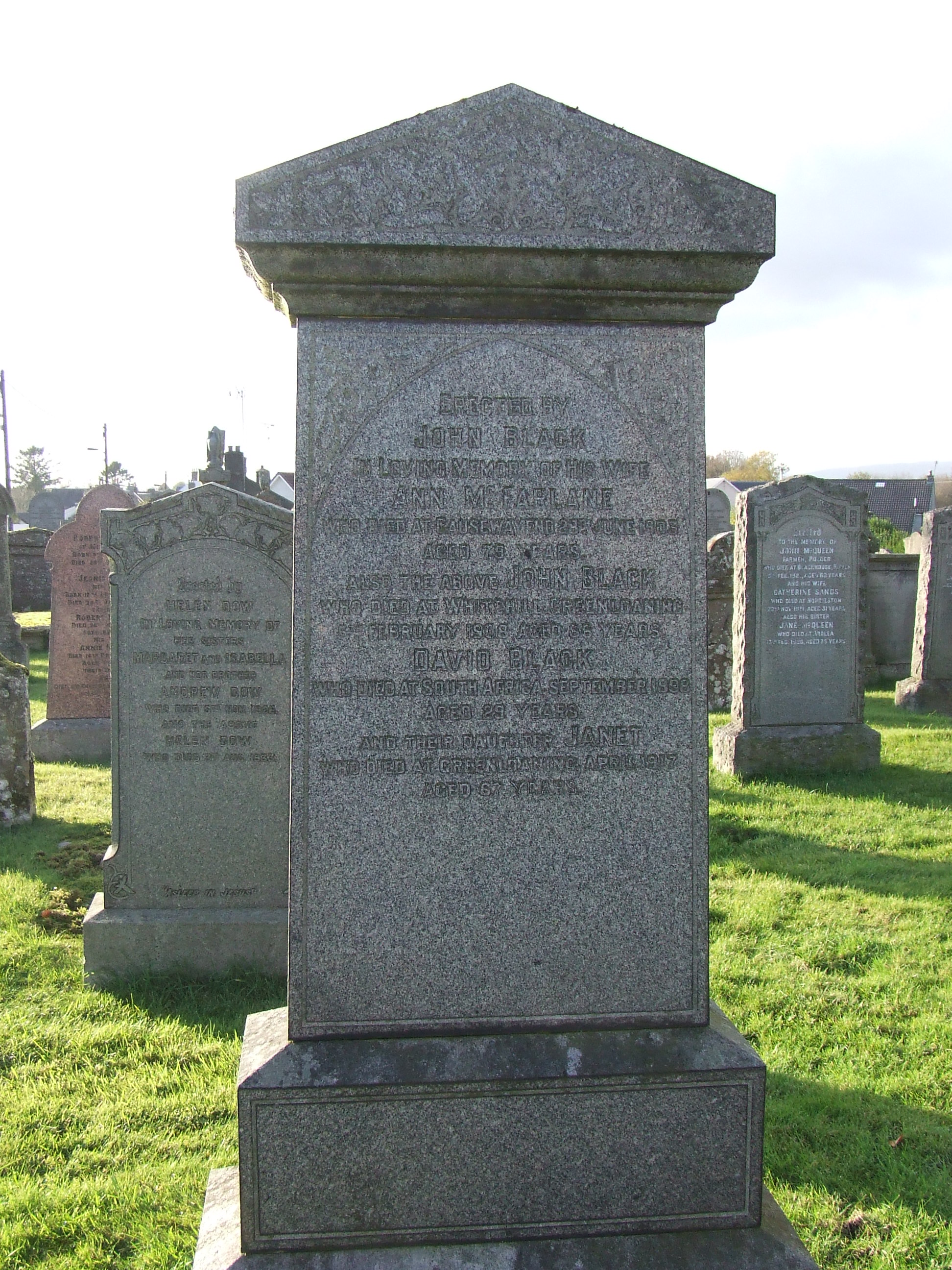
Black family headstone © Carol Sklinar

Names of crofts, villages, towns and occupations are also found on headstones thus pinning your research down to smaller areas.

Erected by John Black in loving memory of his wife Ann McFarlane, who died at Causeway End 28th June 1908 aged 79 years.  Also the above John Black, who died at Whitehill, Greenloaning 6th February 1908 aged 66 years.  David Black who died at South Africa, September 1908 aged 29 and their daughter, Janet, who died at Greenloaning, April 5th 1917 aged 67 years.

Then there are headstones to whom we are very grateful to those who told the monumental mason in great detail what to include.  The family of Robert Thomas Downie chose a unique design for his headstone along with full dates of birth and death for most of those remembered upon it.

http://www.cwgc.org/find-a-cemetery/cemetery/25703/TORONTO%20CEMETERY,%20DEMUIN

MacLaren family headstone © Carol Sklinar 2015

Robert was born in April of 1826 ad died in December 1886. Others remembered on the headstone in Thornhill Kirkyard are:- William Downie, Janet Gardner Downie, Wm Downie MacLaren who died in France, Janet Downie, Robert Alexander, Janet Marjorie Banks, Margaret Forrester.  Lichen has taken its toll on some of the dates but a closer inspection could solve that problem.

Wm Downie MacLaren stands out for me on the names listed.  Who was he, which regiment did he serve in and where did he die?  Firstly, William was the son of W G and Mrs F  MacLaren of Drummore, Doune.  The CWGC entry for him gives his regiment as the Canadian Infantry, his service number as 437495 and hi rank was, private.  He died on the 8th of August 1918 aged 24 resting in Toronto Cemetery, Demuin, which is in the Somme region of France.

As William served in the Canadian Infantry, a look at the Canadian Archives came up with his entry, but sadly, his records have not been scanned yet!  But, it can be seen that his name is spelt McLaren.  His reference for the records is RG 150, Accession 1992-93/166, Box 7019 – 12 with an item number of 157791.

After a pleasant walk around Norrieston kirkyard I now know a little more about who rests or is remembered within its walls.

Will Transcriptions

Will Transcriptions

While doing some research on the internet I can across a website I had not come across before. As you can see from the title the website concentrates on will transcriptions and better still, the site is FREE to register and FREE to use……..How good is that?

Wills Transcription Website

Will Transcription Website

Will Transcription Website

The wills.  How do they get onto the website?  Well, people like you and me, family and local historians transcribe a will that they have in their collection.  Then a simple online form is completed, which tells whose will it is; where and when the will was Attested and then the content.

Three things I like are  1. The contributor retains the copyright.  2.  The transcription is for family and surname history only but permission should be sought to copy, the site is NOT providing the information for any commercial use.  3. The details of who transcribed the will are kept private but there is the facility of contacting them online through the site – you never know there may be a family link.

Let’s see whose will I can find using the simple search box.  As we all do, I tried surnames that tie in with my family.  Did I really expect to find any, well I hoped a little. I then tried some more common names and found a few dating back to the 1700’s.  Then I tried towns, well two towns and no will came to light.  Now to try a county, surely I must find something here…….Bingo!

The will of John Bass Oliver came to light and informed where he lived and his social status.  The will also went on to tell where John wished to be buried and why.  The information was hard to read as there were no paragraphs, and the information was aligned to the left and the jagged right edge seemed to draw the eye.  But nevertheless, John’s will told of where he had property, who his servants were and how much they were to be given under the terms of John’s will.

Family members, as you would expect, were mentioned along with their spouses, but there was also mention of a  business partnership.

Without going off on a very big tangent and looking for John Bass Oliver, I have spent about five minutes on Google and came up with Birstall, Leicester and London connections to the name and occupations being landowner and solicitor.

 The site was not helpful to me at this time, but I think when the site is better known and more wills are added it could save a lot of time looking for that elusive but of information that you would probably only find in a will.

Happy hunting!

Scotland’s Heroes

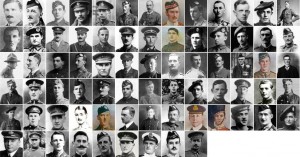
Victoria Cross winners in Scotland during World War 1 – do you have one of Scotland’s heroes in your family tree?

Scotlands Victoria Cross men via BBC Scotland

Scotlands Victoria Cross men via BBC Scotland

During The Great War 627 people were awarded the Victoria Cross, the highest military decoration awarded valour ‘in the face of the enemy’ to members of the armed forces, or civilians under military command, of Commonwealth countries and previous British Empire territories.  It is the first order of wear in the UK and takes precedence over all other orders, decorations and medals – including the Order of the Garter.

What I have just omitted to tell you is that 74 of these Victoria Cross winners were Scottish.  In an earlier blog I spoke about Piper Daniel Laidlaw, who served in the DLI (Durham Light Infantry).  All of the 74 recipients will be remembered as part of Scotland’s War Project

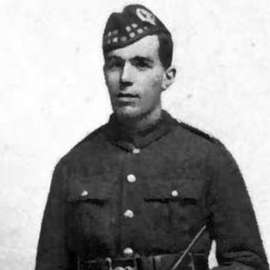
Lance Corporal Robert McBeath via bbc.co.uk

Lance Corporal Robert McBeath via bbc.co.uk

Robert McBeath, born in Kinlochbervie, Lairg, served as Lance Corporal, 240171 in the Seaforth Highlanders. Robert was the youngest of the 74 Victoria Cross recipients.  His citation  in the London Gazette for the 8th of January 1918 reads:-

GAZETTE ISSUE 30471, VICTORIA CROSS,:    His Majesty the KING has been graciously pleased to approve of the award of the Victoria Cross to the undermentioned:- No. 240171 Lance-Corporal Robert McBeath, Seaforth Highlanders (Kinlochbervie, Lairg, Sutherland). For most conspicuous bravery. On 20 November 1917 west of Cambrai, France, when with his company in attack and approaching the final objective, a nest of enemy machine-guns in the western outskirts of a village opened fire both on his own unit and on the unit on the right. The advance was checked and heavy casualties resulted. When a Lewis gun was called for to deal with these machine-guns, Lance-Corporal McBeath volunteered for the duty, and immediately moved off alone with a Lewis gun and his revolver. He located one of the machine-guns in action, and worked his way towards it, shooting the gunner with his revolver. Finding several other hostile machine-guns in action, he, with the assistance of a Tank, attacked them and drove the gunners to ground in a deep dug-out. Lance-Corporal McBeath, regardless of all danger, rushed in after them, shot an enemy who opposed him on the steps, and drove the remainder of the garrison out of the dug-out, capturing three officers and thirty men. There were in all five machine-guns mounted round the dug-out and by putting them out of action he cleared the way for the advance of both units. The conduct of Lance-Corporal McBeath throughout three days of severe fighting was beyond praise.

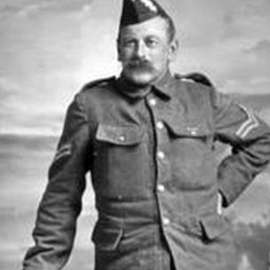
John Ripley, V.C., via bbc.co.uk

John Ripley, V.C., via bbc.co.uk

The most common age group, according to research on these 74 men is between 20-24, then 25-29 followed by 30-34.  The oldest recipient was a 47 man named John Ripley, who served with the Black Watch.

John had been born in Keith, Banffshire in 1867 and served as Corporal 2832, later rising to the rank of Sergeant.  His citation was included in the London Gazette on the 29th of June 1915 and reads as follows:-

VICTORIA CROSS,: http://www.london-gazette.co.uk/issues/29210/pages/6270. No. 2832 Corporal John Ripley, 1st Battalion, The Black Watch (Royal Highlanders). On 9th May 1915 at Rue du Bois, France, Corporal Ripley led his section on the right of the platoon in the assault and was the first man of the battalion to climb the enemy’s parapet. From there he directed those following him to the gaps in the German wire entanglements. He then led his section through a breach in the parapet to a second line of trench. With seven or eight men he established himself, blocking other flanks, and continued to hold the position until all his men had fallen and he himself was badly wounded in the head.

John survived the war and died in 1933 in St Andrews after falling from a ladder.

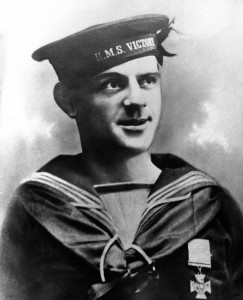
One final man to be mentioned is Seaman George McKenzie Samson, born in Carnoustie in 1889 and served in the Royal Naval Volunteer Reserves as Petty Officer, O.N. 2408A.  George was awarded his Victoria Cross during his time in Galipoli.  His citation from the London Gazette of 16th of August 1915 reads:-

GAZETTE ISSUE 29264, VICTORIA CROSS,: http://www.london-gazette.co.uk/issues/29264/supplements/8132. The KING has been graciously pleased to approve of the grant of the Victoria Cross to the undermentioned for the conspicuous acts of bravery: – Seaman R.N.R. George McKenzie Samson, O.N. 2408A. On 25th April 1915 during the landing on V Beach, Cape Helles, Gallipoli, Seaman Samson, with three other men was assisting the commander of their ship, HMS River Clyde at the work of securing the lighters. He worked all day under very heavy fire, attending wounded and getting out lines. He was eventually dangerously wounded by Maxim fire. Medaille Militaire.: http://www.london-gazette.co.uk/issues/30870/supplements/10092.

Seaman George M Samson V.C. via Scotland's War

Seaman George M Samson V.C. via Scotland’s War

George was also awarded the Medal Militaire and his citation for the medal awarded by the French Republic reads :-

GAZETTE ISSUE 30870, MEDAILLE MILITAIRE, Decoration conferred by the President of the French Republic for distinguished services rendered during the War. His Majesty the King has given unrestricted permission to wear the Decoration in question.

The Victoria Cross belonging to George is part of the Lord Ashworth Collection in the Imperial War Museum, London.  He joined the Merchant Navy after the war,  dying of pneumonia. He rests in St. George’s Military Cemetery off Secretary Lane in St George’s, Bermuda.

Fight the Good Fight – Book review

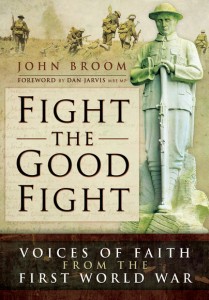
Fight the Good Fight: Voices of Faith from the First World War

Fight the Good Fight: Voices of Faith from the First World War the first book  by John Broom, was published in October by Pen and Sword – the Barnsley based publishing company who specialise in a variety of local history and specialised subject.

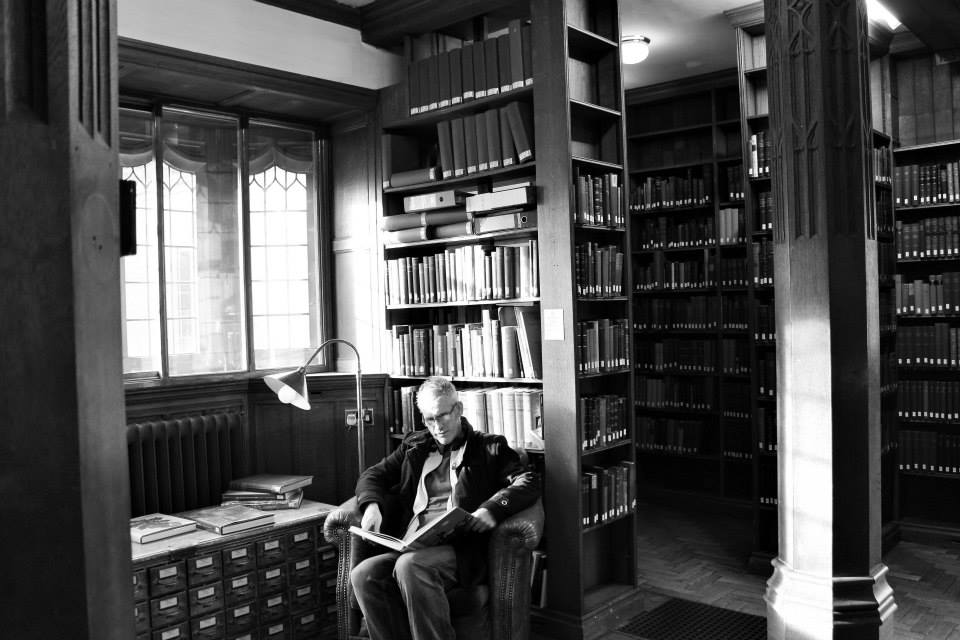
John Broom studying at the Gladstone library via his blog

John Broom studying at the Gladstone library via his blog

John, a history lover, graduated in 1991 and has  pursued a career in teaching, firstly in History, and latterly as a Specialist Teacher in Autism.

In 2006 he was left a collection of 170 letters and memorabilia from his late father who served in the Desert Rats during WWII.  This sparked an interest in discovering the links between twentieth century warfare and religion.   pursued a career in teaching, firstly in History, and latterly as a Specialist Teacher in Autism.

Fight the Good Fight via John Broom's blog

Fight the Good Fight via John Broom’s blog

Fight the Good Fight: Voices of Faith from the First World War investigates nationalism and militarism in Europe and beyond during and just following the Great War.   The book investigates how the Christian faith that united millions around the world is interpreted in many ways.  Whether Church of England or Nonconformist, Catholic or Presbyterian, German Lutheran or the American Church of Christ in Christian Union, men and women served their country, or not,  according to their beliefs.

The book focuses  on 23 individuals and families, including some whose names are known world wide.  While others were a story waiting to be told.  Each case has been well researched, includes 23 plates and is stacked with notes and references for you to make further study somewhat easier.

 At that time we were a country divided by class, politics, denomination and gender, but none the less these people were united in one cause to Fight the Good Fight. Fight the Good Fight take the subject of Christianity during conflict to the wider audience.

Just to give you a little taster of who is in the book, before I let you know where you can get your copy, which is a nice pressie for someone for Christmas or save your Christmas money and treat yourself in the New Year.

Who has a chapter dedicated to them – a lady known the world wide and recently been in the news, Nurse Edith Cavell, who was executed in 1915. The Chavasse Family, focusing on  Noel Chavasse V.C. and Bar, who was awarded the Victoria Cross twice and was an Olympic athlete. Fight the Good Fight also includes tales of brave Belgian priest, a French heroine, a German U-boat commander and America’s most decorated war hero.

Receiving glowing reviews from academics and historians, Fight the Good Fight has prices ranging from £15.99  and is available from:  Pen and Sword ;      Amazon  (hardcover or Kindle)  ; or directly from the author himself, via his blog – maybe if you ask nicely, you may get a signed copy!

Let me know what you think of this, the first book by John Broom

Epsom College men ii

Epsom College men at war

If you have read my previous blog about the college, you may be interested to know about one more Epsom College man who fought for their King and Country.

There are many men recorded within the pages of the Epsom College Register 1855-1905. Many followed in their father’s footsteps and joined the family firm or joined the political services, or even worked for international banks or businesses, while others joined the military as a career. But it is not a career man who is the focus of this entry but a man who was an architect.

Who is this man, with a name that seemed so interesting as to tempt me to tell you about him? William Leonard Boghurst Leech, a name that doesn’t seem to trip off the tongue but still commands attention.

William, for short, had his birth registered in the last quarter of 1887, in the Stow Registration District of Suffolk, being born in Woolpit, Suffolk. He was the son of Albert H Leech, a Registered General Medical Practitioner, also born in Woolpit, while Annie M was his mother.  In the 1891 census William is three years old and his younger sister, Emily M is one year old.   I had been looking for a marriage for Albert and Annie M, but after a few searches, gave up – it was not that important.  But, what do they say about people who wait?  Well, I waited and the 1891 census handed me her maiden name upon a plate or a census sheet!  Also living in the house, ‘White House’, Woolpit are two other ladies, listed after three servants.  Who are these ladies?  Frances Boghurst, widow, are you getting a clue now?  Frances was Annie M’s mother. Also in the house was Agnes J Boghurst, Annie M’s sister. Don’t you love it when everything just comes into place!

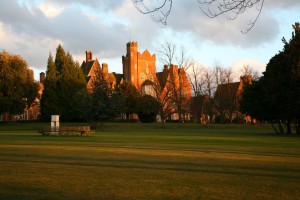
"Epsom College main building and lawn" by Naveed Barakzai/Maxal Photography, via Wikepedia

“Epsom College main building and lawn” by Naveed Barakzai/Maxal Photography, via Wikepedia

Ten years later Master Leech was 13 years old and what a merry chase he led me while looking for him in the census.  Eventually, he gave in and there he was, Leech, Wm. Leonard Boghurst, as a pupil in Epsom College, College Road, Epsom.

The enumerator’s book describes the institution as ‘Epsom College, A School with Masters & Pensioners detached Houses’. At the time of the census, Thos. Northmore Hart-Smith was the Head Master, who gave his occupation as ‘Head Master, Clerk in H O, Ch of E’ (Clerk in Holy Order, Church of England).  The college was founded in 1855 with the patronage of Her Majesty Queen Victoria.  The founder, Dr. John Propert raised funds to help orphans and widows of the medical profession.  The Royal Medical Benevolent College opened its doors and gave education to more than 100 boys in its first year.  William’s entry in the College Register list his parent as Mrs Leech, Seven View, Coalport, Trowbridge, Salop., so it looks Albert had died prior to 1905 when he left the establishment.

By 1911, William has left Epsom College (he left in 1905), and can be found by his full name, living at 5 Waverley Street, Nottingham, in the home of Mr Walter Snushall and his wife Sarah Anne.  Walter is a brewer’s agent but also in the house is Kenneth, his son; Noel Hartley West an insurance inspector and his wife, Dorothy; Henry Alderman Dickman and William, who are both architect’s assistants, followed by Bridget Mary Doyle, a 21-year-old servant from Dublin.  The house on Waverley Street had 10 rooms, so there may only be a little bit of sharing!  We know William was an architect’s assistant but he eventually became an Associate of the Royal Institute of British Architects.

It was just over three years later that war was declared and men volunteered to fight for King and Country as ‘it would be all over by Christmas’.  William at this time was living in Ealing and enlisted in London, joining the 9th (County of London) Battalion (Queen Victorias Rifles), becoming Rifleman 3407.

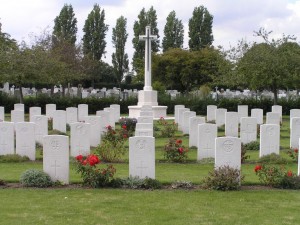
Southend-on-Sea cemetery via CWGC

Southend-on-Sea cemetery via CWGC

William’s regiment had served in France from late 1914, but it was only May of 1915 when he had been wounded in Flanders and sent home to England.  William died of wounds received in action on the 14th of May 1915 in Fort Pitt Military Hospital, Chatham.  He rests in Sutton Road Cemetery, Southend-on-Sea along with 280 identified casualties.

The Medal Card for William was also not as simple to find as you might think, and was only found by using his service number as he was

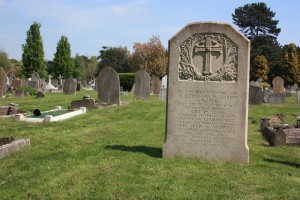
William Leonard Boghurst Leech headstone via findagrave

William Leonard Boghurst Leech headstone via findagrave

recorded and transcribed as LEACH W.L.V.   Anyway, his service number was correct, as we know as was his regiment and his date of death.  The card did not have much more information to tell, but there was a note from the regiment asking how to dispose of the 1914-15 Star.

Record No. 189636, Registry No. E(?)/84872/1 in the Army Register of Soldiers’ Effects tells confirms his full name, regiment, date and place of death and confirms that all his outstanding monies from the army will go to his mother, Annie M.

Probate for William of 28 Edgerton Gardens, West Ealing, was granted in London on the 17th of June to Annie Madaline Leach, widow (we now know his mother’s middle name), with effects of £1951 18s 1d.  This was revoked on the 18th of November the same year and further granted on the 8th of February 1916.

I had looked for Albert and Annie M’s marriage but seemed to fall short of an entry, now I had the information of Annie’s surname and middle name, all fell into place.  Annie Madaline Boghurst married Albert Herbert Leech in the late summer of 1886 in the Tendring Registration District.

What did you get up to on Heritage Weekend?

Heritage Weekend, September seems such a long time ago!

DSCF5454 v1It was now until I was transferring the photographs from my camera to get ready for another outing that I found the photographs  I had taken during Heritage Weekend.

During that weekend up and down the country, places that are not normally  open to the public, throw open their doors for us to peek inside. These buildings organise volunteers, some provide refreshments and talks. While others just leave their buildings, mainly churches, open – how wonderful is that?

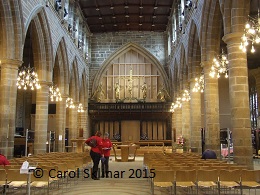
Wakefield Cathedral during Heritage Weekend 2015

Wakefield Cathedral during Heritage Weekend 2015

What did I get up to?  Normally I plan where I want to go, sometimes it seems like a military operation!  This year, due to limited time, I was hoping to ‘kill two birds with one stone’.  Well, that was the plan. So, I headed off to Wakefield Cathedral.  I’m not a great lover of the ‘new’ layout, but I can understand why all the pews have been removed and replaced with chairs.

The building was partially closed due to a continuing programme of work behind the rood screen. But guided tours of behind the scenes were being offered and that fell in nicely with my need to photograph a memorial, as additional information for a project……….looks like everything would go to plan.  What do they say about the best laid plans?

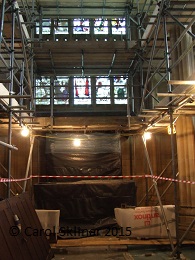
Behind the Cathedral

Behind the Cathedral

After signing our life away, opps, waver, myself and two others donned our fashionable hardhats and followed our guide outside the building, behind Treacey Hall and entered by the side door that takes up into to the Cathedral or down to the rooms below.

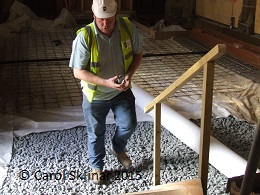
As we entered the closed area there was scaffolding everywhere.  The stonework and woodwork had been completely covered for protection in either sheet board or thick plastic.  To our right we could

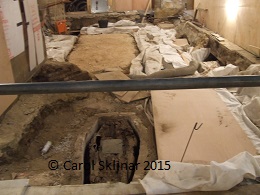
Excavated floor showing one of the coffins

Excavated floor showing one of the coffins

see that part of the floor had been removed and excavated exposing three coffins.  One was quite close, the coffin was not in a bad condition to say where it had been and now long it had lain beneath the floor.  Another coffin lay had been protected by wood sheeting as a pipe had been placed over it for the duration of the work.  But, beside the pipe a small room had been found.  Sadly, due to good old health and safety, we were not allowed to venture inside.

Our guide explaining modern conservation techniques

Our guide explaining modern conservation techniques

Our guide certainly knew his stuff, keeping his audience captive while he told us about the building work and the differences between the old renovation techniques, which must stay, and the modern sympathetic ways of preserving.

Our tour ended, but there were not many questions to be asked, as we were a small group it was easy to just chip in and ask questions as we went along. The tour lasted just under an hour and was well worth venturing into Wakefield on that September Saturday afternoon.

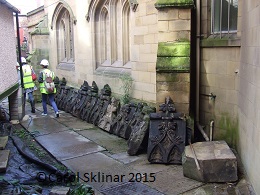
Headstones stored outside ready for putting back inside

Headstones stored outside ready for putting back inside


If you remember I was also going to look for a memorial.  Did I find that memorial, you might ask. Well, remember the best laid plans of mice and men…………..No, the memorial remains unfound, hidden behind sheet board or plastic and will remain so until around Easter 2016, when another visit is needed.

E. Stead, Drighlington War Memorial by Guest Blogger, Philip L Wheeler

E. Stead on Drighlington’s War Memorial………                                                                                                                          a surprise for the researcher.

The recent Remembrance Day commemorations will no doubt have seen an increase in people attending services at churches and war memorials throughout the country. Unsurprisingly at this time much of the interest will probably have been shown in the high numbers of service personnel who lost their lives in the First World War.

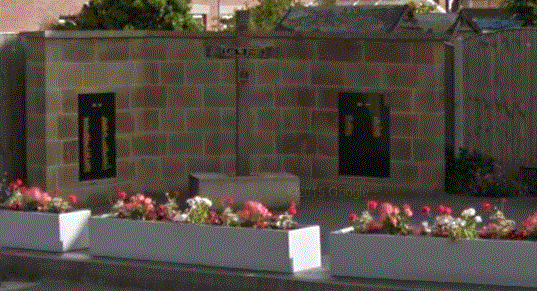
Drighlington War Memorial

Drighlington War Memorial

The village of Drighlington lost 62 men according to the list of names on the war memorial in Whitehall Road, but there are some names missing from the memorial, as indeed there will be on many village memorials of the time. All of the stories behind the 62 names on the memorial can be found in a 200 page file to be found in the reference section of Drighlington Library.

Because of the commemoration of the one hundred years since the start of the First World War the names on memorials for the Second World War have tended to be left behind in terms of research into their lives and where they met their sad demise. There are not as many names on the Second World War panel on Drighlington’s memorial in fact, but at least one name tells an intriguing story that will surprise many who have looked at the name, E. Stead, and wondered what regiment they served in or what ship they went away in.

With the help of the extensive databases now online at ancestry.com and now the 1939 register at Findmypast.com the story of E. Stead can be revealed, at least in part. The recent release of the 1939 register gives historians a snapshot of where people were at the outbreak of the Second World War. It was really a census in all but name and gave details of families and where they lived and what work they did in the first year of the Second World War.

Researchers looking at the First World War are greatly helped in their quest to tell the soldier’s stories by the release of the 1911 census. Unfortunately, it will be many years before we can see the 1931 census, which will help in finding out about the lives of servicemen of the Second World War.

One name, that of E. Stead, on the village war memorial shows what fascinating stories lay behind these names, often forgotten in family histories. Surprisingly, the E. on this panel did not stand for Ernest or Edgar, it signified the name of ‘Edith’. For Edith Stead’s name is included on the Second World War panel of the Drighlington War Memorial. There are of course other memorials which include women as part of their commemorations, but probably not too many. So, who was Edith Stead, and why is her name on the panel of the memorial?

Edith was a Drighlington lass and was the daughter of Samuel Stead, who lived at 43 Spring Gardens in Drighlington. Samuel is shown on the 1939 register as living with his wife Christine, who was too young to be Edith’s mother, and so Samuel had been married before it seems. Edith had a brother, Harry, who was three years younger than she was but there were three other siblings in the family household at the time as well. Edith herself was born in 1912.

At some stage Edith decided to go to London to work. Whether this was a long time before the start of the Second World War or not only family historians can clarify. However, Edith takes up residence at 166 Southwark Bridge Road and starts to work in a homeless shelter in nearby Elephant and Castle.

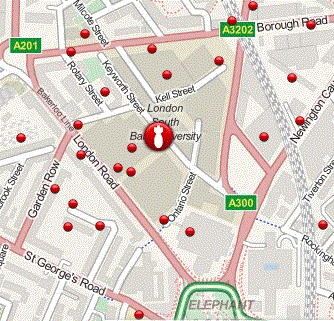
Keyworth Street area from bombsight.org

Keyworth Street area from bombsight.org

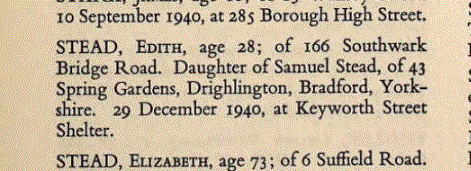
It is this job that seals her fate, as on the night of December 29th 1940 she was killed when the Luftwaffe bombed London once more and the shelter in which she was working, Keyworth Street Shelter, suffered a direct hit. Several casualties are known to have occurred in this same bombing incident but current information about the actual numbers is sparse.

Edith Stead’s name was recorded in the records of ‘Civilian Casualties of the Second World War’ and for that reason her name has found its way on to the Drighlington War Memorial. She was not a soldier, sailor or airman, but a young girl who went to London to do her bit and found herself working with the homeless. At the same time as she was working in the shelter her father Samuel was ironically working as part time Air Raid Warden in Drighlington, in addition to his job as a weighing machine repairer.

The news of his daughter’s death must have been a great shock for Samuel Stead and it is quite fitting that he decided that her name should be put forward for inclusion on the village war memorial, which it has been on now for many years. Many people will be surprised to learn the true story behind the name of E. Stead on the village memorial I am sure.

Additonal information:-

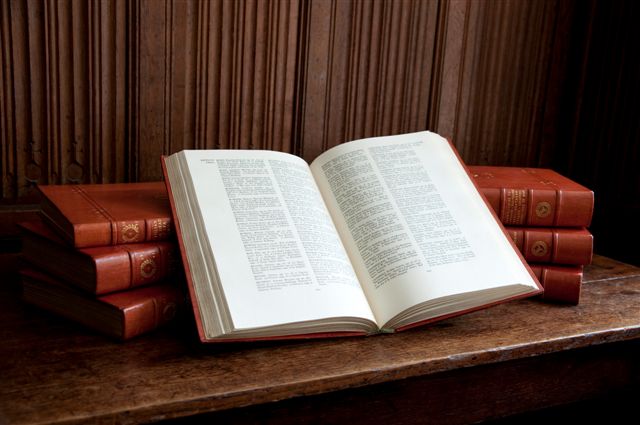
Civilian War Dead Registers via CWGC

Civilian War Dead Registers via CWGC

The Commonwealth War Graves Commission gives information that her death was reported to the Metropolitan Borough Cemetery, Southwark, and gives the impression  she may be one of the   1007 civilian war dead resting there.

The Civilian War Dead Roll of Honour, commemorating some 67,092 men, women and children whose deaths were due to enemy action during WWII is displayed in St. George’s Chapel, Westminster Abbey.

Civilian War Dead WWII entry for Edith Stead

Civilian War Dead WWII entry for Edith Stead

Note: WWII Civilian War Dead can be searched on the Ancestry website.

Wakefield Express WW1- widow complains of cruelty

Wakefield Express WW1 – widow’s complaint of cruelty

Another extract from the pages of the Wakefield Express for the Great War period, this time from the West Riding Court, 24th of August 1918:

A soldier’s widows unhappy marriage – William  Dallow(?), miner, Methley, a discharged soldier with two wound stripes, was summoned by his wife for persistent cruelty. – Mr. Benson Bailey, of Leeds, who prosecuted, stated that the applicant formerly lived at Rawdon, and when she met the defendant she was a soldier’s widow, with three children, her husband having been killed in July 7th 1916. Complainant and defendant were married on December 22nd 1916, and Mr. Bailey suggested that defendant married this woman in order that he could get the money she had received from the Government in respect of the death of her first husband. Owing to defendant’s assaults and threats complainant was compelled to leave him on August 8th. – Complainant said defendant was not only unkind to her, but he was unkind to the children.  He wanted her first husband’s medal, and when she would not give him it he struck her.  Defendant had a pension of 11/- a week, and he was also working as a miner. – Evidence was given by two neighbours and P. S. Pearson.  The sergeant said the parties appeared to have lived unhappily.  Defendant admitted to him that he had struck his wife and that he was sorry for what he had done. – Defendant denied ill-using his wife. – The Bench granted complainant a separation order, and defendant was ordered to pay her 15/- a week. He had also £2 4s costs to pay.

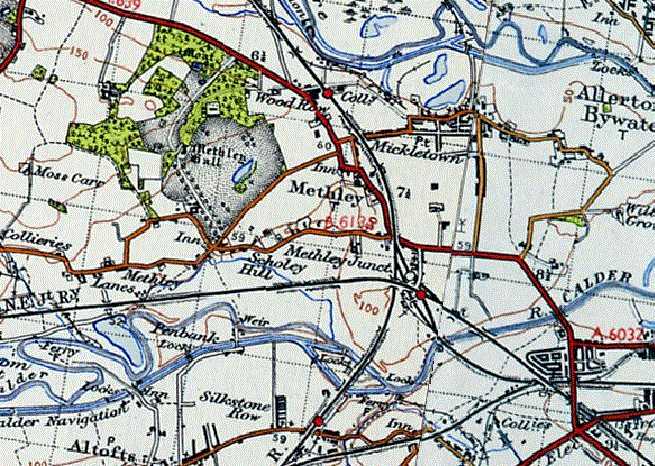
Scanned Yorkshire map

Scanned Yorkshire map

 I have been looking for a William Dallow in and around the Methley area and in Army records as we have been told he was in receipt of a pension of 11/- per week. The newspaper does not give the name of his wife, so she remains a mystery.

A look through the G.R.O and a search of Freebmd sheds not even a faint glimmer of light on who William was, even his date of marriage is known.

Have I read the newspaper article correctly when transcribing his name? Probably not!  There is a black line through his name due to photocopying directly from microfilm, making some of the letters a matter of chance. The only chance in this case was his name.

Do you know who William is?  Do you know his wife’s name and the name of her first husband? If you do know, why not let me know!

Sidney Botham & Ernest Williamson in WWII

Sidney Botham and Ernest Williamson during WWII ‘did their bit’ for their  community and were recognised for their bravery.

Shall we start with Sidney first?  Sidney was born in 1910 in Sheffield, being the son of John and Emily Botham, who in 1911 were living at Hoyland Road, Hoyland Common- John, was working as a butcher.

Sidney, lived through the Great War and by 1943 he had been a police constable for just over 11 years. Home, was 8 Carlton Terrace, Pontefract for Sidney and his wife of 10 years, Ruby (nee Russell).

As both Sidney and Ernest are both linked to an event, it is now Ernest’s turn! There are three Ernest’s who are born within two years of each other in Yorkshire, but the one that fits the most seems to be the son of John and Harriet Williamson, who in 1911 were living at 8 Hey Lane, Lowerhouses, Huddersfield.  John worked as a tailor.

Ernest, like Sidney was also a policeman, but Ernest is listed as Police War Reserve, living at 146 Lower Oxford Street, Castleford.

What did they do to be written about here?  The follows are snippets from the WWII Civil Defence Gallantry Awards –

Case 2119A – Mr Sidney Botham – 33 years.  Police Constable, West Riding Constabulary, Wakefield – 11 1/3 years.  Civil Occupation – Policeman.

Assistance in the rescue of two Civilians trapped in a burning house at Darrington, York,s on the night of 18th September 1943.

Recommended by – Chief Constable, West Riding.  Commendation dated 14.10.43

Case 2119B – Ernest Williamson – 36 years. Police War Reserve, West Riding Constabulary, Wakefield  – 3 1/3 years.  Details as for 2119A,

Both cases were Recommended by the Committee  and the Treasury 14th December 1943 and Gazetted 21st March 1944.

Particulars of Action –  At 23.45 hours on Saturday, 18th of September, 1943, a Halifax No.2 bomber number B.B.245 crashed, burst into flames, demolishing and setting on fire a row of cottages 200 yards on the Womersley side of Darrington Cross Roads, Darrington, which is three miles south of Pontefract.  The plane, whose parent station was at Riccall R.A.F. Station, was flying north Jto South on a night flying exercise, and all six of the crew were killed.  1032914 Sergeant John Henry Viercant, 4th Heavy Battery, R.A. Womersley, was travelling along the Womersley Road, Darrington, in a motor lorry, in charge of the following men of his unit:- 3662690 Gunner Hugh Donaghy; 858099 Bombardier William Yorkston; 1043079 Gunner Charles Savage; 844866 Gunner John McLeod; 101152 Gunner H Mae-Bishop, and saw a large burst of flame about one mile ahead.  This party was off duty / Police.

That was the event, but lets hear about the event in more detail!

Police Constable 17 Sidney Botham and Police War Reserve 476 Ernest Williamson were on motor patrol duty on the Great North Road, Ferrybridge, when they saw a red flash in the sky towards Doncaster.  They immediately proceeded in this direction, and arrived on the scene just after Sergeant Viercant and his party.  Four of the cottages were burning furiously, but in spite of this Sergeant Viercant, Gunner Savage, Gunner McLeod and the two policemen, seeing by the light of the flames saw two persons John Wardle, and his wife, Alice Maud, trapped under fallen debris, fought through flames and, removing the fallen masonry, etc., rescued Mr and Mrs Wardle, and thereby saved their lives.  During the whole of this time ammunition was exploding in all directions.  All five men further searched the house but failed to find anyone else, and were eventually forced to leave the house owing to the fire, bursting flares and smoke.

These men, together with Bombardier Yorkston, Gunner Donaghy and Gunner Mae-Bishop, then gave all their attention in an endeavour to rescue the trapped occupants of the plane. They broke open the rear turret, and as ammunition was still exploding from it, and to safeguard themselves, Gunner Donaghy climbed inside, removed five belts of live ammunition, and, with assistance, the turret guns.  In an endeavour to locate the crew, Gunner Donaghy, at great personal risk, then proceeded along the narrow body of the blazing plane, and would have gone farther but Sergeant Viercant, realising that his man would soon be cut off by flames, recalled him to the rear turret.

Civil Defence armband

Civil Defence armband

All men had worked with courage and disregard for personal safety, especially Gunner Donaghy.  The soldiers carried on trying to keep the flames down, and formed a bucket chain party, but the fire got out of control.  The two police officers had taken charge and caused the necessary N.F.S. and Civil Defence Services to be hurried to the scene.  There were 4 people killed and 4 people insured who lived in adjoining cottages and a further 6 people rendered homeless.  (Signed C.G. Vaughan, Chief Constable West Riding Constabulary).

Statement of Sergeant Viercant – About 23.40 hours on Saturday 18th September 1943, I was in charge of a party of men of my unit.  We were travelling by lorry along the Womersley Road, Darrington, from the direction of Pontefract towards Womersley.  I then heard a thud, and immediately following this I saw a large burst of flame what I judged to be about 1 mile ahead of us in the vicinity of the road on which we were travelling.  Appreciating that something was wrong I ordered my driver to speed in this direction.  In the space of about  two minutes we reached a place I now know as Chapel Hill, Darrington, and there found that an aeroplane had crashed into a block of cottages on the offside of this road facing Womersley, and some two hundred yards on the Womersley side of Darrington Cross Roads.  Three or four of the cottages were then partly demolished and an aeroplane enveloped in flames was in the midst of the debris.  Ammunition in the plane was exploding almost incessantly, and bullets were whizzing in all directions.

By the illumination of the fire I could see a woman trapped about the middle of the debris of one collapsed house.  Her whole body up to her neck was covered by fallen masonry, and a man hear her was in a sitting position trapped in the debris up to his knees.  These people were obviously helpless to assist themselves and were at this time surrounded by flames rapidly increasing in intensity.   Along with 1043079 Gunner Charles Savage, and 844866 Gunner John McLeod of my unit I at once broke through the flames, and we jointly set about removing debris from around these persons in an effort to rescue them.  At this stage we were joined by two policemen who also entered the burning building and assisted us.  We rescued the two people and removed them on the road clear of the fire, when they were in turn taken to a nearby house.  Before the rescue was effected, the flames had reached these people, and I think they had both suffered burns, cuts and bruises.

Despite the imminent danger of fire and smoke, my two men and the policemen helped to me to make a further search of the house for possibly trapped persons.  We failed to find anyone else, and were driven back by fire, bursting flares, and smoke.  We then made an effort to enter the rear turret of the plane, and here we were joined by 3662690 Gunner Hugh Donaghy, 101152 Gunner H. Mae-Bishop and 858099 Bombardier William Yorkston, all of my unit. We broke open the rear turret with a shovel and an axe. Ammunition was still exploding from within it, and to safeguard us from the danger of this Donaghy climbed inside the turret and removed five belts of live ammunition, and then with assistance removed the turret guns.

Donaghy then tried to go along the body of the blazing plane to search for members of the crew, but I recalled  him because he was thereby putting his life in peril.  We then, as a party had to break off the rescue work owing to the flames being so intense.  My men and the police worked with utter disregard for their own safety.  We then formed a bucket chain and fought the flames, but this was useless, and the fire got completely out of control, and further attempt at rescue would have been futile.  The fire was later extinguished by N.F.S. Units.

It was moonlight, clear, and there was no wind.  The nose of the plane was facing westwards after the crash. I cannot say in what direction or at what height it had been flying prior thereto. (Signed 1032914 Sgt, John Henry Viercant.

 P. S. 17 Sidney Botham – At 11.45 pm Saturday 18th September 1943, I was on motor patrol duty with W.R. 476 Williamson in the Great North Road, Ferrybridge when I saw what appeared to be a red flash in the sky coming from the direction of Doncaster. I proceeded South in this direction, and 11.50 pm came upon the scene of a crashed aircraft in Womersley Road, Darrington.  The plane had crashed into a block of occupied cottages at the side of the road. Both the plane and four of the houses were burning furiously.  A number of soldiers of the 4th Heavy Battery R.S. Womersley were already on the scene.

After ascertaining from Special Constable Waterfall that Pontefract Divisional Headquarters had been warned concerning the crash and resulting fire, I along with E. Williamson joined a number of soldiers in removing debris from a demolished and burning house where it could be seen that two persons were almost completely covered by fallen masonry and who were in immediate danger of being burnt to death.  These two persons John and Alice Maud Wardle were extricated and moved to safety, later to Pontefract Hospital.

By this time other soldiers joined the rescue work and an effort was made to rescue possible occupants of the plane.  During this time rescue was being carried our ammunition was exploding almost incessantly.  In spite of this, one of the soldiers entered the plane by the rear turret door, after the door had been broken open with an axe.  He then removed life ammunition from the plane, and with some assistance the turret guns.  This same soldier attempted to pass farther along the aircraft in search of possible members of the crew but the flames by this time had reached such proportions that any further attempt at rescue was impossible.  The soldiers then formed a bucket chain party until the arrival of the N.F.S., meanwhile nearby  houses were evacuated owing to possible danger of fire.  Later with the N.F.S. in attendance the C.D. Rescue Parties became operative and rescue work was resumed.  At 5 am 19.9.43, four bodies were recovered from the wrecked house of Harry Dean, ‘Glencoe’, Womersley Road, all four bodies were badly charred.  The fire was finally extinguished by the N.F.S. at 5.30 am.
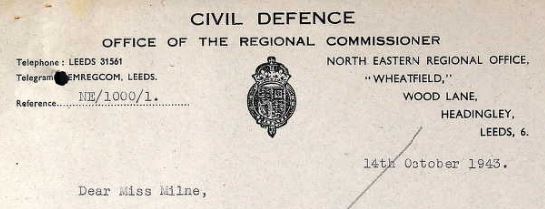
Civil Defence letter to Miss Milnem, Whitehall

Civil Defence letter to Miss Milnem, Whitehall

A letter from the Civil Defence Regional Office, ‘Wheatfield’, Wood Lane, Headingley, Leeds, to Miss J. M. Milne, Ministry of Home Security, Whitehall, London, tells that the Commissioner and the Chief Constable agreed that as far as the two policemen were concerned  that ‘they might receive a personal letter of congratulation rather than any award or commendation from the King.  These letters world presumably come from the Air Ministry if it were decided to send them. Details if the actions of the soldiers have already been sent to the G.O.C. -in-C., Northern Command, but I am letting you have them to as it may be helpful to bear in mind the part they played when considering the policemen’.

The two policemen did not get an award but were Commended for Brave Conduct and were Gazetted on 21st March 1944, Supplement pages 1330/1.

For further information and eye witness reports visit here