Category Archives: General

UK, Royal Mail Pension and Gratuity Records, 1860-1970

UK, Royal Mail Pension and Gratuity Records, 1860-1970

I am always pleased when Ancestry of FindMyPast add new collections to their portfolio, and their latest is quite interesting. Like many other researchers, I always put my family names in the surname search area to see who can be found in their index. This new collection was no exception. I searched for the surnames Riach and Siddle and came up with only a few Riach people, but more Siddle’s – more research is needed.

What is this collection? The UK, Royal Mail Pension and Gratuity Records, 1860-1970. The record set covers a good number of years, and you will be able to find a surname of interest.

A young man named Frederick Bartholomew Rabey (Ancestry have him indexed as Rahey – when you look at the typed original document, the bottom part of the ‘b’ has not scanned well).

The document is headed ‘Application for Gratuity to the Legal Personal Representatives of a Deceased Civil Servant Under Section 2 (1) of the Superannuation Act. 1909. ‘ From that heading, you can deduce that Frederick Bartholomew Rabey has died. According to FreeBMD, he died on March ¼, 1918, in Wakefield, aged 31.

According to the scanned image, Frederick was born on 22 July 1886 and worked as a postman for seven years and two months with a salary/wage of 27/- per week (70 8s 6d per annum). He had a boot allowance of £1 1s. His uniform was valued (estimate) at £2 7s 6d, and Sunday pay worked out on average at £5 10s 7d. Totalling £79 7s 7d on which the gratuity is based.

The reverse side of the document tells that Frederick was appointed to the Post Office in 1909 and worked in Rotherham (30 March 1910). And for the London Postal Service (8 January 1915) and Wakefield (26 March 1916).

More helpful information included on the form is that Frederick received an Army Pension of 16/6 a week. So, he served in the Army for some time. That information will wait for a moment. He died on the 7th of January 1918 as a result of Pneumonia. The Post Office statement said that Frederick discharged his duties with diligence and fidelity to the satisfaction of his superior officers by command of the Postmaster General.

And so, on March 4, 1918, John Bradbury (of the Treasury Department) signed a document to give Frederick’s legal personal representatives a gratuity of £79 7s 7d.

Although he made Wakefield his home, Frederick was born in Smithfield, London. He attended several schools but was removed from education after his mother died in 1899.

When Frederick enlisted in the Dorsetshire Regiment at age 18 in 1904, he listed his occupation as a Pawnbroker’s assistant.

With a fresh complexion, hazel eyes and brown hair, would you recognise the 5′ 5½” tall Frederick as he walked down the street? He was placed on the Army Reserve list in 1907 and discharged in 1914 as ‘physically fit for War Service’.

In 1912, Frederick married Annie Brooks in The Congregational Church, The Green, Ossett, and they made their home in Ossett.

Frederick was taken off the Reserve List and became part of the British Expeditionary Force, entering France on the 16th of August 1914 and saw action in the Battle of Aisne when he received a shrapnel wound to the left elbow. He returned to England to be hospitalised (possibly Netley Hospital), which resulted in his left arm being amputated. As he was no longer physically fit, he was given a Silver War Badge to show the public that he had been a soldier and was discharged due to illness or disability. Along with his SWB, he was entitled to the 1914 Star and the British and Victory Medals.

His wife, Annie, lived at 1 Storrs Hill Road, and after Frederick’s death, she received half of his military pension.

Annie married for the second time in June 1920 – in the same church- to Ewart Brook, a 29-year-old widower who worked as a farm labourer. Annie’s re-marrying would mean losing her first husband’s Military Pension.

Annie died in 1962, followed by Ewart in 1973.

Ancestry also has the UK Postal Service Appointment Books, 1737-1969, which may also be worth examining.

Another Walk Around Sugar Lane – Rhodes and Ward Families

Another Walk Around Sugar Lane

William Jepson Rhodes was born in Wakefield in 1876. He was the son of Ezra Rhodes and his wife Hannah. By the time William was 15, his father, Ezra, was a widower looking after two teenage boys who both worked as joiner labourers with their father, a joiner. Home for the small family was Rhodes Yard, in the Primrose Hill area of Wakefield. Both Rhodes boys had been born in Wakefield, while Ezra had been born in Morley. Next door was widow Elizabeth Rhodes, who was living on ‘Own Means’ also from Morley – could she have been his mother? And could her husband have been responsible for the building of Rhodes Yard?

William, now 25, lived in Epsom Place in the Parish of St Mary, Wakefield, and was a cabinet maker.

Just short of ten years later, William was now the father to three daughters and one son. Home for the family was Mollacree’s Yard, Kirkgate, Wakefield. He had married Mary Ann nee Ward in the summer of 1898. William’s father, Ezra, was on the marriage certificate as a Master Joiner. He was also a witness on the happy day. Mary’s father was James Ward of Sun Lane, Warrengate, Wakefield, a foreman railway waggon shunter.

In 1939, William and his wife Mary were together in Duke of York Street, Wakefield – William was now a joiner and shopfitter.

Between the census dates, another set of documents tells another side of the Rhodes family – passenger lists. In 1908, mum Mary and three children were on SS Etruria bound for Middlesbro’ Kentucky from Liverpool. Why? The passenger list tells that the nearest relative was an aunt who lived in Northgate, Wakefield – no name of the aunt, but something maybe to research later. Where was William Jepson Rhodes? Had he died? No, I have seen the headstone; William was still alive. Did he stay in Wakefield? No. William, aged 32, travelled on SS Lusitania in February 1908. His wife Mary was living in Zetland Street, Wakefield, probably preparing for her upcoming journey.

Why did the family leave the country? They only stayed briefly, as they are in the 1911 census. All eight of the Rhodes’ are living in Mollacrees Yard. William, a shopfitter, works for George Blakey on Back Lane, Westgate, Wakefield.

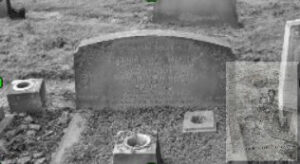
Family headstone in Sugar Lane Cemetery ©

William died in May 1945. His wife, Mary, followed in October 1958. The headstone gives the reader one valuable snippet of information – Mary was the sister of Thomas Ward. Thomas, included on the memorial, died in Boston, USA, in November 1946. There is now a link to America. In modern-day traffic, the journey from Boston to Middlesboro, Kentucky, is over 14 hours and a longer and more arduous journey during the first decade of the twentieth century. A visit to Mary’s brother could be the reason for the short stay.

Although I am curious to delve a little deeper into the Rhodes / Ward families, I must tell myself to stop and leave any further digging to the family or someone with another connection – not me!

West Riding Comtemporary Biographies

CENTRAL WEST RIDING OF YORKSHIRE

AT THE OPENING OF XXth CENTURY

Contemporary Biographies

I bought this book quite a few years ago, even though it was in a rather sad state. I seem to recall that it was on a stall at the York Family History Fair – I can’t remember how much the asking price was; however, I do remember parting with £5 after some bargaining. The front and back covers were, and still are, separate from the rest of the book; the spine is damaged, and the front fly cover is also loose. Saying all that, there is only one loose section – one piece of paper folded in two with the names – The Right Hon. the Earl of Scarborough; Mr Alexander Wentworth MacDonald Bosville, JP; The Most Rev. William Dalrymple Maclagan, PC., DD., DCL., and Sir John Austin, Bart., JP., pages 103, 103a, 104 and 104a. Considering the outside condition, the other pages are in very good shape.

It seemed such a shame to leave such a once handsome, large and heavy book to an unknown future. I knew it would come into use one day. The following are extractions with a Wakefield connection.

Bruce – Samuel Bruce LLB., JP., St John’s House, Wakefield: only son of the late Thomas Bruce, gent., of Wakefield: born at Leeds, July 10th, 1829: educated at the West Riding Proprietary School (now the Grammar School), Wakefield and University College, London. Barrister-at-Law; graduated 1851 and a member of Convocation; student of the Middle Temple (1851-55); called to the Bar, November, 1855; has practised in Wakefield; appointed Stamp Distributor in 1874, and is one of three only in the United Kingdom allowed to receive death duties; appointed a Justice of the Peace n the first grant of a Commission of the Peace for Wakefield, 1870; a Governor and Treasurer for the Crowther and other local charities; has long taken a prominent part in public affairs, especially in educational and political matters.

Fernandes – Charles Bathurst Luis Fernandes, JP., Wakefield; son of Joze Luis Fernandes, the elder, of Wakefield, and his wife, Catherine Mary, only daughter of George Hutchinson, of Whitton House, near Stockton-on-Tees, in the county of Durham, and of Wet Brunton, in the county of Northumberland; born at Porto Bello House, Wakefield, November 27th 1833; of Portuguese extraction, being descended, on the paternal side, from the Marquis de Tavora, the political opponent the Marquis de Pombal; educated at Christ’s Hospital, London, and Wakefield Grammar School. Admitted a Solicitor in 1857; is Solicitor to the Governors of the Wakefield Charities; Clerk to Normanton Urban District Council;Clerk to the Normanton and District Joint Hospital Committee; Clerk to the Trustees of Lady Hutchinson’s Charity, etc.,;acted as Solicitor in promoting a scheme for supplying Wakefield with water from the Penistone Hills, instead of the water which was then drawn from the River Calder; was also engaged as Solicitor either for or against nearly all the schemes propounded for supplying pure water to Wakefield, which culminated in the present supply from Rishworth Moors, takes a deep interest in agriculture and the breeding of horses, particularly thoroughbreds and draught horses; owner and breeder of Middlethorpe, Yorkshire Lad, and Chief Baron; owns and maintains the Sturton Stud Farm, near Gainsbro’; Lincolnshire. Married Francis Sarah, daughter of Thomas Bayldon, of Hollinghurst, near Wakefield, who was the proprietor of a large landed estate at Mowthorpe, in the East Riding of Yorkshire.

Kingswell – William Henry Kingswell, 95 Northgate, Wakefield; son of William Henry Kingswell, silk merchant; born at Wakefield, December 29th 1874; educated at Wakefield Grammar School. Articled with H Plews, of Wakefield; admitted 1899; was Managing Clerk with Messrs. Clements, Williams and Company, 11 King Street, E.C.; returned to Wakefield, 1901, and acquired the practices of Messrs. Brown, Wilkin and Scott, and Mander and Company; Steward of the Manor of Crigglestone, and of the Manor of Newland-cum-Woodhouse Moor.

Ottley – John Bickersteth Ottley – 1, Hatfield Street, Wakefield, eldest surviving son of the late Rev. Lawrence Ottley, Rector of Richmond and Canon of Ripon, Yorkshire, who was the eldest son of sir Richard Ottley, late Chief Justice of Ceylon; his mother was Elizabeth Bickersteth,, was daughter of the late Rev. John Bickeresteth, of Sapcote, Leicestershire, and sister of the late Bishop Bickersteth, of Ripon, and Dean of Bickersteth, of Lichfield, and niece of the late Lord Langdale; born at Acton, Suffolk, February 5th 1845; educated at St Peter’s School, York, and afterwards a Foundation scholar at Charterhouse, London; in 1864 he obtained an pen Exhibition at Trinity Hall, and afterwards an open Scholarship at Emmanuel College, Cambridge; graduated Second class in the Classical Tripos in 1868; articled to the late Mr Octavius Leefe, of London; admitted solicitor, Trinity term, 1871; succeeded, in 1874, to the practice of the late Mr Charles Oriel (also an old Carthusian); appointed, after the passing of the Bancruptcy Act, 1883, Official Receiver in Bankruptcy at Wakefield, the Bancruptcy district of Barnsley County Court being added to his jurisdiction in 1895, on the death of the late Mr Clegg, of Sheffield. Married August, 1896, Margaret Wray, of Newmillerdam, near Wakefield, and had two children living.

Beverley – Christopher Beverley, JP., West Royd, Farsley, near Leeds; son of the late Christopher Lodge Farsley, of Wakefield; born at Wakefield, November 22nd 1847; educated locally. Justice of the Peace for the city of Bradford; head of the firm of C Beverley and Company, commission wool combers, Albion Works, Bradford, Chairman of Beverley Bros., Ltd., Eagle Brewery, Wakefield. Married Evangeline, daughter of the late Israel Roberts, of Westfield, Stanningley Club: Bradford and County Conservative.

Fawcett, Joshua Swallow, JP., Ashleigh, Ossett; son of Frederick Fawcett, of Horbury; born at Thornes, near Wakefield, March 28th 1842; educated at local school, Leeds and Dewsbury. Extract wool, merino, and mungo manufacturer, and oil extractor, Caldervale Mills, Healey, Ossett; started business in 1872, in partnership with Messrs. Firth and Jessop; formed company, 1898, as Fawcett and Firth Ltd.; is Chairman of the Company; was member of Ossett Borough, 1893. Married Mary, daughter of the late Jeremiah Fisher of Horbury.

RhodesWilliam, Fern Bank, St John’s North, Wakefield; son of the late Joseph Rhodes; born at Wakefield in 1844; educated at local schools in Wakefield, and at Almondbury, near Huddersfield. Engineer and ironfounder; proprietor of the Grove Iron Works, Wakefield which were established in 1824, by his father, whom he joined on leaving school; for the last nine years member of Wakefield Corporation, formerly member of the Board of Guardians; Chairman and Vice-President of Wakefield Liberal Club; Chairman of the Engineering Employers’ Federation (Wakefield Association); Governor of Wakefield Charities; member of the Society of Freemasons, Sincerity Lodge, No. 1019, Wakefield.

note – ironfounder is one word in the book.

Wade, Henry, Redville, St John’s North, Wakefield; son of the late Walter Wade, of Wakefield; born at Stanley, June 17th 1866. Cloth manufacture; entered his father’s business, 1881; became partner, 1895; in 1897 the business was turned into a private company, of which Mr Wade is one of the Managing Directors; a Governor of Clayton Hospital; a member of the Council of Mechanics Institute, Wakefield; Treasurer of Wakefield Cricket Club. Married Emma, daughter of John Northcote, of Newton Abbott, Devon.

Ward, Joseph, Bottomboat House, Ossett, Yorks; son of the late Samuel Ward; born at Ossett, in; educated locally. Mungo manufacturer at Bottomboat Mill; started business in 1854; for the past forty years has been interested and associated with all Ossett improvements and advances; served on the old Board of Surveyors, then on its successor, the Local Board, and finally a member of the Corporation; Mayor, 1898, member of the Finance Committee; was Chairman of Gas-works Company, now Corporation property.

Married Elizabeth, daughter of the late James Benson, of Liverpool.

Childe, Henry Slade, Homegarth, Wakefield and Holbeck Hill, Scarboro’; son of Joshua Childe; born April 4th, 1861, at Eccleshill, near Bradford; educated at Wakefield Grammar School. Member of the firm of Messrs. Childe and Rowand, mining engineers, 59, Westgate, Wakefield and Barnsley Union Banking Company Ltd., and of the Yorkshire Railway Waggon Company Ltd.; returning as a member of Wakefield City Council, representing St John’s Ward, in 1898; Mayor of Wakefield, 1901-02; a Freemason. Past Provincial Grand Registrar in West Yorkshire Freemasonry, and Vice-Chairman of the Charity Commission of that Province. Married in 1890, Kate, only daughter of Henry France, of Thornes. Clubs; St Stephen’s. Leeds and Wakefield.

Note- Rowand – spelling as in the book.  It could be Messrs. Childe and Rowland, mining engineers. Reasons- Childe history pages and one of Childe’s children using the middle name Rowland.

Another Walk Around Sugar Lane Cemetery – Rhodes


Another Walk Around Sugar Lane Cemetery – Rhodes

William Jepson Rhodes was born in Wakefield in 1876. He was the son of Ezra Rhodes and his wife Hannah. By the time William was 15, his father, Ezra, was a widower looking after two teenage boys who both worked as joiner labourers with their father, a joiner. Home for the small family was Rhodes Yard, in the Primrose Hill area of Wakefield. Both Rhodes boys had been born in Wakefield, while Ezra had been born in Morley. Next door was widow Elizabeth Rhodes, who was living on ‘Own Means’ also from Morley – could she have been his mother? And could her husband have been responsible for the building of Rhodes Yard? William, now 25, lived in Epsom Place in the Parish of St Mary, Wakefield. He was working as a cabinet maker.

Just short of ten years later, William was now the father to three daughters and one son. Home for the family was Mollacree’s Yard, Kirkgate, Wakefield. He had married Mary Ann Nee Ward in the summer of 1898. William’s father, Ezra, was on the marriage certificate as a Master Joiner. He was also a witness on the happy day. Mary’s father was James Ward of Sun Lane, Warrengate, Wakefield, a foreman railway waggon shunter.

In 1939, William and his wife Mary were together in Duke of York Street, Wakefield – William was now a joiner and shopfitter.

Between the census dates, another set of documents tells another side of the Rhodes family – passenger lists. In 1908, mum Mary and three children were on SS Etruria bound for Middlesbro’ Kentucky from Liverpool. Why? The passenger list tells that the nearest relative was an aunt who lived in Northgate, Wakefield – no name of the aunt, but something maybe to research later. Where was William Jepson Rhodes? Had he died? No, I have seen the headstone; William was still alive. Did he stay in Wakefield? No. William, aged 32, travelled on SS Lusitania in February 1908. His wife Mary was living in Zetland Street, Wakefield, probably preparing for her upcoming journey. Why did the family leave the country? They only stayed briefly, as they are in the 1911 census. All eight of them are living in Mollacrees Yard. William, a shopfitter, works for George Blakey on Back Lane, Westgate, Wakefield.

William died in May 1945. His wife, Mary, followed in October 1958. The headstone gives the reader one valuable snippet of information – Mary was the sister of Thomas Ward. Thomas, included on the memorial, died in Boston, USA, in November 1946. There is now a link to America. In modern-day traffic, the journey from Boston to Middlesboro, Kentucky, is over 14 hours and a longer and more arduous journey during the first decade of the twentieth century. A visit to Mary’s brother could be the reason for the short stay.

Although I am curious to dig a little deeper and delve further into the Rhodes / Ward families, I must tell myself to stop and leave any further digging to the family or someone with another connection – not me!

Gomersal Cemetery

Gomersal Cemetery

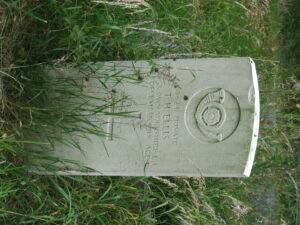
While wrestling with what else to include in this issue of Cameo, Morley & District Family History Group magazine, I came across a few photographs taken in Gomersal St Mary’s cemetery while on the hunt for a family headstone. In the slightly overgrown grounds, I came across the headstone of T. H. Ellis, a CWGC memorial.

Ellis CWGC headstone Gomersal Cemetery © C Sklinar 2020

The first website I must visit to find out who T. H. Ellis is is the CWGC site to input some of the information I already know. T. H. Ellis – the search gave six results. It was the first of these results that was of interest and confirmed by his burial place. And so it was that Private 68624 Thomas Henry Ellis of the KOYLI Reserve Garrison Battalion who died on the 5th of December 1918 aged 19; Thomas was the son of Mrs Sarah Thrippleton, formerly Ellis, – well, that last bit of information certainly gives one clue, but I’ll come back to that later.

Thomas Henry was born in Liversedge in the 1st Quarter of 1899. By the time of the census in 1901, Thomas Henry was two years old and living with his 13-year-old sister, Lily, his father, Micklethwaite, aged 45; his mother, Sarah, and Henry, Micklethwaite’s father, aged 73 – Some family trees on Ancestry have Henry dying in 1869, if that is the case, how is he listed in the 1901 census? In 1903 Micklethwaite died. With two children, Sarah had two choices – to marry again or muddle through. She chose the first choice, and in the December Quarter of 1903, Sarah married William Thrippleton, a woollen weaver, in the Dewsbury Registration District.

The 1911 census shows that William and Sarah had been married for eight years and had no children, but Lily and Thomas Henry were each ten years older and still living with their mother. There was one addition, though, Ivy Ellis, a three-year-old classed as granddaughter-in-law. William called Sarah’s children by the term in-law, not stepdaughter or son. The family live on Moor Lane, Gomersal, in a two-roomed house. That sounds like it was a little on the ‘cosy’ side!

Back to Thomas Henry. As we know from his headstone, he enlisted in Bradford into the KOYLI. The Service Record relating to Thomas Henry does not appear to have survived. I don’t think Thomas Henry served abroad, as he has no Medal Card either, so I’ll work with what is available.

The Army Register of Soldiers’ Effects 1901-1929 includes Thomas Henry and his mother, who was beneficiary to the £3 11s 8d owed to him by the army. The next record set, which includes some interesting information, is the Fold3 collection – a sister site to Ancestry but with an added fee to view. If you are a member of the Western Front Association, they can be viewed from their website for free, as the WFA have the care of the original cards. The faded pink card shows that Mrs Sarah Thrippleton was the Dependant but was superseded by William Thrippleton, who now says that he is the stepfather. Home for William is Burnleys Cottages, Hill Top, Gomersal nr Leeds. But most importantly included is the reason why Thomas Henry rests in a Gomersal cemetery. He died ‘at home’, meaning in the UK of pneumonia.

Sarah, whose maiden name was Brewell, died in February 1926 at Hill Top, Gomersal. William, born in 1869, was included in the 1939 Register along with Lily and Ivy – could this prove that Ivy was Lily’s child? Another question, but one I’m not going to attempt to answer.

William died in June 1945, aged 76 and was buried on the 29th of the same month in plot 644 in the extended graveyard.

Another Walk around Sugar Lane – Grace

A Walk around Sugar Lane – William John Grace

   William John Grace had been born on the 10th of January 1856 and nine months later he was taken by his parents, William and Jane to St Mary’s Church, Wakefield to be bapt.ised. The family more than likely walked from their home in Thornes Lane for the happy occasion.

   In 1861 the four year old John was living with his parents and two younger brothers on Holliday Row; His father, William was employed as an engineer in one of the local worsted mills. By the time of the next census, 1871, William’s father had died and Jane, now a shopkeeper was the head of the family. The 1881 census came and went and Jane now had no occupation listed but John William was a mechanic. His brother Henry was a postman, while his youngest brother James was a telegraph clerk working for the Great Northern Railway.

   In 1887 life changed for John William, as aged 30 while living in Sandal, he married Mary Ann Firth (31) in St Michael’s Church. Mary Ann was 31 years old and lived in the Westgate Common area. Both John and Mary signed their name on the church register while a witness, William Firth had to ‘make his mark’. The church register gives the impression that John’s father is still alive as there is no ‘deceased’ written below his name. The newlyweds lived at Belle Vue, moving a couple of times but still in the same vicinity.

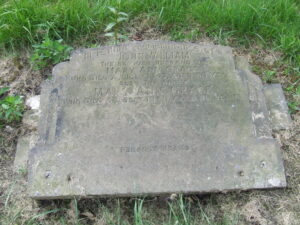
Grace family headstone © C Sklinar 2014

 John and Mary went on to have four children, three girls and one boy, all born between 1891 and 18994.

   John died in 1907. The 1911 census gives more insight into the couples lives. Having been married for 7 years (which should not have been included on the form and was struck through by the enumerator) Mary had had four children and by 1911 only three were alive. Mary was working as a charwoman. Her children were employed as a stitching machinist, an apprentice stitching machinist and an apprentice fitter at a steam economist works, probably Green’s Economisers and the youngest child aged 11 was still at school. The family lived at 7 Wright Street, Belle Vue, consisting of a cellar, house, bedroom and attic, just above the address where the head of the household signs is the name John Wm Eason, who gave the reason for being there as witness. Mary Jane Grace just ‘made her mark’. Strange, as she did sign her marriage entry in the church register, albeit in a very poor hand.

   When it was time for the 1921 census to be handed in, it was a Mr Grace that signed the double-sided sheet – this could have been her only son who had now left home. The three daughters were now all working – the eldest two were boot machinists for James Ledgard and Sons, Alms House Lane, while the youngest girl was a stocking leg knitter for Isaac Briggs and Sons, Gradient Mills, Barnsley Road.

   The 1939 Register includes Mary and two of her daughters, still living at 7 Wright Street. The two daughters are now working for the GPO (General Post Office) as office cleaners, but there is a new entry. The new addition is for Harry Grace born in 1924 who works as a messenger boy again for the GPO. Now a question arises. Is Harry the son of one of the daughters? Is he Mary’s grandson from her only son? Is he a nephew? With curiosity rising and the knowledge the answer was only a website away I took a closer look. Harry was the son of James Grace and Gertrude Wootton – so Harry was her grandchild from the only son, James and his wife Gertrude nee Wootton.

   Well, that was another short insight into the life of someone named on a headstone. With two names, dates of death and ages enough information was given to start a family tree. And quite quickly three get    nerations were found. There were only two sources that took a little time and that was the 1939 Register and the 1921 Census I had to look a few of the images before finding the correct family. In fact it has taken me longer to write this than do the research. Anyway, the research is always much more fun!

   ‘In faithful remembrance of John William the beloved husband of Mary Ann Grace who died 7th July 1907 aged 50 years also the above Mary Ann Grace who died 5th Sept 1946 aged 80 years. ‘Perfect Peace’.’

WW1 Envelopes and a Hand-crafted Belt

WW1 Envelopes and a Hand-crafted Belt

A cardboard box full of WW1 ephemera was given to me recently and packed full of beautiful bits and bobs. What is inside the container? A trench periscope, envelopes, a 1918 New Year card, a snuff box in the style of Dutch clog, a tapestry belt, and much more. One of the utmost special items was an original newspaper from the 11th of November 1918.

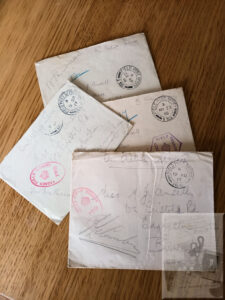
A set of four letters sent from a soldier on Active Service ©

A set of four letters sent from a soldier on Active Service ©

Firstly, I would like to tell you about the envelopes. All of them had been addressed to Miss M J Ansell, Ben More, 62 Bristol Road, Edgbaston, Birmingham.

Who is or was Miss M J Ansell?

You must know a little of me now to see that I am a sucker for a name, a serial number or any clue that may lead me to someone no longer walking among us and able to tell their tale.

So many questions arose from the envelopes – when was she born, who were her parents, did she have an occupation, did she marry and have a family? To my great sadness, the letters were no longer in their original packaging. So many bits were needed to complete my jigsaw. As a result, with no letters, this was a one-sided chase!

The letters were dated the 23rd of April and 23rd of May 1916 and the 19th of August and 29th of September 1917. Each discoloured envelope was postmarked from a Field Post Office and passed Field Censorship. Should I rightly or wrongly assume the writer had been a soldier, not a VAD or a nurse who had been in one theatre of war and then moved as the censor office numbers changed from 937 to 799?

Let’s get started by using ANSELL in Edgbaston on the online website. The results came back; one stood out in the 1911 census. Mabel Jessie Ansell a 29-year-old Secondary School Teacher. Mabel was the daughter of William, a 62-year-old manufacturer of iron and brass ship fittings and Jessie Ewen Smith, aged 63 at the time living at 78 Bristol Road, Edgbaston.

By 1921 Mabel’s father and Jessie’s husband had died (1919), and the family home was now a little down the road at 62 Bristol Road. Jessie, on the completed census form, says she is the mistress of the house. Mabel was now a science teacher at King Edward Grammar School, Camps Hill. The census form also included 16-year-old Millicent Stackhouse, the family servant.

Going back to William, he had died in Bushwood Nursing Homes, St Jame’s Road, Edgbaston, just a 15 minutes walk away from the family home. Did William leave any money? Yes, he did! He left £29,664 5s 5d to his widow, Jessie and his children, Mabel and Frank and Oliver Richard White, Chartered Accountant, was left to deal with his accounts.

Jessie died in 1935. According to Probate Register, she left just over £7,000 – where had the money gone? The money was left to Mabel, Frank Ewen Ansell, and Herbert William Lyde.

Mabel’s brother Frank (d 1956) had married Ethel Lomax in the Kings North Registration District in 1910. The couple had Ewan P Ansell, born in 1913, followed by Peter Benson Ansell, born in 1916. Ewen married Elizabeth Woodward in 1943. Ewan died in 1973, but in his career as a pulley manufacturer, he took out a Patent in 1959 based on improvements of a pulley design and mounting.

Peter Benson Ansell went to the same school where his aunt taught – did he get preferential treatment? At school, Peter was a star on the rugby and cricket fields. His rugby position was centre three-quarter. He also played for the Edwardians. When at Birmingham University, studying Medicine, he was also part of their Rugby team. On three occasions, he played for the North Midlands Union. He was also a keen supporter of Midland Rugby Club. Sport was undoubtedly in the family, as his grandfather, William, was for many years the honorary secretary of Warwickshire Cricket Club. When the 1939 Register was taken, Peter was a medical student at the General Hospital along with many other students, doctors, surgeons, nurses, and of course, patients.

Peter died on the 17th of October 1940 while still a medical student because of an accident. With Peter’s death being during WW2 and his age making him eligible for war service, the CWGC website was searched next, and here I got a surprise. Peter’s death was not military but civilian.

Peter is remembered on the Birmingham University Roll of Honour, his local church in Streetley, Birmingham but sadly is NOT on his school memorial. He may not have fought, but he died due to enemy action. German fighter bombers were attacking London, Liverpool and Birmingham on the night of his death. The visibility was terrible that night, making detecting enemy action very difficult. Even so, Birmingham was not left in peace, and over 2,000 souls lost their lives during WW2. I remember I read that he was injured while driving and then taken to the Queen Elizabeth Hospital, where he sadly died. I seem to have misplaced this source, though.

Mabel, I’m still working on her! In 1939, she lived at 113 West Street, Warwick and still worked in her chosen profession, teaching.

Mabel died on the 22nd of July 1963 in Birmingham and left £4,988 19s for Lloyds Bank to distribute according to her will.

Mabel remained a spinster all her life, and this raises more questions. Why is it with family history, be it your own, for someone else or just a name that sounds interesting there, is always another question? Mabel never married. Could the four envelopes contain letters written by her beau? Is it even more possible that she remained single because he never came home? Only Mabel knows. Or does she? Can someone else answer my question?

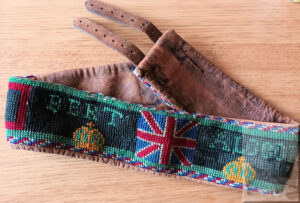
WW1 belt made by Bert Alcock ©

WW1 belt made by Bert Alcock ©

Secondly, I’d like to tell you about the tapestry belt. That is the only way I can describe it. Hand stitched on a repurposed leather back and leather straps. Worked into the belt are A Alcock and the year 1916. Who was A Alcock?

Using the CWGC as a base source, there were quite a few soldiers who could have been the owner of the belt. Saying that I am presuming, a thing you should not always do, that he died during the war. He could have survived. The previous belt owner had done a little research and thought he was Albert Harry Alcock. Whether right or wrong, this is all about Albert and the few bits of information I was given and a great deal more found by myself.

Albert Harry was one of three sons (Fred and John William) of John and Wilhelmena nee Willisford, who had married in St Mary’s Uttoxeter in 1887. All three of their sons went to war, a war that was later to be known as The Great War.

Back at the time of the 1911 census, only Fred and Albert, known as Harry, lived in the family home. The three brothers all enlisted into the army sometime after hostilities began. Fred joined the 1/6th North Staffordshire Regiment and became Private 2635. William became Private 18553 in the York and Lancaster Regiment. Albert Harry became a Private in the 1/6th North Staffordshire Regiment, the same regiment as his brother.

All three brothers paid the ultimate sacrifice.

Fred died on the 2nd of July 1915 and rests in Blauwepoort Farm Cemetery, Belgium. He was only 19 years old.

The military Pension Records belong to the Western Front Association and can be accessed via the WFA website (members) or Fold3. These records tell that William John had been classed as missing after the first day of the Battle of the Somme, 1 July 1916. He was later classified as dying on that day. He is remembered on the Thiepval Memorial to the Missing. He was 25 years old. William’s Pension Card, like many others, includes the names and ages of his siblings – and sometimes their regiments. The brothers’ father was next of kin, and a change of address had been included.

Using Pension Cards, Albert Harry was also classified as missing on the 1st of July 1916, like his brother is remembered on the Thiepval Memorial to the Missing.

In just twelve months, John and Wilhelmina had lost three children, two on the same day, and received less than £28 from the Government in return.

Wilhelmena died in Cheadle in 1942. John lived a few more years and died in 1953.

If only A Alcock could confirm he was the soldier?

Another Walk Around Sugar Lane – James Whitham

Another Walk Around Sugar Lane – James Whitham

Many headstones hold secrets. When and where a person was born? Who were their parents and siblings? Who was their wife or husband? Or did they remain single? Did they or their family decide to tell the passer-by just enough information on the headstone? But that ‘just enough information’ sets the future relative or researcher on a journey of curiosity – Who were you?

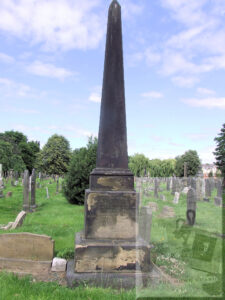
James was a Solicitor and Town Clerk of the Borough of Wakefield who died on the 22nd of April 1867, according to his headstone. The headstone is three rather solid squares of stone set on a solid base with a splendid four-cornered spire. It looks quite impressive as most of the headstones around are of a more standard size and shape.
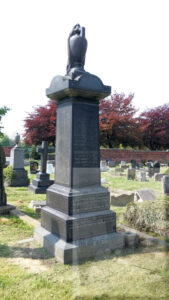
The other name on the memorial is that of James’ wife Maria, who he married in St John’s Church, Wakefield in 1837. Maria nee Kelshaw was born in the Thornes area of Wakefield in 1810 and died in 1877. Sadly, the year information on the headstone has been damaged, but other documents confirm the 1877 date.

Going back to James, according to his census entries, he was born in Bangalore, India. The Ancestry website has a collection of transcripts entitled ‘India select births and baptisms 1786-1947’ in which James is recorded as having a father named Richard and a mother Lucy. The transcript continues with a date of birth, 30 November 1812 and baptism on 3 February 1813 in Mount, Madras, India – could this be James? Don’t you get a good feeling of satisfaction when a little bit of extra ‘digging’ pays off? FindMyPast has on microfilm the baptism of James – it reads, ‘This is to certify that James son of Robert Whitham, Sergeant Major H.M. 84(?) Regt and of Lucy his wife. Born 30th Novr 1812, was baptised according to the form of *** his baptism outlined in the service of the Church of England this 3rd day of February 1813 by me, W Thomas, Chaplain. Sponsors George Boothroyd, Winsor Hazny (sic), Ann Reid. The two male sponsors were both from the 84th Regiment.

In 1851 James and Maria were living on King Street with a servant named Elizabeth Hall, who had been born in Stanley 36 years earlier. Ten years later, Cliff Parade was the home to the Whithams. Elizabeth Waterworth, a married sister aged 53 and two servants were also in the house. Now another question. Was Elizabeth James’ sister or his wife?

The Leeds Mercury 2 May 1867 – …. Mr Mander then moved a resolution to the effect that the Council testifies its sympathy and condolence with the widow of the late Mr James Whitham,
town Clerk, on the recent bereavement she has sustained by his death; and its regret at being deprived of the services of a gentleman, who since the incorporation of the borough, had filled with such marked ability and efficiency the important office of Town Clerk. The motion was seconded by Mr Lamb, supported by Ald Wainwright, and carried unanimously. The gentleman who spoke, and also the Mayor in putting the motion, gave their testimony as to the value of the services performed for the borough by the late Town Clerk’.

Huddersfield Chronicle 27 April 1867 – On Monday, Mr James Whitham, solicitor, Wakefield and Town Clerk of that borough, died at his residence at St. John’s, Wakefield. The deceased gentleman, who was highly respected, was 54 years of age. He had been in practice as a solicitor for 34 years, and as Town Clerk of Wakefield since its incorporation in 1848. For some time past his health had been giving way, and, the Town Council had granted him six months’ leave of absence, he had been in the South of England for about three months. Mr Whitham was a gentleman of acknowledged ability and was well known and much esteemed in the profession.

Yorkshire Post and Leeds Intelligencer, Tuesday 1 October 1867 –Lot 1 All that Detached Messuage of Dwelling House, situate at Cliffe Parade, in Wakefield aforesaid, containing on the ground floor, entrance hall, dining-room, drawing-room, breakfast-room, store-room, and large kitchen. On the first floor, five bedrooms, a water closet, and a housemaid’s closet, and the basement, large kitchen, laundry, larder, and beer, wine and coal cellars, and possessing a well-yielding abundant and invariable supply of pure water. Together with the plantation garden, shrubbery, yard and outbuildings thereto belonging and containing an area (including the road at the north-east end thereof), of 2256 square yards or thereabouts, formerly in the possession of the late James Whitham, Esq., and now Mrs Whitham.

A portion of the purchase money of this lot may remain on a mortgage if required.
Lot 2 – All that Seat or Pew numbered 1, containing eight sittings, situated in the centre aisle of St John’s Church, Wakefield, aforesaid.
To view Lot 1, apply on the premises between the hours of Two and Six o’clock in the Afternoon, and for further particulars and information, apply to the Auctioneer, at his office, in Southgate, Wakefield, or at the offices of W H B Tomlinson, Esq., Solicitor, Wakefield or of Messrs Wright and Waterworth, Solicitors, Keighley. 14 Sept 1867.

Another Waterworth connection, and yet another when James’ Probate entry shows he left less than £5000, and John James Waterworth gets a mention as a solicitor in Keighley and also James’ nephew. This information still does not answer whose sibling John James’ mother was.
After the sale of the property at St John’s, Maria moved to Thornhill Terrace, where she lived as an Annuant with one servant

Wakefield Free Press Saturday 26th of May 1877 – Deaths – Whitham. On the 23rd inst, aged 67 years, Maria, widow of James Whitham and Town Clerk of this Borough (No Cards). Maria’s Probe is quite disappointing as she left under £450. This raises an age-old question ‘Where did the money go’?

Note: There is an entry in the Uk, Regimental Registers of Service, 1756-1900 for Robert Whitham aged 14 Attested on 23rd of June 1794.  If this is the correct Robert he had been born in Whaley, Lancaster.  Robert was 5′ 2½.  He had a fair complexion, brown hair and grey eyes.

An entry slightly higher up the page if for a young man named David Willis,  David was 17 years old and slightly taller than Robert, at 5′ 6¾”.  He had a light complexion, light hair and grey eyes – what is the connection, I hear you ask?  David was born in Wakefield.  Does he belong in anyone’s family tree?

A Walk Around Sugar Lane – Traub family

A Walk Around Sugar Lane – Traub family

If you come from Wakefield you may not be familiar with the surname Traub. In Wakefield you would be aware of the surnames, Hoffman and Zeigler – these families were known as pork butchers with a German background.

Mr Gottleib William Traub was a pork butcher born in Germany and running his business in Batley. William as he came to be known was born in Weinsberg on the 14th of October 1863.

When William came to England I don’t know. But I do know that on the 30th of April 1892 he married Mary Elizabeth Hartley in St Peter’s Church, Morley. William at the time used his full name of Gottleib William and he told the Curate in Charge, Mr James, that he was 28 years old, a butcher, living on Queen Street, Morley. He also informed the Curate that his father was named Christopher and he was a farmer.

Mary Elizabeth was 29 years of age when she walked down the aisle to meet William. Like William, she also lived on Queen Street. Her father was John Richard Hartley and like Williams, father Christopher, he was also a farmer. There were two witnesses on that memorable day, William Kynder Smith and Marion Smith Beck.

The marriage of William and Mary Elizabeth took a little finding as the transcriber wrongly interpreted the name as FRANK.

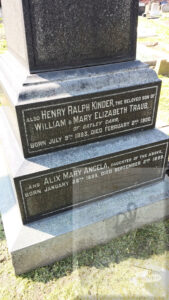
The young couple settled into married life and a year later Henry Ralph Kinder Traub was born (1893), he sadly died in February 1900. A daughter Sybil followed and by 1901 she was five years old. The family by now were living at 62 Town Street, Batley and William was now working for his-self and he was now a British Subject.

In the Valuation list for Batley in 1910 William is listed with a house and shop at 62 Town Street, Batley. One very interesting thing for the time is that William had owned an electric motor, 2 h.p.

Another ten years passed by and the family are still at 62 Town Street, Batley. Both William and Mary Elizabeth are 47 years of age, Sybil Elizabeth B is 15 and she has a younger sister, Muriel Pauline aged nine. The couple had been married 18 years and had lost two out of their four children. We know about Henry but not yet about Alix Mary Angela who was born in January 1899 and died on the 2nd of September the same year.

The First World War came and went. Life carried on year by year until 1939 when William and Elizabeth are living at 52 Brunswick Street, Dewsbury. Sybil has taken over the role of the head of the house. She works as a Secretary to Woollen Rag Company. Her mother Mary Elizabeth is classed as Incapacitated. William is a retired pork butcher and young Muriel is an elementary school teacher.

Following on from the 1939 Register in October of that year William, even though he had become a British Citizen was still included on the ‘Enemy Alien – Exemption from Internment – Non-Refugee’ list. He must have had to attend a Tribunal as the result was ‘Exempt from internment until further order’. His Identity Book number is also included – 200516.

Sadly, although Mary Elizabeth nee Hartley, was a British Citizen by birth and parentage, at the time of her marriage she took her husband’s country of birth. So she also has an ‘Enemy Alien Card’. In the 1939 Register, her occupation is ‘incapacitated, by October on her card she is now a housewife. Mary’s Identity Book number follows on -, 200517

In the early autumn of 1942, Mary Elizabeth died, she was 79 years old.

Traub headstone in Sugar Lane Cemetery © C Sklinar 2016

The following year Sybil Elizabeth Bohn Traub died o the 16th of January (1943) at Dewsbury & District General Hospital. Her Probate was also granted in Llandudno and again Muriel was to receive money to the value of £2305 4s 4d.

William died on the 28th of January 1944. Probate was granted in Llandudno on the 27th of March to Muriel Pauline Traub, a spinster with effects to the value of £5208 14s 3d. You may ask why was Probate in Llandudno? Due to the was much of the probate staff transferred to Llandudno for the duration. If you look on the index pages for the period 1939-1945 there are a great number of Llandudno registrations.

Muriel Pauline went on to have a long life. She died in Stockport in the first quarter of 1997. Later the 0same year Muriel’s Probate is granted. As she died in 1997 she is just outside the criteria for searching via Ancestry or FindMyPast. I said earlier that Muriel had been a teacher. FMP has her Teachers Registration. She registered on the 1st of January 1933. Registration no. 90506. After training at the Mather Training College, Manchester, Muriel attained a Board of Education Certificate. Later teaching at Whingate Road Council School, Leeds.

Traub headstone in Sugar Lane Cemetery © C Sklinar 2016

So, we now know a bit about the Traub family. But it is only the two children who died in infancy that are remembered on the Hartley family headstone which reads: In Memoriam. John Richard Hartley of Wakefield was born on March 28th 1836. Died February 16th 1874. Also Elizabeth Ann Beck of Morley. Born April 28th 1838. Died February 15th 1904. Also Frederick Leonard Beck son of the above. Born January 1st 1880. Died March 24th 1924. At Rest. Also, Henry Ralph Kinder, the beloved son of William and Mary Elizabeth Traub of Batley Carr, was born July 9th 1893. Died February 2nd 1900 and Alix Mary Angela, daughter of the above. Born January 28th 1899. Died September 2nd 1899.

Antigua and Bardua War Memorial pt 1

Antigua and Bardua War Memorial

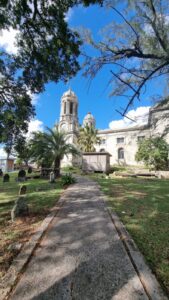
St John’s Cathedral, Antigua © K Sklinar 2021

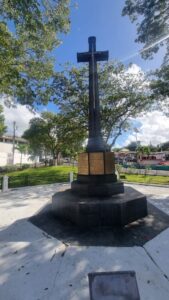
I think in some respects my children know me too well! A set of images of a war memorial were attached to a message. Followed shortly after by images of the war memorial, images of a cathedral and a tomb appeared. The memorial remembers those who fought in World War One on the islands of Antigua and Barbuda. Though the dark stone memorial has six sides, only three are used. One is in the memorial brass plaque, and one brass panel on each side shows the names. A further small plaque commemorates six islanders from the 1939-1945 conflict.

Before I tell you about the young men whose names are on this memorial, let me give you some background information.

The memorial was erected in 1919 and honours 24 young men. During this period, 1914-1918, over 16,000 men and women volunteered to serve. A new regiment, the British West Indian Regiment (BWI Regiment), was formed in October 1915. A large number of men from the islands, joined this regiment, while others joined existing regiments.

Antigua and Barbuda War Memorial © K Sklinar 2021

Antigua and Barbuda War Memorial © K Sklinar 2021

Returning to the men who are listed alphabetically on the memorial.

Dennis John Freeland Bradbury is first on my list. He was born in Antigua in 1898, the son of Patric Joseph O’Leary Bradbury and his wife Ellen Mary Freeland. Ellen and Patrick are both originally from England, but Patrick’s job required them to move abroad. Oxford-educated Patrick served as Second Master at Antigua Government School. Later Inspector of Schools in Jamaica, followed by Director of Education.

Dennis and his younger brother Basil, in 1911, were living with their aunt and uncle, Georg Henry and Mary Ann Doggett, at Abbey House, Cambridge. Were they here to be educated?

The Southport Visitor opened up a window on the young Dennis on the 30th of November 1916. Denis’s uncle, Dr J. A. Bradbury, former union medical officer for Wigan, wrote that he attended the Moravian School, Leeds (Fulneck School) and later Cambridge University.

In the midst of the Great War, Dennis joined the King’s Own Royal Lancaster Regiment, later the North Lancaster Regiment.

Dennis was wounded in 1916 and taken to a base dressing station where he died, aged 19, on the 15th of November 1916. He rests in Mailly Wood CWGC Cemetery, Picardie. The UK Army Register of Soldiers’ Effects shows a considerable amount of money to be paid to his family.

The base of his headstone are the words “To live in the hearts we leave behind is not to die!.
On the memorial, James Harvey Bryson is listed as the second name. James Bryson was the only child of Robert and Isobel Bryson of Antigua. He was born on the 12th of May 1899. De Ruvigny’s Roll of Honour 1914-1919 includes an interesting biography for James.

Initially educated at Kenley School, time at Aldenham School followed At Aldenham, James took part in both football and athletics and was a senior cadet in the O.T.C. On leaving time at school he joined the army. He was Gazetted 2nd Lieutenant in the R.F.A., in June 1918 and served with the Expeditionary Force in France and Flanders in August of that year. A few months later he was Killed in Action near Cambrai on the 20th of October 1918 aged 19. James rests in Cambrai East Military Cemetery. Information in a booklet held at the cemetery tells that James served with “Y” 24th Trench Morter Battery and that his parents at this time lived at Dunmara, Bourne End, Buckinghamshire.

Like the previous officer, James’ family would receive a considerable amount of money owed for services. James’ name is included in the Aldenham School War Memorial, as well as the list of Ireland’s World War I Casualties 1914-1922, and as we know the Antigua memorial.

In April 1919, Probate for James of 113 Landsdowne Place, Hove, Sussex, was granted to Robert Bryson, Esq., with effects totalling £270.

As well as having his own grave, James is included on that of his grandfather, James M Bryson in, New Calton Cemetery, Edinburgh. The burial place of James M Bryson who died 6th January 1894 aged 69 years. Mary Dunn his wife died 30th August 1902 aged 67 years. James died 3rd Jany 1870 aged 9 months. Jessie Gillespie died 2nd Sept 1875 aged 15 years. Maggie Bannatyne died 27th May 1880 aged 21 years and in proud and loving memory of James Harvey Bryson 2nd Lt. RFA who fell in action in France on 20th Octr 1918 aged 19 years interred at East Cambrai son of Robert Bryson Antigua and grandson of the above James M Bryson. David Dunn Bryson died 26th Jany 1933(?) aged 77 years, Mary Dunn Bryson widow of Peter Bonthron died 30th April 1938 aged 75 years”.

The Scotsman Saturday 20 October 1923 remembers James – “In proud and loving memory of James Harvey Bryson, Lieut., R.F.A., killed in action on the 20th October 1918, aged 19, only and dearly beloved son of Robert Bryson, Antigua, B.W.I., and “Dunmara”, Bourne End, Bucks., and grandson fo the late James M Bryson, Inverleith Row, Edinburgh. “Eternal honour give to those who died in that full splendour of heroic price that we might live”. There is also a mention of James on his parents’ gravestone in Hove Cemetery, Old Shoreham Road, Hove.

The third name on the memorial and the final name for this section is that of Ernest Brooks.

Ernest born around 1892, was the son of William Brooks of Sea View Farm, Antigua. Sea View Farm is a township located in the parish of St George – located approximately halfway between the capital city of St John’s and the island’s largest reservoir, Potworks Dam.

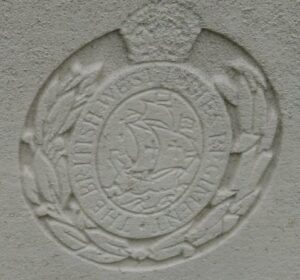
British West Indies insignia on CWGC headstone

Ernest served in the BWI (British West Indies Regt.,)9th Battalion, as Private 11847 from roundabout July 1917. Ernest was injured and taken to No 4 CCS (Casualty Clearing Station) where he died on the 5th of October 1917. Dozinghem Military Cemetery is the final resting place of our young soldiers and over 3,300 others. These soldiers are made up of Commonwealth soldiers from both world wars including those from the Allied withdrawal from Dunkirk and 65 German war graves.

The website Lives of the First World War includes information that Ernest’s medals were not claimed. Monies owing to Ernest, according to the Army Register of Soldiers’ Effects, were sent by Crown Agents to an Antiguan bank account. Another entry for Ernest in the same collections has differing amounts of money being paid to his father, William – this time via the Colonial Society, Antigua.

This link of how to research a BWI soldier may be of interest

Looking for a Caribbean soldier who died in WW1 try this link, Caribbean Roll of Honour,