Category Archives: News

Western Front Association – Charles F Payne

Western Front Association – Charles F Payne

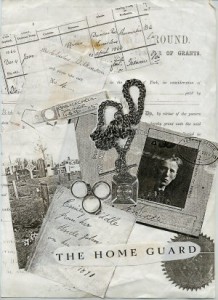
Don’t the months go by so quickly?  It doesn’t seem a month since my last visit to the Western Front Association meeting in York.  The speaker at this months meeting (May) was Chris Payne.  I had been looking forward to his talk as it seemed to be more about a person not a battle.

Charles Frederick Payne was the reason I ventured north for the Saturday meeting. Chris was informative and enthusiastic in telling the packed audience of Charles’ time during WW1 and seemed to hold the every one of us in the palm of his hand.

Although I was a little disappointed that there was more battle information than family history information, I didn’t mind as Chris guided every one of us through Charles’ time fighting for King and Country.
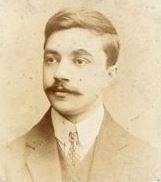
Charles was the son of Henry Stableforth Payne and Emily Clarke and was born in 1883 in Westminster, London and had 6 siblings.  He married Ida Muriel Payne – after the meeting I spoke to Chris about Charles’ wife having the same surname – was this how he included them on his tree or was his Ida a Payne before marriage as well as after her marriage – yes they were both Paynes and distantly related. That sorted that one! And was confirmed by FreeBmd who showed them marrying in the early summer of 1909 in the Wandsworth Registration District of London.

1911 has Charles and Ida living at 44 Tranmere Road, Earlsfield, London. Charles was aged 27 and a Pitman qualified shorthand typist.  During his life Charles travelled in Europe where his skills were needed.

1914 came around and Charles enlisted into the West Riding Regiment with the service number 235435.  His service took him through France, seeing fighting near Arras and Rossignol Wood (Nightingale Wood) and all the while he was receiving letters and packages from Ida and his family. I think I will let Chris Paye tell you more about Charles Frederick Payne letters from his wife.

Chris went into details about the places and conditions that Charles and his fellow soldiers endured during their time in France and all the while seemed very concerned that one of his parcels from home had not arrived.

I think the whole room breathed a sigh of relief when we found out from Chris that the war was over and Charles was still alive.  However, Chris continued his talk and a silence fell around the room, you could hear a pin drop and I am not ashamed to say I had a tear in my eye – Charles Frederick Payne died on the 11th of February 1919 aged 35 and rests in Terlincthun British Cemetery, on the outskirts of Boulogne.
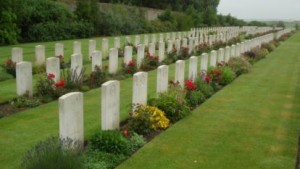
Terlincthun had been a site for rest camps since June of 1918 and from 1914 Boulogne and Wimereux had had hospitals and other medical establishments within their boundaries.  By 1920 the CWGC cemetery had over 3,300 burials, including Charles.  The cemetery during WW2 suffered greatly from shelling during the early part of the war and later from German occupation. The inhabitants of the cemetery has grown and there is now over 4,300 Commonwealth burials and more than 200 graves of other nationalities – mainly German.

So it seems that Ida was all set to welcome Charles back home to his children and family to be so distraught and disappointed some three months later when she would have heard the news of his death.

Ida never re-married and died on the 18th of May 1980 in Cornwall.
Wakefield Express WW1 – Pioneer Briggs

Wakefield Express WW1 – Pioneer Briggs

Who was Pioneer Briggs and what has he done or achieved to make have an entry in the local newspaper?

Pioneer Briggs, was according to the parish registers of St Michael, East Ardsley, the son of Christopher and Mary Ann Briggs.  The registers also tell that he was baptised Haydn Harry on the 2nd of May 1897.  The family at the time were living on Cave Lane, East Ardsley.

A few years later when the census enumerator came to call Christopher told him he was aged 40, from West Ardsley and working as a Railway Engine Driver. He was the husband of Mary Ann aged 39, who came from Bowden in Cheshire.  The couple were parents to five children aged between 17 and four, the four year old being Haydn.

Ten years later, Mary Ann was a widow, who had given birth to seven children, with six living to be counted in the census.  Home was now Old Hall Farm, East Ardsley.  Her occupation now being given as farmer.  Her two eldest daughters were elementary school teachers. while the boys worked on the farm.  The farmhouse boasted ten rooms – not including the kitchen, bathroom scullery or landing.  Haydn Harry was now 14 years old, a teenager, but in a few years time he would have to become a man!

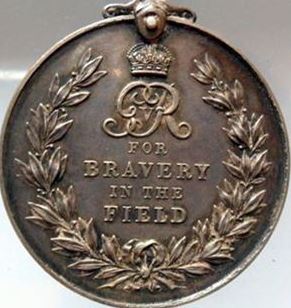
Military Medal

Military Medal

East Ardsley Soldier’s Gallantry – Pioneer H H Briggs, Royal Engineers, youngest son of the late Mr Christopher Briggs and of Mrs Briggs, The Hall, East Ardsley, has been awarded the Military Medal for conspicuous gallantry during the months of July and August.  Prior to enlisting he was employed as a fitter at the Great Northern Railway sheds, Ardsley.  He was twenty years of age, and  attended as a boy the local Council School.  His elder brother Fred, is serving in the Royal Flying Corps.

The next question is did Haydn and Fred make it through the war?  A look though the CWGC website revealed no entries for either brother, but that could be due to a transcription error – no transcriber is perfect! No record of Haydn’s death in the surviving military records or a record of any medal awards – as there should be……..never mind.  The question is still looming, did he survive?  I am pleased to say that the Electoral Registers for 1921 gave the answer, as both Haydn and Fred are included in the listings, along with their mother, Mary Ann who are all still living at Old Hall.

FREE family history websites to get you started

FREE family history websites to get you started

compilation logoWhen starting your family project you don’t always want to commit a sum of money.  Although you may be curious about your family’s history, you may not want to or have the funds to splash out on a pay-per-view website……………yet!
With FREE in mind, here are a few websites I used while researching, but not listed in any specific order.

  1.  FreeBMD – An ongoing project to transcribe the Civil Registration index of births, marriage and deaths for England and Wales.  Not yet fully transcribed but a very useful site and if you know a few shortcuts the site opens up other avenues of research. FreeBMD is part of the FreeUKGEN initiative helping to make high quality UK primary records freely available online
  2. FreeCen – another of the FreeUKGEN sites. Covering the 1841 – 1891 census for the UK it is a wonderful tool if you don’t have access to a pay-per-view site – you are minus the image but a good transcription could help you go back a few generations.  Some areas have greater coverage but still useful.
  3. FreeReg – Another of the FreeUKGEN initiative sites, this time focusing on Parish Registers.  Another good site but………. error messages appear if you don’t fill in enough of the search boxes.  However, the information given is useful.
  4. FamilySearch – FamilySearch is the online family history face of the Church of Jesus Christ of Latter-day Saints. The FamilySearch website has been around for many years and is a must for all family historians and genealogists.   The aim of the Church is to preserve family history and historical records and allow them to be freely available. What can you search for? Census, Parish Registers, Passenger Lists and Service Records to name a few.  The records are worldwide and are also available, for FREE, in the Church’s Family History Centers.
  5. CWGC – The Commonwealth War Graves Commission – Covering WW1 and WW2 and lists names of servicemen and women who died through enemy action at home and abroad. You can search by casualty or by cemetery, with most of the cemeteries run by the CWGC having at least one image.   A very good site to visit.
  6. The Marriage Locator – This site helps convert the General Register Office reference numbers for marriage from a Registration District into a church – how good is that!  But with like all volunteer projects it is an ongoing work.  My recommendation is that you keep popping back.
  7. UKBMD – Again a site using information transcribed by volunteers.  One set of information on this site is the transcription of the registers from many local Register Offices.  I personally, found this a hard site to manoeuvre around, but for FREE information, give it a go!
  8. Cyndi’s List – Cyndi’s List has been around for many years and continues to grow.  Cyndi has collected and been sent many links to family  and local history site worldwide. Whether you search by country or category you are certain to find something that will help you in your search.  You may end up going a little bit off your search criteria as you wind your way around the site, but it will be worth it.  Grab a cuppa and enjoy the trip ……..Happy Hunting!
  9. Rootsweb – Although Rootsweb is part of the Ancestry community, this part is FREE and is full of information from family and place name message boards and mailing lists to hints and tips, blank charts.  Rootsweb like Cyndi’s list has been around for quite a while.
  10. FindAGrave – This site is the home to over 145 million grave records and is searchable by name or cemetery. If you are looking for a picture of a headstone, don’t forget this site.
  11. DiscoveringAnzacs –  Looking for military personnel from Australia or New Zealand who served in The Great War, look no further.
  12. Canadian soldiers of the First World War –  Another good website for researching Canadian servicemen from around 1914 – 1918.

While mentioning a few of the websites I have used during the years it seems amiss of me not to include my own –  Wakefield Family History Sharing & Genealogyjunction

Enjoy!

Wakefield Express – Absentees October 1917

Wakefield Express – Absentees October 1917

Absentees taken before the Petty Sessions and included in the Wakefield Express issue of 27th November 1917.

Not everyone gets a chance to scan the pages of the Wakefield Express for the war years as they are not available online – sadly, they are only on microfilm.  If you live too far away to access the film, I am sorry to say that you are missing a fantastic resource.  To try and bring Wakefield closer to you here are a few extracts from the aforementioned issue.

Wakefield Petty Sessions.  City Court – Saturday before Ald G Foster.  A Violet Deserter – William Moorhouse, Belle Vue, was charged with being a deserter from the KOYLI.  Sergt., Sheard and P.C. Gardner visited defendant’s house in the early hours of Saturday morning and found him in hiding.  The man became very violent and struck the sergeant in the jaw. Prisoner was remanded to await escort.

Thomas Allen, Barnsley, was charged with being an absentee under the Military Service Act, and he was ordered to  be handed over to the military authorities.

The following Monday more absentees were before the courts:-

Percy Tew

Percy Tew

City Court – Monday – Before Major Bolton (presiding), Ald W H Kingswell, Mr Fred Simpson, Ald G A Moorhouse, and Mr C Mellor.  An Absentee in ‘Civvies’ – John Henry Harrison was charged with being an absentee from a Labour Battalion connected with the Lincolnshire Regiment.  Prisoner, who appeared in the dock in ‘civvies’, was arrested in a house in Union Square, Kirkgate, by P.C. Kirby shortly after midnight on Saturday.  The man admitted he was an absentee, and said he had done away with his uniform.  He was remanded to await escort, and the officer was recommended for a reward of 10s.

 West Riding Court – Monday.  Before Mr Percy Tew (presiding), Mr W Briggs, Mr T P Robinson and Cr A Johnson.  Absentees – William Thomason, Normanton, and Alfred Arundel,  Newton Hill, were charged  with being absentees from the Lancashire Fusiliers and the  Norfolk Regiment respectively, and they were remanded to await escort.

Wakefield Express WW1 – Harold Day

Wakefield Express WW1 – Harold Day

The Wakefield Express, along with many other local newspapers, has wonderful snippets of life as it was.  Many of the articles are filled with information and are full of details.

One such article is for Harold Day – who was Harold?  What did he do for a living?  Did he join the services?  Did he come home to his family?  All important questions for family historians and genealogists.

Harold in the 1911 census was living with his wife, Violet Annie Baylis Day at 14 Ellen Terrace, Sandal, Wakefield.  Harold was 29 years old and born in Soothill.  Violet was also 29 years of age and hailed from New Mill, Huddersfield.

Harold had married Violet on the 8th of August 1908 at the Parish Church of Gawthorpe and Chickenley. He stated he was a bachelor, working as a schoolmaster and living in Gawthorpe

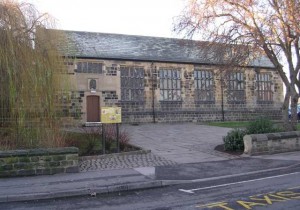
Cathedral School via Betty Longbottom, Wikipedia

Cathedral School via Betty Longbottom, Wikipedia

and his father was Joseph Day.  Violet on the other hand, was also of Gawthorpe and the daughter of Walter Topham.  Witnesses on that memorable day were John Richard Dickinson and Walter Topham.

Some of the questions have now been answered, but who was Harold before 1908?  The 1901 census can answer that one.  Wakefield Road, Soothill was the address give to the Day family in 1901.  We know that Joseph was Harold’s father – he was employed as a School Attendance Officer aged 60.  His wife was Clara, who was five years junior to her husband and Harold’s siblings living at home  were Sarah, Ezra and Charles.

Ten years earlier in 189, Joseph Day was a School Warden and his son  Harold was aged 9 and a scholar – ten years later he would be an assistant schoolmaster.

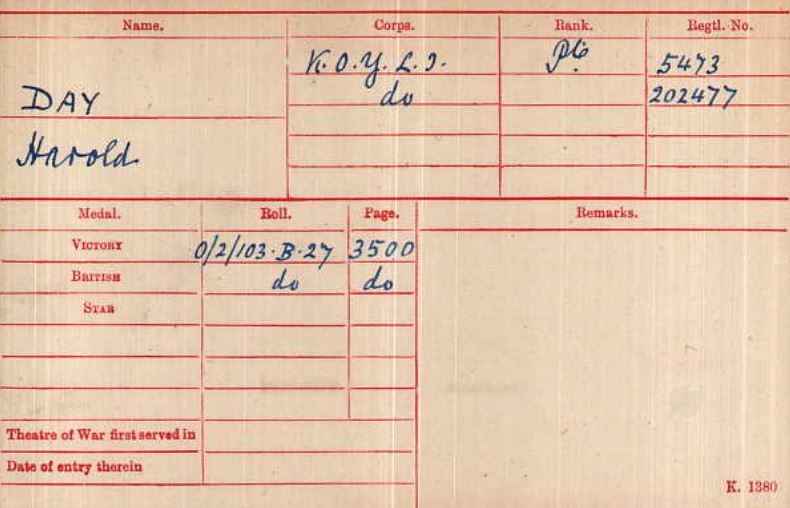
Harold Day's Medal Card via Ancestry.com

Harold Day’s Medal Card via Ancestry.com

Harold did join the army, becoming Pte., 5473, and later 202477 – according to his Medal Card. What happened next?  The Wakefield Express issue of 1st September 1917 may answer that one!

Cathedral Day School Teacher Killed – Private Harold Day, KOYLI, who was killed in action at August 10th, leaves a widow and a little son, who lived at Ellin’s Terrace, Sandal.  He attested under the Lord Derby Scheme, and was called up at the beginning of June, 1916.  He went into training at Clipstone and proceeded to France  in May.  Previous to joining up he was assistant master at the Cathedral Boys’ School, where he had been since 1906.  His death is a very great loss to the Cathedral Schools, for he was an excellent teacher, and had he lived he would have done well in his profession.  His death is very greatly regretted by the managers, teachers and scholars, who thought very highly of him.

Harold rests in Croisilles British Cemetery, Croisilles some 13 km south-east of Arras along with 1,170 other casualties of war, including 647 unidentified casualties, six Commonwealth airmen of the Second World War and 18 German war graves.

Violet, at home with their young son received £227 from Harold’s estate when Probate was completed in December 1917  and  would still be receiving money from the War Office until September of 1919, which came in 2 installments.

The Somme Remembered

The Somme Remembered

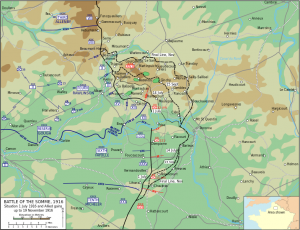
The Somme Remembered – during the month of July 100 years ago many servicemen, nurses and aid-workers lost their lives.

The Somme 1916 via Wikipedia

The Somme 1916 via Wikipedia

The First Day of the Battle of The Somme saw Commonwealth countries and the allies suffer over 650,000 being killed or wounded, while Germany had approximately 450,000 killed or wounded.  Such huge numbers for one day – imagine taking the populations of Liverpool and Edinburgh off the face of the earth!

What can Wakefield Family History Sharing do to mark this month?

31 days 31 casualties

The month of July will feature 31 casualties – servicemen, nurses, aid-workers who lost their lives in that month during World War 1.

Did one of your family, or  someone you know of die in July 1916?

Let Wakefield Family History Sharing know and their life and times could be featured in our The Somme Remembered month.

Use the contact form initially to show your interest or email    Somme (at) Wakefieldfhs.org.uk

The First Day of the Somme Imperial War Museums podcast

Top 100 Genealogy Websites of 2016

Top 100 Genealogy Websites of 2016

GenealogyInTime Magazine  have compiled a Top 100 for genealogy websites.

The fifth in the series of top 100 genealogy websites, includes many names we are familiar with, including Ancestry (various countries); Find My Past.co.uk; Rootschat; Forces War Records; Scotland’s People and Family Tree Maker to name just a few.  Also included are lesser known sites from Poland; USA; Canada; Norway; Germany, Ukraine and Spain.

The list, a very informative list  gives the name of the site.  What the site relates to for example, records, family trees, DNA, newspapers or search engines.  The list gives the name of the country that records relate to and if they are free or a fee is chargeable.  Last years ranking is also included, but most important is the URL or website address with a link direct to the site.

Follow the links below to have a look at the list – you may find something new!

top 10 genealogy website 2016 top 25 genealogy website 2016 top 50 genealogy website 2016 top 100 genealogy website 2016

Book Review – Shot from the Shadows by Mike Atherton

Book Review – Shot from the Shadows by Mike Atherton

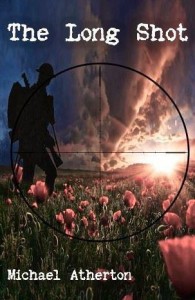
At a craft fair in 2014 I met Mike, who had a stand to promote his recently published book, The Long Shot.  As I have an interest in anything related to World War 1, especially the people who went to war, I bought a copy and Mike was kind enough to sign my copy.

The Long Shot by Mike Atherton

The Long Shot by Mike Atherton

The ‘Long Shot’ is set in WW1.  jack Adams and Jim Cunningham are friends and work as gamekeepers on an estate in Derbyshire.  One a natural shot  the other with an intuitive gift for observation.  The Great War has already started when a chance meeting with a serving officer on leave introduces them to a new kind of warfare, sniping. The Germans are already experts in this deadly game of marksmanship and the British are losing men at an alarming rate, something needs to be done urgently. Working as a team in the battlefields of France and Belgium the two men quickly make a name for themselves.

Jack becomes notorious, or heroic depending on which side you are on.  He is a wanted man, dead or alive. Circumstances and events lead Jack to be the hunted rather than the hunter and the man charged with hunting him is an older, and wiser German sniper named Albert, he too has a bounty on his head but this time by the British.

I found the book a thoroughly enjoyable read, as I was taken back to 1913 in Derbyshire, then later to the 1st of July 1916 and beyond.  Well done, Mike… when is the next one coming out?

The last question I can now answer, and the answer is, this month, March 2016.

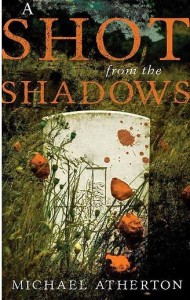
Shot from the Shadows by Mike Atherton

Shot from the Shadows by Mike Atherton

A Shot from the Shadows‘ see’s Albert Hagerman caught up in the dark world of political uncertainty in a demoralised and beaten Germany.   The Nazi party is in its infancy but it already shows signs of being a ruthless and murderous organisation.

In London people are noticing that the path to conflict is looking like it might become a highway for the great nations of Europe to be dragged into another war.  If it is to be avoided they must convince the main party, the Nazi party to toe the line.  To do this they have to convince its leader Adolf Hitler, and get him to see sense.  Jack Adams and Albert Hagerman are sent to collect him from the heartland of this new Nazi party.

Nobody expect it to be easy but the rewards are too important to leave any stone unturned, and any action to ensure the meeting take places is authorised.  In a modern day France an old Commonwealth War Grave collapses into a previously unknown bunker.  What the recovery team discover causes a ripple in the modern day.

Looking forward to another good read!

Follow the book title links to go to Mike’s shop and get hold of copies of his books.

FFHS Useful information 2016

FFHS Useful information 2016

The FFHS (Federation of Family History Societies) had issued ‘Our Really Useful Information Leaflet‘ and it is packed with useful hints, tips and over 180 societies  that cover the length and breadth of the UK and worldwide.

The on-line leaflet also has a long list of interesting and useful websites that could help with your research, add background information or just be of interest and be worth a visit.

If your family is from Britain or the Commonwealth? Were they a clergyman? Did they work on the railway or were they part of the military? Did they go to America, Canada or Australia? Or did they appear at the Old Bailey? Whatever they did or where they went during their lifetime you will find a website listed on this leaflet that will certainly be of help and aid your research.

As well as the useful websites, the leaflet has a section starting on page 6 giving useful hints and tips for those just taking the first steps into who the people in their family were.  From the ‘Where do I start?’ to the ‘What else can I expect to find out about my family?’

The 2016 leaflet has an informative section starting on page 16, focusing on Quarter Session Records in England and Wales – what a treasure trove of information is held within those records.  The records themselves survive in some counties from the 15th century and go up to 1972 when they were replaced by Crown Courts.

What can be found in the Quarter Sessions?  Crimes and felonies, Bastardy Orders (they can be very interesting), Settlements (who was moved from one parish to another and why), Apprenticeship Indentures, Matrimonial matters, Militia and much more.

If you are starting out in your research or have been researching for many years you will be sure to find something of help and interest within the 20 pages.

The Federation also publish ‘Our Australasian Really Useful Information Leaflet’, again packed with information relating to the area.  If you have family in Australia or New Zealand, it is worth having a browse.

The Federation’s newsletter, published six times a year is also packed with useful information and links – follow the link to subscribe.

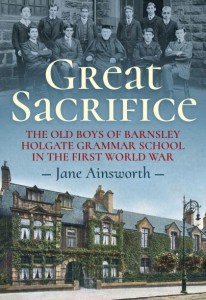
Great Sacrifice

Great Sacrifice – The Old Boys of Barnsley Holgate Grammar School in the First World War.

In the past few years there has been a influx on the book market, of commemorative books- remembering those who died as a result of conflict during WW1, battles and the military hierarchy.

Many seem to have hopped on the World War 1 bandwagon, while others, like myself, have been transcribing war memorials and researching soldiers for many years.

Another person who has had a long standing interest in The Great War, as it became known, is Jane Ainsworth.  Jane, like myself, has decided that the men of her home town should be the focus of her putting pen to paper or fingers to keyboard!  But neither of us are forgetting the women!

Great Sacrifice cover

Great Sacrifice cover

The Great Sacrifice focuses its attention on the 76 men, ‘old boys’, of Holgate Grammar School, Barnsley who went to war.

…...also included is a detailed history of the grammar school and extracts from the school’s magazine. Barnsley Holgate Grammar School was prestigious and its first headmaster, Reverend Charles Stokes Butler, was inspirational. The Old Boys felt a strong loyalty and affection for their school and this feeling was reciprocated by the teachers and other pupils. During the First World War, details of all those serving their country were recorded in the Old Boys’ Association magazine Alumnus, which was sent to men fighting at the front along with copies of the Barnsley Chronicle. Many of the men in the forces visited their old school when home on their precious leave and some contributed articles and letters about their experiences, which have been reproduced in this book. Determined to create a Memorial Book that was different from others Jane’s breadth of her research clearly demonstrates how she has achieved this. The men’s life stories are told in as much detail as possible, concentrating on their family and personal development as well as experiences during the war. It is important to remember that 42 additional brothers served and five of these died, as did three brothers-in-law. The invaluable contributions from Alumnus and many obituaries from newspapers allow us to get to know these men as real people. Jane’s aim is for these young men to be remembered as individuals, who could have achieved so much more if they had survived the sacrifice of their valuable lives for their country. Attending the Holgate encouraged the majority to go on to achieve their potential after school, with a lot becoming teachers. It instilled in them the values that led to early enlistment and rapid promotion in the forces. This is what united them – not the disparate “resting places” for their bodies, whether buried in a foreign grave or just a name on a War Memorial overseas. They were all much loved as sons, brothers, friends, colleagues, Old Boys of various educational establishments, husbands and fathers.

 Jane’s book is available in paperback from Helion & Company contains 408 pages with over 200 black and white and colour illustrations  is available from March 2016.     at a cost of £25.00 and an ISBN number of 9781911096085.

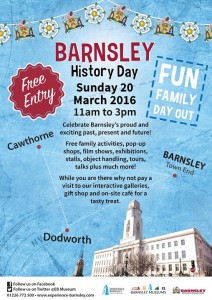
Great Sacrifice – The Old Boys of Barnsley Holgate Grammar School in the First World War is also available  at the book’s launch on Sunday the 20th of March, 11am – 3pm, in Barnsley Town Hall during Barnsley History Day, at an introductory price of £20.

Barnsley History Day 2016

Barnsley History Day 2016

Also during the day local groups will provide information about their projects.  Plus, three talks will be taking place during the day:- Vikings  in Yorkshire; The life of Maurice Dobson and Pre-Raphaelite links in Barnsley, with FREE entry, it looks like it could be an interesting event for those with a Barnsley connection.