Category Archives: General

WW1 casualty remembered in Golcar Parish Church

Over the past weeks, I’ve been doing a family tree for a friend and yesterday after threatening to go and visit the area and a local museum, off I went.  It was a nice day albeit a little nippy – my hands were feeling the chill while taking photographs in the churchyard…. but you carry on for the cause!

So, it’s 12:15 and the museum opens at 2pm and my plan was to photograph the family headstones in the churchyard and then cross the road to the museum that was once the home of the family I’m delving into – the Pearson family.  I’m not going to go into the family here as I still have to add some photographs etc., but that churchyard is a family tree in itself as many of the names on the headstones tie in with the Pearson tree.

I digress, as I said the Pearson people are not the aim of this blog, the true star of these lines is a young man named John T Gledhill.
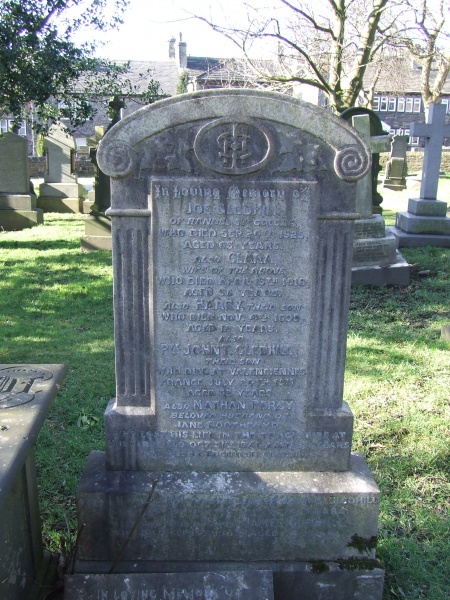
Gledhill headstone. Carol Sklinar 2012

Who was John Taylor Gledhill, well he was born the son of Joe and Clara Gledhill, and lived in 1901 at The Green, Golcar.  Joe was aged 43 in the census and worked as a woollen percher.  Clara nee Taylor was aged 43 and the mother of  3 children aged between 9 and 16 (Jane, James and John).   For those of you wishing to find the family in 1901 they have been transcribed as GLADHILL.

By the time of the 1911 census the family were living at 38 Knowl Bank, Golcar in a 5 roomed house.  The 3 children were still living at home and all working within the woollen industry, weaver, spinners and twisters.  The census tells that Clara had had in total 4 children but only three had survived to the census and the couple had been married 26 years (Sept Qtr 1885 in the Huddersfield Registration District).

John Taylor Gledhill joined the Northumberland Fusiliers in Huddersfield and became Pte., 290/706.  He was later transferred to the Prince of Wales’s Own (West Yorkshire Regt.,) 16th Battalion and changed his service number to 40858.  Soldiers at this time changed their service number when they changed Battalion or Regiment and Officers during this time had no service number.  During WW2 service men and women kept their number for the duration of service and now officers had service numbers.

The service records for John don’t seem to have survived but from Soldiers who Died in the Great War I have been able to glean that he Died on 24 July 1917 .  The Commonwealth War Graves Commission confirms his service number for the West Yorkshire Rgt. It also confirms his date of death but also tells us where he now rests – Valenciennes (St Roch) Communal Cemetery and the position within the cemetery, IV D 27 – relating to section, row and number within that row.  Each cemetery has a box within or near the entrance where you can find a plan to help pinpointing the grave.

Another source, The Medal Rolls Index told that John was eligible for the Victory and British Medals which would have been given to his next of kin.

John is recorded on the War Memorial inside the church and also on the St John’s School  Memorial, also in the church.
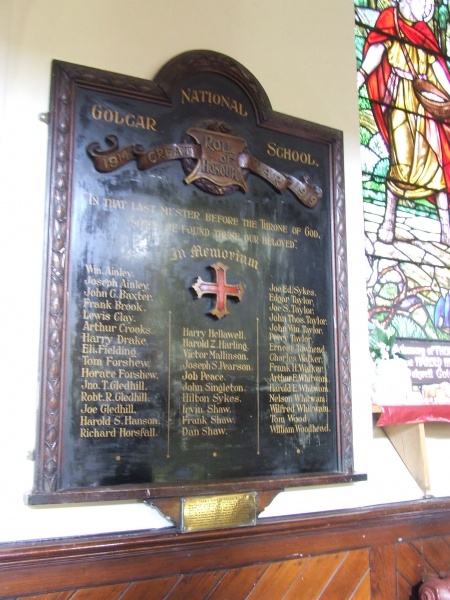
St John's School Memorial. Carol Sklinar 2012

What did John look like ? How tall was he ? Did he have any scars or tattoos ? With the lack of his service record I may never know. Has John ever had a visitor to his resting place in France and how many people have strayed from the path and wondered among the many headstones and learnt of Johns fate – in modern times probably not many. But today John will have his name written once more and many will now know of this young man from Golcar.

Lest we Forget
Non-Resident births in Wakefield

What do you know ?

Your family came from London, the South or the Channel Islands.  You know they had children during the period 1939 – 1945.  Can you find their birth registered in that area ?  No !

Carol Sklinar copyright 2007

I found out the other  day that during the early years of WW2 families, women and/or children were sent ‘up North’ for safety.  As a result of that Wakefield had its population artificially risen, this lead to a rise in the number of births in the region.

Walton Hall, a maternity home in the Wakefield area had a great number of extra births with the addresses of the parents being London, Birmingham, other areas in the South and ofcourse, those families who lived on the Channel Islands, the only part of Britain to be occupied by enemy forces.

If you can’t find the birth you are looking for try looking in a wider area as they could have been Registered in a Yorkshire town.

Find My Past ie

Create your Irish family tree with Find My Past.

You can now create your Irish family tree online thanks to the launch of Find My Pasts latest lauch.  So whether you are a beginner or an experienced genealogist their software can store all the names in your tree in one place and you can access this information from any computer.

As I have just said you can create your family tree with Find My Past i.e. but they have also just added to their ever growing cornucopia of information over 4 million, yes 4 million names from the Irish Prison Registers.

Click here to start building your Irish Family Tree

Or click on the logo to visit Find My Past ie

If your family is not from Ireland but the UK or Australia here are a few links for you. Both sites have a vast array of information from census (England and Wales), Religious records, Military, Directories + lots more – take a visit and find out how Find My Past could help you.

Above is a free trial for Find My Past with lots of UK records or click below to start building your UK Find My Past tree

And finally, click on the banner below to start or add to your Australian research.


Dunbarton War Memorial WWI & WWII

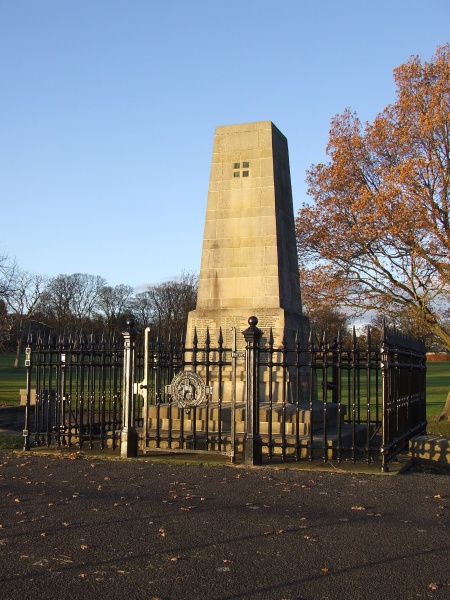
When we visited Dunbarton  a quick drive round the area only found the Dunbarton Memorial to those who died in the South African Campaign.  Well, it was an easy find as it was just outside the Town Hall, but I did have to get out of the car and do an ‘Anneka Rice’ impression before I found out it was not exactly what I was looking for, but a bonus.

After going inside the Town Hall and enquiring I eventually had directions to the memorial, but I must add the directions were not all that good!.  In the end I saidto my long suffering husband ‘just park the car and I’ll find it’ .

You would be surprised how many people use a park every day, walk past a large lump of stone with wrought iron fencing and don’t even know what it is – well, after having my website for over 12 years and doing the memorial transcriptions for about 8 or 9, I am not surprised, I am ashamed.

Dunbarton War Memorial by Carol Sklinar 2010

So starting with the South African Campaign Memorial, who is there ?

Peter Robert Denny, Capt., 1st Kings Dragoon Guards was killed on 24 April 1900.  Also mentioned is J M’Ghee, Pte 2101 in the Scottish Rifles.  He died at Spion Kop on 24 January 1900.   Just to name a few.

Now to the WW1 & 2 memorial.  This wonderful piece of stone stands in Lenongrove Park – close by the path that runs along the Clyde.  Although, this memorial and the South African Campaign memorial are not on my website yet, I thought I would give you a little of glimpse of what it to come……….soon!

For starters, I thought I would let you know about Pte Robert Mustarde – he served as Pte 202169.  Robert was born in Kirkintilloch and enlisted in Stirling, joining the HLI.  He is recorded as dying on 14 April 1917 at sea and is remembered on the Mikra Memorial, Greece.  Robert is more than likely 1 of over 5oo nurses, officers and men who were lost on transports and hospital ships in the Mediteranian.  Many were washed ashore, identified and buried in Thessalonika, others like Richard were not so lucky and a name on a memorial is there only memorial.

William Yuille, son of John and Catherine of 1 Beechwood Terrace, Dunbarton is also on the memorial.  He served s 43314 in the Royal Engineers.  He was born in Dunbarton, also enlisting in the town.  He was KIA on 7 December 1916 and rests in Bancourt British Cemetery near Bapaume.

Basil Withy, the son of Henry and Mary Forrest Withy of Brantford House, West Hartlepool. Henry was in the 1901 census listed as being a shipbuilder, by 1911 he is a widower and retired.  But on those census I can find no mention of Basil who was born in 1886 in Hartlepool – where was he?   Basil  served as a Lieutenant in The King’s ( Liverpool Regiment).  He Died of Wounds on 2 July 1916 and  rests in La Neuville British Cemetery, Corbie.  Henry, his father was granted Probate at Durham on 6 September with Basil’s effects adding up to £5049 15s 1d.     Note – there is an Ernest, son of Henry and Mary who is of a similar age, could this be Basil who is known to the family by a differant name……….does anyone know any different?

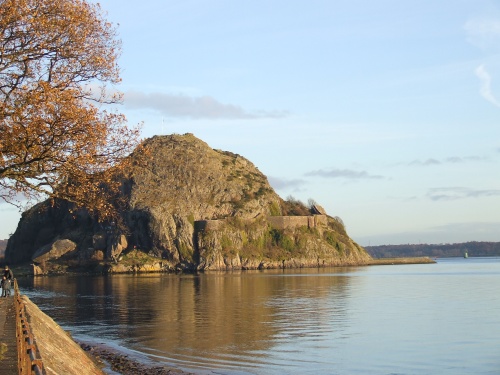
Just a few names and information to be going on with along with an image of the memorial and I could not let this posting go without leaving you with this view from just along the  path.

William Harold Ryder

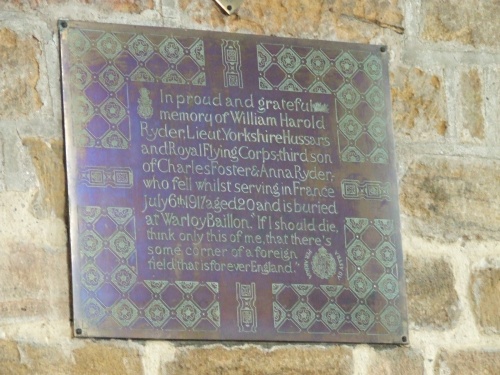
While writing a previous blog I remembered my visit to Bardsey Church a few years ago and while clicking through the pictures I took on that morning I found one, a photo of a memorial plaque.

What do we know about this young man from the plaque on the wall of the church?
He was called William Harold Ryder, the third son of Charles Foster and Anna Ryder. Now another question arises, who are they as there is also a memorial to them.

But back to William, he served during WW1 as a Lieutenant in the Royal Flying Corps and fell whilst serving in France on July 6th, 1917 aged 20 and rests in Warloy Baillon.

William’s memorial plaque C Sklinar 2007

The information on the memorial inside the church gives a good start to finding out more about William.

William, as we know, was the son of Charles Foster Ryder and his wife Anna. Anna died in 1907 and a memorial in the church informs all that Charles Foster had the church floor relaid to its original level in 1914 in memory of his wife.

Charles F Ryder married Anna Potter on 7th February 1888 at Christ Church, Lancaster Gate. Charles was aged 32, a bachelor of Chapel Allerton and the son of Charles Ryder a brewer. While his new wife was aged 25, a spinster with no occupation living at 48 Cleveland Square, the son of William Potter (decd.), a merchant. Witness to this joyful event were Anna(?) L Ross and W Henderson.

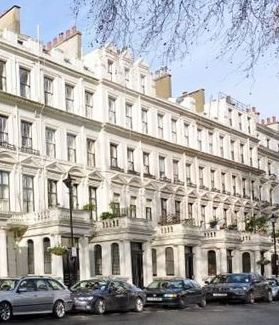
Cleveland Sq. (source unknown)

Anna, in the census of 1881 was living with her father, William and mother Agnes (both from Manchester) at 48 Cleveland Square, where William gave his occupation as that of East India Merchant. In the household were the parents, Anna and her brother and 7 servants.

In the census of 1901 Charles F, a brewer is living on Leeds Road, Scarcroft with his children – Daniel G aged 8, Agnes L aged 6 and Wm H aged 4, Rosamund aged 2 and Marion E Harrison a visitor – Anna is not with her husband in the census. But a search for Anna born in 1863 in Little Missenden, find an Anna Ryder living as married Head of The Hall, Little Thurlow, Suffolk. With Anna is Georgina M Bryant a 25 year old trained hospital nurse and other staff – could Anna have been sickly and lived in the country for her health?

By 1911 Charles is a Brewery Director, more than likely Tetley’s Brewery, and living at The Grange, Scarcroft. On the census for The Grange is Charles F, Agnes Louisa, Rosamund Daphne and 7 servants. The Grange was a 20 roomed property with 10 persons living within its walls. William now aged 14 was a boarder at Uppingham, one of Englands Public Schools. The school seeing many people pass through its doors who have now become well known including:- 5 Victoria Cross recipients; Richard Thorp, actor ; John Suchet, journalist and broadcaster ; Phil Spencer, property expert ; C R W Nevison, Official War Artist in both World Wars ; Sir Donald Campbell ; Sir Malcolm Campbell and William Henry Pratt aka Boris Karloff to name just a few.
William served in the RFC and his medal card states that he had served in the Yorks Hussars as a Lieutenant but there is no mention of any medals awarded in his name, but his date of death is recorded in the remarks section.

William died on 6 July 1917 and Probate was granted in London on June 8th, 1918, to Charles Foster Ryder, gentleman.

Find My Past – Irish and Australian sites

Find My Past has recently set up sites for Ireland and Australia with information specific to those countries.  Fantastic I hear you say, and yes I agree, but there is a BUT !  If you are an annual subscriber to FMP you would think that for an extra charge you would be given entry to those two sites – NO.

Unlike Ancestry, who for an extra charge or upgrade the world becomes your oyster and you can visit any section i.e.   ancestry.ca (Canada) ; ancestry.com (USA); ancestry.com.au ( Australia) and even ancestry.fr (France) to name a few.

120x60: I’m, your Nan

Ancestry                              FMP England                  FMP Ireland                         FMP Australia

So, after all which do I prefer ?  Well, to tell the truth I love Ancestry as I find the search easier especially for the census as I know where my rellies were born but not where they were living.  FMP likes you to put where your family were living…. come on how are you supposed to know where they went after they were born.  I have one family who moved after the birth of every child, and they didn’t just move around the corner they moved big time!

A birth certificate tells you where they were born but does not give you a crystal ball and tell you where they will be months or years later – I wish one came as standard !

Find My Past does or did have records that were stand alone to them and were very useful when I was transcribing naval records for war memorials.

So, if anyone at Brightsolid is reading this, just think about those of us whose families venture overseas or in the case of Australia came from overseas.  Twoor three memberships may not be an option but an upgrade could well be a possibility in these days where we have limited income to spend on things that we love!!

Men from Wakefield in Lijssenthoek CWGC

Resting in Lijssenthoek CWGC Military Cemetery are over 35 young men from the Wakefield area.  I know there names and in which section they rest but only two I know very well – one being my great uncle Herbert Siddle.  Herbert was 1 of 13 children born to Charles Siddle and his wife Emma Mills – Emma lost 3 of her children within months of their births.

The siddle family lived in the Kirkgate area of Wakefield, with cousins living just up the hill on Warrengate, Stanley Road and in the East Moor area.

Herbert was born in  Wakefield in the year 1892 and by 1911 he was a driller at the local boiler works, living with his parents, 4 siblings, a nephew and a niece, an uncle and a boarder on Hardy Croft, Wakefield – 11 people in a 5 roomed house.  I was brought up in that house and I can’t imagine how it would have been living in a house with a dining kitchen, front room, 2 double bedrooms and an attic.  It would have been so different from when I lived there with my parents.

Herbert enlisted in Wakefield, joining the KOYLI and becoming Pte 242874.  He had been wounded in the Somme and sent home to recuperate before being sent back to France and Belgium.  In April of 1918 he was in a trench and was shot in the neck.  Very quickly he was taken to a Dressing Station at Kemmel before becoming one of the many who are KIA.

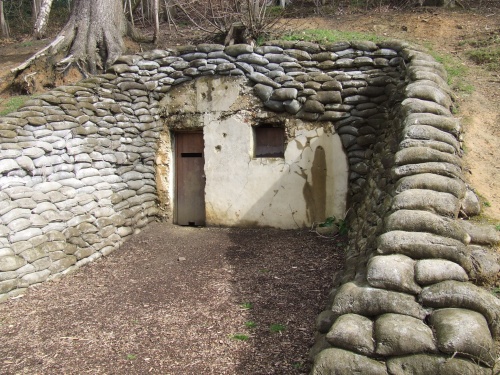
Kemmel Wood bunker copyright C Sklinar 2008

Mrs Siddle had 2 other sons serving in WW1, Claude served as 241166in the RFA; Edwin served as 268976 and had been in in the WRVAD Hospital – he had been awarded, along with his other service medals, the Silver War Badge which he would have worn on his lapel to show he had been injured out of service.

Coming forward many decades to the 1980’s my father and I often met and chatted with an old gentleman whom we met while shopping.  After not seeing him for many months I mentioned to dad that we’d not seen him in a while, to which I was informed that he had died.  The conversation went on about the gentleman only for it to be brought up that this man was next to or very near great uncle Herbert when he had been shot !!!  By the 80’s I’d already started the family tree and there are no words to describe how I felt at this moment – should I scream ‘Why did you not tell me?’, utter a few choice words or just throttle my dad.  The reply I got from a bemused father was ‘Well, didn’t think you’d be interested’, like hell!!

I could have throttled my dad but could give my great grandma a very big hug for she kept all the paperwork from the army, including an eye witness report from Sgt Greasby and the Red Cross along with a newspaper from the time with Herbert on the front page. The local paper tried to put a picture of the young men on the front page  when Wakefield lost a son, brother or father.

I have this about my Wakefield soldier but do you have a soldier from Wakefield or know anything about your Wakefield soldier who was KIA or DoW during WW1?  Please let me know.

Please contact me with information.

Imperial War Museum in the North

After trying to arrange a visit for a few weeks and work always getting in the way I finally got there!

Did I enjoy my visit ?  Was I disappointed ? Wait and see !

Firstly, the museum was reasonably easy to find and we only went twice around a roundabout once – I must add I was not driving and the front passenger did give good directions and in plenty of time – I say no more!

The car park was larger than I expected with enough pay machines BUT I was disappointed that people with a Blue Badge even had to ‘cough up’.  One thing I did like, but did not seem to be well advertised was a cabin, a wooden hut that gave change – a good idea.

The building seemed strange, not because it was modern and industrial but seemed lifeless, now was that a play on the subject within, I don’t know.  We entered via a large tower, at the time seemed pointless and a waste of space and money – we were peering through the slatted sides of the tower as we went in and it seemed one big void.  On entering we found it was basically a lift shaft to a viewing tower and a charge of £1.40 was made for the journey to stand over a chasm – not flippin’ likely!  Passed the lift ladies have their handbags searched, yes, for good reasons, but why only women and why only handbags?

Although the museum is free entry you are still funnelled via a ticket machine and a little persuasion is made to purchase a guide.  Ticket entry via a turnstile would be ideal, you would still get a ticket, they would still know how many people are in for fire regulations, you would not be badgered into buying a guide (unless you wanted one) and on exit you go through a similar turnstile – at the moment you are ticketed, counted on the way in, but there is no count on the way out – does not seem right when fire regulations come into it

Mini moan over, we entered the museum which is on the 1st floor.  Well, as we entered the first hall my companion and I decided the outside matched the inside – it was claustrophobic, even though the hall was very high, oppressive and depressing.  I’ve been in many military and war museums over the years and never felt this on entering.  Yes, war is a harsh subject but never have I felt this on entering a museum before, even a modern museum.

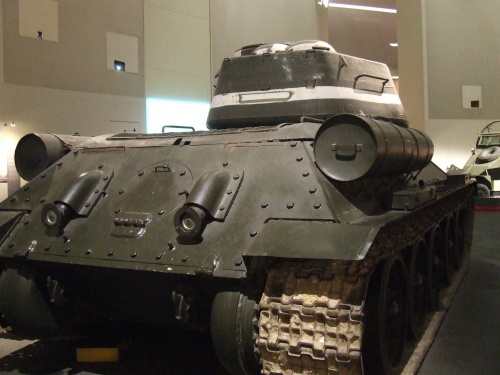
A Harrier Jump Jet was the first thing we saw, mounted in mid air – what a wonderful thing to greet you, they always seemed larger in flight.  The halls were very spacious, only the tank, a Trabbant, and other large displays on the floor – still leaving a very large amount of open floor space.  The main exhibits were in cabinets within the walls and for the amount of space there was not that many.

copyright C Sklinar 2011

The cabinets did hold some fascinating artifacts for example: – A souvenir In Loving Memory of the women and children killed in an air raid on London on June 13 1917, War Bonds and one or two cabinets dedicated to people with a definate story.  I’ll blog about those later. I was surprised that how much wall and floor space there was there did not seem a great deal of artifacts on display.  I could have spent time spelling what it was like in the trenches, what wet smelly socks smelt like or what a lot of men together for a long time with no where to wash or limited facilites also smelt like – that was one for the kids as were a lot of the displays.

While we were in the main hall a visual display started and the already dimly lit room went virtually dark apart from the illuminated images on the walls and the slide show.  If you only wanted to listen to the slide shows description, walking around without tripping over someone who was sat down or just standing around was a task.  The darkness also made reading any description in and around the displays a waste of time.  When the lights came back on it was done quite gradually.

The museums history of war started with WW1 and went up to the present, with a special display telling of the fantastic work that war correspondents do in time of conflict.  One of the displays in this section was for want of a better word a chart showing how many journalists from all over the world have had their lives taken by the very thing they wanted to tell the world about.

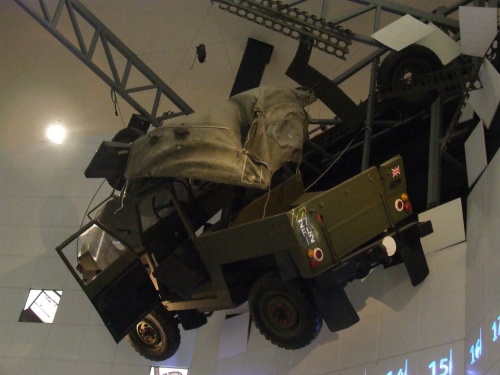
copyright C Sklinar 2011

Time to check out the café! Yes, it was lunchtime but the queues were reasonable apart from the picnic section and one lady with a hoard of children who could not make up their mind.  Overtaking them and going straight for the kill – coffee and cake, the prices were reasonable and the portions very good.  The pork lunch served with all the trimmings was very good value and looked fantastic.

Yes, I bought a book, again that information is in another blog, but I also bought two other items, but can’t tell you about those as they are ’stocking fillas’ for christmas.

The shop had the usual bits and bats for children and then some very nice memorabilia, gifts and some wonderful jewellery made from buttons in all shapes, sizes and colours – so unusual and very retro.  After this I, we, homed in on the WW1 books but we were both disappointed in the small display.  The sections for wars post WW1 was far better, but not really my or my companions main interest.

Would I go again to the Imperial War Museum in the North, I don’t think so; next time will venture to the original in London.

If you do wish to visit a wonderful place full of interest and packed with information, artifacts and displays that suit children, military personnel, veterans and those with an interest in all things military,  visit the Royal Armouries in Leeds.  On the various floors there are good displays from all over the world – from the UK to India and Japan , from times gone by to modern warfare and policing – go on pay it a visit.

To see information about the Imperial War Museum click here

To see information about the Royal Armouries, Leeds click here

To see information about the Royal Armouries, London click here

Queen Victoria’s youngest grandson

While reading my newest purchase – yes it has either family history or military connections I came across an entry for the following and found it quite interesting as years ago I transcribed Eton College War Memorials for no other reason than something to research and with a couple of family members who were KIA – I was hooked and as my family and friends know I can now spot a war memorial at a great distance !

So, who caught my interest this time?

Prince Maurice Victor Donald of Battenberg, was the son of Princess Beatrice and cousin to the Tsar and Kaiser.

Maurice was born in October of 1891 at Balmoral and was the first prince to be born in Scotland for nearly 300 years.

He served as a professional soldier in the KRRC – into which he was commissioned in 1910 and moved with his battalion France in August of 1914.  A few short months later there were only 10 of the original officers left.  On the 13th of October Prince Maurice was Mentioned in Despatches.  The battalion moved to near Zonnebeke and on the 27th of October, while leading his men forward he was killed by a shell burst.  During this time, his cousin, Prince Arthur of Connaught, was an ADC to Sir John French and he made every effort to attend his cousin at the dressing station – but was too late.   Kitchener suggested that he be brought ‘home’ but his family, mainly his mother, decided he should rest with his friends and his men and to this end Prince Arthur made the arrangements.

The family had a memorial service in the Chapel Royal attended by King Geore V and Queen Mary along with other members of the family, the Prime Minister and Lord Kitchener.  The Prince of Wales is reported to have said that he had found the names of many of his friends and fellow officers on casualty lists, including his cousin Prince Maurice, his equerry, Major Cadogan and two of his father’s equerries.  He is also reported to have said that he should not have a friend left soon.

The Prince’s elder brothers also fought in the war – Prince Alexander was invalided home with an injured knee and Prince Leopold, a platoon leader in the Grenadier Guards was hospitalised with a chill and he was sent home – according to some, this was not a bad thing.

Prince Maurice Victor Donald of Battenberg rests along with many others in Ypres Town CWGC Cemetery & Extension

To visit the Commonwealth War Graves Commission website click here

To visit Major and Mrs Holt’s Battlefield click here

To purchase any of Major and Mrs Holt’s Battlefield Guides visit Pen & Sword  click here

I-Tunes new addition – StreetMuseum Londinium

Free App, yes a free app.

This brand new app combines an ancient map of Rome with today’s modern London map, showing you what the city could have looked like over 2000 years ago.

Did you know The Roman Temple of Mithras stood just moments away from where Bank Tube station is now situated? Or that the Amphitheatre – used for gladiatorial games – was located near St. Paul’s Cathedral?

Unearth hidden artefacts, listen to the hustle and bustle of the city, and step back 2,000 years as augmented reality video presents scenes of Roman London against today’s modern backdrop.

Streetmuseum Londinium is available TODAY for iPhones and iPads and is free to download from the iTunes store – the link on the right hand side will take you directly to the i-tunes store.