Category Archives: General

Wakefield Institutions listed in 1911 census

Wakefield Institutions listed in 1911 census

While searching through the 1911 census using a place search of ‘Wakefield’ I came across the entries for a few institutions that were in existence at the time (one or two are still in use today).  In order of entry, the places were: Wakefield Prison, West Yorkshire Pauper Lunatic Asylum, The Workhouse at Eastmoor and finally in the consecutive list is Clayton Hospital.

One of the entries for Wakefield Prison caught my attention while scrolling through the pages looking at the various occupations of the inmates.  The occupations were wide and varied and included fishermen, employees at the various mills around the area, theatrical people, labourers, navvies, miners to name a few but one occupation that caught my attention was that of Policeman – what had this policeman done to be placed in the prison on Love Lane?  But the policeman John Huddart (?) is not who interested me but a 53-year-old widow named Bertram Mortimer.

From the 1911 census, there are a few things that are instantly known about Bertram.  As I’ve said he was 53 years old and a widower, what I have omitted was that he was born in New Orleans, USA and his occupation was Quack Doctor.  From knowing this information more questions arise.  When did he come to England?  Who was his wife?  Was she English or American?  What was he in Wakefield Prison for?  All burning questions for a family historian – whether it’s your family or not, you NEED to KNOW!

I needed to find out when Bertram came into the country but the census for 1901 England didn’t help.  On to the 1900 census for the United States, again no help with too many non-specific entries.  With the known information that he was in prison, perhaps the West Yorkshire Prison Records may help.  These records did help somewhat, Bertram had been convicted on the 16th (?) of June 1908 in Exeter for Four years for False Pretences.  He had served time in Dartmoor before ending up in Wakefield Prison.  At the end of his sentence, he was discharged, with one year and 34 days remaining,  under licence to go to London on 18th June 1912.  So far so good.

On the 6th of April 1908, Bertram is before the Swansea Borough Court.  The following week he appears before the Borough Sessions and convicted later that year for False Pretences – so this is further information about him ending up in Wakefield via Exeter and Dartmoor.  The documents tell that Bertram was aged 50 and worked as a Medical Specialist born in N. Orleans, U.S.A. So far so good or not so good in Bertrams case!

Still keeping with records I knew or hoped he would appear in I continued with prison records and eureka!  The Swansea and surrounding area Goal Records throw a bit more light on Bertram but I think a bit more light is an understatement, a lot more light is shed and this information has saved some time-wasting research.  His entry extracted from this Ancestry source tells –
BERTRAM MORTIMER, 15 months, Assizes, Bristol, 26th November 1907 (conspiring to procure a girl to have a carnal connection) as Wm Joseph Powell.
12 months, Assizes, Wells, 7th June 1899, (bigamy), as Wm. Joseph Powell.
5 Summary Convictions for assault and drunkenness
Since Committal:-
15 months, North London Sessions, 12th May 1908 (larceny and receiving).
4 Years penal servitude (concurrent with above) Devon Assizes, Exeter, 19th June 1908 (fraud)

Unlawfully obtaining by false pretences, the sum of £2 from William John Griffiths with intent to defraud on the 17th February 1908 at Swansea
Also unlawfully obtaining by false pretences the sum of £8 from Thomas Date, with intent to defraud on the 22nd February 1908, Swansea.

Bertram pleaded guilty to both of these charges and was sentenced to 6 calendar months hard labour to run concurrently with a sentence of 4 years penal servitude.  A little bit more about the life of Bertram is now known and other avenues of research can be followed.

This new snippet of information led me back to the Incoming Passenger Lists looking for a William Joseph Powell, nothing the same as before when looking for Bertram Mortimer.  OK, alter the search parameters and there he is Dr B J Powell aged 40 arriving at Southampton from
St Louis. Launched in 1894, served as a troop ship in WW1. Via Ancestry

New York, New York – probably so good that in the future it would be named twice……..ooops, sorry! Arriving on the St Louis on the 3rd of February 1898.  He wasn’t in the country long before he started to gain a name for himself.

After spending some time looking for a William Joseph Powell the 1880 census using various formats I decided to search for just the initials, W J Powell and came up with something that could be interesting.  W J Powell born about 1859 in Louisiana, son of B and S E Powell.  When just looking at the transcript I learnt that home for the family was Milan Street, Houston, Texas.  The head of the house was aged 48 and born in Scotland.  The wife was Tennessee born and W J  aged 21 had been born in Louisiana.  Other members of the family ranged in ages from 16 down to 3.  Could this be them?  I needed to see the original image.

The U.S.A. census pages are very long and don’t allow for much space between the words or even lines.  With a great deal of information being crammed onto a form – a greater number of columns that the UK census – but do more columns mean more useful information?

The Powell family are the last family on the page, continuing to the next for a few of the younger children.  Is there anything there that could confirm if this is the person mentioned in the UK documents.  Well, W J is there aged 21, single and employed as a clerk.  This is where things get interesting!  The head of the household, B Powell was a DOCTOR! Could this be the family of Bertram Mortimer / William Joseph Powell?  One thing that I found on this census was that his 16-year-old sister, Mary, was suffering from Malarial Fever on the day the census was taken – yes there is a column to include any illnesses being suffered by the people included in the census – how interesting is that?

All set to go back a further ten years in the U.S.A. census.  Would I find the family names entered as initials?  Or would names be entered in full?  In 1860 there is a J B Powell aged three, so far so good.  Here is the spanner in the works.  The head of the household according to the 1880 census should be B Powell, however in the 1860 census Lucas Powell aged 60 is listed.  One option is that Lucas is not a parent but grandparent.  The occupation of Doctor is consistent though.

What happened to W J Powell or Bertram Mortimer?  There is an entry in the Outward Passenger List for the UK where a Mr J B Mortimer, Gent, born around 1856, leaving Dover onboard Kroonland of the Red Star Line, bound for New York, U.S.A. Obviously from this side of the Atlantic, New York can’t be that good as we only named it once!  Is this the subject of this tale?  Who knows?  Or do you know any better?

At least how he ended up in Wakefield is known and more to the point why he ended up here!
Guest Blog – Barnsley Pals Colours Project Half-way up the Fundraising Mountain

BARNSLEY PALS COLOURS PROJECT HALF-WAY UP THE FUNDRAISING MOUNTAIN!

The Reverend Canon Stephen Race, Rector of St Mary’s Church, and Jane Ainsworth, Volunteer Co-ordinator of the Barnsley Pals Colours Project, are pleased to announce that they are now just over halfway towards their fundraising target to frame the two King’s Colours and conserve the 200 names on the First World War Memorial Pillar. This is thanks to the generosity of many individuals, groups and funders, most recently the approval of £5,000 from South Yorkshire Community Foundation (SYCF).

SYCF was founded in 1986 and has raised £28 million over the last 32 years to support voluntary and community groups in South Yorkshire. Their goal is to improve the lives of local people by helping those facing hardship and disadvantage as well as volunteers working to improve their local community. SYCF ‘connect people who care about South Yorkshire and have the means to invest in its future with the community groups striving to build stronger and healthier communities’. To date, they have supported more than 8,500 groups.

In the last five years, SYCF has awarded over £450,000 in 146 grant awards to community groups and charitable organisations working to improve local communities in Barnsley. In that time, reportedly over 200,000 people benefitted from the funding.

Jane explains: ‘As any individual or group who has been involved in fundraising knows it is hard work and very time consuming, however worthwhile the cause. Having recently returned from a holiday in the Cairngorms with mixed weather, I would compare it to climbing (by car) a mountain or even a mountain range in rain and shine!

When I became passionately interested in the Barnsley Pals Colours in 2016 and volunteered to find a way to ‘preserve’ them, I had no idea what effort this would involve. Last year, I increased my fundraising target by a third to just over £20,000 as I offered to include the cost of conserving the War Memorial Pillar and Plaques, because these and the Colours all honour Barnsley Pals.

I have suffered disappointment from rejections of applications, which feels like falling into the depths of a valley on a dull, wet day, and the joy of climbing up mountains of different heights in the sunshine as donations or grants come in. I appreciate all funding greatly and continue to publicise donors, most recently in my exhibition for the recent Heritage Open Days at St Mary’s.

I was advised by a member of staff at Barnsley Council earlier this year to contact Karen Walke at South Yorkshire Funding Advice Bureau (SYFAB) to discuss other possible sources of funds. I met Karen, who is very knowledgeable and helpful, and she suggested that I apply to SYCF. I also joined their mailing list to receive news about available grants for specific purposes and relevant training courses, two of which I have attended.

I am extremely grateful to SYCF for approving my application for £5,000 and paying this grant from their York and Lancaster Fund. Over the summer, I was successful in being granted £500 each from Cudworth, Kingstone, Penistone, St Helen’s and Stairfoot Ward Alliances, having applied to all of them in the absence of any central Council budget for projects that cover the whole borough. Mel Dyke (MBE being presented next month) made a very generous donation at the Commemoration with Procession on 2 June and Friendly Lodge 1513 added another £250 to their original donation from a raffle.

I had a very interesting and useful conversation with Melvyn Lunn, SYCF Trustee and Chair of the Barnsley Grants Panel, when he visited St Mary’s during our open days. He was keen to view the First World War Memorial Chapel, where my exhibition was set up, the two Colours and replicas. Melvyn was so impressed with the wealth of heritage, he agreed to become one of our Founder Friends of St Mary’s Church.

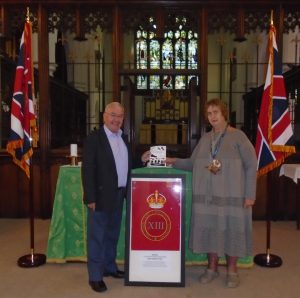
Melvyn & Jane

The photograph of us was taken holding a flier for the Royal British Legion Churchfield Branch’s Festival of Remembrance, which is returning to St Mary’s Church this year on Monday 7 November at 7pm. We are working closely together once again and my exhibition will be on display along with the replicas of the Colours etc’.

If anyone is interested in supporting this important First World War heritage project by making a donation or if you would like to join Friends of St Mary’s Church please contact 

                Jane Ainsworth at 45 Victoria Road, Barnsley, S70 2BU or janemaa@hotmail.co.uk.

Jane Ainsworth

Sugar Lane contd., Wilson family headstone

Wilson Family Headstone, Sugar Lane Cemetery

Extracted from an article I wrote a few years ago

Continuing my walk around Sugar Lane. By now Christmas has been and gone, as has the New Year celebrations, but there may still be the odd pantomime coming to the end of its season……….oh no it isn’t. Sorry!

I have been waiting for the right time to tell you about this headstone. The memorial, firstly remembers Frederick Wilson of Ipswich, who died in 1882 aged 29. Next on the ornate headstone is Cinderella Wilson, his wife, who died at Gosforth, Newcastle-on-Tyne, in August of 1891, when she was aged 32. Next comes Tobias, son of Dozer and Ada Shaw, dying in 1894 aged 8 months. Followed by Mark, Frederick and Cinderella’s son who died in 1899 aged 19.

We know who is remembered on the headstone, but who were they.

Frederick in 1881 was 30 years old and said he was born in Yarmouth, Norfolk. His occupation, he gave as a licensed hawker. Cinderella was aged 25 and born in Cambridge. Mark was born in London.

Cinderella had married Frederick in the early summer of 1879 in the Grantham area. Going back to the 1881 census, Cinderella’s parents Tobias and Priscilla Shaw and five children are adjacent entries. Tobias is also a licensed hawker and home for both families is a caravan in Fairfield (Macclesfield Old Road), Derbyshire.

Ten years later Cinderella is back living with her parents, now aged 30. Her age from the last census seems to be five years out. Three generations are living in caravans and what looks like on the census as a ‘lean to’ in Newington, Kingston-upon-Hull . Three of the eldest children aged from 23-30 and both parents are licensed hawkers. The family’s surname has been transcribed as Show.

Mark Wilson, was born on the 21st of January 1880 and baptised at St Lukes, Cheetham Hill, Manchester on the 4th of February 1880. Home being on Bignor Street, Manchester. Frederick in the register is Frederic and Cinderella has been transcribed as Cinderell.

Dozer and Ada (nee Bird), mentioned earlier, married in the winter of 1890 in the Prestwich area. 1901 comes around and Tobias is now a widow, living with his son and grandson. Next door is Dozer and Ada with three children, Sarah, Nellie and Flora, and a five-month-old boy. Next door is the Bird family and home for them all is a set of caravans on Didsbury Road, Heaton Norris and all three families are still earning a living working as licensed hawkers.

There is a death for a Dozer Shaw in 1902 but with a variation in age……..it could be him but who knows?

Going back to our ‘lead’ Cinders, what happened for her venture north to Newcastle-on-Tyne after the death of her husband?

With a little further digging as to why the headstone to the Wilson and Shaw family sits within the boundary walls of Sugar Lane, it appears that Frederick died in the Wakefield area. While Mark’s death is registered in the Ashton area, and Tobias Shaw’s death was registered in Leeds.

I seem to have been sent off on a tangent and poor Cinderella has been left behind and not gone to the ball! But at least some of her family had a bigger part in the pantomime.

Diary of a D-Day Veteran

Diary of a D-Day Veteran

Pte. Charles Wilkinson

Extracts from the 1944 diary of Charles Wilkinson, Despatch Rider, D-Day + 1 hour

Diary notes are in italics

1st June (British evacuated Crete 1941)
A good job pictures in camp or it would be awful having nothing to do, but still I suppose we would have made the best of it

2nd June (Battle of Mount Sorrel, 1916)
Left camp on slacks(?) as luck would have it Cynthia ***  ** as she was working in Winchester & did that make things worse, arrived at Camp 1.30 and walked again.

3rd June (Evacuation of British Army from Dunkirk completed, 1940)
Left camp to go to L.S.T. at docks Southampton and boarded boat 264, serial 2740, and it is miserable, nothing to do and a long time to do it in.

4th June
Rumours circulating, chat on board but no one knows what rumours are.

5th June

We sail today.  Destination unknown.  I suppose we will get to know as we sail on.  Briefing at 1600 hrs, but we have a good idea before we go.

6th June

D-Day today & What a day! Landed on  Cherbourg peninsular H+60 (minutes).  Lucky for us no enemy aircraft, the sea was enough, tore bottom off L.C.P. on ramp & no mines.

7th June (Battle of Messines began 1917)
First Battle at Cruelly.  Heading towards St Leger our final objective, going goo.  Lost 3 M10’s also we were shelled by Navy, hope never have same experience again. 8″ shells dropping 25 yards from us, awful experience. Lucky(?) pinned down by our own guns, after that straffed by typhoon.

DID YOU KNOW?  The D-Day landings had 18 operational squadrons of Typhoons 

8th June (British Advance into Syria began 1941)
Objective reached! After very stiff fight, at farm.  80 enemy took objective and dug-in.

9th June
Still dug-in having a rest – not much of that for me, as am continually travelling to “B” Ech (or Bch).

10th June (Italy declared War on Great Britain and France 1941n– Withdrawal of British Troops from Norway 1940)
Don’t feel much better after hold in line. 8 solid shots keep coming over, they are spent but still they make us duck.  Canadians are taking a bashing, over on left flank, mortar action went to aid & were pinned down with air bursts and spandau

Extracted from Wikipedia
“The MG 42 (shortened from German: Maschinengewehr 42, or “machine gun 42”) is a 7.92×57mm Mauser general-purpose machine gun designed in Nazi Germany and used extensively by the Wehrmacht and the Waffen-SS during the second half of World War II. It was intended to replace the earlier MG 34, which was more expensive and took much longer to produce, but both weapons were produced until the end of the war.”

11th June (Sunday)
Relieved the Canadians to attack strong point and it was strong.  Strong enough to beath the 7th GH *** but we weakened them a lot, withdrew to C.P. and dug in or tried to. M.G fire, too thick so we kipped in a gulley for night with my raincoat for a blanket.

13th June
Withdrew a little further back and did dig in and held the Hynie(?), cushy time except for occasional spandau spray.

14th June (Fall of Paris 1940)
relieved by 48th Div. & went to “B” Ech (or Bch) for a rest, but did not get much rest, as we were in front of 25 spandaus. and I am still running to “B” Ech (or Bch)

15th June (Battle of Piave began 1918)
Moving forward for an attack on strong point, kipping night in an old farm at Conde-sur-Seuelles and making contact in morning. Proceed 0500hrs.

16th June
Contacted him at 07:30hrs (enemy) and is he strong cannot advance down road at 88 reps.  continually firing down road and what a row it makes.  Digging in and having another go in morning.  R.E’s are going forward to draw Blockhouse which contains 88mm. Hope they succeed.

17th June
Attacked strong point and reached objective, but were beaten off with 6 Mark 6 after one tank had gone back for the night.  Lost I company and the C.O. all believe were taken prisoner. Withrew to old position and dug in.

19th June
Settling down, and finding out what we really did lose.  Jerry keeps shelling us with 105mm but does not do much damage.

20th June
Still dug in, and having it pretty easy for this Btn.  E. Yorks relieving us today.  We are reserve Batt. on flank.  We always get reserve Batt. when an attack is not going in.

21st June (French sign German Armistice Terms 1940 – Germany attack Russia 1941)
More digging on flank.  Browned off of it bit still is for the good.

22nd June
Still in reserve and start if the 10 vital days.  First to spring of T.T. Times of which I manage to get a copy for a souvenir.

23rd June
Feeling pretty hungry on compo(?) so we started to look for some spuds and we got some farm shelter, so we will be ok for quite a while.  2nd of 10 Vital Days!!

24th June (French sig Italian Armistice Terms 1940)
3rd of the 10 Vital Days and nothing much happened yet! Still in a defensive position with occasional air burst to liven things up, otherwise very quiet.

25th June
Relieved by Devons and took up move offensive positions near Boch, still quiet(?) our guns pummelling hell our of Jerry.

26th June
Still quiet and ongoing(?) plenty of firing with 3″.  Good job we use alternative position as we would probably be blown to hell out of it as he (enemy) occasionally shells some after we have moved on.

27th June
Browned off of compo so we had to look for some more food! and we found it  1 sheep slaughtered, cows milk & fresh butter and potatoes and now we are living like Lords.

28th June
Still the same

29th June
1000 tons of bombs dropped on enemy tanks, Panzer Division and not one tank was left after pocket firing.  Typhoons followed up with mopping up operations.

30th June (Channel Islands occupied by Germany 1940)
Quiet day.  Discovered girl who can speak English very good, but cannot visit her after as she is far away from camp.

1st July (Battle of Albert, 1916; Ypres 1917: Somme began 1916)
This area not much good for food, was looking at farms for some spuds & finally found them, and did we scoff.

2nd July
Nearing the end of our quiet position, as we take over from *** Battn. shortly and are they getting some shit.

3rd July (Naval Action at Oran 1940)
Ma**e bet (50F). Well not me my friend, that we would be relieved in fortnights time, but it looks as though we have had it, as we are taking **** for L.O.B and about means everyone (?)

4th July
Relieved fwd Batt. quiet day, but rowdy night.  Does he (the enemy) like to lob his 108mm over.  Good job it is only occasional ones that drop in Batt area or we would be wiped out now.

5th July
Quiet day except for 1 or 2 shells one of which was dud and lane within 25* of MPHQ.  Awful night shells and spandau.  The spandau cutting the grass.  Luckily we are dug in.

6th July
Very tired after nights experience which lasted until 03:30 and we covered OM stand too at 04:3..  12:30 was told I was going LOB for 48 hours on M/C

7th July
LOB. What a place, lovely and quiet except for our own guns firing over our heads. Went to Bayeux for bath, and bought some cheese and it was smashing.  Went to TT concert party and came home and ate part of cheese with some hard tack.

8th July
Returned to Batt, feeling none the better for 48 hours LOB to top things off was put on guard and lucky for us the shells that were dropping were falling well forward in front of PB

9th July
Started using his (enemy) guns, 210’s but they were well behind our own RA.

10th July
Relieved by DLI .  We return to their pos.  Still quiet.

11th July
Nothing much doing.  I think that both sides are B.O.

12th July
Big attack on Caen coming off as barrage on flank is tremendous.

13th July
Took over 5 EY positions in one of old areas, but more quiet this time than before.  It looks as though it has been very rough as the hills are bare.

14th July
Occasionally retired to slit as 105 & moaning Minnies were sent over, but did very little damage, only to crops.

15th July (Battle of Delville Wood 1916)
Clashed by armoured car all down left side and taken to 3ccs and from there to MDS and then to 20 GH where I was 40 hours.

Charlie crashed into the German armoured car which was lost inside our lines, while a despatch rider – no one in the German vehicle lived.

16th July 
What a life at 20 Gen.  I am all pains with laying on stretcher.  I don’t feel a little bit hungry.

17th July
Was prepared to go to beaches early on and what a redect(?) was. Have made some good friends, both in Navy and Army.

18th July
Boarded LST at 15:30 and sailing 21:00. But missed convoy and had to wait while tomorrow before sailing.

19th July
Lifted anchor 0900hrs but moving fret fog and had to drop it (anchor), finally got moving at 13:30 and arrived Pompy at 22:30.

20th July
01:30 Ambulance train and it was a good journey to Woking.  When it was about 06:30 were taken off and put in an ambulance to be taken to EMS for treatment.  It’s a lovely place, nice and quiet & miles away from anything.

21st July
Still laying in bed & I am B.O, as anything on bottom of my back with forever laying on it, would b a little better if I could roll over to change position but can’t with leg being in plaster.

Charlies diary continues – he gets to know his fellow patients, the staff and has a visit from his sister who brings a parcel from the family.
He gradually starts to walk and in September, after pay day, is given a 4 day Royal Warrant.  He does not say where he goes but he does record in his diary that he has a slight accident which results in him being put back to bed. After examination the following day he is prepped for theatre.  By the end of the month he is discharged, but still in hospital as his diary tells he was promoted to Ward Seargent as all N.C.O’s have gone.

By December he is out of hospital and in Nottingham, where on the 30th of December 1944 he writes:

Dance, and got acquainted with one of the lovelist girls I ever saw.  Her name is Betty.

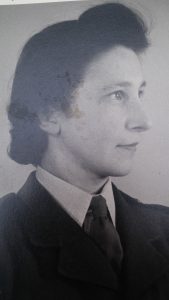
Cpl Elizabeth Ann Riach

Cpl Elizabeth Ann Riach

The following day, the 31st, he wrote that he’d been to the pictures with Betty, and then ‘sat out the old year nice and quiet ’round a lovely warm fire’.

He wrote in the memo section Pte Reach (spelt incorrectly) 12 Sect V, HPC, Notts.

Betty was my mum, Cpl. Elizabeth Anne Riach, who he married in 1952 in The Tower Hotel, Elgin, Morayshire.  The couple made Wakefield their home.

Elizabeth, known in Scotland as Lizzie and in Wakefield as Ann, died in 1982.

Charles then joined many veteran associations, becoming a committee member to many,  including The Normandy Campaign Association, The Normandy Veterans Association, The Eighth Army, The Royal Engineers, The Combined Services and many other associations.  He was also the President of the Royal British Legion in Wakefield and for over 25 years was the sole poppy organiser for the city.  He was known as ‘The Poppy Man’.

He also, with other veterans and friends attended many of the Normandy reunions.  Charles was also guest of honour onboard HMS Ark Royal when he was presented with a cheque.

As D-Day 1 veteran he attended a Garden party at Buckingham Palace along with three other Normandy Veteran Association, Leeds 61 Branch members.

When he died in 2008 his coffin was draped in the Funeral drape of the Royal Engineers and the Union flag.  His beret sat on the Normandy Association cushion along with his medals.  His branch Presidents Jewel was was draped around his beret and medals.  His funeral service was in Wakefield and was well attended with representatives of many ex-service people, friends and family.  The Mayor and Mayoress of Wakefield attended in an unofficial capacity and the Police sent a representative.  It was a day he would have been proud of especially when the Normandy March was played.

His family received letters of condolence from the Mayor, the Police, the Royal Engineers and the British Legion to name a few.

He was a generous, kind, helpful and considerate man who was well thought of by many but most of all he was my dad.

Guest Blogger – Jane Ainsworth – Barnsley Pals Colours Project

Guest Blogger – Jane Ainsworth – Barnsley Pals Colours Project

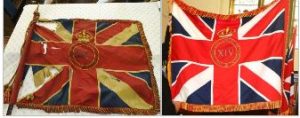
Barnsley Pals Colours before and after conservation

I am the volunteer co-ordinator of this ongoing project and I am liaising very closely with Reverend Canon Stephen Race and the PCC for St Mary’s Church in the centre of Barnsley where the King’s Colours are laid up.

In November 2016, Conservators inspected the two Colours to report on their condition and take photos, which were used last year to commission replica flags. The replicas were blessed in a special service for the Armistice Centenary. They are being used by us on 2 June and this year’s Remembrance. They will also be on display for the Heritage Open Days as St Mary’s is participating this September for the first time.

We are willing to lend them to groups and organizations for relevant events free of charge. I have produced an agreement for this as the York and Lancaster Regiment Association borrowed them for their Commemoration on 12 May when they donated two special benches at Silverwood Scout Camp (originally Newhall Camp where the Barnsley Pals were billeted and trained).

We hope to produce an educational pack for schools to borrow them at a later stage but will need to find someone interested with the appropriate skills and experience in addition to fundraising to pay for it.

My research into the history of the Colours was published at the end of last year in a 50 page booklet with lots of old photos, designed and printed by Pen and Sword to support our project. Copies cost £5 and I am donating all proceeds to this project. (Copies are available from Sheffield Cathedral shop, Clifton Park Museum shop in Rotherham, Experience Barnsley shop, various other outlets in the Barnsley area and myself. Booklets can be posted @ £2 for post and packing).

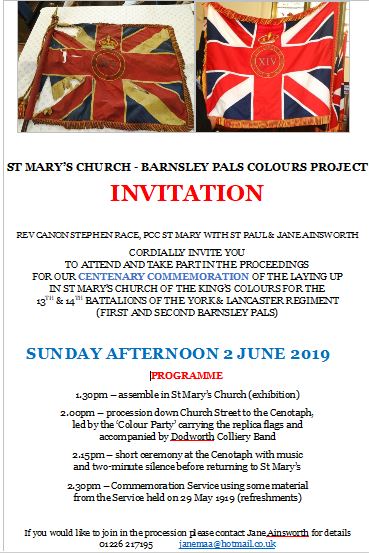
Barnsley Pals Project Invitation

We are currently fundraising to frame the two King’s Colours and relocate them back to the War Memorial Chapel were originally laid up, with proper interpretation. (We have permission from the MoD to do this). We also need to conserve the six panels listing 200 men (and one woman – the only one on a WW1 Memorial in Barnsley I am aware of) on the impressive War Memorial Pillar as some of the names have almost worn off.

As and when all the necessary funding is in place and the work is completed, we will hold another special event. I’ve submitted some applications for grants but if other individuals or groups are interested in making a donation this would be most welcome and they can contact me for details.

St Mary’s Church will be open this year for the first time for some of the Heritage Open Days.

Lissentheok – in search of Riach’s

Lissentheok – in search of Riach’s

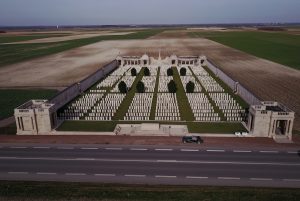
On a recent visit to Lijssenthoek CWGC Military Cemetery, with two purposes in mind, I went on the hunt for two Riach headstones, and I went off on a tangent, yet again!

My first stop, as usual, was the small room where the Roll for those who rest within the cemetery walls is kept along with the visitor’s book. I already had the grave references, but I needed to photograph the cemetery plan so I could go directly to the two headstones in question – Nigel Stewart Riach (I’ve blogged about him before but the photograph of his headstone was added information) and a C Riach.

http://www.lijssenthoek.be/index.php

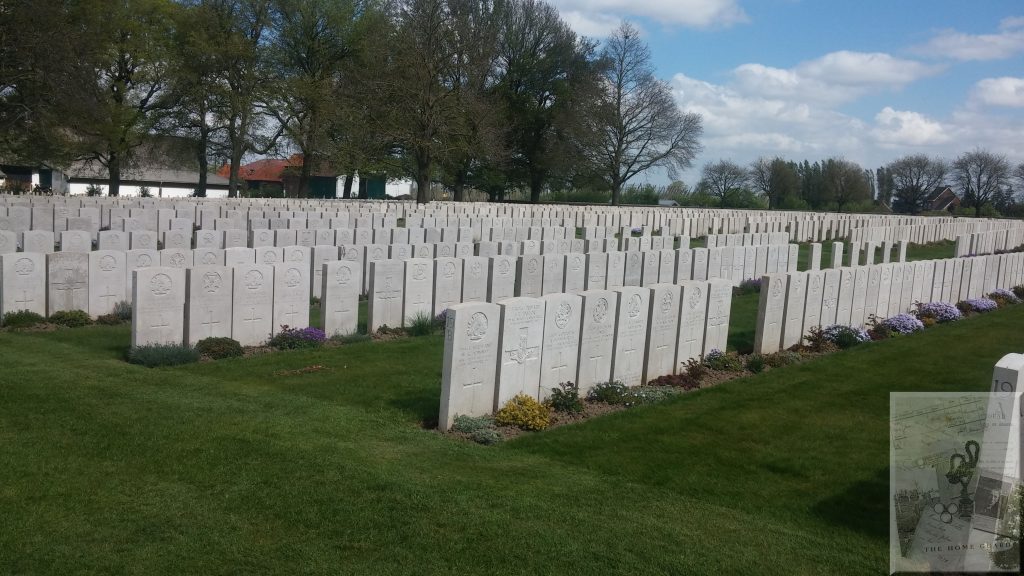
Lijssenthoek Military Cemetery © C Sklnar April 2019

That particular morning, it was a bright sunny Belgium day and I was the only living person among over 10,000 who had given their lives in conflict – from many nations they are all equal in death.

I quickly found Nigel Stewart Riach and C Riach. The two Riach’s were located in adjacent sections, XXV and XX1V – not that far apart really.

I’ve already told you about Nigel Stewart Riach and now it’s C Riach’s turn.

C Riach headstone Lijssenthoek CWGC © C Sklinar April 2019

C Riach headstone Lijssenthoek CWGC © C Sklinar April 2019

C Riach, was known to his family as Charles. He had married Mary Shield, the couple lived at 17 Barr Street, Glasgow. Charles joined the Royal Field Artillery in Glasgow and became Driver 7219 and entered France in July 1915.

As part of ‘C; Battery, 64th Brigade, he served until he died at no. 10 CCS (Casualty Clearing Station) on the 30th of September 1917 aged 25.

Charles, as he was serving in France in 1915, was eligible for the 1915 Star, along with the Victory and British Medals.

His widow, Mary later remarried and became known as Mary Wilson, as can be seen from documents and from the CWGC entry for Charles.

At the base of Charles’ headstone are the words “He is Gone but Not Forgotten”.

Sayles Family Postcards – who are they?

Sayles Family Postcards – who are they?

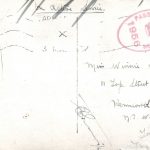
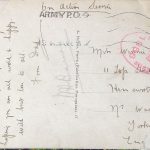
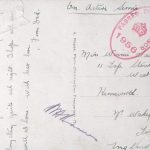
At a recent meeting of local family history society, I was shown a set of three WW1 postcards. During the society notices the postcards were mentioned as they had a local connection – did anyone know the family or the surname? No one came forward. In the likely hood that no one came forward I had already I volunteered myself the task of finding who the people were – the sender and the recipient.

Each of the hand coloured postcards portrayed pretty young girls in various seated poses, each one held or had a posy of flowers. The 100-year-old cards were nice but what was written on the back was even more interesting, well it was to me.

After leaving the cards alone for a few days I sat down with them and with a couple of minutes I had the family in 1911. A few minutes later I had the service and pension records of the father of the family.

Who were these people found in records over 100 years later? They were Winnie Sayles and her father Ernest who sent the cards to his daughter while he was in France during March of 1917.

Ernest had been born in 1885 in Kirk Smeaton, Yorkshire, the son of William and Annie. In 1891 the family were living at Cistern Cottage, Hemsworth, where William aged 28 worked as a railway platelayer. Ten years later, their home was now on Sand Hill Terrace, Hemsworth where a young Ernest was a chemists’ apprentice.

In the winter of 1906, Ernest married a young lady named Sarah Briggs and the following year their daughter Winnie was born. A few years later the family were living with Ernest’s parents and a lodger, William Wilson, at 11 Top Street, Hemsworth, the address to where the postcards were sent and my initial find with the 1911 census. Ernest was now working as a cycle repairer, probably as an agent for a larger company.

The years passed and on the 11th of August 1916, Ernest, now aged 31and a mechanic and dealer Attested to the ASC (Army Service Corps) and became Private, M2/201741. He did seem to be a bit picky on where he served as question 9 Are you willing to be enlisted for General Service? Ernest answered Yes, with Motor and Mechanical Transport. Not sure if that went down too well with the recruiting officer as after Yes, has been struck through. There are only three pages of Ernest’s service record but they do give quite a bit of information.

Firstly, information as to his address of 55 Doncaster Road, Goldthorpe, Rotherham. His wife is named along with her maiden name and the date of their wedding – 21st November 1906 in Hemsworth Catholic Church, Next are his children and their place and dates of birth – Winnifred Annie, 31st October 1907; Agnes, 23rd June 1911 and William Edward 13th October 1914.

When Ernest wet to France in September 1916, life carried on for his family. Ernest was in the Motor Transport Depot, Calais and it seems possible that the three postcards to his daughter Winnie were sent from thereabouts

The postcards are dated, even though the date stamp is very faint, between the 3rd of March and the 18th of March. The day following his last postcard Ernest is reclassified as a Technical Storekeeper and on the 11th of January the following year Ernest is ‘Discharged, No longer physically fit for war service para 392 (XVI) KR.

Following Ernest’s discharge, curiosity leads me to wonder why and thankfully there are pension records surviving that can answer that question. There are 13 pages of these records and they include much of the information a service record would, however, this set of records contain much more. They are not in date order so I will go through page by page and pass on information about the father of our family.

The Pension Record Card for Ernest gives a name; date of birth; rank, regiment and service number – which is expected; date of examination; details along with invaliding disability and degree of disablement plus a short medical report. All very interesting headings but the information contained under those headings answers some questions. Ernest was medically examined and was given the diagnosis of Dilation of Myocardium in December 1916 and given a 20% disability. He had been also examined in France – Dyphoera (?) and Palpitations. The card continues with examinations taking place in Sheffield, Barnsley and Wakefield. Ernest complained of shortness of breath, sleeplessness but overall was well nourished. Although the medical examiners writing is quite technical there are some words that can be understood, including – intermittent and irregular sounds, becoming very faint, ‘has a large hypertrophied heart and definite aortic sclerosis’ when talking about Ernest’s heart.

As I’ve already said Ernest’s medical history started in France in December 1916 which was noted in a Medical Board Examination in December 1917 wrote ‘Not the result of but aggravated by military service, overstrain and hard work. Impossible to state if permanent.’ Ernest’s time in France lasted less than 12 months (6 September 1916 to 31 May 1917), having served at home from 9 Aug 1916 to 5 September 1916.

Ernest was discharged from Woolwich Dockyard on the 11th of January 1918 aged 33 years and 6 months old. Whoever completed the form included the wrong age for him and it was struck through. He was 5′ 8” tall and a fully expanded chest of 35½”. He had a fair complexion, grey eyes, light brown hair and had three moles on his back and had a good character.

The Medical History for our soldier seems to have made him shrink ½”. Added details include that he weighed 125lbs and the moles were between his shoulder blades. He also had two vaccination marks. This document also includes Ernest’s birth parish – Kirk Smeaton.

Although these Pension papers are not in any order and while writing I feel his life is a little disjointed I do hope that the information is of interest. One more printed sheet tells that in May to July of 1917 he was in Tooting Military his with abscess of lids – Patient was admitted with boils on neck which resulted in complications. As we already know, Ernest left France in May of 1917 – the day he was admitted to Tooting Military Hospital, which was were, after his medical complications, his heart problems were discovered.

And it was that Ernest left the army with a Conditional disability and was given a 24/- pension plus 14/1 for two children – what had happened to the third child he had previously been given a small pension for? His degree of disability going from 20% to 60% in 1922.

An SWB (Silver War Badge) number 315,128 had been issued to Ernest when he had been discharged due to sickness (KR 392 (xvi) 2 (b) I). This document gave his date of enlistment as 12 December 1915, which contradicts his date of Attesting in August 1916.

Did Ernest and Sarah live long enough to be recorded in the 1939 Register? Yes, they did! 6 Parkhill Avenue, in the Dearne Urban District was where the family called home. Ernest confirmed by his date of birth, 29th June 1884 was a Public Assistance Clerk; Sarah, born on the 22nd November 1882 was UDD (Unpaid domestic Duties) and William Ed. Born on 13th October 1914 was the only other visible entry – the other three being officially closed.

Winnie, the recipient of the postcards married Edward Gray in early 1940 in the Doncaster Registration District.

Sarah, Ernest’s wife died on the 14th of January 1955, a day that has special significance for my family. Don’t you find that in family history there are many coincidences, some stranger than others?

Ernest died in 1967.

Does anyone know this family?

From George Street to Upper Kirkgate

From George Street to Upper Kirkgate

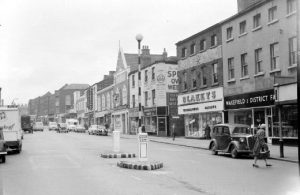
In 1967 a friend of my father, a Mr R G Pearson or Pawson made a list of the shops on Kirkgate from

Kirkgate – opposite side of the road copyright info

the junction with George Street to the junction of Upper Kirkgate.  I found the names shop titles fascinating and evoked wonderful memories of the area.

“Demolition work commenced in Kirkgate from George Street to the corner of Upper Kirkgate, (on the west side) in mid-September 1967.

Prior to this when George Street was widened the corner shop of Kirkgate and George Street, was that of Mr Fred Wood, the Sadder, this was demolished, and it was thought to be the only Sadlers shop in the country to have a Wind and Spirit Licence.  

Also demolished was the Music Shop of Mr Arthur Webster, (Piano’s etc.,) 

Therefore when demolition started in September 1967 the following is a list of premises affected from the corner of George Street:- The British Oak, a public house; Sammy Herbert’s Fish and Chip Shop; Wakefield Radio Co.; The Spinning Wheel, Wool Shop; Hoffman, Confectioners; The Wool King – then an entry into the car park, with a Police Box on the corner (This entry was made by demolishing two shops). Then Malcolm’s Flower Shop; Wormald’s Butchers; Progress Butchers – then a passage.  Halford’s Cycle Shop; The Criterion, public house.  Then an entrance into a yard.  Scarr’s Hardware Shop; Morton’s Post Office; Dewhirst Butchers; The Double Six, public house; Kay’s, gents outfitters; King’s, gents outfitters; Hilton’s, boot and shoe shop; Cavendish Furniture shop (Once Jackson’s Arcade). Another shop occupied by Halford’s (after they left their shop previously mentioned.  The Army Stores, and before that Isherwood’s Radio and Television.  Entrance to a yard.  Timothy White’s, chemist; Leicester and Kettering, boot and shoe shop.  Pickles, gents tailors.  Then Kirkgate Corner.”

So many memories, On a Saturday after shopping it was occasionally fish and chips from Sammy Herbert’s.

One of my school friends lived at the Criterion public house which was run by her parents.  Inside the place was a rabbit warren of rooms, you could easily get lost.  I also remember the man from Wakefield Radio, he had a very large German Shepherd dog who I seem to remember sat a great deal of time in the entrance of the shop.  Timothy White’s and Scarr’s are also vivid in my memory, as is a gents shop, I remember going there with my father – something to do with the fact they would order military blazer badges and re-ribbon medals.

Fred Stringer, or is he?

Who is Fred Stringer, you may ask? Why is he deserving of a page in my ramblings?

Fred has been mentioned before. Where? In my previous blog about Arthur Moorhouse. Remember near the end I said I would tell about ‘Betty and Fred’. It seems their time has come!

Starting from where my interest in Fred began while looking for a Service or Pension record for Arthur Moorhouse, his brother,  I came across an entry for ‘Arthur Moorhouse, Wakefield, brother’. Could this be the Arthur I was looking for, well yes it was, but in the wrong context – I wanted a soldier, not a brother. But saying that, and after a little diversion from Arthur I found something just as interesting – his brothers Pension Record – a bonus and interesting.

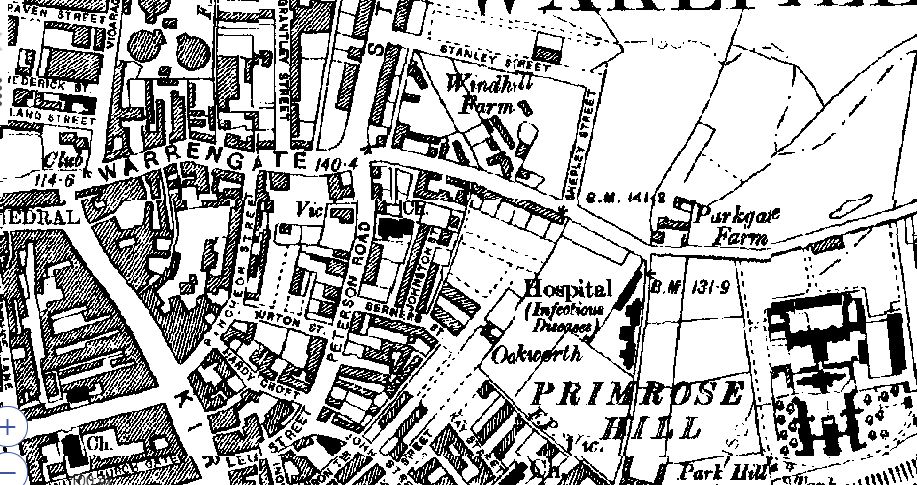
Warrengate area via Wakefield MDC

The record set opened and told me Fred’s relatives – his mother was Betty Moorhouse of 23 Warrengate, Wakefield. His elder brother was William of Briggs Yard, Northgate, Wakefield and two younger brothers, Arthur (we know of) and Ezekiel, both of Warrengate. This family were all mentioned in Arthur’s section and confirmed in census records.

Fred’s Pension Records – Fred Stringer of Ossett near the town of Leeds, according to his Attestation – don’t start me on that one! Was nearly 21 when he signed before a local magistrate in Leeds in November 1911 and on the same day he was determined to be fit for the Army.

Have you noticed the name difference? Fred is a Stringer, while his mother is Moorhouse. Fred seems to have changed his name as on his and his siblings’ baptism records he is the son of a single woman, Betty Moorhouse. Anyway, back to Fred’s Pension Records.

Fred 5ft 6½ in I height weighed 154lbs. He had a 37½ chest which included a 7-inch expansion – seems quite large compared to other records I’ve seen but could be an error or bad writing on behalf of the medical staff. His complexion was fresh, he had blue eyes and fair hair and gave his religion of C of E. Fred had a scar on his scalp, a mole on his right forearm and one on his left shoulder. His pulse was recorded as 80, you don’t see that mentioned a lot in records. So, Fred Private 7721 was in the Hussars.

It looks like Fred’s service got off to a bumpy start, as after being in the army only three weeks, he is in the Guard Detention Room from the 23rd of November to the 20th of December (given 28 days and loss of pay until he made good the sum of £1 12s 11d in respect of his kit). All former service was forfeited. Service not allowed to reckon. His service began again on the 15th of December 2011.

Fred was posted to the 18th Hussars on the 15th of March, 1912 BUT the day before, the 14th, he is ‘Declared a Deserter’. Towards the end of April, he was given 35 days for being ‘Absence without Leave, making the Detention Barracks his home once more. .

Working through his service records in order and not always in date order, he gave his next of kin as his sister Jane Reed of 20 Vicarage Street, Wakefield.  Jane Reed answers another question posed in Arthur Moorhouse’ entry – who was the Reed who completed the 1911 census for Betty and her family – seems that one is now answered, could it be her son in law?

While looking through this recordset I have been wondering why Fred joined the services in the first place. He was posted again in May 1912 and by the 6th of the following month was absent again. He was in custody by the 15th of June. In July he was tried by DCM and sentenced to ’84 days and to be discharged with **ming for (i) Deserting his Majesty’s Service (ii) When a prisoner in confinement attempting to escape. The sentence has bee confirmed by GOC 2nd Cav Bde. who raises the sentence to read ‘To **dey detention for 84 days’ All forms forfeited on conviction desertion’. And so it goes on – Detention; Absent; Stop Pay; Disrespect for uniform.

And so it was on the 25th of May 1914 he was Discharged for Misconduct under paragraph 392 (xi) Kings Regulations. Fred’s Application for Discharge confirm his age and height but also include the reasons for discharge with his character being marked as BAD. A footnote told ‘I do not know whether this man misconducted himself with a view to discharge but I have no reason to suppose so’. Signed by C H Corbett, Major at Tidworth.

The plot thickens as on the 10th of November 1910 Fred Moorhouse Attested in Wakefield, joining the Royal Artillery as 62880. And so on to his description – 5ft 6½ inches in height. Weight 152 lbs. . He had a 39-inch chest with a 4 in expansion. With a fresh complexion, grey eyes, light brown hair he told his religion was C of E. He had a pulse rate of 70 and still had a scar on the back of his head. Again he was found to be fit to join the Royal Regiment of Artillery in Halifax.

He was given the rank of a driver and posted on 27th of November 1911. By the 11th of June 1911, he had deserted at Newbridge.

The next few lines tell ‘Fraudulently enlisted into Corps of Hussars of the Line on 1.11.11 as no. 7721. Pte: Fred Stringer and held to serve therein’. The next page seems to be where we began Fred’s tale, with his mother and siblings. Is there any more to tell? Just a little.

The Attestation for service in the RA gives Fred’s occupation as Rural Labourer, a change from carter. He had been vaccinated in infancy and in later life. In October of 1912 and also in May 1913 Fred had been admitted to hospital in Tidworth with boils, the cause of which were not known.

And so Fred’s service records end. He seems to be a bit of a character but at least consistent in his actions.

One question remains – why did he enlist under the surname of Stringer?

This is where Arthur and Fred’s lives cross as I omitted some information from Arthur entry.

In 1881 Betty Moorhouse was aged 24, employed as a rag sorter and living with her daughters, Anna aged 5 and Elizabeth Ann aged 2. Fred was baptised at St Paul’s. Alverthorpe on the 26th of November 1890 after being born on the 22nd of December 1888. He was registered and baptised as Frederick Stringer Moorhouse in the first quarter of 1889 – where did the Stringer name come from that he used later in life?

The answer is to be found in 1891 – Betty Moorhouse was now living at 5 Blakeys Row, Alverthorpe. She was now aged 34 and had 5 children living with her, including 2-year-old Frederick. But the head of the household was one William Stringer, aged 36, a joiners journeyman, with whom she said she was cohabiting. Does that answer the question, I think it goes a long way to do that, don’t you?

But to continue on to 1901, where Betty is now saying she is the head of the house. She has 4 children with her – some have moved on but Arthur and his younger brother are included, as is, William Stringer who is now a lodger.

I find it fascinating the twists and turns families take and lead us in wrong directions, but not so Betty and her brood. Ten years later in 1911, Betty once again, tries to confuse the later generations when she classes her self as a widow! Did she try to have some form of conformity in her life, a little bit of respectability, or had she and William been together so long it was taken for granted by the community they were married………….who knows. But it does go some way to answer the question of why Fred enlisted as a Stringer and a Moorhouse. But not the more burning question of why he enlisted twice. I think that one lies with Fred himself.

William Stringer died in the summer of 1907 aged 55. Betty Moorhouse died aged 64 in 1920.

Frederick S Moorhouse born in 1888 died in June 1957 aged 69.


Private Arthur Moorhouse, York and Lancaster Regt.,

Wakefield Soldiers Killed

After being in France only a fortnight, Pte. Arthur Moorhouse, of the 10th Batt. York and Lancaster regiment met his death in the battle of Loos. He was 23 years of age, and lived in Warrengate, Wakefield. Pte. S H Whitehead, of the 10th Batt. K.O.Y.L.I., who lived in Pinderfields Road, Wakefied, has died of wounds. He was only 18.

“While ever someone says my name, I did not die”.

Let’s say his name again………….  Arthur Moorhouse.

Firstly, Arthur Moorhouse, for no other reason than he was mentioned first in the Sheffield Independent article dated Saturday 16 October 1916. With only a name and a regiment for me, there is only one place to start – The Commonwealth War Graves Commission website. I’m starting there due to the fact that in the census, although, the newspaper says he was from Wakefield, he may not have been born there and there is an awful lot of Arthur Moorhouses dotted up and down the country, plus he may not have lived at his address in Wakefield for long. For me, the CWGC website will give back more information than I have to input to find him. Luckily there are just 9 Arthur Moorhouse’s in their records. If he had not been there it would have more than likely meant that his first name was cut short to just an initial. Luck was on my side! Well, somewhat on my side.

With one search, there he is. Moorhouse, Arthur, Private, 19770. York & Lancaster Regiment. Died Sunday, September 26, 1915, and that was it. No next of kin attributed to his entry. I do, however, know more than I did a few minutes ago.

Next recordset. The Medal Cards. This set tells, obviously, which medals Arthur’s next of kin were able to apply for – Pip, Squeak and Wilfred. The theatre of war in which he fought is given as France along with the date of 10 September 1915 when he arrived. His death date is given as ‘KinA 26.9.15’.

On to the next search, this time, Soldiers Died in the Great War (SWDTGW) – there he is. I find this set of records very informative as they can tell quite a lot if there is no surviving Service Record, as in Arthur’s case. Anyway, I’ve still not looked at a census, hopefully, this could lessen the search when I get there. It seems that Arthur was, according to SWDTGW, born in Scarborough and moved to Wakefield sometime after. We know his date of death, so that’s nothing new, but what I didn’t know was that he enlisted in Pontefract. Most of the other information was already know but one little gem of information stood out – Arthur had previously served as 18488 in the Yorkshire Light Infantry – bonus!

On to the next set of records – the Army Registers of Soldiers’ Effects and with the absence of a service record this can give, hopefully, a next of kin. I am not let down, there it is written in dark blue ink ‘Mo Betty’ (mother Betty) followed by confirmation in bright red ink ‘Mo Sole Leg Betty’. Betty was to receive in 1916 the sum of £1 11s 2d, followed by a War Gratuity of £3 10s in 1919.

Loos Memorial via CWGC website

Not a lot for the life of a son. Sadly, the family, like many others, have no place to mourn. No headstone to include a private tribute to a fallen son. Arthur is remembered on the Loos Memorial with over 20,500 casualties with no known grave. The site is also the final resting place for many, many Commonwealth soldiers who are marked with the well known CWGC headstone.

I’d looked at my usual record sets, with only one not visited yet. I was dithering thinking, no he would not be included there, but as I used to tell to my class a few years ago, it was always better to have a look and waste a few minutes and find nothing, than miss something that could be of use later. So with my voice ringing in my ears, I followed my advice. I am so glad I listened to myself and visited the WW1 Pension Records.

I wondered why good old Ancestry had opened up on a page in the middle of a set of records, but they were records of a Moorhouse of 23 Warrengate, Wakefield. Betty was there as the mother. Whose records were they? Time to scroll to the beginning. Well, that was a shock as I found who the record was for and continued reading the pages – he was a bit of a character. These were the records of Fred Moorhouse, the elder brother of Arthur. Fred seems to warrant a blog all to himself. Anyway, Arthur is there, in these records, mentioned as being relatives of Fred.

So much has information has been gathered as a result of a few lines in a newspaper – not even a local paper, at that!

It’s census time – 1901. 33 Georges Square is home to Betty and her family – Esme aged 16; Frederick, aged 12; Arthur, aged 8 and Ezekiel, aged 7. There I one other brother, William but he has left home. Betty, the head of the house, tells the enumerator she is a single woman working as a worsted spinner. Do you remember when I looked at the SWDTGW and Scarborough was given as Arthur’s place of birth, well that now differs – Alverthorpe is now his place of birth. But could that have been confused with New Scarbo’? Who knows?

Ten years later things all change. Betty is now a 53-year-old widow working as a shopkeeper on her own account (from home), born in Ossett. William is a pipe fettler in an iron foundry, born in Wakefield and Ezekiel is a wetter off in a local glassworks, again born in Wakefield. Home is 23 Warrengate, three-roomed house. Betty did not complete the compulsory form herself, A Reed, was tasked with the job. Who was A Reed? Was he a friend, a neighbour or even a relative?

Betty, was she a widow or a single woman? Whichever, she had born 13 children and sadly lost half of them before the 1911 census. Could Arthur baptism entry answer this question? Yes, it does and answers another question I asked earlier. In Alverthorpe parish on the 24th of July 1894, Arthur was baptised along with his younger brother, Ezekiel. Arthur had been born on in February 1891 with his younger brother following on May 10 1894. Betty seems to be the only name recorded on these entries – I’m leaving you to make your own conclusion. But home was New Scarboro’!

I don’t want to go off on a tangent and take away anything Arthur, I do that a lot? But it seems that Betty and Fred also have a story to tell.

The first paragraph of my ramblings give you, the reader, the sense that another person is to be mentioned, Private Whitehead, was that second soldier but alas, he will also have to wait a little longer to have his story told.