Category Archives: News

Why can’t I find him in the 1891 census ?

Well, if you are just starting out on your family search and you are looking for a relative, there is a chance you will look, look again and then think what a stupid hobby and take up topiary – as the hedges will grow faster than your tree is.

I was foolishly going off on a tangent and looking for Queen Victoria in the 1901 census, then thought better of it as she had died in January, so off to search 1891.

I had looked for H M Victoria, Queen and Victoria born in 1819 but to no avail, desperation drove me to search for THE in the Christian name box, lots of entries and some were very surprising including, The Leadbeater who when you look at the original census form is Thos Leadbeater.

Then I thought I’d try HER and see what that brings up! Well, it brought up 70 hits and the one that made me laugh and feel very sorry for the beginner in family history looking for their relative.  So, I’m looking for HM Queen Victoria among these 70 hits and I find this – Her Vest Black Van. Now, is this a name, no! It is a wonderful example of someone who has looked at a census document and written what they think they see.  One question to ask, and an important question is, does this person have knowledge of British surnames? Another important question is, do they have a knowledge of British places?  In this case, I think the former is certainly a NO!  But, they have a knowledge of English words, hence the transcription.  It’s like the old quiz show ‘say what you see’.

Who is Her Vest Black Van, well she turns out to be a her after all, but a he! He is Herbert Blackburn the 7-month-old son of John and Mary Blackburn and living in Bolton. He was one of 8 children aged between 20 years old and 7 months.  John worked as a printer compositor to feed his family and some of his children worked in the cotton mills.

The moral of this story is don’t just search for the obvious.

Another moral is to think out of the box.

If all else fails put your relative on the back burner, he is not going anywhere, and follow another side of the tree.  Then, go back refreshed and full of enthusiasm, open your mind to searching wider i.e. searching by first name and year of birth with either a county or town – it will take you longer but all the spelling variations turn up.  This would not help in the case of Her Vest Black Van, but you would certainly have had a chuckle along the way.

Absent Voters List 1914-18 War – update

A while ago I mentioned the the Absent Voters Lists as being a valuable source when looking for a WW1 soldiers army number, but I thought I would just update this and add to the information I told you about.

Carol Sklinar 2010

So here goes – In the General Election of 1918 all those not at ‘home’, those who were away from their place of residence were classed as Absent Voters.  The reasons you were away could be for example, working, visiting family or serving your country in WW1.  The information for someone serving his King and Country usually included the following :- The man’s name, service and regiment along with rank and service number and his home address.  I say this information is usually included but in Morley his name and HM in a column are the only information you are getting, but it is still worth knowing he served.

It was an Act of Parliament passed on 6th February 1918 that allowed service men to register  and obtain their vote ‘at home’.  The first lists were published on 15th October 1918 and again on 15th April 1919 and the details were provided by the voters.  Men aged 21 and over could supply information about their vote, so for us family historians, a young man under the age of 21 but still serving his country could not vote.

Also, something to be remembered – a soldier’s number was not his for his service.  A soldier changed his service number for many reasons including changing regiment.  You will find many service records or CWGC information with the words ‘formerly’, very kindly giving a previous service number.  If you search for a serviceman by just his number you may find many men who were issued that number.  For example a search of the SWDTGW for 2497 comes back with 100 men issued that number.  It was not until 1920 that a unique number was issued to service men.

Something else to bare in mind is that during WW1 Officers were not given service numbers but by WW2 numbers were issued and again they were unique.

This wonderful source of information for Wakefield, has been transcribed and can be found here, the information has also been put on to a cd and is useful for those not wishing to use the internet and is available here along with many other useful tools for family historians.

When looking for AVL’s you may like to try your local history library, local archives or pose a question on a local messageboard – it may save you time.  Please note:- there is a chance they may not have survived in your area, so be prepared to use other sources to find the service number of your man i.e newspapers.  Years ago a service number was a must for you to take your research further, now with the internet and some very useful websites a service record, if it has survived can be found by inputting varying degrees of information i.e. name and town if that is all you know, but don’t forget to allow for transcription errors and a search could get longer if a name and town, in all the spelling variations, brings up nothing – you may have to resort to just a town, a little long winded but does eventually pick up all the wonderful spelling variations that transcribers try to put in our way.

Many family historians are a dogged bunch and are not easily put off by a name or town spelt in a way that bares no resemblance to what it actually should be.  I think sometimes it is just ‘lets pick a few letters, jumble them up and that will do’.

A selection of Absent Voters Lists online

Wakefield click here search by constituency

Leeds click here search by surname

Accrington click here – search by name or constituency

Grimsby & Cleethorpes click here – search by name

Woodchurch click here – complete list

Titanic records

In a few short days it is 100 years since Titanic was lost at sea and in recognition of this Ancestry have just launched a set of records relating to this, including survivor list, crew lists, deaths at sea and grave lists.

Some of this information  is very interesting for those of you who have relatives connected with the disaster.

One example of these records is for Charles C Jones, he was referenced as body no. 80.  Estimated to be about 45 years old with light coloured hair.  His clothing is listed as :- evening dress, grey leather lined overcoat and black boots.  And his effects were as follows :- Silver watch with C. C. J., gold pencil, three gold studs, letters, knife, eyeglasses, America Express Co. cheque book.  $19 in bills in back pocket, 13/4 halfpenny and £2 5s 3d in purse.

Charles  of Bennington, Vermont was a 2nd class passenger  and the form was signed for by Jas. H Donnelly.

To view these records visit then click on the home page click view all records in the ‘What’s happening on Ancestry’ section.

Find My Past have also included Titanic records in their collections

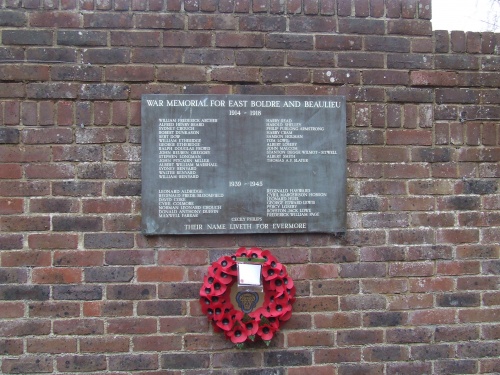
Beaulieu War Memorial

What a quest to find the memorial in the village.  Before my visit someone had said they thought it was in the church.  In the village shop, and on this occasion I am not ashamed to say I spoke to two ladies, who were both convinced there wasn’t one but disagreed as to where it was.  I was told to go the the Motor Museum and ask there.  The wonderful local chocolate shop at least were honest and said they should know but didn’t.  Not one to give up I spied a lady walking across from the village school with arms full of baskets – this wonderful person said ‘yes, follow me’.  So less than 20yds off the road there was the memorial – so thank you, who ever you are!

One name seems to stand our more than any other on the Beaulieu War Memorial, could be because it is the longest.

Stanton Degge Wilmot-Sitwell born on 25 July 1896, in the Kensington Reg. District,  the son of Francis Stanton Wilmot Sitwell and Mary Innes the daughter of Capt., Charles E Farquharson.

In 1901 the family were living at The Hall, Holbrook, Derbyshire.  The family consisted of Francis and Mary and their children Robert B aged 6, Stanton aged 4 and Francis E aged 2 along with 4 servants ranging from parlour maid to nursemaid.

2nd September 1914 Stanton was one of the gentleman being appointed Probationary Second Leiutenants.

2012 C Sklinar

March 1915 Stanton is noted in the Gazette as being granted the temporary rank of Lieutenant.

Stanton served in the Royal Marines, Royal Navy Div.  He was KIA during the battles of Gallipoli and died on 14 July 1915 being remembered on the Helles Memorial along with nearly 21,000 other identified casualties.  The memorial at the moment (2012) is undergoing major renovations after years of severe weather conditions and seismic activity.

The family seem to be from the Derbyshire area, so where is the link to Beaulieu ?     Well, found a link to the Lymington area – Francis S Wilmot-Sitwell died in the Lymington Registration District in 1929.  There is also a death for a Mary in Christchurch but will shelve that one until further proof comes my way.  Just as an afterthought I looked up a Probate entry for Stanton and the entry tells that Probate was granted in 1920 at Winchester.  The Lymington war memorial has no mention of the Wilmot-Sitwell family, so why the Beaulieu memorial?

Sources:

Plantagenet Roll of the Blood Royal

1901 census transcribed as Stanton D Wilmothwell – RG13; Piece: 3227; Folio: 108; Page: 2.

1911 census – a family history snippet

Charles Waldo Lionel Churchill has been my last entry and while trying to find his parents on the 1911 I came across this gem.

The enumerator who collected Charles Churchill’s sheet was not too pleased due to his crossing out.

Charles and his wife, Emily were aged 69 and 68 respectively but Charles had put them both on the same line, The second line he had put that Emily had a room at Lambeth and he had a room at Westminster.  The enumerator had filled in that both were married and had been for 46 years, they had had 7 children and lost 2.

The third line, normally for a third person stated that on April 2th (yes looks like th) slept at Hackney and had no occupation, but later the enumerator completes an entry for waiter.

The fourth line stated they have one room.

The enumerator also completed the entry for one being from Westminster and the other from Lambeth.  The icing on the cake or the enumerator was fed up, was that he put Emily’s age in the male column.

For the signature Emily signed and where the postal address should have been is Charles’ name with the address of 26 Trelawney Road, Hackney being squashed in below.

Ten years previous (1901) the couple at living on Queen’s Road, Hackney where Charles aged 57 is a Porter Officer.

1891 has the couple still in Hackney but now 76 Richmond Road and Charles is a Refreshment Room Attendent and the couple have one son, Charles aged 24 living with them – he is a Carman.

1881 Charles and his family are living at 100 Great Suffolk Street, Southwark – Charles is a waiter and his children are as follows – Charles 14 a soap packer ; Louise 11 scholar, William 8 scholar; Margaret 6 scholar – still a few children missing but someone else will have to find them.  I just thought you might have been interested in the fact that not every one is perfect and not everyone can fill in forms -nothing changes, does it ? Except now many of the forms are on line.

Source  1911 census: Class: RG14; Piece: 1140

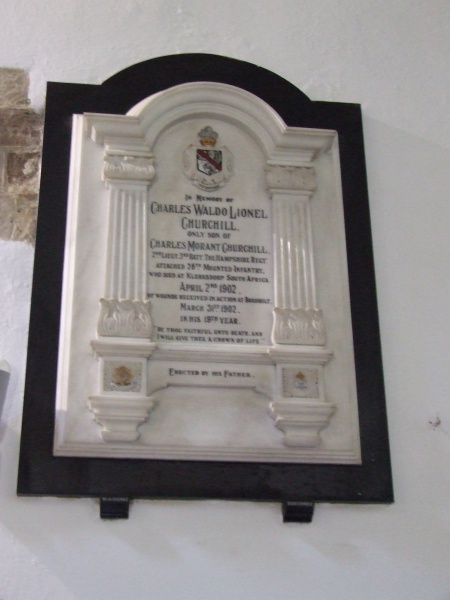
Charles Waldo Lionel Churchill

Charles Waldo Lionel Churchill was born on 16 May 1883, the son of Lt. Col. Charles Morant Churchill, JP (b 19 May 1842) and his wife Ellen Harriette Augusta Meade-Waldo (b 4 Nov 1856).

In the census of 1891 the family are living at Everton Grange, Milford, the family being : Charles Morant Churchill aged 48, Lt Col. Retired Pay, HMS, JP Dorset born in Dorset; Ellen Harriet A Churchill aged 34  born in Cork, Ireland ; Charles Waldo Lionel Churchill aged 7 born in Maidstone ; Frances C E Churchill aged 10 also born in Maidstone + Edmund Wm (?) Waldo father in law aged 61 late 1st Life Guards, JP Kent born in Dawlish, Devon ; Cicely E M Waldo mother in law aged 38 born in Derbyshire ; Margaret A M Waldo sister in law aged 9 born  in Rushall, Kent; Katherine A M Waldo sister in law born in Barmore Castle, Beal aged 7 and finally 10 servants – Daniel M Davis 29 Albert Henry Gregory 19 Charlotte Jane Brown 23 Annie Phillips 26 Mary Jane Fossey 26 Kate E Carpenter 26 Annie Saneroft 17 Emily Peters 16 Annie Palr  Htkins 49 Emma Pearson 38 all being born in Hampshire, London or Dorset.

2012 C Sklinar

Charles joined the 3rd Battn., Hampshire Regt., in June of 1900.  He had been with M.I. in South Africa from December 1901 with the rank of 2nd Lieut and was attached to the 28th Mounted Infantry.

On 31st March 1902 The Damant’s Horse, part of Lt. Col. Cookson’s column were along the Brak Spruit and came in contact with a convoy of burghers and followed in to Boschbult farm.  The superior Boer forces attacked the column who managed to entrench before nightfall and the Boers retired at nightfall.  Charles was wounded during the day and died of his wounds on 2nd April at Klerksdorp.  His final resting place in South Africa has not been determined, but some websites say that he rests in Wimbourne.  His memorial is however, on the wall of Wimborne Minster.

Officers died – South Africa 1899 – 1902

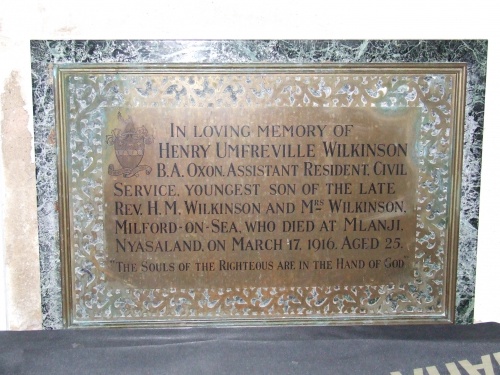
Henry Umfreville Wilkinson

The memorial to Henry can be found inside the church at Milton on Sea, but who was Henry ?

Well, he was the son of Henry Marlow Wilkinson (b 4 Aug. 1827 Godshill, I.O.W d 9 Dec 1908, Milford-on-Sea ) and his wife Florence Amy Kemp-Welch (b 1852 in Brixton, Surrey, died on 5 Jun 1927 in Milford on Sea) who married in Christchurch in the winter of 1886.  Henry Marlow Wilkinson was a clergyman living with his wife, family and servants in Milford vicarage at the time of the 1901 census – Henry Umfreville was aged 10 and like his sister Marie he was not listed as a scholar. Henry Marlow was from a family of clergymen.

Ten years before in 1891, Henry Marlow Wilkinson was aged 63 while Florence his new wife was aged 38 and for children she had 3 under 5 – John, Cyril and Henry aged 10 months.

By the time of the 1911 census Florence was a widow and living at Milford Corner with her 4 children and 4 servants in a 17 roomed house.  Good news for family historians Florence added that she had had 7 children but had lost 3 by the time of the census.  Who were the other children ?  In 1911 John Rothes Marlow Wilkinson was 23 and a student ; Cyril Hacket Wilkinson was 22 and a student ; Henry Umfreville Wilkinson was 20 and a student  and finally, Marie Cecile Florence Wilkinson aged 17 and also a student.
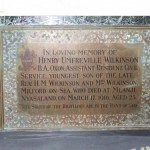
2012 C Sklinar

From the memorial we know that Henry Umfreville was a student at Oxford and attained a B.A., he also was a member of the Civil Service and it was during this service in Mlanji, Nyasaland that he died on 17 March 1916 that he died aged 25. I’ve not found a lot about Henry but will his brother who was a soldier during the Great War be any different ?

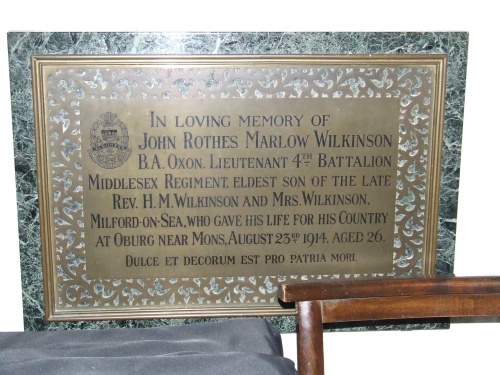
John Rothes Marlow Wilkinson, as we know he was the elder brother of Henry U but he has more of a story to tell.

In the London Gazette John is mentioned as to be a Second Lieutenant in the Territorials dated 17 December 1909.   Another mention gives information regarding Second Lieutenant Wilkinson being transferred from the 7th Bttn Hampshire Regt., to the Duke of Cambridge’s Own (Middlesex Regt.,) He was a University candidate on 24 March 1911but would not be getting pay of allowances prior to 7 February 1912.
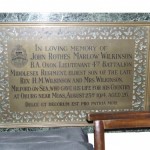
2012 C Sklinar

Soldiers who Died in the Great War tells us information we have already gained from the London Gazette but that he was Killed in Action on 10th September 1914 near Mons.  But a look at De Ruvigny’s Roll of Honour gives an insight as to who the young man was.  He was a handsome young man, with I suppose you could say he had film star looks – well you could if this was the 1940’s or 50’s.  He had good strong features and a neat moustache.  His education was at Winchester College and Worcester College (1907-1911) and was Captain of the colleges boat club.  We know he was killed near Mons, but what happened ?  A Private from C Coy., 4th Middlesex Regt., wrote “On Sunday 23 August, we were entrenched in front of a convent, when Capt., …..gave Lieut. Wilkinson an order to take half his platoon (two sections) to reinforce A Coy.  The Coy. was at the left of our positions and was hard pressed.  We took up position under heavy fire at a group of houses.  Your son went into one of the houses, and was heard directing the fire of his two sections through the skylight of the root.  He directed his fire so well that he forced the Germans to retire from his front.  it was from this house that he was overwhelming numbers of Germans coming through the wood to his front.  The Germans came on again until they were within 200 yards.  Lieut. Wilkinson came out of the house into the trench.  It was here that he got the order to retire.  He got the order twice, but would not take it, as he thought it was not an official order.  Eventually he got the order from the G.O.C. to retire.  It was then I noticed he was limping.  To retire we had to go through barbed wire ; here we got separated owing to the heavy shell and rifle fire.  I am very sorry to say that I was not the only man of those two sections to get away from that place.  No officers could give me any information of Lieut. Wilkinson.  I reported to the C.O. what had happened and told him that Lieut. Wilkinson was a very brave man.  He replied, ‘Yes, I know that, and I am very sorry to have lost him’ … I must say your son was a man in very sense of the word.  I think he was as brave a gentleman as one could meet here.  I told this to Capt.,……. I think I have an idea of a brave officer, as I went through the South African War and have eight clasps to my medal”  Such sad news for a family to hear but good to know that a Private thought enough of his Lieutenant to write to his family and inform them what really happened.  So many other families could only wonder or imagine the fate of their loved one.

He was 26 years old when he was KIA and rests in St. Symphorien Military Cemetery, Hainaut, nr Mons, Belgium.

Within a two year period Florence  had lost another two of her boys but she did live on for another few years.

Papers of the Wilkinson of Milford  family can be found in the Bodleian Library

James Marlow Wilkinson was one of over 2000 people who corresponded with Darwin

Roll of honour of sons and daughters who gave their lives in the Great War

Naval Dockyard, Portsmouth

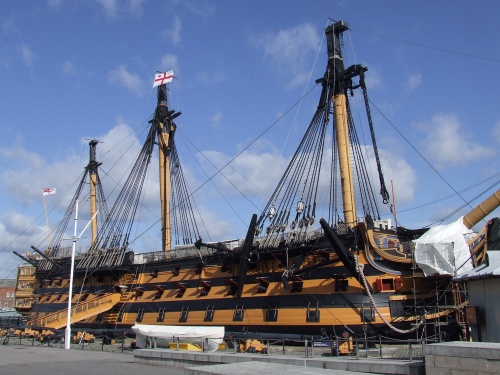
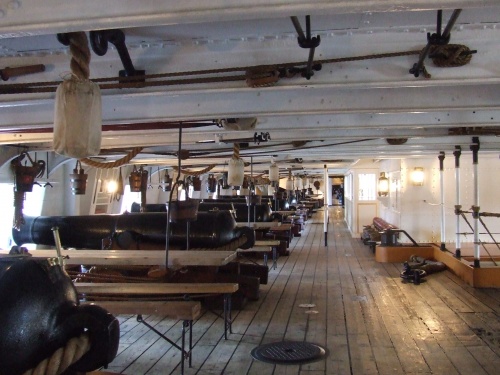
The Naval Dockyard is world famous as the home of Nelson’s flagship – HMS Victory, but the dockyards are also home to the Mary Rose and HMS Warrior.  Well, everyone talks about HMS Victory, so I shall give it a miss except to say that I am glad that I went on board and can appreciate the  every day conditions the men and boys had to endure – well I can imagine.  The conditions during a battle must have been horrendous – noise, the organised and well practised Battle Stations and the accidents of one mis-timed move, all this in cramped quarters with many men not being able to stand upright.

The crew would have consisted of over 800 men and boys – 11 Officers, 48 NCO’s, 80 Petty Officers, over 500 seaman and 40 boys plus approx., 150 Marines of various ranks.  I always thought the Marines were the extra military side of a battle – the sharp shooters and able to go from land to sea and just as capable on either.  But I was told that they were what you would call a peace keeping service – keeping peace between the seaman and the officers as unruly men could cause a great loss of life during a voyage.

HMS Victory 2012 C Sklinar

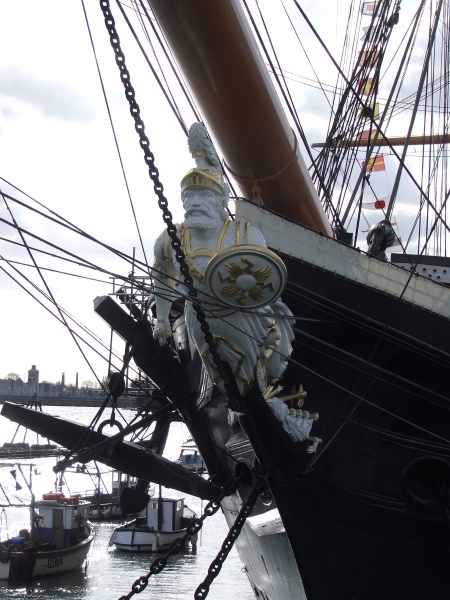
So, here she is – at the moment her top masts have been removed for work to be carried out on them and part of her has an outer shell of scaffolding and part of the 150ft Bowspirit has been removed.  To make it easier for the Oldest Commissioned War Ship to survive the masts and the bowspirit are now hollow wrought-iron masts,  from a ship called the ‘Shah’ in the 1880’s. These are lighter than the original wooden masts and require less maintenance.  The original main mast would have been taken from a tree with a 3ft diameter fir, spruce or pine, such woods are known to be strong but flexible.   You can only go onboard with a guided tour but it is worth the wait for a tour to begin and there is lots to do while you wait.

HMS Warrior – The largest, most heavily armed and heavily armoured warship.  No opponent dated to challenge her. She was 418 ft in overall length (compared to HMS Victory 227ft) and the 60 years since HMS Victory showed in the technology.  She had at her centre an armour plated box to protect her guns and machinery and this was impenetrable at even close range with the latest guns. She had the recent innovation of watertight compartments only made possible by her iron construction.

HMS Warrior 2012 C Sklinar

Not only was HMS Warrior feared for her guns but she was also fast, very fast – under sail she could reach 13.75 knots but she also had steam power made possible via her 10 boilers (each with 4 furnaces) and could reach 14.33 knots using these but using both steam and sail 17.5 knots could be made.  Her armament was also impressive. Warrior had the new breach-loading guns now firing shells – normal cannon balls bounced off ironclads.  Warrior unlike Victory had only one gun deck – she was longer but much more stable and able to carry heavier guns, with each gun having a crew of 18.

HMS Warrior 2012 C Sklinar

The crew of 705 men were made up of : 42 Officers and Midshipmen, 3 Warrant Officers an d 45 NCO’s, 401 seaman and boys + plus the engineering staff – 12 Chief Engineers and Engineers, 66 Stokers and Trimmers as well as 3 Rloyal Marine Officers and 24 NCO’s and Artilliary men.  Compared to Victory the decks were a lot more spacious and airyn and brighter. Also by now sailors weren’t ‘press ganged’ and volunteered.  After serving a set time they could achieve a pension

HMS Warrior was first of the Black Battle Fleet of the 1860’s and by 1875 Britain had built a further 22 armour-plated battleships.  The latter 22 had no sails but could steam 3 times further than Warrior without refuelling, but HMS Warrior never had to fire a shot in anger, surely that shows how successful she was – a real success story.

Along with the museum sections there is also a Harbour Tour a fantastic way to see H M Fleet and the harbour.  Sadly, Ark Royal, the one I wanted to see as my father had been a guest of honour on board her some years ago.  He received a cheque, the money raised by the crew to take a Normandy Veteran back to France and my father was chosen.  He had no idea he was going and didn’t normally go on the RNA trips but he did as he was told and turned up at the muster point all suited, booted and medalled.  The group were all on one of the decks ready to be photographed by a helicopter when his name was called out and the Captain presented him with a cheque – he was both emotional and honoured that his piers had chosen him.  Another honour came later that year when he again was one of three D-Day 1 vets to be invited to a Garden Party at Buckingham Palace.  Again he was overwhelmed when he mentioned the Garden Party to another member of the RE Association, who in turn told someone else, and dad ended up being chauffeur driven from home to the Palace – the two other vets had to catch a train, not fair I know but as it goes ‘it’s not what you know but who you know’.

So, needless to say I was disappointed at how much of the Ark I saw and sad that she rests in what is basically the Government version of ebay.

It is expensive to get in but entry allows you one visit to HMS Ark Royal, Harbour tour and Mary Rose Museum but unlimited access for 12 months to the other sections of the site – a good place to visit.

Non-Resident births in Wakefield

What do you know ?

Your family came from London, the South or the Channel Islands.  You know they had children during the period 1939 – 1945.  Can you find their birth registered in that area ?  No !

Carol Sklinar copyright 2007

I found out the other  day that during the early years of WW2 families, women and/or children were sent ‘up North’ for safety.  As a result of that Wakefield had its population artificially risen, this lead to a rise in the number of births in the region.

Walton Hall, a maternity home in the Wakefield area had a great number of extra births with the addresses of the parents being London, Birmingham, other areas in the South and ofcourse, those families who lived on the Channel Islands, the only part of Britain to be occupied by enemy forces.

If you can’t find the birth you are looking for try looking in a wider area as they could have been Registered in a Yorkshire town.

Find My Past ie

Create your Irish family tree with Find My Past.

You can now create your Irish family tree online thanks to the launch of Find My Pasts latest lauch.  So whether you are a beginner or an experienced genealogist their software can store all the names in your tree in one place and you can access this information from any computer.

As I have just said you can create your family tree with Find My Past i.e. but they have also just added to their ever growing cornucopia of information over 4 million, yes 4 million names from the Irish Prison Registers.

Click here to start building your Irish Family Tree

Or click on the logo to visit Find My Past ie

If your family is not from Ireland but the UK or Australia here are a few links for you. Both sites have a vast array of information from census (England and Wales), Religious records, Military, Directories + lots more – take a visit and find out how Find My Past could help you.

Above is a free trial for Find My Past with lots of UK records or click below to start building your UK Find My Past tree

And finally, click on the banner below to start or add to your Australian research.