Category Archives: News

Piper Daniel Laidlaw, V.C.

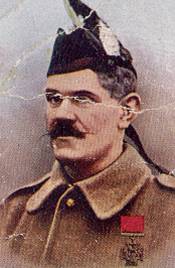
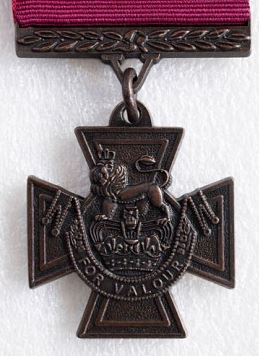
Piper Daniel Laidlaw won the Victoria Cross,  in 1915.

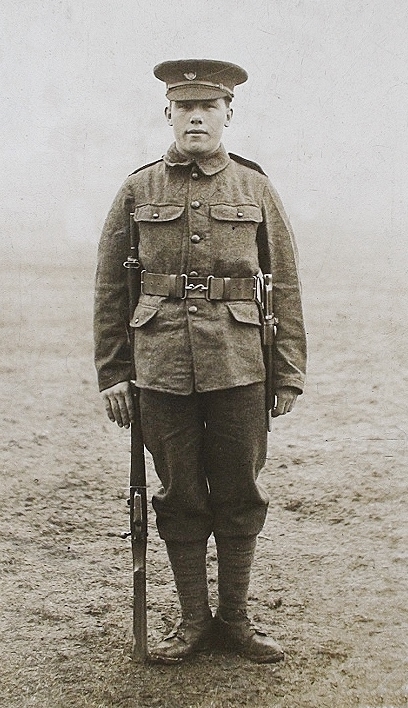
Daniel Laidlaw V.C. via Wikipedia

Daniel Laidlaw V.C. via Wikipedia

Daniel, had been born in 1875 in Berwickshire, enlisted in 1896, joining the Durham Light Infantry, serving in the army in India.  He re-enlisted when war broke out and served The King’s Own Scottish Borderers and by the following year, 1915, he was 40 years of age.

The attack on the French village of Loos on the 25th of September 1915 was the first time the British had used poison gas.  The gas was released and due to a change in the weather, instead of heading towards the enemy the gas came towards the allies.

London Gazette, 18 November 1915 ], Loos, France, 25 September 1915, No. 15851 Piper Daniel Laidlaw, 7th Battalion, King’s Own Scottish Borderers.

“For most conspicuous bravery prior to an assault on German trenches near Loos and Hill 70 on 25 September 1915. During the worst of the bombardment, Piper Laidlaw, seeing that his company was badly shaken from the effects of gas, with absolute coolness and disregard of danger, mounted the parapet, marched up and down and played company out of the trench. The effect of his splendid example was immediate and the company dashed out to the assault. Piper Laidlaw continued playing his pipes until he was wounded.”

Victoria Cross

Victoria Cross

Piper Laidlaw, was invested with his Victoria Cross by King George V at Buckingham Palace on the 3rd of February 1916.

Only one other piper was awarded the Victoria Cross during The Great War and that was, Scottish born Canadian soldier James Cleland Richardson

Daniel’s medals have been donated to the National Museum of Scotland, Edinburgh and are on display on the 5th floor.

To read more about Piper Laidlaw and his experiences visit the BBC Scotland website or take a look at the youtube interview with Piper Laidlaw, V.C.

Further information about Daniel Laidlaw, Victoria Cross –

Victoria Cross – click here

Battlefields1418 – click here

St. Helen’s, Sandal – burial and plot records

St. Helen’s church, Sandal burial records and burial plot records.

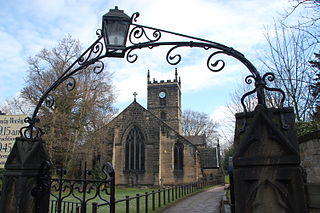
St Helen's, Sandal via Wikipedia

St Helen’s, Sandal via
Wikipedia

While visiting the website of St. Helen’s church, to see if they were open this weekend (Heritage Weekend), I came across something that will be of use to family historians, both at home and overseas – I can only hope that other churches will do the same.

What has St. Helen’s done?     St. Helen’s church have transcribed their burial records, scanned the burial plans and added them to their website content and is searchable.

The burial plans – The burial plans are available Free to download, available in sections with a master plan showing the sections, paths and boundaries.  The majority of the plans have a surname written within each plot – very handy for confirming the correct plot by using the surrounding names as a guide.

What information do I get?     The burial  information is quite basic – Surname; First name(s); Burial date; Section and Plot.

Although the information available is basic, it can be enough to conform a relative’s burial, or make a visit worthwhile.  But, and there is always one of those, isn’t there?  It does not tell you if there is a headstone!  A visit is sometimes only worth the journey if there is something physical to see.   That little problem could be solved though, as Wakefield & District Family History Society have transcribed the headstones and monuments for St. Helen’s, Sandal.    With a bit of planning, you could find the section for your relative(s) on the St. Helen’s website, next find the transcription booklets on the family history society site –   then only buy index of names or the section book you need.

Who can I find in the records? – J. D. Tute who rests in Section 4E Plot 47.  J. D.

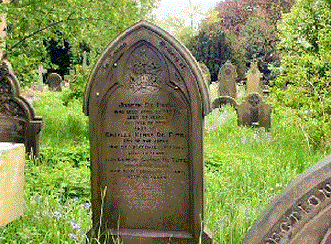
De Tute headstone St Helen's church.   image C Sklinar

De Tute headstone St Helen’s church.
image C Sklinar

Tute is infact Joseph De Tute who was buried and the headstone includes Charles Henry, Albert Gaunt and Elizabeth.

At St Catherine’s church on October the 20th 1879, Joseph and Elizabeth de Tute, took four children to be baptised – John Thomas, Joseph, Charles Henry and Ben.  Joseph was a foreman Poster and either he gave his address as St Catherine’s or the Vicar Edward Rowland, simply entered the parish, as all his entries did.

I suggest you visit St Helen’s church website if you have family from the surrounding area  – it may be of help with your research.    Pictures of St Helen’s churchyard and other churchyards in the Wakefield area can be found here

WW1 Deserters from Wakefield

Extracted from the Wakefield Express issue of September 27th 1917 – Wakefield Court Petty Sessions.

“City Court – Saturday. Before Ald. G. Foster.  A Violent Deserter – William Moorhouse, Belle Vue, was charged with being a deserter from the K.O.Y.L.I.  Sergt. Sheard and P.C. Gardner visited defendant’s house in the early hours of Saturday morning and found him in hiding.  The man became very violent and struck the sergeant in the jaw. – Prisoner was remanded to await escort.

Thomas Allen, Barnsley, was charged with being an absentee under the Military Service Act and was ordered to be handed over to the military authorities.

City Court Monday. Before Major Bolton (presiding), Ad. W. H. Kingswell, Mr. Fred Simpson, Ald. G. A. Moorhouse, and Mr. C. Mellor. – An Absentee in ‘Civvies’,  – John Henry Harrison was charged with being an absentee from a Labour Battalion connected with the Lincolnshire Regiment.  Prisoner, who appeared in the dock in ‘civvies’, was arrested in a house in Union Square, Kirkgate, by P.C. Kirkby, shortly after midnight on Saturday.  The man admitted he was an absentee, and said he had done away with his uniform.  He was remanded to wait escort and the officer was recommended for a reward of 10s.

West Riding Court Monday. Before Mr. Percy Tew (presiding), Mr. W. Briggs, Mr. T. P. Robinson, and Cr. A Johnson.  Absentee – William Thompson, Normanton, and Alfred Arundel Newton Hill, were charged with being absentees from the Lancashire Fusiliers and the  Norfolk Regiment respectively, and they were remanded to await escort.

James Fairweather in Prison – Book Review

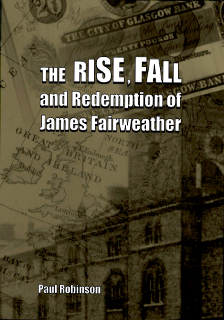
The Rise, Fall and Redemption of James Fairweather by Paul Robinson.

by Paul Robinson

by Paul Robinson

The book ‘Six Years in the Prisons of England’, published anonymously in the 1860s, offers a fascinating glimpse into the harshness of Victorian prison life. Written by a once wealthy and respectable Dundee jute merchant, the author’s first-hand account describes the conditions under which he and fellow convicts were kept and exposes the many failings in the prison system of the day. Now, a century and a half after his story was first told, the author is identified and the events leading to his fall from grace, his imprisonment and subsequent release are laid out alongside the original text. ‘The Rise, Fall and Redemption of James Fairweather’ provides a detailed and unique accompaniment to a fascinating human story and an important social commentary.

James spent a short time at Wakefield prison but was transferred to the newly built invalid convict prison at Woking – to see why you need to buy the book!

The Rise, Fall and Redemption of James Fairweather contains 230 pages and is one of five books written by Paul Robinson that are available from Lulu.com

Paul is a local history and genealogical researcher – his main interests being criminal history, Staffordshire and the Black Country.

Bleue Maison

Bleue Maison Commonwealth War Grave Commission cemetery is situated within the community of Eperlecque,  Pas de Calais.  The cemetery, made in spring 1918 to be a final resting place for the dead from a group of Casualty Clearing Stations in and around Watten. Situated a short distance from the main St. Omer/Dunkerque road is where 60 casualties of WW1 and one unidentified casualty of WW2 now lie surrounded by fields of corn.

Bleue Maison is a small place compared to other cemeteries in France and Belgium, but sometimes these are more personal. While the vast numbers of white stones in the larger cemeteries show how horrific war could be, this small cemetery, close to a small road and surrounded by fields can, like other small places can be left out, while the bigger, more well known get all the glory.  But not this time!

Let’s take a little walk around and see who is there!

DSCF4843

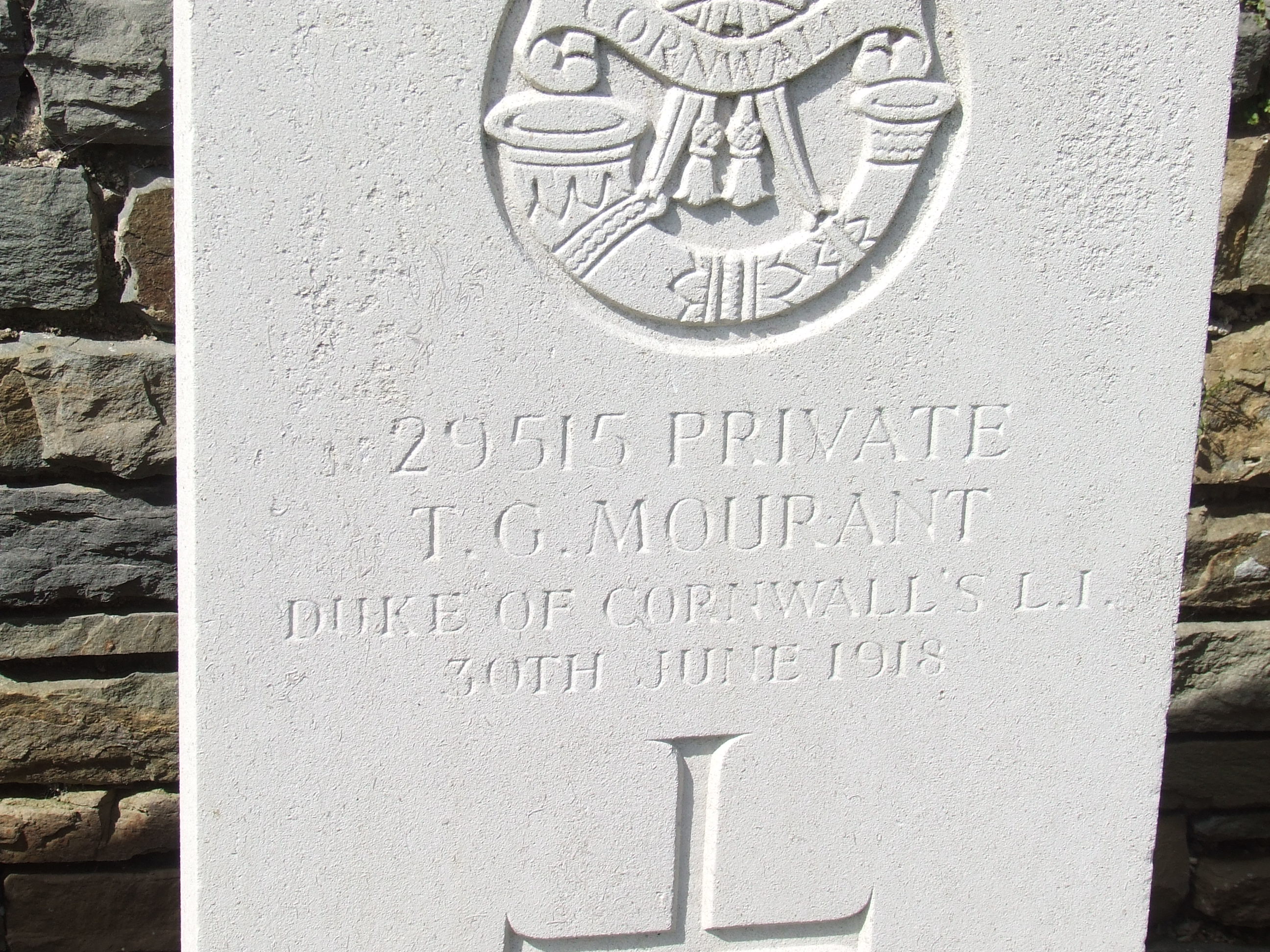
Bleue Maison CWGC – T G Mourant

Thomas George Mourant – Thomas was the son of Thomas Mourant and his wife Eliza.  In the census of 1911 the couple had been married 15 years and Eliza had given birth to three children, two of which had survived to be named in the census – Thomas aged 14 and his younger sister, Violet who was only three. Thomas snr, a house carpenter, was born in St. Clements, Jersey, while his wife was born on mainland UK in London.  Thomas jnr, was born in Grourville(?), while his sister was born in St Martins.  In this census the family of four were living at Percy House, Gorey, Jersey.

During the Great War, Thomas served in the Duke of Cornwall’s Light Infantry, as Private 29515. He enlisted in Grouville, the place of his birth and had previously served as no. 172 in the Royal Jersey Garrison Bn.  Thomas, like all other Jersey men, volunteered to go to war, as Jersey and the other Channel Islands did not call-up their young men.

Thomas George Mourant died of wounds on the 30th of June 1918.  He had been one f over 6,200 Jersey men who served in HM Forces and one of 862 who were either killed in action or died of wounds. His entry in the Army Register of Soldiers’ Effects, tells that monies due to him were paid to his father and  had all been finalised by the end of 1919.

DSCF4834

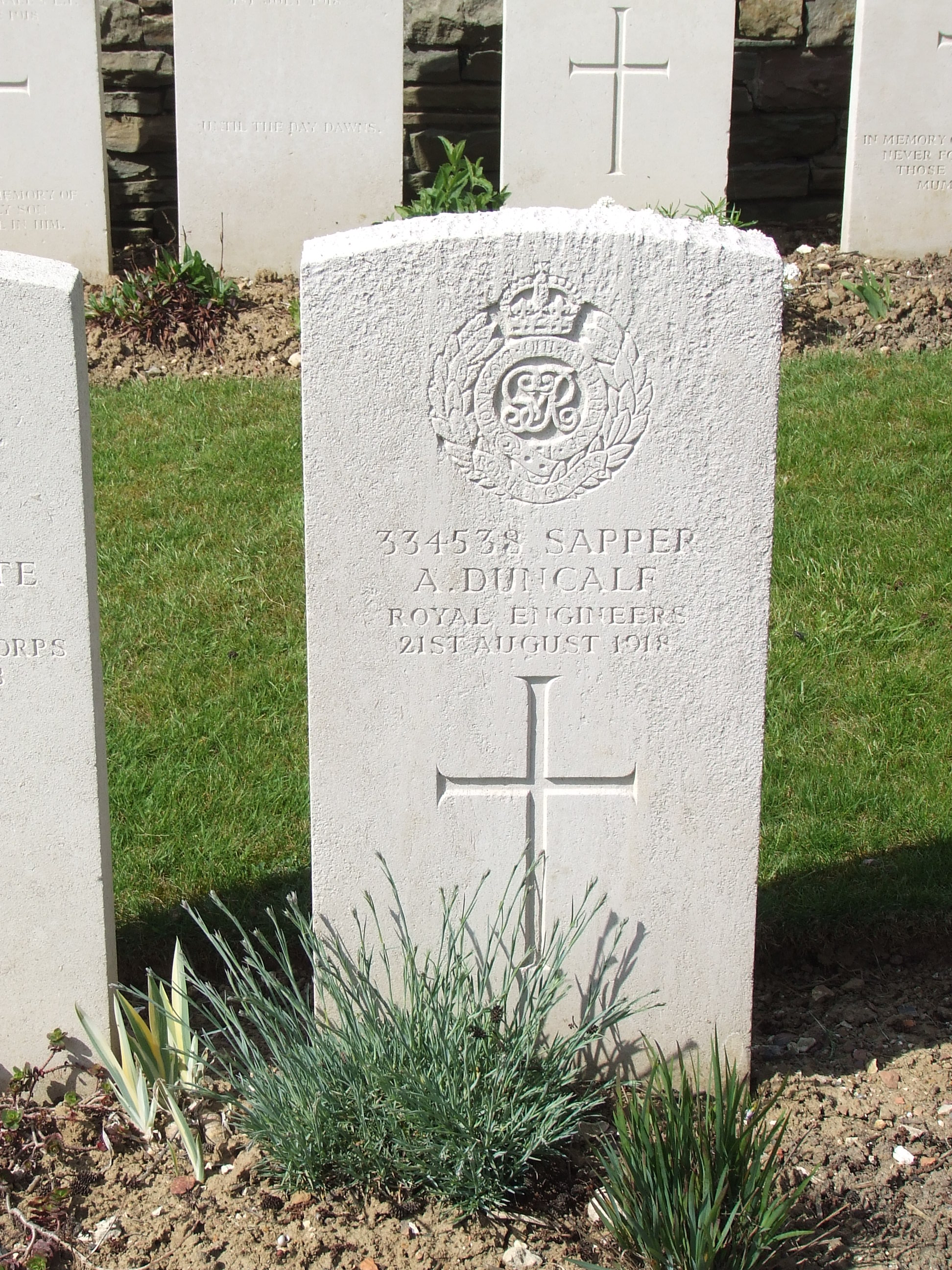
Bleue Maison CWGC – A Duncalf

Arthur Duncalf – Arthur, born in 1898, was the son of Arthur and Charlotte Duncalf, who in 1911 lived at 3 White Street, Widnes.  Arthur snr, worked  a local soap works.

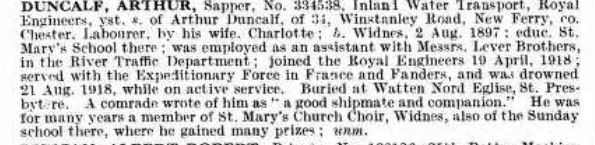
Arthur enlisted in Lower Bebington, joining the Royal Engineers and becoming Sapper WR/334538 and served in the Inland Water Transport battalion.  Arthur died on the 21st of August 1918 aged 21.  The extract below gives us a little more information about Arthur – especially the fact that he drowned whilst on active service only a few months after joining the RE’s. The information also tells that he was previously buried in the small churchyard in Watten before being moved to Bleue Maison.  It seems that he was liked by many, and that can’t be a bad thing, can it?

Arthur Duncalf extract from De Ruvigny's Roll of Honour

Arthur Duncalf extract from De Ruvigny’s Roll of Honour

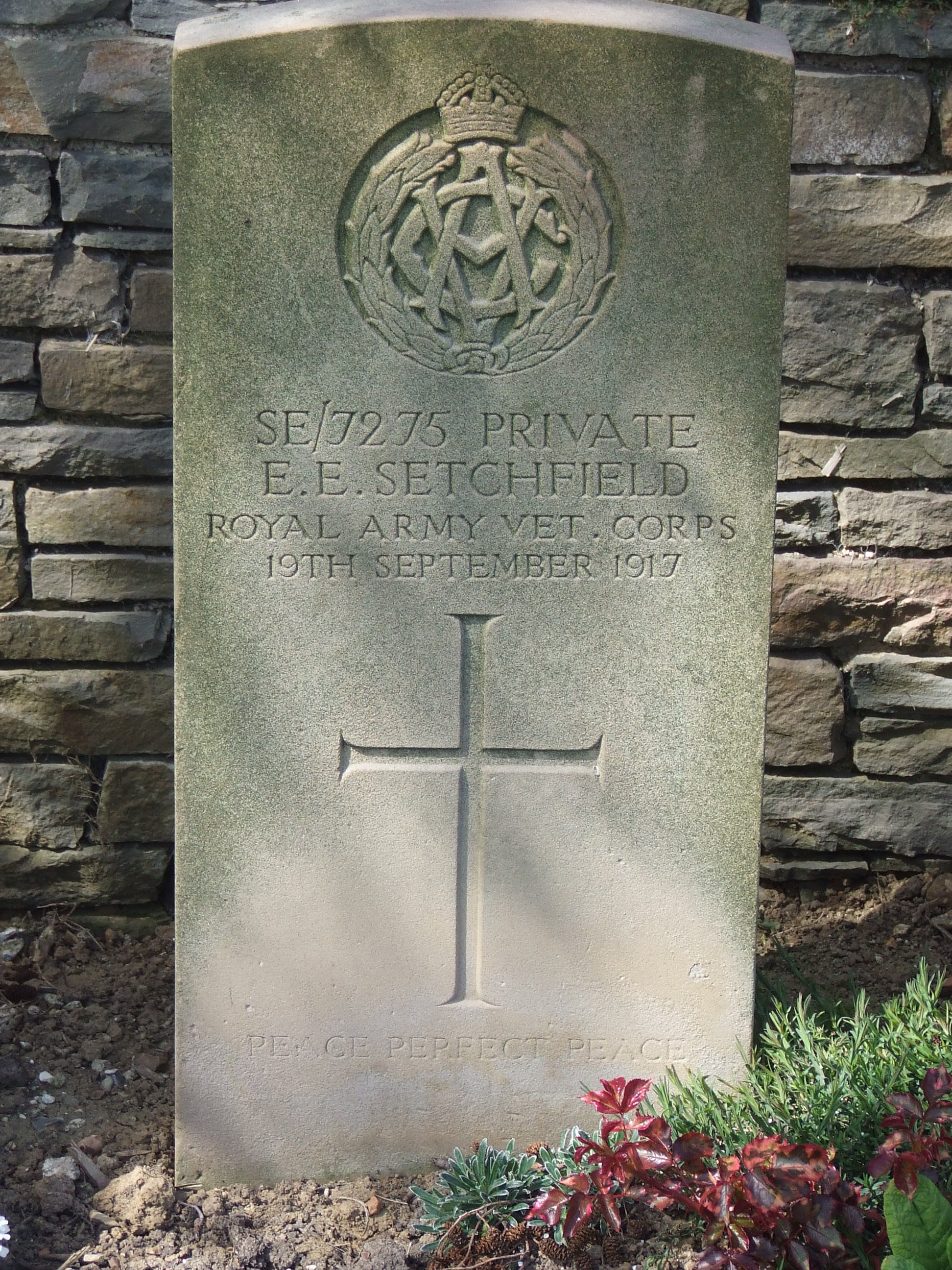
E E Setchfield

Bleue Maison – E E Setchfield

Edward Ernest Setchfield – His entry in Soldiers Died in the Great War, tells that Edward was born in Emneth, Norfolk, and that he enlisted in Norwich.  The Army Veterinary Corp., had Edward listed as Private SE/7275 and he died on the 19th of September 1917 age 37.

Edward had married Rose Adamson in late 1901.  By the time of the 1911 census Ernest and Rose were living in Wolsoken, with their two children at 40 Elizabeth Terrace.  Ernest worked as a coal porter to support his family.

Looking a little further into the surviving records, the Register of Soldiers’ Effects sees all Edwards effects finalised by 1919.  But one thing that is noted, is how he met his death.  Edward Ernest Setchfield is noted as being accidentally drowned in France or Belgium.  Edward rests in a sheltered, shady corner in what is quite an open cemetery.


Mail Online – Did your ancestors own slaves?

The Mail Online has an article informing its readers of a new database containing the names of 46,000 Brits who received compensation on the abolition of slavery.

The brief article tells of a few household names whose family were in receipt of part of a portion of £20million.  These names include David and Samantha Cameron, Benedict Cumberbatch, Ben Afflick and Ainsley Harriott, whose great-great-great grandfather, James Gordon Harriott, was the descendant of a line of slave owners.

Going back in time, John Gladstone, father of prime minister William Gladstone, owned nine sugar plantations – British Guiana and Jamaica – of which compensation ranged from £2074 to £22443.

In one of my earlier blogs I told you about, Guy Victor Baring, who is the related to Alexander Baring, 1st Baron Ashburton, and other members of the Baring family who are on the database – and if you visit the blog about Guy, you will find he is distantly related to me.  The Baring family of bankers and investors had between them a number of plantations, with the numbers of slaves varying from 9 to over 320.  Their plantation names included:- Fuller’s Rest; Spring Garden; Cotton Tree; Belair and Philadelphia. The Lascelles family of Harewood House, also had property in Barbados and were entitled to money from the fund.

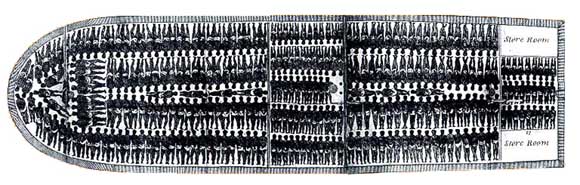
SlaveShipThe database is can be found on the Legacies of British Slave-ownership website is a project based at the University College London.  The informative site, has information about the project and a blog – a little sparse in its content, but what is there is interesting.  The search area is well thought out and depending on your research criteria, there are three sections:- Individual’s Details (including name, occupation, religion and more); Address Details and finally, Claim Details (including claim number; Estate; Parish; Claimant Category along with compensation details and number of enslaved).

There are two estates indexed that have over 550 enslaved – John Blackburn, a Glasgow merchant whose estate was in Jamaica and James Henry Mitchell, a gentleman, of Heath House, Oxfordshire, who also had estates in Jamaica.

Recently, I found a link to a fascinating interactive map on Slate.com, who had an article The Atlantic Slave Trade in Two Minutes.  The map in 2 minutes shows 350 years of the slave trade and includes 20,528 voyages, equating to millions of lives.  The map counts up, showing the voyages year by year, ending in 1860.  Some of the years are quite shocking in the number of journeys that took place.  When playing the map, it interesting to see that North America has less voyages than the Caribbean and countries in South America (mainly Brazil).

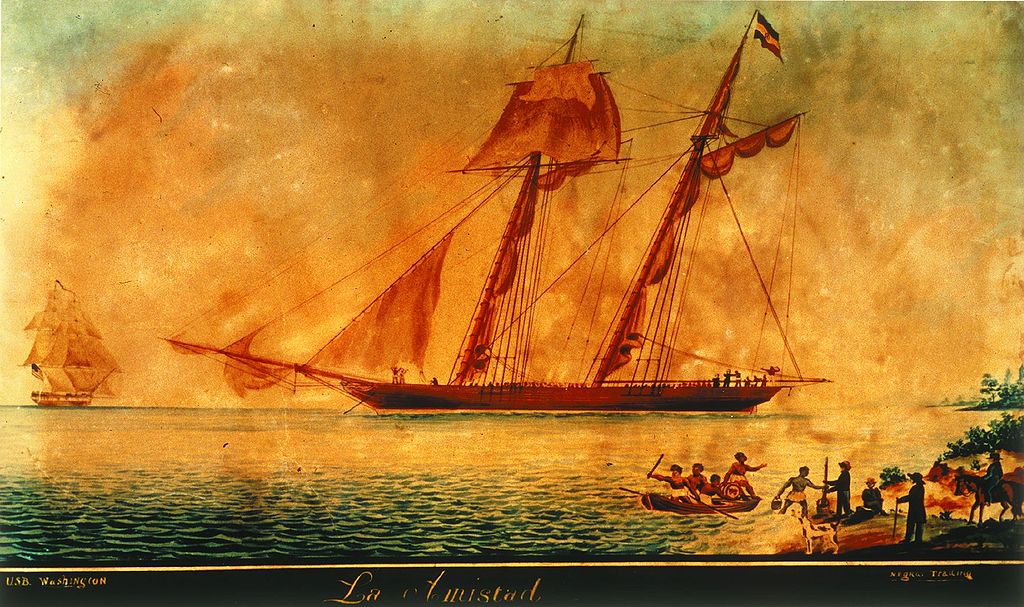
Armistad

Armistad

Another site, also with a link found on Slate.com’s site is The Trans-Atlantic Slave Trade Database which list details of 1,000’s of voyages and includes details of ownership, captain and journeys.

Also  on the same site, is the African Names Database lists 1,000’s names, with physical details i.e. height, age, arrival year, where they embarked and disembarked including a link to African Origins.

On Wednesday 15th of July, 2015 on BBC2 at 9pm there is a documentary entitled ‘Britain’s Forgotten Slave Owners’.  Historian David Olusoga will, in the first of two programmes, discover the cost of the abolition of slavery.  The short series will also who who it was that owned slaves, and not always who you would think.  There were many people including: shopkeepers, clergymen and the ordinary 18th century middle class.

British Red Cross

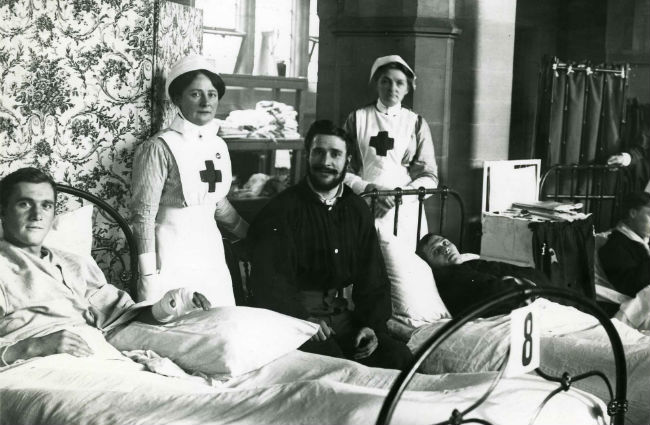
Red Cross volunteers via redcross.org.uk

Red Cross volunteers via redcross.org.uk

British Red Cross

Over 90,000 people volunteered for the British Red Cross at home and overseas during the Great War, they provided vital aid to naval and military forces and cared for the sick and wounded. County branches of the Red Cross had their own Voluntary Aid Detachments (VADs) made up of both men and women. The VAD’s work included such jobs as nursing, transport, rest stations, working parties and auxiliary hospitals. They ran libraries, did air raid duty, and a service that is still being used today – Missing and wounded service.

As women volunteered for jobs normally undertaken by men prior to the war it enabled over 11,000 men to be released for military service of some sort.

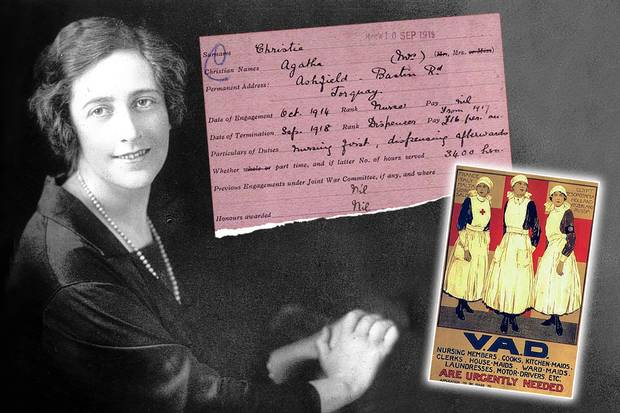
Agatha Christie, VAD WW1 via redcross.org.uk

Agatha Christie, VAD WW1 via redcross.org.uk

Did you know that Agatha Christie, volunteered for the Red Cross before publishing her first novel in 1920 and worked in a Torquay hospital. Vera Brittain, famous for her ‘Testament of Youth’, joined the VAD in 1915 and by 1917 was working in France. Enid Bagnold, of National Velvet fame served in London. Did you also know that E M Forster, novelist, critic and essayist, was a pacifist and instead of fighting he worked with the Red Cross.

Deaths – even though the VADs were non-combatant, they suffered many deaths. During the war, 128 nursing members and over 100 other VAD members not all directly working for the Red Cross died or were killed. The Roll of Honour contains records of the deaths of 498 Joint War Committee members. This figure includes 8 VADs who died as a result of the sinking of the SS Osmanieh on 31 December 1917. The vessel was contracted by the British navy and was struck by a mine laid by the German submarine UC34 and sank, killing 199 people. They are remembered at the Alexandria (Hadra) War memorial cemetery. The most common cause of death of the VADs was pneumonia caused by Spanish flu.

Red Cross HospitalAn obituary in the Red Cross Journal, 1918 stated that: “Miss Elger died on February 10th from pneumonia following influenza… For two and a half years she was a devoted and conscientious worker at Clayton Court Hospital, where her loss is felt most keenly by all who knew her. Clayton Court, it will be remembered, was most generously placed at the disposal of the Red Cross by Mr and Mrs Elger early in the war. After doing so much to help their country, it seems hard that they should have to bear this further personal sacrifice”.

The VADs who died during the war are commemorated in the great Seven Sisters window in York Minster.

The Red Cross has recently transcribed personnel records and at the moment surnames starting with the letters A and B are currently available to search. Volunteers are still working to update the site with more names.

One such volunteer was Achsah Bradley of Westbourne, St Andrews Avenue, Morley. Her record card shows that she had originally lived at Denshaw, Morley. Achsah served from March 1917 to January of 1919. Her work as a Special Service Probationer, a pantry worker, was at Roundhay Auxiliary Military Hospital, Leeds, where she worked part time. In total she worked 3,920 hours, which roughly equates to nearly 40 hours per week for her 2 years’ service.

There are also a number of wonderful photographs, looking to be identified.………..have a look and see if you know who they are?

Source – http://www.redcross.org.uk/ click About us then Who are we and then World War 1

Wakefield Express WW1 – R Metcalfe, Woodlesford

Wakefield Express WW1 – R Metcalfe, Woodlesford

Another look through the Wakefield Express copies and I came across an entry for a young man who had gained military honours.

A WOODLESFORD SOLDIER HONOURED – Sergeant Brittlebank, of the K.O.Y.L.I., writing to a resident says – “I desire to bring to your notice and the people of Woodlesford the honours that have fallen to the lot of Corporal Metcalfe, who has won the Military Medal and the Distinguished Conduct Medal for bravery in the field.  I am his Platoon Sergeant, and can personally say he thoroughly deserves the two great honours that have been conferred upon him.  The N.C.O’s and men of his regiment feel right proud of him.  He enlisted in the first rush of war and he served in the Miners’ Battalion of the  K.O.Y.L.I., ever since, with distinction and ability both in Egypt and France.  Knowing him to be quiet, unassuming young fellow.  I think his people and fellow townsmen should know about his honours.  I think they have every reason to be proud of him.

Wakefield Express 10 February 1917
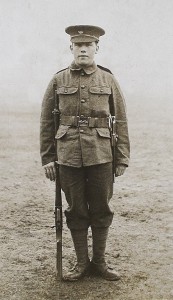
Robert Metcalf via Woodlesfordstation.co.uk

Robert Metcalf via Woodlesfordstation.co.uk

Again, what do we know about Corporal Metcalfe – well his name, his rank and his regiment, and of course, where he was from!

A very quick search through the D.C.M. Citations, came up with one :-

12/44 L/Cpl. R. Metcalf – For conspicuous gallantry in action.  Although wounded, he remained at his post and dressed the wounds of several men under heavy fire.  On another occasion he showed great courage and initiative in manning a trench after the explosion of an enemy mine. (13.2.17)

Could this be our Corporal Metcalfe?  If it is we now have an initial and a service number.  Now to the Medal Card Index with our new found information – his service number!

Well, the Medal Card Index entry for Corporal Metcalfe, confirmed by his service number, now tells me his first name was Robert.  He now had attained the rank of Sergeant.  He was eligible for the British and Victory Medals.

But what happened to Robert?  Did he make it home?  But more to the point who was Robert? Robert was born in Goole around 1894.  He was the son of Henry Metcalf and Fanny Welburn, from Carlton.  By 1901 the family were living at the Woodlesford Lock, on the Aire and Calder Canal, where Joseph Henry Metcalf, aged 54, was the canal lock-keeper.  In the 1911 census there was a Robert Metealfe (Metcalfe), aged 17 who was born in Goole.  Robert gave his occupation as labourer in the brickworks.  He was lodging with Walter Shorter, a colliery pit sinker, from Kent and his family.

A further search for Robert with his service number I found an entry on Soldier’s Who Died in the Great War and found an entry for a Robert Metcalfe, all seemed to fit, but his place of birth is given as Swillington, Garforth.  Robert enlisted in Rothwell, he is a Sergeant, in the K.O.Y.L.I.  He Died of Wounds on 17th of April 1918, had been awarded the D.C.M. – no sign of his military Medal.

Before I found Roberts name, I Googled ‘Metcalfe, MM DCM Woodlesford and came up with the following:-

WOODLESFORD KILLED AND WOUNDED SOLDIERS. – In the current issue of the Parish Magazine of All Saints’, Woodlesford, is the following reference to local military casualties: – We much regret to have to record that the war is responsible for the deaths of two well-known residents in our village. John Borman, who had only been in France a short time, has been killed in action. Robert Metcalfe, who had been in the lines nearly all the time, has died from wounds in a base hospital in France. He had greatly distinguished himself and won the M.M. and other distinction, and been promoted to the rank of sergeant. They, along with all others who have died in defence of our country, win our lasting gratitude, and their relatives and friends have our sincerest sympathy.h

Rothwell Courier and Times 1918
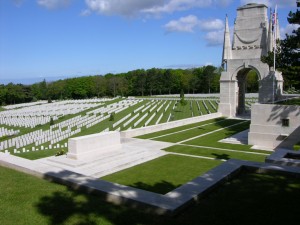
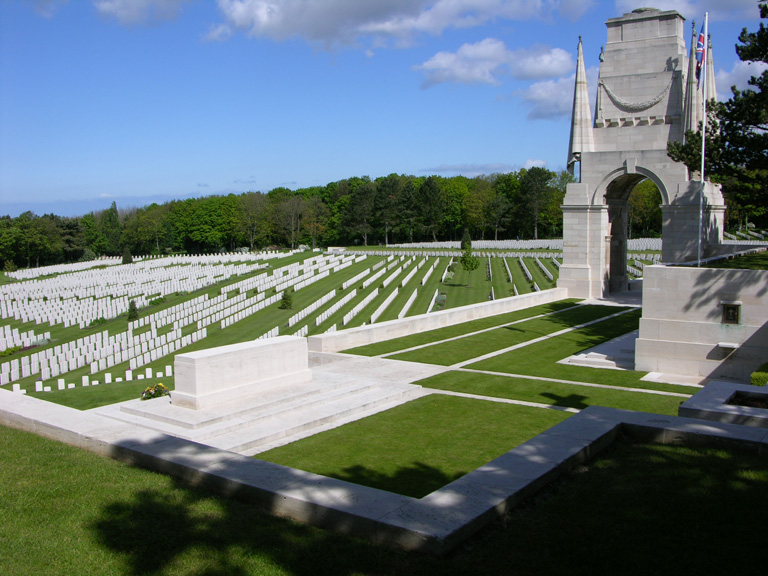
Etaples Military Cemetery via CWGC

Etaples Military Cemetery via CWGC

The entry for Robert in the Commonwealth War Graves Commission, has his name – Robert Metcalfe (no e), his service number, rank, regiment and battalion, along with his place of burial, Etaples Military Cemetery  and plot references XX1X E 10A.   He rests with over 10,770 other casualties of war, of which 35 are unknown.

Etaples and the surrounding area was dotted with reinforcement camps and hospitals, due to its location – being remote from attack, apart from aerial attack.  The area was also accessible by rail, from both the north and the south.  In 1917, over 100,000 troops were camped in the sand dunes close to the town, in the hospitals, which included eleven general, one stationary, four Red Cross hospitals and a convalescent depot, could deal with 22,000 wounded or sick. In September 1919, ten months after the Armistice, three hospitals and the Q.M.A.A.C. convalescent depot remained.

Robert is also remembered on the Oulton and Woodlesford war memorial, Woodlesford School memorial 

Wakefield Express WW1 – J W Mann, East Ardsley

J W Mann, East Ardsley found in the Wakefield Express

In the recent months I have gathered quite a few photocopies of sections of the Wakefield Express for periods during WW1.  I have extracted the information I needed but there are still little snippets of information surplus to my requirements, but could be of interest to others.

Here goes with the first snippet:-

EAST ARDSLEY SOLDIER KILLED – Information has been received that Private J W Mann, of the Green Howards, who formerly lived with his parents at Bradford Road, East Ardsley, and who had been previously reported as missing since Aug. 21st 1915, was killed on that date. Deceased who was 21 years of age, enlisted soon after the outbreak of the war.  He was an engine cleaner at the G.N.R. shed at East Ardsley.  He was a good worker in the Weslyan Sunday School, and at the time of his  enlistment he was Secretary of the Hope of Thorpe Juvenile Temp(?), Independent Order of Rechabites. His father, Lance-Corporal C H Mann is now serving in France.

Wakefield Express 10 February 1917

Not a lot to go on, but I know which regiment he served with, where he lived and worked and who his father was.  I also know where his religious leanings were.

Where to look first, to me there seems be a couple of places, but which one to search first? Commonwealth War Graves Commission – not many to chose from, but his entry may only have his initials. It may not parental information listed.  He could be entered under another regiment (if he was transferred) – retreat and recover!  Looks like the 1911 census is next for a visit.

Here he is!  Joseph William Mann, the son of Charles Henry Mann and his wife Mary Jane Hornsey, whom he married in the autumn of 1894, their marriage taking place within the York Registration District.  Their first two children, our Joseph and his sister Dorothy were born in York in 1896 and 1900 respectively. Their third child, Doris was born in Carr Gate in 1905. Charles, born in York, worked as a house painter.  Mary, one year her husband junior, was born in Newcastle. The census form has the family living at 2 Binks Buildings, east Ardsley.

Now we are on first name terms with Joseph, I stand a better chance of finding him in the CWGC  – there are two Joseph William Manns, both are Private’s, but here they differ.  One is aged 35 and the other is 20 – the 20 year old seems to fit the bill with our Joseph being 15 in the 1911 census.  Now we have access to his service number.

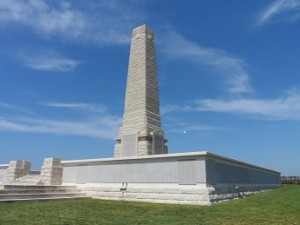
Helles Memorial, CWGC

Helles Memorial, CWGC

Joseph Mann, born in York, enlisted in Leeds. He served in the Yorkshire Regiment or Yorkshire Hussars (Queen Alexandra, Princes of Wales’ own) 6th Batt., as Private 10567.  Joseph was sent to the Balkans and it was there on the 21st of August 1915 that he was Killed in Action.  Back to the CWGC entry for Joseph and we find that he is remembered on the Helles Memorial, panel 55-58.  Additional information for Joseph, gives his parents and their address of 22 Gordon Street, Heslington Road, York – looks like they moved back to were Charles and two of his children were born – after Joseph’s death but before the details were collected for the CWGC.

The Register of Soldier’s Effects gives information we already know and  a little more – The entry tells that he was in the M.E.F. (Mediterranean Expeditionary Force), entering the Balkans on 14th July 1915.  His date of death is given, 21st August, 1915, with the following note:- Death pres? His parents are again listed as being granted his monies in 1919.

St cuthbert's War Memorial.  http://yorkandthegreatwar.com

St cuthbert’s War Memorial. http://yorkandthegreatwar.com

Although, Joseph had lived in the village of East Ardsley, he is not remembered on the village memorial.  He is however, mentioned in The King’s Book of Yorkshire Hero’s, held in a locked case in York Minster, and St Cuthbert’s War Memorial.

A little more information has now been added to that in the newspaper regarding Joseph, but what happened to Charles, his father.  Well, as he is mentioned in his sons entry in the CWGC and not entered as ‘the late Charles………..’ I feel it is safe to say he came home to his family.  There is a possible death entry for him in the September Quarter of 1953 in York.

Plague Pits of London

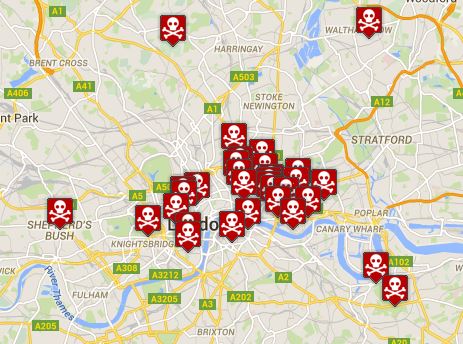
London during the plague saw over 15% of the population wiped out with the two year period – 1656-1666.  The bodies had to go somewhere and hence, plague pits were dotted over the London area.

Plague pits all over London

Plague pits all over London

Historic Uk, have made available an interactive map of London showing the reputed Plague Pits. Gathered from various sources with a pop-up information box for each skull and crossbones link.

The burials places include :- Vincent Square; St Giles in the Fields, where the church’s own site gives information about the deaths; Pitfield Lane, Hoxton, was once home to a large plague pit; Queen’s Wood, Highgate; Knightsbridge Green; Bakerloo Line and Cross Bones Graveyard – known as the unconsecrated memorial to thousands of prostitutes who lived, worked and died in the area.  The pit was used during the height of The Great Plague.

History UK, say that although there is little evidence of the exact locations of the plague pits, this information is based on various sources and is an on-going project, and as such they are always willing for information on any other sites in the area.