Category Archives: News

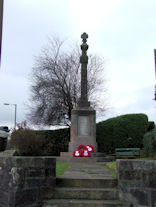
Baldernock War Memorial

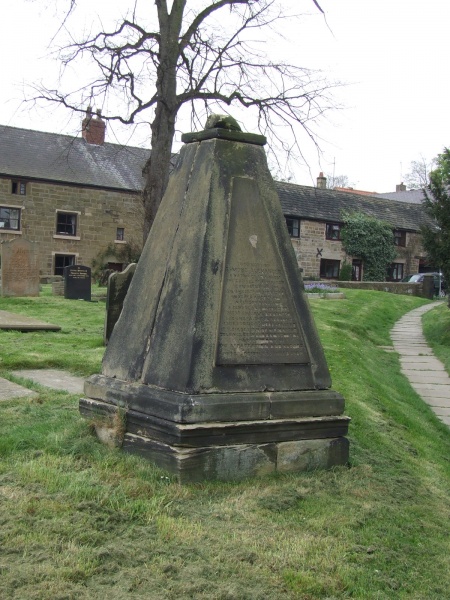
Just added the finishing touches to Baldernock War Memorial in Dunbartonshire.
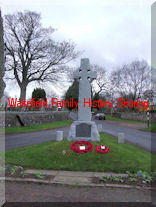
We visited on an overcast day but managed to find a gap in the clouds and take the war memorial and a few headstones in the kirkyard.  In fact, I think we found the memorial by sheer fluke and that won’t be the first time that has happened.

It is a nice memorial, set on an island of grass and as it was a late November day there were poppy wreaths and a patch of poppy crosses.  To one side of the memorial is the old kirkyard and the other has a larger cemetery.

It’s funny, most of the time I quickly get out of the car, quickly take the memorial and the names in small sections to ease transcription, and then jump back in the car.  But, sometimes a memorial touches you in some small way, it could be where it is and the view is wonderful, it could be a name on the memorial or it could just be that the memorial feels good, nice and peaceful – Baldernock feels just like that!

Who is mentioned :- William B Tinto, HMS Defence ; Major  C E Higginbotham ; Andrew Douglas MacArthur Anderson of Tullichewan Castle and George Hannah, AIF to name just a few.

To visit Baldernock War Memorial click here
Strathblane War Memorial

As I have said in previous entries I can spot a war memorial at a few thousand paces and my family always make a joke that whenever I go anywhere, there always has to be an ulterior motive i.e. a memorial or a CWGC headstone.

Over the years I have uploaded a lot of transcribed headstone from all over the country including France and Belgium  and have still many, many more to start work on.

So, today I have transcribed Strathblane War Memorial and for the majority of men have given their entry extra information – you know who were their parents, where they lived and were they finally rest or are remembered.

Some of the men include :- John Y Barr who was the son of Prof. Archibald Blair ; Wilfred Blake Moyes the son of Rev. W B Moyes and his wife Clara who was educated at public school and later Oxford and William George Edmonstone the eldest son and heir to Sir Archibald Edmondstone.

There will be a few, well more than a few other memorials being uploaded within the next week or so all from around the Stirlingshire, Dunbartonshire, Fife and Argyll and Angus areas.

Have fun and happy hunting

Digitised Australian Newspapers

Have just found this website and thought you may enjoy having a look around aswell!

So, do you have ancestors in Australia, if you do, have a look.  The date range of the newspapers and magazines starts around 1800 and goes up to the mid – late 1900’s – but there are big gaps. A seperate page lets you see at a glance what the coverage is.

What did my couple of minutes mooching find ? I searched for convict, sorry but the first thing that came to mind and I found this :-

John Horace Hays an habitual criminal who escaped from Yatala labour prison near Adelaide on Wednesday afternoon has so far succeeded in eluding the systematic efforts of the police to recapture him (Northrn Territory Times Tuesday April 15 1930.

And, our Outlands correspondent writes :- Mrs Arthur Turner of Oatlands had received the sad news that her husband, Private Arthur Turner, had died of wounds in France.  Much sympathy is felt for her and the little children (The Mercury, Hobart, Saturday 27 January 1917.

Also, there is mention of Baden Powell in one of the 1900 issues where is in South Africa.

I did searches for a few family names that I know were in Australia and did come up with some interesting information.

But, and most things have a ‘BUT’ don’t they and so does this site, very good as it is.  The niggle is that the information, the pages have been scanned using possibly OCR and as we know if the print is off a little an ‘o’ can become an ‘e’ or an ‘a’ can become an ‘o’ and some letters are left blank.

But, yes there is another one and quite a good one this time – the site gives you the option to edit the text translation, now isn’t that good and makes it easier for people who follow you to find the family or entry they want.

The site is quite easy to work your way round, and probably like me, you will wander.

Well done, Australian Trove, and I look forward to visiting again and finding lots of empty years being filled in.

Find My Past – what’s new and interesting!

Firstly, I went to the Specialist Records and thought I would have a look there as I normally just visit the 1911 census and some of the military collection.

So here I am, what should I look at ?  The Kelly’s Directory for 1901 seemed as good as any and as I have Baring people in my tree I started with Baring, clicking on Wyndham Baring.  Guess who popped up and caught my eye ? The Rev. Savine, Baring-Gould with a little biography. I tried some of my other names i.e. Siddle, Binns, Officer, Grace and le Carpentier but it only seems the distant in laws are listed – never mind I enjoyed my moochings.

Medical Registers – 1913, now I new here I would find one of mine, James Allan who with a fellow James had St James’s Hospital in Leeds named after them.  He worked at the Union Infirmary Beckett Street, Leeds – a long way from his home village.

Did you know that the Military section has Ireland’s Memorial Records – looked for Donnelly and found a couple but not sure if mine, but still interesting.  Also on the military theme and I use quite a lot when transcribing my collection of war memorials, is the Distinguished Conduct Medal Citations 1914-1920.  They certainly do put a different light on people who served and sometimes died helping others.

The Migration section also has some interesting finds – one of my Younie family worked within the Judicial system in Bengal during WW2, sadly he never came home, but did find information regarding his time in India.

To complete my quick visit to Find My Past, did you know that lots of Family History Societies have uploaded in total millions of entries from their transcription listings.  You may still want to buy the publication from the relevant society once you have found the person you want,  but you can now do that knowing that your relative is there and you may find others who link in later.

To see these and other collections click on the  Find My Past link

Medical terms

What did it say on the death certificate ?

Or what did aunt Peggy say he died of ?

Or, what did you say she had when a child ?

Half of the time when looking in old documents or certificates the meaning of terms can be very strange, take for instance – Atrophy, Bronze John, camp fever, long sickness, morphew, scotomy or spru.

If you heard the description, you would know what the problem was.

But anyway, pop along to the medical terms section on Wakefield Family History Sharing and see how many you can decipher without looking.

Medical Terms can be found here

Doric terms and phrases

Local slang terms have just been uploaded to Genblog, so I thought I had better go with the other half of my heritage, Scottish.

Have you ever heard of a kail-gullie, a mort kist or safe, a byre, a hynd, ling, kiltie?

You may have come across words similar to these in the OPR’s of Scotland or a will and not known or understood the text in which it was written.

The Doric terms on these pages could help you.

Go on, have a look!

Doric words and phrases can be found here on a sister site of Wakefield Family History Sharing

Local slang

A little ditty about ‘Bob’

If y’ur Bob dosn’t gi’ our Bob th’t Bob th’t your Bob owes our Bob, our Bob is gunna gi’ y’ur Bob a bob on’t  nose !!!!

Now you know perfectly well what that means, don’t you ?

If your Robert does not give our Robert that shilling that he owes him, our Robert will hit your Robert on the nose !!!       –        simple isn’t it!

No matter where you live  or what your social standing there are words that are associated used and only those from the locale or social circle will know.  But you will find the exception to the rule, as you always do as many of the words and sayings are known nationwide.  For example :- Gaffer or Gaffa, Boss ;  Gear, clothes ; Doff, take your cap off ; Poor Show, went badly and so on.

The Slang page of Wakefield Family History Sharing can be found here


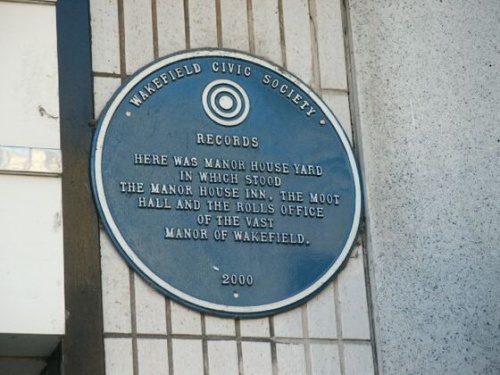
Blue Plaques

How many of us walk from A to B in the shortest route and in the quickest time. Iin every day life, probably nearly all of us. We only tend to mooch, look around and take our time when we are on holiday or a day out.

Next time you are in your village, town or city look around and look up, you will be surprised what you will notice that went totally undiscovered before.

How many bars, restaurant and shops do we only know from street level – look up, you may learn what the building was orignally used for.  Wakefield for example, has a street known as Westgate.  In modern times most popular for its ‘Westgate Run’.  Westgate, a long street, one of the main entries and exits of the town had a very large number of public houses, the ‘run’ was to have a drink in each of the pubs.  The ‘run’ has now changed slightly as the pubs have now been superseded by bars.

If you looked up while walking down Westgate you would see that the majority of the buildings, grand buildings, were at one time banks.  These banks were needed in previous centuries due to the amount of money that was changing hands in the area, either from the great cattle market held only a couple of minutes walk away or the number of merchants that were in the area who did their business in the old cloth hall.

Look around, you never know what you might find – images of Wakefield’s Blue Plaques can be found here

A list of the Blue Plaques with a short description of where the plaque can be found – click here

Lots of other towns have their Blue Plaques on the internet for example :-

English Heritage Blue Plaques – mainly London and the surrounding areas
Oxfordshire Blue Plaques
Tameside Blue Plaques
Canterbury Blue Plaques
Windsor Blue Plaques
Birmingham Blue Plaques

Why not look around the place where you live ?

Who voted for in the Borough Election on 12th June 1865 in Wakefield

The Poll Book of the Wakefield Borough Election
Wednesday 12th June 1865

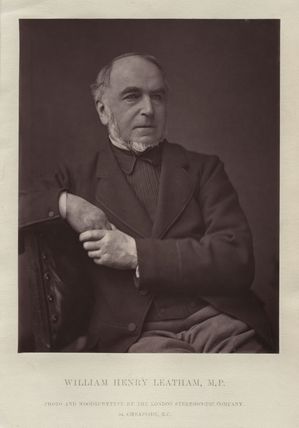
Who voted for the Liberal, Mr Leatham, who voted for the Tory, Sir J C D Hay and who did not vote.

Wm Henry Leatham
It was after the great Reform Bill of 1832 that Wakefield became entitled to send Member to Parliament. The first Member to be elected was Daniel Gaskell of Lupset Hall in December 1832. Gaskell was re-elected in 1835.
Have you ever wondered if your Wakefield ancestor voted and more to the point, who he voted for !
Well the scanned images of a small booklet can answer those questions.
Mr George Green Binns of Wood Street and Mr John Binns or Northgate both voted for Mr Leatham, as did Messrs., David, Edward, John, Robert Jefferson, Mr Robert Bownes Mackie all of Cliffe Field House.
While, Mr W H B Tomlinson of Calder House, Mr Alexander Mackie Child of Park Street, Charles Joseph Cambridge of Vicarage House and Benjamin Blackburn of the Fair Ground all voted for Sir J C D Hay.
But who didn’t vote – James Aspdin of St Johns, Guy David Fernandes of Sandal, Charles Roberts who had left the country, Thomas Giordani Wright of Westgate and Frederick Edert.
If you have family from Wakefield, take a look at the book, you never know what you may learn or who you may find.
To view the Poll book of the Wakefield Borough Election on Wednesday 12 June 1865 click here

Names, but this time Latin

I’ve just published a couple of Blogs on names and naming traditions and it seems logical to follow on that thread with a few names in Latin, after all, we all have to look at Latin registers or documents at some time – we don’t always want to………….. but needs must.

A few years ago I put together a list of Latin names with their modern equivalent i.e. Gualcherus – Walter; Guido – Guy; Jacobus – Jacub/James; Guliemus – William.

Go on, have a look or bookmark the site for future reference – click here