Tag Archives: History

History in a Wardrobe

What a wonderful way to learn about capsules of time – through a wardrobe, or should I say what is kept in a wardrobe.  But Lucy Adlington has a unique, informative and enjoyable way of bringing history alive through her History Wardrobe talks.

A friend of mine has known Lucy for many years, becoming friends by attending  one of Lucy’s talks and asking questions afterwards.  Talk, does not seem the right word as the events are more than that – more like a walk through a period of time with the audience being a friend or someone to have a conversation and a joke with.

I met Lucy earlier this year when my friend suggested I go to one of her events – that didn’t go to plan as the traffic was terrible and I arrived a little late. Lucy had started and  was all decked out (ouch!) in her finery as a first class passenger on the Titanic with her ‘husband’.

The changing of costumes during a day onboard the Titanic was wonderful, interspersed with jovial banter from the pair and was a delight – just like being party to their private jokes.  Then sadly the news of the iceberg reached the passengers and we follow the couple as they tell what happened to them – I won’t give away who their characters are as that would give away the ending!!

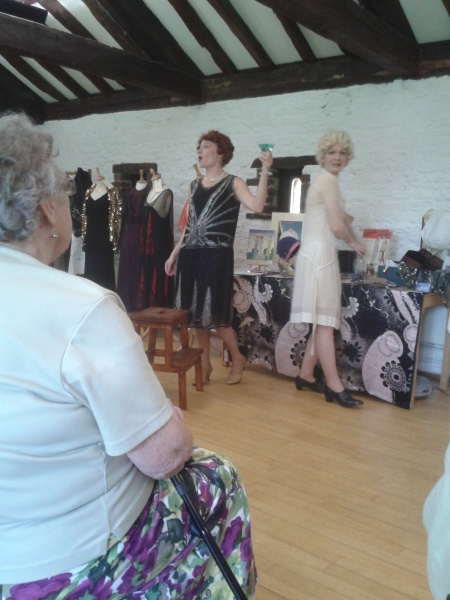
I next saw History Wardrobe when Lucy was in Agatha Christie mode during the 1920’s onwards and with the help of Merry wore some wonderful and original costumes from morning attire, day wear to an evening dress that would not be out of place on the red carpet today.  The duo worked off each other with quips and remarks flying fast and furious.

But seriously, the costumes together with snippets of Agatha’s novels went down a treat.  As with most of Lucy’s talks there are extra costumes on mannikins and memorabilia from the  period.

My latest show was ‘A woman of a certain age’, about Jane Austen and women in various times of there life in Jane’s  novels – the girl, the spinster, the married woman, the dowager, the widow and the ‘lady of a certain age’.  The costume worn by Lucy was simple but very striking.  Lucy de-constructed the dress, which in some places was held together with pins.  Hats were worn, flouncy capes worn, sections of Jane’s novels were read as examples of the times in a woman’s   life. An enjoyable time was had by all and many in the audience have been to more than one talk.

So, who is this lady that travels the country doing what women like doing – dressing up and talking?  Lucy is a graduate of both Cambridge and York Universities with degrees in English and Medieval Studies.

Cocktail anyone?

She has run workshops, given presentations and with her hands-on approach  is always in demand.  As well as all this Lucy is an accomplished author of childrens and young adult books.

A full diary of events can be found on the History Wardrobe website, so where ever you are in the country you will be able to see an event……………BUT !!!  keep it a secret, as I want to be able to get a seat!!!

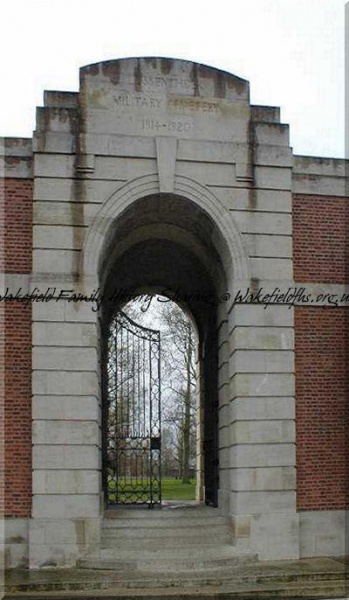
Lijssenthoek Military Cemetery – Who is resting in peace

Lijssenthoek Military Cemetery nr Poperinge has a very special place in my heart, not only does my great uncle rest there but Nellie Spindler from my home town also calls Lijssenthoek ‘home’.  But recently while doing a bit of research I came across another man whose final resting place is also Lijssenthoek – Conrad Hugh Dinwiddy.
I think his name sounded similar to a place we used to stay on our way up to Lhangbryde when I was a child, so what do you do, or should I say ‘I do’ but find out a little about him………you know the thing, who were his parents, where did he live and what did he do before joining the forces and who survived him.     Here goes….

While waiting for a website to open I thought I’d try Wikipedia – lots of info there, not always correct but is somewhere to start and to my surprise there was not an established page for Conrad, there is an opening if any one wishes to start a page for him.

Here we go !  Conrad was born early in 1881 to Thomas Dinwiddy and his wife Eliza Charlotte nee Rooke (b. 1845 Marylebone).  In the census shortly after Conrad’s birth Thomas was aged 37 and was working as an Architect and Surveyor (b 1844 Bristol).  The family lived at 12 Croom’s Hill, Greenwich (now the London Fan Museum)– the road was home to other professionals and retired servicemen incl. William Rivers Retd., RN; Gay Shute, Surgeon; Thomas Creed(?), General Practioner MRCSE St Andrews Uni.; others include Stationers, Annuitants.

Thomas Dinwiddy is noted for having designed the main administration block (Grove Park Workhouse) of what was Grove Park Hospital. The plans were approved in 1897 and the foundation stone put in place 2 years later.  The plans were presented at the Paris International Exhibition in 1900 and won a Diploma of Merit. One of the local roads is named after Thomas.  In the early 1990’s the site was sold for housing development but Thomas’s administration block and a some of the original workhouse buildings survived.  The site had not been listed by the local authorities.  One of the buildings designed by Thomas did manage to get a listed status – Laurie Grove Baths including : swimming baths, slipper baths and launderies were designed in the mid 1890’s commissioned by the Vestry Board of St Paul’s Deptford under the Public Baths and Wash-houses Act of 1846.  The building is of Jacobean style and still has many of its original features.  A few other buildings by Thomas were Greenwich Board of Works Offices and Roans Girl’s College, Greenwich.

Ten years later, 1891, Conrad was hard to find on the census but eventually by just putting his year of birth +/- 2 and Greenwich as his place of birth he is found. He is at a school with some of his brothers in Walmer, Kent.

Another ten years on in 1901 the family are at The Manor House (?), Croom’s Hill – Eliza with her children, Conrad by now is classed as a student, and four servants but no Thomas.  Thomas was in fact staying at the Adelphi Hotel, Ranelagh Place, Liverpool with people from all walks of life incl. George Herbert Lindsay of Edinburgh a Distiller; Daniel Shurmann a Merchant  born in Russia.  That solved that problem, so now forward a few years.

On 27 September 1909, Conrad’s elder brother Malcolm, Capt., Royal West Kent Regt., who had served in Singapore, married  married Miss Laura de Satge, dau. of the late Mr Ocar de Satge, late member of the Upper House of Queensland.  The wedding took place in Folkstone and Conrad was the Best Man with various cousins from both sides being bridesmaids.  Guests included Lords and Knights of the realm and serving regimental Officers

The 1911 census finds that Conrad is now a newly married man.  He had married Winifred O Pochin in the Autumn of the previous year.  Conrad worked as a Surveyor employing a number of people and they lived at 76 Warwick Gardens, Kensington, a nine roomed house, with a number of servants and was a member of the RICS, which held a portrait of him.

Conrad served in the military and various entries in The London Gazette have him serving in various ranks incl. Temp Captain.  But it is The Medal Rolls Index Cards that tell a better story.

Conrad initially served in the RFA as 157860.  Later serving in the RGA as a 2/Lt., and now has no service number as Officers were not issued with a number at this time.  He is later in the 13/Siege Bty, RGA as an A/Major, then Major, with a medal entitlement of The Victory Medal and The British Medal.

Conrad was the inventor of the ‘Dinwiddy’ Range-finder for detecting enemy aircraft – this was adopted by the War Office. He was also a Councillor for the Borough of Kensington and a known mountaineer.

C H was one of five children and had three brothers in the services.

Conrad Died of Wounds received on 27 September 1917 aged 35, leaving Winifred and a young son, Hugh P Dinwiddy born in 1912.

Conrads brothers – Major Malcolm J Dinwiddy, as we have already said he married in 1909.  He served in  the Royal West Kents  and applied for his service medals in June of 1920.  He died on 19 November 1925 aged 46 and had at least one child. Probate was granted to Laura Emily Dinwiddy, widow or Fairview, Osborne Road, South Farnborough.

Donald Dinwiddy, married Ella May Jones in 1909.   He died on 19 February 1937.  Probate was granted to Ella Mary Dinwiddy of Red Cottage, 54a Parliament St, London

Harry L Dinwiddy. Harry Lurwyche Dunwiddy  married Ethel Maud MacArthur in 1903 and by 1911 they were living at 13 Pond Road, Blackheath with their son Thomas Lurwyche and a number of servants – Harry working as a solicitor.  He was living at Little Paddock, White Beam Way, Tadworth when he died on 21 April 1950.  Probate was granted to Thomas Lutwyche Dinwiddy, solicitor on 8 June of that year.

Conrad also had a sister – Dora, she married Stanton Freeland Card, a Royal Navy Instructor, in 1902 and by 1911 they were living with their three children and a few servants at Parkhurst, Westcombe Park Road, London.  Stanton of 24 Crown Lane Gardens, Streatham died at Putney General Hospital on 6 October 1940 with probate granted in Llandudno on 2 July to Westminster Bank Ltd.  Dora of Lawrence Road, Hove died on 24 March 1945 with Probate being granted in Llandudno on 20 December of the same year to Harry Lutwyche Dinwiddy, Solicitor.

Sources :

Singapore Free Press and Mercantile Advertiser. Issue 29 Mar 1909, page 5

Ancestry.com.

Freebmd

The Fan Museum

Heritage-explorer.co.uk

Archiseek

Lost Hospitals of London

Flight Global

Tedbah Siddle ??

I started my family history nearly 30 years ago.  I had no grandparents and only one parent.  After my Scottish grandfathers death that side of the family seemed to drift off a little – as families do when the hub goes away.  That has, I am very pleased to say been rectified.

But, back locally, my grandmothers maiden name was Agnes Siddle and she married Ernest Wilkinson.  My aunt was born in 1907 before grannies marriage to Ernest.  I remember asking her as a child ‘why does daddy have a different name to you?’  I was told that grandma married twice – a plausible answer and as a youngster it shut me up.  Oh, aunty, if you knew what I knew now!!!!

While looking though Ancestry for any trace of my great uncles military service – 4 of my grandma’s brothers fought in the Great War, with 3 coming home again to their family, I kept coming across this young man – Tedbah Siddle.  Who is he ? And does he link into my Siddle line?  Tedbah can sometimes be found with the spelling, Tedbak and Tedbor.

Anyway, who is he?

Well, I know he has a service record, so I’ll come back to that later but starting with the census, 1911 as I know he served in WW1 and that’s the nearest census to that milestone in his life.

The 1911 census has Tedbah aged 28, being born in Heckmondwike, a worsted spinner, living with his mother and 4 siblings at Walker St, Littletown, Liversedge.  Tedban’s mother was either very formal or chose to be a rebel as she wrote in red and her entry reads:- Mrs Siddle, head, aged 50, married 29 years, 10 children with 8 surviving to the census, works at home and was born in Gildersome.  But she signed Mrs E A Siddle – a small clue there.

Tedbor Siddle, according to Freebmd was registered in Dewsbury in the September Quarter of 1881 and this was confirmed by looking at the GRO Indexes.

Back to the census – I thought Tedbor or the variations in his name would be the stumbling block in this trail.  I searched the census for all the ways his name had been found – Tedbor, Tecbak and Tedbah and still none of his family could be found.  A search for his mother would be very long and hard as all I had found in the 1911 census was her as Mrs E A Siddle.  A sibling, that would be the way to go, try and find one of Tedbor’s siblings who was a similar age and hopefully pick up the man himself.

One of Tedbor’s siblings, Amanda was born in 1892, therefore she should be in the 1901 census.  Amanda Siddle born 1892 +/- 5 years found nothing.  So in for the long haul – a search for an Amanda born around 1892 in Yorkshire that could take time.  But, not as hard as I thought just around 460 entries and I quickly started at the last page and worked back, came to the s’s and there she was Amanda Siddal and I thought Tedbor would be the stumbling block.  So 1901 who were this family and were was Tedbor.   Well, Mrs Siddal was there and her name was Emma, she was aged 40 and a cloth weaver born in Gildersome.  Tedbor was there now entered as Ted aged 18 and a woollen twister.  There was a Jane aged 16 and a worsted spinner.  Alonzo aged 13 also a worsted spinner.  Robert aged 7 ; Ada 5 ; Norah 3 and Amanda aged 9 – no idea why she is out of age order.  But where is Mr Siddal as Emma states she was married.  Back another 10 years to find out as he must have been around within the last 3 years at least – well according to the ages of the children !

What I find in the 1891 census, I did not expect.  We have Emma A Siddal, giving her status as mother, aged 30 and still a cloth weaver.  We have Clara E Haigh, daughter aged 11 a scholar born in Dewsbury. There is, what looks like, Delert Siddal (our

Carol Sklinar 2010

Carol Sklinar 2010

Tedbor) aged 8. Jane A is there aged 6, along with Alonzo C aged 3 and Olive C aged 1.  But, as the head of the household is one Joseph Crawshaw aged 40 a warp dresser born in Dewsbury.

Tedbah Siddle was in a marriage entry for the December Quarter of 1911 in North Bierley to Gertrude Wooller the exact date being 11 December 1911.

Back to the service record, where I initially found Tedbah – There are four entries for Tedbah with the first being dated 1905 when he is Attesting for the Militia or Reserve Div.,   He  joined the 3rd West Riding Regt., no. 14948.  He was single and aged 22 years 6 months and a millhand – all this we know from census and birth entries.  He said that he had served/ was a currently serving with the Volunteers 1st Bn W R Regt., and that he had purchased his discharge.  Further paperwork goes on to bring him more to life – he was 5′ 3″ tall, weighing 113lbs, with a fresh complexion, brown eyes and hair and worshipped within the Church of England and had no distinguishing marks. The Army Recruiting Office wrote to the local police to enquire about Tedbah, the reply came back that they knew him to be of good character.  A reference from Joseph Armitage, Manager stated that he had know Tedbah for over 12 years and last saw him 3-4 days ago (from date of signing Jan 13 1905) – Joseph commented that Tedbah was sober, honest and respectable.  Tedbah attending various training sessions.

In 1913 he re-enlisted after notice, by now he was a married man, his writing had become a more confident hand.  He was part of the B.E.F and rose through the ranks becoming a  Company Sgt., Major.  He ceased to be a CSM when he was transferred to the Heavy Branch – M.G.C and now his army number changes to  7870644.  He was wounded  and a letter from Mrs G Siddle of 4 New Brighton, Oakenshaw, Bradford dated July 14th 1921 asks  if she could be supplied with the following information.

“Is 14948/7807

644 Sgt T Siddle MGC yet demobilised or is he yet serving in the H M Forces.  He has been in India for the last two years (or there abouts) and is at present in this district, and is reported to be on six months leave prior to been transferred to South Africa.  I was given to understand that in July 1919 he had re-enlsited for a period of four years.  I am his lawful wife and am curious to get correct information on the matter and herby appeal to you for such. Thanking you in antisipation for an early reply.  I am Sirs, yours truly, Mrs G Siddle”

A reference in his army records gives the answer to Mrs Siddles question.  A margin note for Tedbak said that he was placed on the married establishment list, in view of the fact that he is separated from his wife by mutual consent.  There was a type written reference to this by his Commanding Officer, basically saying that as he had entered a status of married on the Attestation that had stood as there had been no update to this saying he was now separated.  The regarding his marital status would be altered and that ‘the soldier’ would proceed to Deolali enroute to the UK.

Note – Deolali – a town in India where the Deolali transit camp was based.  It was known for being an unpleasant environment and boredom and many soldiers with psychological problems pass through its portals – hence the terms ‘gone doolally’ and ‘doolally tap’ – terms for someone who  has ‘lost their mind’ possibly due to the stresses of war.  In Urdu the word tap meals a malarial fever.

One part of his service records was an award for the D.C.M. and he should be presented with such in accordance with the Northern Command Authority.  His citation reads “For conspicuous gallantry and resource at Ypres on the 20.3.1915 when he held on to a position with his section, although the trench was destroyed by the enemy;s shell fire, throughout the day until relief arrived.  During the defence of his post he managed to take back a report to his company, from whic

h he was cut off, under heavy shell fire, and then returned to his section. He was wounded during the day. “ This report answers an earlier entry in his records.

Further information gives information that Mrs Siddle was requesting that her husband acknowledge that he is the father of at least one child, a child that will come into the world very soon. He acknowledge two children, Gladys Irene born 15 April 1912 and Mabel born 12 October 1916 (Mabel is the unborn child referred to)

I’ve done a potted history of Tedbor and his siblings, found out his mother’s name and eventually his father’s.  But I still don’t know where his name comes from – is it a family name ? A search of Freebmd only lists one Tedbor and the Army Records, as we already know, shows up Tedbah, while the GRO gives a zero result.  I am no nearer to know where nor why he was given that name………………May be someone reading this knows !

Addendum – Cleckheaton Advertiser and Spen Valley Times Page 2 July 1st 1915 has an interview with Tedbah about his exploits – he was in line for a V.C. but received the D.C.M. instead.

Andrew Moynihan, Wakefield’s V.C.

If you mention the name Andrew Moynihan to anyone, do you think they will know of him?  Was he a criminal? Was he a business man?  What is his connection to Wakefield? Well, who was he?

As Ancestry have included a database of Victoria Cross Recipients on their vast website – wonderful I thought as it could help me with additional information when transcribing war memorials for my website.  So, to see who is there – a search with no criteria completed except the place, Wakefield.  To my surprise only one entry, Andrew Moynihan – lets go looking for him.  From his Ancestry entry I know he was born in Wakefield, in Saw Yard to be exact, in January of 1830 but could not find a baptism for him,  He could possibly have been a Catholic so would more than likely still be held by the church, not to worry. A search of FamilySearch soon came up with the goods – 14 March 1830 in St Austins Catholic Church, Wakefield with parents Malechy Monaghen and Ann. So on to the census of 1851 with his name, year of birth +/- 5 and his town of birth, Wakefield – again no joy.  Various search information was included and excluded, ending up with Andrew and Wakefield but still no entry for him.

One not to be beaten I googled him and came up with a site for Manchester people which did shed a little bit of light on him – the family moved to Dunkinfield when Andrew was a young child.  My search now went to the other side of the Pennines.  His early life seems to be a little mysterious but some sources say he worked in a couple of local mills and worshipped at a local Methodist Church.

At 17 years old he enlisted in the 90th Regiment of Perthshire Volunteers, who at the time were stationed in Ashton.  Aged 23, on the 31 December 1853, and with his name now being spelt Moyniham,  he married Ellen Parkin in Ashton Parish Church. With the outbreak of the Crimean War in 1854, Andrew and many others were sent to fight the Russians.  The following year he was awarded the Victoria Cross.

His citation in the London Gazette for 24th February 1857 states : Ensign Andrew Moynihan (note change of spelling), 8th Regiment, late of the 90th Regiment.  When Serjeant, 90th Light Infantry, at the assault of the Redan, 8th September 1855, he personally encountered and killed five Russians.  Rescued from near the Redan a wounded officer, under heavy fire.

The initial attack on the Redan Fortress at Sebastapol failed but Andrew’s actions made further attacks possible. Despite heavy Russian fire and being driven back numerous times Andrew re-entered a building to  rescue an officer but was wounded and taken prisoner.  The British were repeatedly pushed back to their trenches but further attacks enabled him to escape and save a wounded soldier despite his own injuries – Various reports say that he had 12 wounds by the end of the day.

A hero’s welcome greeted him on his return home to Dunkinfield and various presentations were made to him but in 1857 he received from Queen Victoria his Victoria Cross.

Andrew later served in Ireland, the Indian Mutiny, Gibraltar and Malta and it was in Malta in 1867 that he died of Typhoid Fever at his home in Floriana, and rests in La Braxia Cemetery (Section S, Grave 182).  He is also mentioned in memorium on the headstone of his daughter, Ada, in Lawnswood Cemetery, Leeds.

Although, Andrew did not stay in Wakefield for very long at least we can say he was born within our city boundary.

Footnote – Wikipedia has an entry for Berkeley George Andrew Moynihan, who is listed as the son of Andrew.  He moved with his mother to Leeds, where he was educated and later educated at the Blue Coat School,  London and later at the Royal Naval School.  He returned to Leeds to study medicine and joined the Leeds General Infirmary as a house surgeon, reaching the height of consulting surgeon in 1927.  During WW1 he was on the Army Advisory Board and by the end of the war held the rank of major general.  He also served as President of the Royal College of Surgeons.  He was knighted in 1912 and created Baronet of Carr Manor in 1922.  In 1929 he wa raised to the peerage as Baron Moynihan of Leeds.

Sources :-

Ancestry

Civilian and Military heroes of Manchester

FamilySearch

Wikipedia

La Braxia Cemetery

Blue Plaque tribute to Andrew Moynihan

Find My Past ie

Create your Irish family tree with Find My Past.

You can now create your Irish family tree online thanks to the launch of Find My Pasts latest lauch.  So whether you are a beginner or an experienced genealogist their software can store all the names in your tree in one place and you can access this information from any computer.

As I have just said you can create your family tree with Find My Past i.e. but they have also just added to their ever growing cornucopia of information over 4 million, yes 4 million names from the Irish Prison Registers.

Click here to start building your Irish Family Tree

Or click on the logo to visit Find My Past ie

If your family is not from Ireland but the UK or Australia here are a few links for you. Both sites have a vast array of information from census (England and Wales), Religious records, Military, Directories + lots more – take a visit and find out how Find My Past could help you.

Above is a free trial for Find My Past with lots of UK records or click below to start building your UK Find My Past tree

And finally, click on the banner below to start or add to your Australian research.


Men from Wakefield in Lijssenthoek CWGC

Resting in Lijssenthoek CWGC Military Cemetery are over 35 young men from the Wakefield area.  I know there names and in which section they rest but only two I know very well – one being my great uncle Herbert Siddle.  Herbert was 1 of 13 children born to Charles Siddle and his wife Emma Mills – Emma lost 3 of her children within months of their births.

The siddle family lived in the Kirkgate area of Wakefield, with cousins living just up the hill on Warrengate, Stanley Road and in the East Moor area.

Herbert was born in  Wakefield in the year 1892 and by 1911 he was a driller at the local boiler works, living with his parents, 4 siblings, a nephew and a niece, an uncle and a boarder on Hardy Croft, Wakefield – 11 people in a 5 roomed house.  I was brought up in that house and I can’t imagine how it would have been living in a house with a dining kitchen, front room, 2 double bedrooms and an attic.  It would have been so different from when I lived there with my parents.

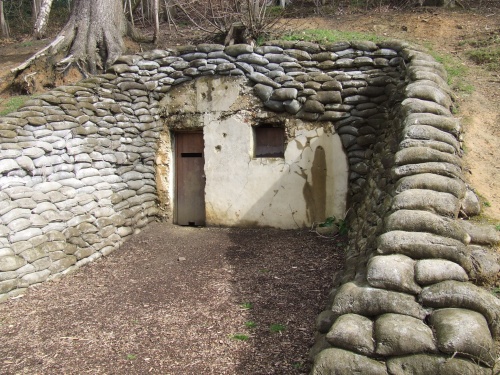
Herbert enlisted in Wakefield, joining the KOYLI and becoming Pte 242874.  He had been wounded in the Somme and sent home to recuperate before being sent back to France and Belgium.  In April of 1918 he was in a trench and was shot in the neck.  Very quickly he was taken to a Dressing Station at Kemmel before becoming one of the many who are KIA.

Kemmel Wood bunker copyright C Sklinar 2008

Mrs Siddle had 2 other sons serving in WW1, Claude served as 241166in the RFA; Edwin served as 268976 and had been in in the WRVAD Hospital – he had been awarded, along with his other service medals, the Silver War Badge which he would have worn on his lapel to show he had been injured out of service.

Coming forward many decades to the 1980’s my father and I often met and chatted with an old gentleman whom we met while shopping.  After not seeing him for many months I mentioned to dad that we’d not seen him in a while, to which I was informed that he had died.  The conversation went on about the gentleman only for it to be brought up that this man was next to or very near great uncle Herbert when he had been shot !!!  By the 80’s I’d already started the family tree and there are no words to describe how I felt at this moment – should I scream ‘Why did you not tell me?’, utter a few choice words or just throttle my dad.  The reply I got from a bemused father was ‘Well, didn’t think you’d be interested’, like hell!!

I could have throttled my dad but could give my great grandma a very big hug for she kept all the paperwork from the army, including an eye witness report from Sgt Greasby and the Red Cross along with a newspaper from the time with Herbert on the front page. The local paper tried to put a picture of the young men on the front page  when Wakefield lost a son, brother or father.

I have this about my Wakefield soldier but do you have a soldier from Wakefield or know anything about your Wakefield soldier who was KIA or DoW during WW1?  Please let me know.

Please contact me with information.

Heritage Weekend 2011

Every year I make a point of visiting churches, homes and halls that are either not open or you have to pay to get in – I prefer to visit the  wonderful places that are only accessible on very few occasions and have been known to plan my visits and routes weeks in advance.

I seem to have visited the local places on more than one occasion and to my disappointment there are no new places signing up to the Heritage Weekend Scheme in Wakefield.  We have an array of wonderful buildings in the area so come on get organised, get volunteers an OPEN next year !

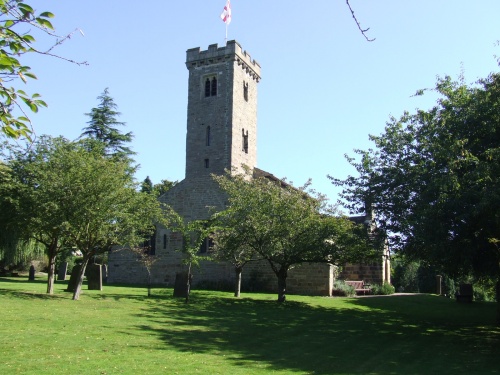
Bardsey Church C Sklinar 2007

Now, back to this year, bookmark these dates 8-11 September – what is open that we can go and visit:-

The Chantry Chapel, Kirkgate, Wakefield  Sunday 11am – 3pm

Clarke Hall, Stanley Road, Wakefield          Saturday 10am – 4pm

National Coal Mining Museum, Wakefield Saturday/Sunday 10am – 5pm

St James’s Church, Denby Dale Road, Wakefield Saturday 10am – 12 noon

St John’s Church, Wakefield Saturday 1pm – 4pm

St Peter the Apostle’s Church, Kirktgthorpe, Wakefield Saturday/Sunday 12 noon – 4pm

The Gissing Centre, Westgate, Wakefield Saturday/Sunday 2pm – 4pm

Wakefield Cathedral Saturday 10am – 4pm

Wakefield Civic Society Guided Walk, Saturday/Sunday 12.30pm – 3.30pm


Further information about the above can be found by clicking here as some of the properties have limited spaces and need to be booked prior to your visit.

But you may not live in the Wakefield area and don’t really want to travel far, so what else is open a little further afield.

Here are a few you may wish to visit :-

Lister Lane Cemetery, Bradford ; Manningham Walk, Bradford ; Halifax Playhouse ; Halifax Town Hall ; Shibden Hall, Halifax ; Masonic Lodge, Haworth ; Brotherton Library, Leeds ; Farnley Hall, Leeds.

Heritage Weekend information click here

Open House London information click here


Imperial War Museum in the North

After trying to arrange a visit for a few weeks and work always getting in the way I finally got there!

Did I enjoy my visit ?  Was I disappointed ? Wait and see !

Firstly, the museum was reasonably easy to find and we only went twice around a roundabout once – I must add I was not driving and the front passenger did give good directions and in plenty of time – I say no more!

The car park was larger than I expected with enough pay machines BUT I was disappointed that people with a Blue Badge even had to ‘cough up’.  One thing I did like, but did not seem to be well advertised was a cabin, a wooden hut that gave change – a good idea.

The building seemed strange, not because it was modern and industrial but seemed lifeless, now was that a play on the subject within, I don’t know.  We entered via a large tower, at the time seemed pointless and a waste of space and money – we were peering through the slatted sides of the tower as we went in and it seemed one big void.  On entering we found it was basically a lift shaft to a viewing tower and a charge of £1.40 was made for the journey to stand over a chasm – not flippin’ likely!  Passed the lift ladies have their handbags searched, yes, for good reasons, but why only women and why only handbags?

Although the museum is free entry you are still funnelled via a ticket machine and a little persuasion is made to purchase a guide.  Ticket entry via a turnstile would be ideal, you would still get a ticket, they would still know how many people are in for fire regulations, you would not be badgered into buying a guide (unless you wanted one) and on exit you go through a similar turnstile – at the moment you are ticketed, counted on the way in, but there is no count on the way out – does not seem right when fire regulations come into it

Mini moan over, we entered the museum which is on the 1st floor.  Well, as we entered the first hall my companion and I decided the outside matched the inside – it was claustrophobic, even though the hall was very high, oppressive and depressing.  I’ve been in many military and war museums over the years and never felt this on entering.  Yes, war is a harsh subject but never have I felt this on entering a museum before, even a modern museum.

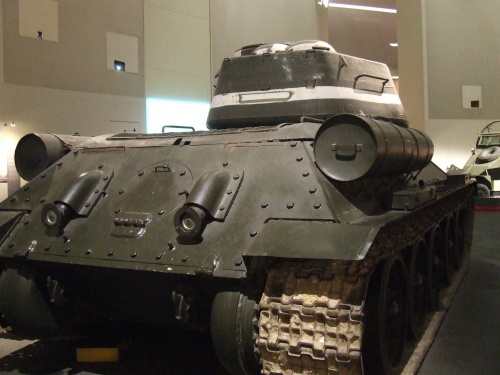
A Harrier Jump Jet was the first thing we saw, mounted in mid air – what a wonderful thing to greet you, they always seemed larger in flight.  The halls were very spacious, only the tank, a Trabbant, and other large displays on the floor – still leaving a very large amount of open floor space.  The main exhibits were in cabinets within the walls and for the amount of space there was not that many.

copyright C Sklinar 2011

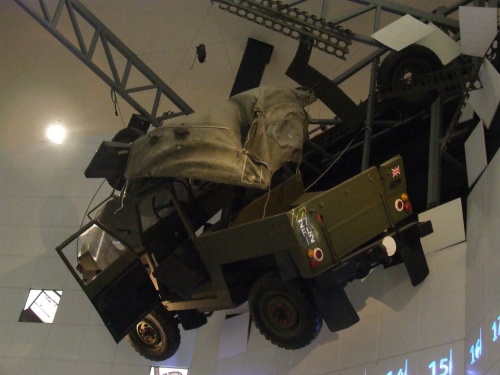
The cabinets did hold some fascinating artifacts for example: – A souvenir In Loving Memory of the women and children killed in an air raid on London on June 13 1917, War Bonds and one or two cabinets dedicated to people with a definate story.  I’ll blog about those later. I was surprised that how much wall and floor space there was there did not seem a great deal of artifacts on display.  I could have spent time spelling what it was like in the trenches, what wet smelly socks smelt like or what a lot of men together for a long time with no where to wash or limited facilites also smelt like – that was one for the kids as were a lot of the displays.

While we were in the main hall a visual display started and the already dimly lit room went virtually dark apart from the illuminated images on the walls and the slide show.  If you only wanted to listen to the slide shows description, walking around without tripping over someone who was sat down or just standing around was a task.  The darkness also made reading any description in and around the displays a waste of time.  When the lights came back on it was done quite gradually.

The museums history of war started with WW1 and went up to the present, with a special display telling of the fantastic work that war correspondents do in time of conflict.  One of the displays in this section was for want of a better word a chart showing how many journalists from all over the world have had their lives taken by the very thing they wanted to tell the world about.

copyright C Sklinar 2011

Time to check out the café! Yes, it was lunchtime but the queues were reasonable apart from the picnic section and one lady with a hoard of children who could not make up their mind.  Overtaking them and going straight for the kill – coffee and cake, the prices were reasonable and the portions very good.  The pork lunch served with all the trimmings was very good value and looked fantastic.

Yes, I bought a book, again that information is in another blog, but I also bought two other items, but can’t tell you about those as they are ’stocking fillas’ for christmas.

The shop had the usual bits and bats for children and then some very nice memorabilia, gifts and some wonderful jewellery made from buttons in all shapes, sizes and colours – so unusual and very retro.  After this I, we, homed in on the WW1 books but we were both disappointed in the small display.  The sections for wars post WW1 was far better, but not really my or my companions main interest.

Would I go again to the Imperial War Museum in the North, I don’t think so; next time will venture to the original in London.

If you do wish to visit a wonderful place full of interest and packed with information, artifacts and displays that suit children, military personnel, veterans and those with an interest in all things military,  visit the Royal Armouries in Leeds.  On the various floors there are good displays from all over the world – from the UK to India and Japan , from times gone by to modern warfare and policing – go on pay it a visit.

To see information about the Imperial War Museum click here

To see information about the Royal Armouries, Leeds click here

To see information about the Royal Armouries, London click here

Charles Dickens Exhibition

Last weekend I spent a few days with my daughter in France.  While we travelled in the Eurotunnel we noticed a sign promoting the Charles Dickens Exhibition in Hardelot, it was something new to visit so we may give it a go.

During Saturday we had taken our time over breakfast and then just pottered around – visiting the local Auchen, and then mooched around St Omer, ending our leisurely visit in a local bar having a coffee while we people watched.  The coffee, now that was an event in itself as we waited 20 mins for it to arrive only to go to the bar and fine the person who took our order did just that took it but did nothing else with it.  It was ok when we fetched it ourselves.

Later that evening we went to our local restaurant for a wonderful meal and a few drinks – wine for my daughter and Kir for me.  After our meal we sat outside in the evening sun and chatted to a family friend.  Isn’t it funny how things happen.  As we all stood up to say goodnight there was a young couple on the next table, as we departed I used the phrase ‘like an asthmatic pit pony’ commenting on something said by our friend. At those words the young man grinned, I smiled and said was he amused by what I had said.  It turned out he had been sat there working out where our accents came from – seems he lived only a few miles from us.  That is not the first coincidence that has happened there, a few years ago I was walking back from the bar and chatted to a couple.  After the usual where are you from etc., it turned out that she was my cousins wifes cousin – she is on my family tree but now I can put a face to a name.

Anyway, Sunday came and off we set armed with bread, meat and drinks to see the Castle at Hardelot. I think I was a little bit disappointed with the entrance, just the rather sorry looking stone posts standing with no gate or barrier and no wall to make an impressive statement.  But we entered through the narrow passage and came upon a track with a few parked cars and open areas with picnic tables full of families having lunch – it was Mother’s Day in France.  The dusty track lead to a country walk, a lake and ofcourse, the castle.

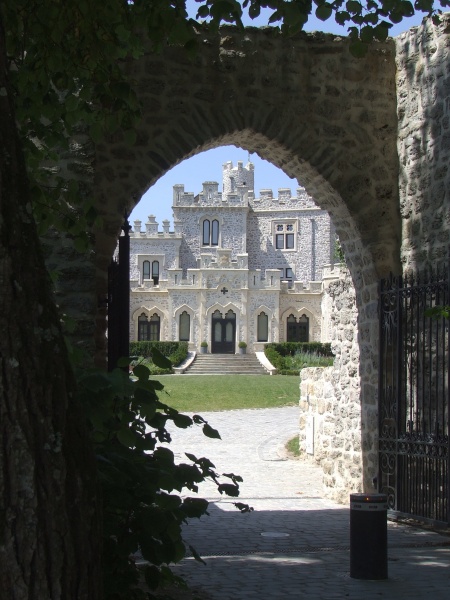
The neglected entrance did not give a clue to what we were to behold only a few yards away.  As you walked through the shade to the stone walls you were greeted through the arched gateway with a brilliant white building as it was lit up by the brilliant sunshine.  Through the archway neat lawns and flower beds stood out against the almost white stone walls and the circular driveway.

First view of the castle © C Sklinar 2011

We walked up the side steps and paid our entrance and entered the world of Charles Dickens.  I did not know that Charles had lived in Condette , just a short way from the castle.  I also did not know, but then had never really thought about it but Charles spoke and wrote in French and had a French publisher – hence the exhibition.

Hardelot Castle © C Sklinar 2011

What was on show, well there was a room display with family portraits, photographs and pencil drawings + items belonging to the family and information on his early life.  There was his desk, what joy and frustration that must have know when Charles was writing his novels.  There was also numerous letters in French and English to and From Charles and here is another strange thing.  My daughter was looking at a display when I noticed a letter with its envelope – split so you could see both front and back.  The franking mark was upside down and I turned my head to try and read the place name better – why I never looked a the address I do not know, but anyway, I thought it said ‘Wakefield’, only then did I look at the address on the envelope – Tadman St, Wakefield and the year was 1850.  I will have to do a bit of research to see who the recipient was.  But I have been told since my return home that Dickens was a friend of Gissing a local writer.  Who would have thought that I travelled to France, by chance visit an exhibition and see a letter to someone in my home town.

Our visit, did we enjoy it ?  Yes,  I think we did.

Was it value for money ?  Yes, I think 2 Euro per person for the exhibition  was very good value for money.

What about parking?   Parking and entrance to the grounds was FREE, so you could walk around at your leisure and finish with a picnic on the tables provided.

Charles Dickens – click here or here for the Charles Dickens’ birthplace museum or here for Charles Dickens online

Some other castle on the Continent – click here

The Gissing Centre, Wakefield – click here

Chantry Chapel, Wakefield – new events

Apart from the Chantry Chapel being one of the venues for the Wakefield Art Walk, which is held on the last Wednesday of alternate months from 5am – 9pm, the Chantry Chapel is a very busy ‘little treasure’.

In March, Kate Taylor, historian, writer and font of knowledge on  subjects including Wakefield and the Chantry Chapel, will be giving a series of FREE talks in the Chantry.

14 March The origins and growth of the Diocese
21 March Reorganisation, reordering and redundant Churches
28 March The changing role and status of women
Tea and Coffee are available and Donations to the Friends fund for maintaining the Chantry Chapel are always welcomed.

The month of May sees another series of FREE talks given by Kate

Mondays 14, 21 and 28 May 10.30am

A course of three talks on the History of the Diocese of Wakefield

In between all this there are a series of Open Days  – 25 April, 30 May, 29 August, 11 September from 11am – 3pm.  Interspersed with a Flower Festival and Cake Stall on July 9th from 10am – 4pm.