Yearly Archives: 2011

Free access to census via Ancestry

Ancestry wrote :-

George Green Binns b 1793 in 1851 census

27th March will be a historic day, as people all over Britain come together to complete the 2011 National Census. As we fill in details of our homes, occupations and relationships, it’s fascinating to look back at our ancestors who have done exactly the same thing every ten years for more than a century.
On Census Day, you can uncover generations of your family, and read key details of their lives, with FREE access to historical censuses at Ancestry.co.uk. Access all UK census record indexes from England, Wales and Scotland, for free for one day, so you can uncover the part your ancestors played in history. Find out more

In 1891 and 1901, the focus was very much on employment, with the effects of the Industrial Revolution hitting home around the country. Everyone was specifically asked if they were employed, and whether they worked at home.

Before that, the 1871 Census reveals concerns about the health of the nation. This is the first record to show any serious medical conditions our forebears were suffering from.

The very notion of a national census has its roots in politics and current affairs. In the early 19th century, the British Government was keen to find new ways to monitor its growing population. Alongside the civil registration of births, marriages and deaths, the census was one of its most important solutions.

The census records at Ancestry.co.uk provide snapshots of the entire country at these key points in time, and let you uncover the role your family played in shaping our nation?s history. Don’t miss your chance to access the indexes for FREE on March 27th

Local History at Lunchtime

Earlier I posted about Leeds Central Library hosting a series of lunchtime talks.  Well the good news is that they start tomorrow, the 18th of March from 1pm – 2pm and the first talks is “The Grand: An Entertaining Story” given by Catherine Callinan.

3rd Floor Meeting Room, Leeds Central Library 1pm – 2pm.  If you can manage to get there, please write a comment on this page and let us all know how it went.

Iron Bridge War Memorial

Before I start this entry for Iron Bridge War Memorial I must just mention this in the hope that some people can make arrangements to visit the event listed below :-

Heroic Spitfire Veterans to Attend 75th Anniversary Event on 5th March 2011 at the RAF Museum, Cosford – to read more click here and scroll down to Latest News. At the event will be a number of Spitfire pilots including Margaret Frost, female pilot.  Margaret being one of only 15 women and 100 men to have a Special Merit Award for their service in the ATA flying replacement fighters to RAF bases during WW2.

image K Scarth 2010

Now back to Iron Bridge Memorial, but firstly a little bit about the bridge that the war memorial stands so close to.

Abraham Darby III in the late 1770’s was an ironmaster working at Coalbrookdale and was commissioned to cast and build a bridge to cross the gorge.  The bridge was opened in 1781 and today still remains a magnificent sample of how Britain was at the forefront of pioneering the way forward.  The gorge over which the bridge spans is a UNESCO World Heritage Site, with the bridge being Grade I listed and a Scheduled Ancient Monument – now isn’t that something for Abraham and his family to be proud of ?

The War Memorial to the men of Ironbridge stands proudly within feet of the bridge and visitors walking over the bridge will pass the memorial.  The soldier atop the memorial plinth stands with his back to the gorge, at ease, resting his hands on the  his rifle as he seems to be waiting, looking for his friends from Ironbridge to come into view and come home once more.

So, who is our soldier waiting for ?  John Wlliam Adams who died of wounds ; Cecil Davies, KIA ; Frederick ; Drewball ; William Onions, KIA ; John Steventon, KIA to name a few.

To visit the rest of the young men of  Ironbridge who never came back to their gorge click here

Buchlyvie War Memorial

Buchlyvie lies between the Highlands of Scotland and its more gentler Lowlands.  In years gone by the villagers would been wary of the ‘fowk from the Highlands’ who were known to come down and steal cattle from the local pastures.

Stirling, Glasgow and Edinburgh are within easy reach, as are the Trossochs and Aberfoyle.  Many inhabitants may commute to work but there are many who stay in the village and keep the services going i.e. The Buchlyvie Inn and the Rob Roy + the cafe, B & B, garage, shop, butchers and hairdresses to name but a few.

Buchlyvie War Memorial C Sklinar 2010

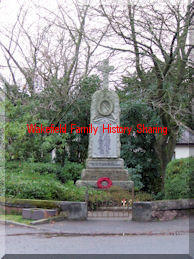
The War Memorial to remember  Buchlyvie men is situated on the edge of the village and sits proud in a small garden at a ‘T’ junction for all passers by to see.  The consists of a contrived rough cut stone set upon a few tiers with a wreath mounted above the names, surmounted by a cross.

So who is mentioned on the memorial ?  Robert Alexander ; Andrew McLaren (MacLaren) ; Willliam McLellan born in Huntingdon, Yorkshire and enlisted in Stirling ; Ronald J McOnie of Buchlyvie, with brown eyes and hair  and served with the Canadian Forces ; Archibald McVicar, son of Niven and Bessie and Alexander McIntyre who died of wounds and rests in one of France’s National Cemeteries.  I’ve only mentioned a few here but follow the link to read more.

Oh! and if you have any more information about these young men, please let me know and I’ll add it the the page.

To read more about Buchlyvie young men who fought and laid down their lives click here

Luss War Memorial

The village of Luss is known to many of us as it was featured in the 1980’s TV Soap ‘Take the High Road’.

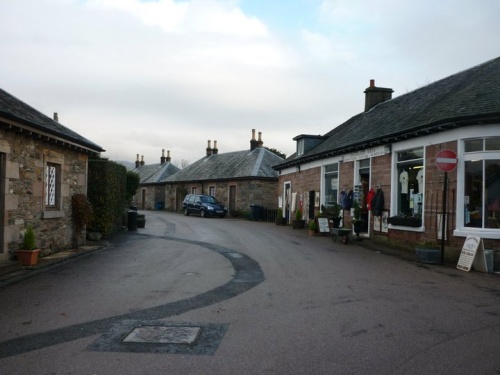
Luss 2010 by K M Sklinar

Luss, in early records was known as Clachan Dubh, the dark village due to its mountain setting.  Many of the village cottages were originally built to house workers in the cotton mill and slate quarries of the 18th and 19th centuries.  The homes have now been fully restored and Luss is  now a designated Conservation Village.

I am pleased to say that Luss is now by-passed by the A82 making the village a very nice place on the banks of Loch Lomond.

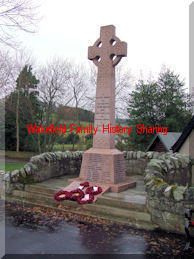
The War Memorial on School Road is set upon three tiers of stone with a simple cross bearing a sword, surrounded by a low dry stone wall.

Some of the names set in stone are :- Ludvic Colquhoun ; James Colquhoun ; Archibald McBeth and Robert T Hamilton to name just a few.

To see Luss War Memorial click here

Rhubarb, Rhubarb and more Rhubarb !!

The Wakefield Festival of Food, Drink and Rhubarb takes place on Friday 25 and Saturday 26 February 2011 – yes, this weekend.

Wakefield’s famous Yorkshire  Forced Rhubarb has now  European Protected Food Status, joining Champagne, Parma Ham, Cheshire Cheese and the Cornish Pasty

Whats happening this weekend then ?

Jean-Christophe Novelli, cooks for Wakefield Hospice – details here

Sean Wilson of Coronation Street fame – cooks in Wakefield Cathedral Precinct – more information

Wakefield Cathedral Precinct ‘foody festival’ on Friday and Saturday – entertainment, cookery demonstrations, walks and tours etc.


For a full list of places to stay, see and do during the 2 day event click here.

What are you waiting for, head into Wakefield on Friday or Saturday, but then why not both days and enjoy !!

Stow War Memorial

Stow, a village in the border region, a few miles from Galashiels.

The industrial revolution had a great impact on the area, changing the pace of life in Stow for ever.  Until the eighteenth century the area was a farming community, but the coming of the Turnpike road to the west of Gala Water in the 1750’s brought with it change and the village became industrious, mainly in the spinning and weaving sector. Following on in 1862 the railway came and made the area easier to get materials and people in and out.

The village has had a connection to the church since the 7th or 8th century with written records surviving and the Parish of Stow became one of three sactuaries in Scotland where there was safety from persicution.

The village war memorial is sited in the centre of the village and is a pleasing site with a small stone wall partially enclosing the memorial and has names of men from both wars carved upon it.

Who is mentioned on the memorial ? George Aitchison, born in Blackadder rests in Selkirk Shawfield Cemetery ; T E Thorburn Brown was mentioned in the London Gazette in 1914 and rests in Grevillers British Cemetery ; James Brydon served with the Canadians as he lived in Canada – a young man with blue eyes and brown hair ; Alexander and Archibald and Charles Chisholm, brothers who died months apart in 1915 ; James H Doig, also served with the Canadians and had gray eyes and black hair ; The Rev. J T C Ireland who died as a result of  HT ‘Transylvania’ being torpedoed  and many others who were sons, brothers, uncles and husbands.

To visit Stow War Memorial click here

Ancestry App for Iphone

You may not always have your family history information at hand on a normal day but you  nine times out of ten have your mobile phone.

If like me you have a lot of ‘stuff’ you need to carry, information wise, a specific ‘outing’ is needed to visit a library, archive or other repository.  If you are going about your every day life, you don’t keep this information at hand or have access to your Family History Diary – although an A5 Family History Diary, could be kept in your bag.

What do you do if you pass a village or house where family came from ? See a local war memorial with relatives names on or meet someone unexpectedly meet a relative or someone who knew your family ?

Normally, its rummage around for a scrap of paper, use a serviette or try and remember all the information.  Yes, done that before and you forget at least something.

Do you have an I phone ? If you do its good news as they have developed an App for such an occasion and it dosn’t cost that much, but could save you the embarrassment of trying to contact the person who gave this information or trying to retrace your steps to find the house or memorial – both time consuming and inconvenient.

I have not tried the App so can’t tell you of any hitches and glitches it may have, but one thing I do know is that as it is mobile phone driven it does need a good signal.  There is no point in getting very frustrated in a graveyard in the middle of nowhere when trying to add information if you don’t have a signal – now that is not the App’s fault.

Itunes store  – link here

www.Ancestry.co.uk

WDYTYA & Find My Past Discount

Good News, Find My Past, like many others will be having a stand at the Who Do You Think You event which opens its doors next the  Friday, 25th February 2011.

To promote this FMP they are offering,  for a limited period 10% discount – valid from 21st February to 4th March 2011.

To take advantage of this discount click on the Find My Past link below and enter the discount code when prompted in the payment section.

discount code     WDYTYA11


As well as Find My Past there will be lots of other well known faces there including :- The Society of Genealogists ; Ancestry ; Alan Godfrey Maps ; Archives for London ; Commonwealth War Graves Commission ; Parish Chest ; Scotlands People ; Various magazines and Publishers + over 100 workshops.

Tip :-  Take smaller denomination notes (£5 & £10) and £1 coins, don’t weigh yourself down with coins but it does make it easier for those smaller purchaces.

Tip :- Take copies of documents, don’t risk the chance of losing the originals.

Tip:- Make notes of the names, places, dates etc that you may need or put it all in a Family History Diary and have all your information in one place and at hand for those excursions i.e. a day out at WDYTYA or a visit to the Archives or Local Studies Centre.

Have a wonderful day

Family History Diaryclick here to get your diary in a choice of sizes and colours – making it easier to follow your family.

Lumphinnan and Shandon War Memorials

A gazeteer entry for Limphanan describes it as follows :-

Lumphanan, a hamlet and a parish in Kincardine O’Neil district, S Aberdeenshire. The hamlet has a station on the Deeside section of the Great North of Scotland railway, 27 miles W by S of Aberdeen; a post and railway telegraph office; a branch of the North of Scotland Bank; an hotel; and fairs on the second Thursday of January, February, March, April, May, September, and December.

The village now has neither a church or a station but does have a golf course, a school and a fine War Memorial.

A Gazeteer entry for 1882 describes Shandon as follows :-

Shandon, “hamlet on north side of Gareloch, 5½ miles north-north-west of Helensburgh, Dumbartonshire. It took its name, signifying ‘old fort,’ from an ancient fortalice, now almost extinct; it has a post office, with money order and telegraph departments, under Helensburgh, and a Free church; and it is near the elegant modern mansions of Shandon Lodge and West Shandon. Pop. 291.

Shandon, however, just a few short miles from Rhu developed alongside similar settlements to form fashionable residential areas for the wealthy Glasgow merchants.  West Shandon House was one of these residences for Robert Napier and housed his vast art collection.  Another residence is Shandon House, built for William Jamieson c1849 and now a Grade B Listed Building .  The house and its grounds overlook Gare Loch – now owned by the MOD  the house has been a school –  a remand home.  But sadly the once grand fittings and plaster work are now in a sad state of decay as Shandon House has lain empty for many years.

The Shandon area is now, since the 1960’s, dominated by the Royal Naval Base at Faslane.

To have a look at the Lumphinnan War Memorial click here

To have a look at the Shandon War Memorial click here