Just received this newsletter and thought some of you may be interested.
Carol
|
||
|
||
|
||
|
Just received this newsletter and thought some of you may be interested.
Carol
|
||
|
||
|
||
|
A short while ago a friend sent me his pictures of Glen Lyon War Memorial. He like many others, know I collect and transcribe them, and he kindly sent me a couple of pics taken on his adventures.
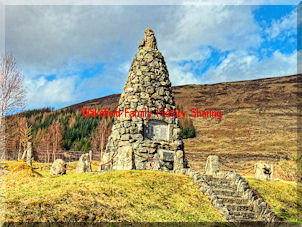
image by J Hall 2011
I can’t say what a beautiful place it is, as I don’t know, but from the picture it certainly looks a pleasant place and with the sun shining and a blue sky, even a cold day would be a pleasant day in Glen Lyon. The glen is approx. 20 miles in length and stretches from Fortingall to Cashlie and from all accounts well worth a visit.
Who is mentioned on this very special memorial, special, you will see why shortly. Firstly, and only because his name appears first on the memorial (all names are in rank order) is Lieutenant Colonel John Robert Beech CMG, DSO who died in Lincolnshire while in command of his troops. Next on the list is Clyde, actually, Robert Clyde Beech, the 20 year old son of John Robert. Next comes Alan Tompson, a relative by marriage of John Robert’s wife, who was the widow of John Bullough or Meggernie Castle. Also on the memorial is Francis Cowie who was before the war was an asistant factor at the castle. So all in all, the family from ‘the big house’ didn’t fair well from the war.
The last name I am mentioning in this ‘snippet’ is that of John Alexander McCallum of Camusvrachan, KIA in October of 1918 aged 23. It was his father Alexander, who designed and built the Glen Lyon War Memorial. What greater gift could a father give to his son, a splendid memorial built at the side of the road that all who pass by will see and hopefully more will now know of the great love and sadness with which it was built.
Where can you read about Alexander and his son and others from the area Click Here
Just before Easter I spent a weekend with my daughter and her boyfriend. The weekend started with my driving down to Ealing, meeting my daughter and visiting one of her friends and her new little one. Then a drive to Basingstoke.
Saturday started with a yummy breakfast and then onto Winchester, lunch in Raymond le Blanc’s, a visit to the Cathedral (memorials to follow very soon ) and finally an interesting visit to see The Round Table.
So Sunday arrived and a visit to Odiham and lunch, but before lunch I was given a short tour of Odiham, including, yes, the war memorial and the church – nice village and nice company. Oh! by the way the church has a beautiful window relating to the local RAF station. I’m not a great lover of modern stain glass but that was nice. But, to my surprise it wasn’t even a window, but a very good deception – a light box, but it still looked impressive.
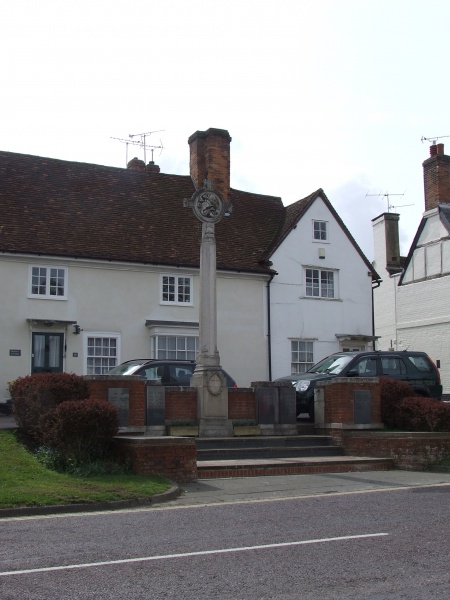
Odiham Memorial, Carol Sklinar 2011
Now to the village memorial to those who have fought and died in two world wars.
Who is mentioned on the memorial to the men and women of the Parish of Odiham ? Geoffrey Harris Gotelee, the son of Arthur and Esther of The Old House. Geoffrey in 1911 was a boarder at St Albans School, his parents at this time ran the Post Office. Richard Elkanah Hownam Healy, the son of Randolph and Alice of Hownam Lodge. 1911 sees Richard living in Kensington Hall Gardens and working as a Reporter for a Daily Paper. He is later mentioned in the London Gazette when he received his promotion.
Another young man from the area was Arthur Henry Pither, son of Stephan and Sophia. Arthur worked in Quebec, arriving in 1908, but was back in the area by 1911. He did however, enlist in the Canadian Army and from that we can get a fleeting glimse of what he looked like.
Guy Lutley Sclater, brother, son and husband. He served as a ~Captain in the Royal Navy and rests in Odiham Churchyard.
Now, W G Wooldridge, he was a little bit of a problem and has not been identified by others who have transcribed Odiham Memorial, but I think family history helps a great deal when transcribing and knowing people make errors and what type of error could occur – well, I found him – so visit the transcription and see who he is and where he rests. In fact, if I had completed the transcription last week, I would have known where he was and could have visited, as I was only a matter of minutes away from him.
The last young man I am going to mention in this taster is Reginald James Moody, son of Charles and Ellen. He served in the RFC and died on 4 March 1917 while flying with 2nd Lieut., Eric Edmund Horn. Edmund had enlisted on his 17th birthday and died on his 19th, so, so young and very brave. They both rest in the same cemetery.
There are still a few young men whose information needs adding to the transcription and they will be finished shortly, as will the WW2 transcript.
To read the transcription or see if your Odiham relative is there Click Here
As secretary and speaker secretary for Morley FHG I Thought you might be interested in our speaker this Wednesday.
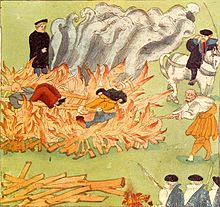
Image from Wikimedia Commons
Roy Stockdill, genealogical researcher, writer & lecturer will be enlightening our group with the tales of Mary Bateman, the Yorkshire Witch. Roy, is well known in family history and genealogical circles and always gives very informative and interesting talks.
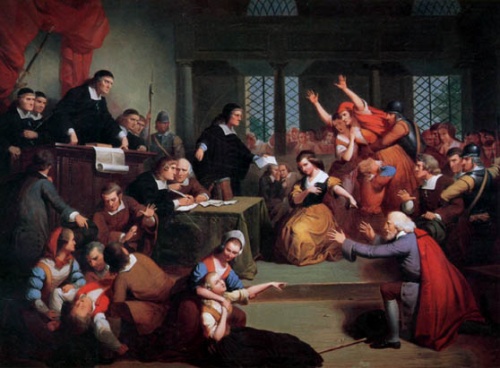
Image from Wikepedia Commons
Just to remind you Morleyfhg meet on the 1st Wednesday of the month in the Baker Room, under Morley Library. We open at 7pm for a 7.30 start, the group pride themselves on always being very helpful and informative to both members and guests. Tea & Coffee is available after the speaker. Members entry is free but we ask guests to pay £1.
Look forward to seeing you.
The Gale Library in America – an American online library is FREE from the 10-24 April. I like that as it’s not every day you get something for nothing.
So what can you see for FREE ?
1. Gale NewsVault — The definitive cross-searching experience for exploring Gale’s historical newspaper and periodical collections — with access to more than 10 million digitized pages.
2. Slavery and Anti-Slavery: A Transnational Archive — The largest, most ambitious collection devoted to the study of slavery. In its entirety, it will consist of more than 5 million cross-searchable pages. Part I: Debates over Slavery & Abolition available now.
Included in the above two links are the following :-
19th Century British Library Newspapers & Periodicals
19th Century UK Periodicals: Empire
Financial Times Historical Archive
Illustrated London News Historical Archive & Times Literary Supplement Historical Archive
So what are you waiting for ? Get on the website and add ‘meat to the bones’ of those relatives on your family tree.
Link to main page of Gale Library
The other weekend I went to visit my daughter in Ealing. After a trouble free drive down I arrived in Ealing and met Kim. She had arranged for us to visit one of her friends who has just had a baby, she’s gorgeous by the way – the baby not the friend and whats even better, only a short walk away, but we did divert to Pitshanger. Pitshanger although minutes from Hanger Lane has a village/small town feel about it. One of the best things is a charity shop and Kim seemed to gravitate towards it, which is good as she has a special fundraising programme for this year. Inside was the most fantastic 196o’s style coat, bright yellow and black with circle pockets and very reasonable – an early Easter pressie and looks wonderful on.
Anyway, after a visit to the new mum, dad and little one we walked into Ealing, Kim gathered her bags and off we set for Basingstoke. The motorway should have been reasonably quiet by that time but no, there had been a few accidents and there were miles of ‘rubber neckers’. We arrived, parked the car outside Kim’s boyfriends house and did none other than went to the pub – drink and food in that order.

Saturday we had a wonderful walk around Winchester, had lunch in Raymond Blanc’s on the Broadway, Winchester and then spent a wonderful time in the Cathedral. Now that was eventful! There must have been a concert on very soon as there was a full orchestra and choir having a rehersal and the sound found every corner of that magnificent building. And the sun shone through all of the glorious windows making wonderful shadows across the stone floors.
Well, I take it you know me by now and you have guessed there were war memorials galore – even Kim and Mark found some wonderful things to immortalise on a ‘chip’.
I think the cherry on the cake was a war memorial to one of my distant relatives – Guy Victor Baring, closely followed by a memorial to a young man who attended Eton College. It was transcribing Eton College that started my collection of memorials and look where that has got me !!
On the way back to the car we stopped of at Winchester Great Hall to see The Round Table.
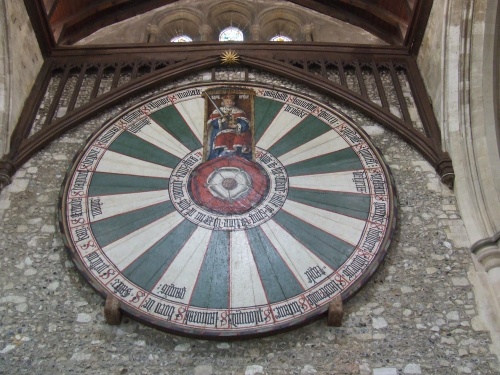
Back in Basingstoke, Mark cooked a meal for us and then we settled down to wine and Scrabble – I won !
Sunday morning we packed up and set off for Odiham – Mark’s parents house, where he cooked Sunday lunch and Kim made vanilla custard tartlets. Before our meal I was given a wonderful tour of the village including the village war memorial, the church and the pest house. The church has a wonderful modern window with an RAF theme. The fact is the window is no more than an illuminated box, but for a modern ‘window’ is wonderful in its simplicity. Thank you Margaret for the tour and hospitality.
My wonderful weekend was over and it was time to head back ‘up North’ and start transcribing the new additions to my collection.
STOP PRESS – Odiham War Memorial full transcription with additional information is coming soon.
A friend of mine is selling his signed copy Scatcherd’s History of Morley 2nd edition (1874) with monochrome plates.
He is open to any sensible offer and can be contacted through me
If there is no interest he will put on ebay this weekend.
The original version is good to look through but if you just want to use the book for reference I have Scatcherd’s History of Morley available on a cd at the shop on Wakefield Family History Sharing
Tonight is census night and whoever is in your house tonight should be on your census form. This decades census asks different questions to those in previous times and is based more on social and cultural subjects. Some, sorry, many family historians question the use of this census in 100 years time. Basic information is being left out, for example it is not asking for a middle name, yet this is now we distinguish a John Smith from a John W Smith. Where were we born, again another question that could distinguish our John Smith from the other. But who are we to argue ?
Yesterday I was thinking, I do that sometimes, about the 1911 census and wondered if I could find two people with the same name, born in the same year with two totally differing backgrounds and lifestyles. I chose a family from one of my war memorial transcriptions but could not find the family on the 1911 census – foiled again! So this morning with a new vigour, 2 monitors (making life easier) and using the pc not the laptop I started my quest for these two people. Who would they be, how old would they be and what would their every day life be like. My challenge is on and a cuppa is called for. Cuppa by my side and here we go !
Who are these young men? What name did I decide upon? How old are they? Questions hopefully we will all find the answers too.
The name – John Radcliffe. The year of birth – 1886 (as per 1911 census). Place of birth, well this is where the difference really starts.
Firstly, John Douglas Henderson Radcliffe was born in 1886, the summer of 1886 to Alexander Nelson Radcliffe and his wife Isabel Grace nee Henderson, whom he had married in the late spring of 1884 in Kensington. Alexander was a solicitor and in the 1911 census he was living with his wife, 4 children, 2 visitors (Noel Burn Rosher b1876 Consulting Engineer born in Higham and Percy Otto St Clair Wilbraham Perryman b 1886 , Asst Dist Commt Uganda born Redhill) and 7 servants (incl cook, nurse, kitchen maid and house maid + butler and footman) all residing on the night of the census at 45 Kensington Square – in total 15 people in 20 rooms.

45 Kensington Sqr
Alexander of Bag Park was born in Paddington in 1856 and died in Widecombe, Devon in March of 1944. His wife Isabel was born in March of 1861 in Fremantle, Australia.
John Douglas Henderson Radcliffe had been a pupil at Eton College, leaving by 1904 and going on to Balliol, Oxford where he was known for his satirical humour and sense of fairness. He rowed in the Eight and was Captain of the Boat Club and according to sources was a first rate coach and gave up his spare time to ‘the river’, being devoted to his College – Balliol. In 1911 he was elected was a Fellow of All Souls College and delighted in the traditions and atmosphere.
After Oxford he joined his father as a solicitor but it was politics that was his goal. In 1913 he married Mary Augusta Garlinda Bolitho and only too shortly after The Great War broke out. John joined the KRRC, serving as a Captain. In July of 1915 there was desperate fighting near Hooge. John was KIA on 30 July 1915 aged 30 when the enemy over ran the trench held by Capt., Radcliffe and his men. John is remembered on the Menin Gate Memorial, Ypres. John had been living with Mary at 20 Craven Street, Charing Cross and he left over £1,500 pounds to her on his death.
So ended John’s life, a life of privilege and opportunities. A life lived in Eton, Oxford and London. Would he, had he had the chance, been able to influence the politics post war? Who knows, but one thing is certain, he left a small piece of himself with all whom he met and was certainly fondly remembered and loved.
Now, which John Radcliffe born in the same year, well we find him in Leeds, the son of John William and his wife Mary Ann. One of 3 surviving children out of 8, John was also born in 1886 and in 1911 living at 36 Wellclose View, Leeds. John W was a 61 year old Organ Builder born in Bolton and his wife was also 61 and hailed from Leeds. John jnr was aged 25 and a Textile Printers Foreign Correspondent and his sister Lilian aged 31 was a Co-op Stores Cash Clerk – 4 people living in 5 rooms.

30-36 Wellclose View, Leeds. Leodis Archive
The houses around Wellclose View were terraced, more than likely on a hill. The terrace ends, those facing the next street had bay windows and attics with full windows making use of the roof space. The doors were straight onto the cobbled streets and most of the houses had usable cellars.
Did our 2nd John fight in WW1, I don’t know. I’ve looked on SWDTGW, Medal Cards, CWGC and Army Pension records and there is not one John Radcliffe that gives a clue to him being our John. Let’s hope if he did go to foreign shores, he at least came home to his family.
Did John marry ? There is a marriage for John Radcliffe in Leeds in the June ¼ of 1912, could this be him ? And there are no deaths that stand out any more than others.
I think it goes to show that if you fit into any of the following categories :- The Great, The Good or The Bad you are recorded very well in historical documents. But, if like John, and his family, you went about your business, sometimes with a little to spare at the end of the week and others the week was longer than the money, records are limited.
If anyone knows of John Radcliffe of Leeds, please let me know I’d like to know what happened to him.
Sorry for the delay this post, but as they say ‘better late than never’.

The small ‘foody’ market was in the centre of Wakefield, just outside the Cathedral and was packed with visitors and most importantly for the sellers, the visitors were carrying lots of bags. But, not only were there stalls packed with all kinds of gastronomical delights there were cookery demonstrations in a brilliant marquee. They included rhubarb scones with Dean Rogers of The Devere Oulton Hall, Ashley McCarthy of Ye Old Sun Inn, Heather Copley of Farmer Copley’s, students of Wakefield College and many more.
My first stall at the busy market was Sean Wilson of the Saddleworth Cheese Co. We had bought Sean’s cheese before from Blacker Hall, a local farm shop. My son and daughter visited there one January morning with my daughter boyfriend and two cheeses stood out above the rest, ‘How’s your father’ and ‘Mouth Almighty’, both cheese names having a link to recent events in our family and if I told you, I think you may be shocked, stunned or just laugh, well, maybe one day I will. But needless to say we laughed and cried over one of the names and came up with some amusing answers to ‘How was your father’?
So Sean’s cheeses were the first of my purchases and yes, again I bought those two particular types. I was asked if I wanted a sample but said, ‘no thanks, know them well’.
Thanks Sean, ‘How’s your father’ is a winner in this household.
My main aim of the day was now over and I could see what was on offer. A compulsive purchase, but one that I have not regretted buying was a small book, well, booklet entitled ‘Walks in the Rhubarb Triangle’ by Richard Bell. Well, I have not been on the walks yet but have certainly made some of the recipes on more than one occasion – I even bought out the local supermarket of Golden Syrup and oats. I did keep the rhubarb very local though – East Ardsley! So, the book, it is packed with easy to follow short walks backed up with snippets of history and easy follow maps. As I said I bought one, then thought better of it and made that 2 – one being for the local family history group.
Oldroyd & Sons had a big stall selling fresh produce including rhubarb goodies including plants for you to grow on in your own gardens.
Two other stall I visited and bought goodies from were Mr Huda’s where I bought a universal curry paste and Raman’s, buying a beetroot relish. Both stalls had very helpful staff and were only too pleased to speak to their visitors. The relish, I was told, goes well with turkey, pepper dusted steak, mashed spuds and venison – yummy!
Venison sausages were next on the agenda, very rich and very nice, but my apologies to the stall holder – I cooked the sausages, ate them and forgot to make a note of his stalls name , but do remember where the farm is – sorry but the sausage were beautiful.
My last purchase was 2 pork pies, but not ordinary ‘growlers’ these were pork, mango and rhubarb, well I think they had rhubarb in, but even so, warmed up and served with a hot cup of ‘builders tea’ they went down a real treat.
My last stall was Farmer Copley’s, a farm shop near Pontefract, I didn’t buy anything, I was very good but was given a discount voucher to use when I paid the farm shop a visit – which I did later and may I hasten to add will be doing so again and again even if its just for the frozen croissants and pain au chocolat.
You can see from my purchases I didn’t stop at the cake stalls, as they say ‘why have a dog and bark yourself’ – I bake, so why buy it! But there were cake stalls providing the visitors with an array of tempting delights. I also noticed a couple of stalls selling rape seed oil and one stall full of blue and white Polish pottery.
So, where can you find out about these stalls and what else they sell and do ?
Sean Wilson’s Saddleworth Cheese Co., and his wonderfully named cheeses
Walks in the Rhubarb Triangle and other publications by Richard Bell
Round Green Farm for venison sausages and much more
Raman’s relishes – winners of Hairy Bikers best cooking family
Mr Huda’s pastes and a selection of recipies and I am pleased to say the only place in Wakefield that this can be bought is in my village – well done R N Binks and Sons, butchers and very nice people.
A short time ago I was sent a link to a song written by a friend about a Chateau in France where we meet most years and dedicated to my husband, Ben.
This reminded me of a cd we had been given in late November 2010 and one of the tracks I found very moving, as from our house you are very close to the mining shaft which was used in the rescue mission of the Lofthouse Mining Disaster – one of my friends was in the team sent in just after to access the damage. I also remembered a lady with whom I worked many years ago, her son was a miner in the Lofthouse Colliery, lucky for him he was not at work that day. In Woodkirk Churchyard, only a few miles away, there is a memorial to some brothers who were killed in a mining accident in Morley.
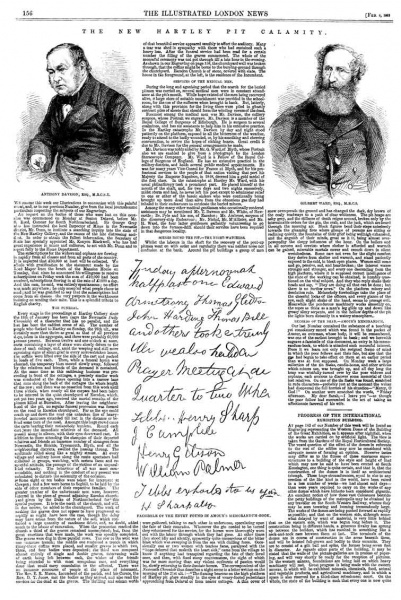
Hartley pit calamity from Illustrated London News
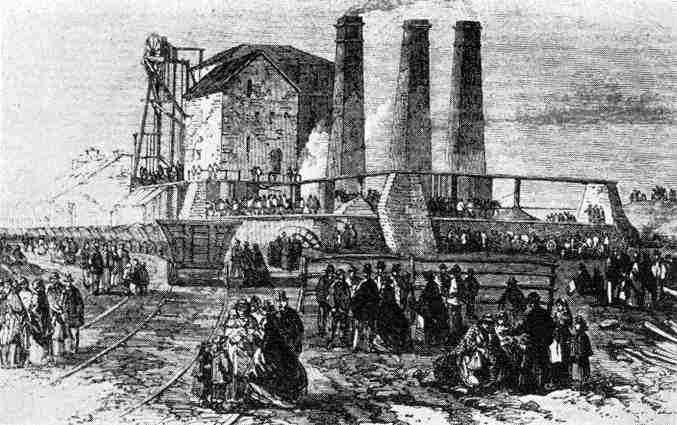
The Hester
Anyway, The Hester Disaster of 1862 – It was a normal day, the same as many others. The men went to their work, the women went about their tasks and the children did what children at that time did, but this day would end very different from any other day in this, the small community of New Hartley.
That day, the 16 January 1862, the fore-shift was just coming to an end there was over 200 men and children down the Hester, whose only entry and exit was via a single shaft. During the process of lowering the new shift and bringing the old shift up to daylight an engine been snapped and fell into the one and only shaft, totally blocking the men’s exit with debris.
At this news, you can only imagine how the families of the trapped miners felt on hearing the news of the tragedy. And it would be a very long 6 days before the rescuers, lead by Mr William Coulson, managed to dig down with the hope of rescuing some of the men and boys. How they must have felt when they were met with 204 people who were family, friends and fellow workers, who would never know the sensation of seeing daylight again after working in the dark for so long.
One of the men down ‘The Hester’ that day was George Hindmarsh, a man in his early 30’s, married with 4 young children. In the 1861 census George and his family were living in Colliery Row, Bedlington where he probably worked down the local pit. By the New Year of 1862 George and his family were in New Hartley and on 16 January 1862 was George’s 1st day at work and his last. George along with the other brothers, sons and dads was laid to rest later that month.
Listen to John Leslie’s moving composition Brothers, Sons and Dads performed by Sawdust Jacks
Other sites about ‘The Hester’ you may find interesting
Names of miners who lost their lives with names of relatives
Names and mine information can be found here
Illustrated London News transcripts for the disaster
The Hartley Pit Disaster article in Tree Magazine 1993
