Yearly Archives: 2011

Medical terms

What did it say on the death certificate ?

Or what did aunt Peggy say he died of ?

Or, what did you say she had when a child ?

Half of the time when looking in old documents or certificates the meaning of terms can be very strange, take for instance – Atrophy, Bronze John, camp fever, long sickness, morphew, scotomy or spru.

If you heard the description, you would know what the problem was.

But anyway, pop along to the medical terms section on Wakefield Family History Sharing and see how many you can decipher without looking.

Medical Terms can be found here

Doric terms and phrases

Local slang terms have just been uploaded to Genblog, so I thought I had better go with the other half of my heritage, Scottish.

Have you ever heard of a kail-gullie, a mort kist or safe, a byre, a hynd, ling, kiltie?

You may have come across words similar to these in the OPR’s of Scotland or a will and not known or understood the text in which it was written.

The Doric terms on these pages could help you.

Go on, have a look!

Doric words and phrases can be found here on a sister site of Wakefield Family History Sharing

Local slang

A little ditty about ‘Bob’

If y’ur Bob dosn’t gi’ our Bob th’t Bob th’t your Bob owes our Bob, our Bob is gunna gi’ y’ur Bob a bob on’t  nose !!!!

Now you know perfectly well what that means, don’t you ?

If your Robert does not give our Robert that shilling that he owes him, our Robert will hit your Robert on the nose !!!       –        simple isn’t it!

No matter where you live  or what your social standing there are words that are associated used and only those from the locale or social circle will know.  But you will find the exception to the rule, as you always do as many of the words and sayings are known nationwide.  For example :- Gaffer or Gaffa, Boss ;  Gear, clothes ; Doff, take your cap off ; Poor Show, went badly and so on.

The Slang page of Wakefield Family History Sharing can be found here


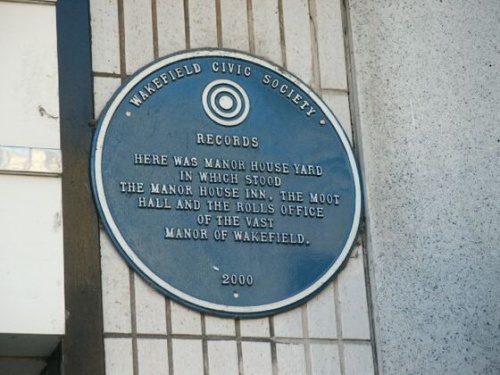
Blue Plaques

How many of us walk from A to B in the shortest route and in the quickest time. Iin every day life, probably nearly all of us. We only tend to mooch, look around and take our time when we are on holiday or a day out.

Next time you are in your village, town or city look around and look up, you will be surprised what you will notice that went totally undiscovered before.

How many bars, restaurant and shops do we only know from street level – look up, you may learn what the building was orignally used for.  Wakefield for example, has a street known as Westgate.  In modern times most popular for its ‘Westgate Run’.  Westgate, a long street, one of the main entries and exits of the town had a very large number of public houses, the ‘run’ was to have a drink in each of the pubs.  The ‘run’ has now changed slightly as the pubs have now been superseded by bars.

If you looked up while walking down Westgate you would see that the majority of the buildings, grand buildings, were at one time banks.  These banks were needed in previous centuries due to the amount of money that was changing hands in the area, either from the great cattle market held only a couple of minutes walk away or the number of merchants that were in the area who did their business in the old cloth hall.

Look around, you never know what you might find – images of Wakefield’s Blue Plaques can be found here

A list of the Blue Plaques with a short description of where the plaque can be found – click here

Lots of other towns have their Blue Plaques on the internet for example :-

English Heritage Blue Plaques – mainly London and the surrounding areas
Oxfordshire Blue Plaques
Tameside Blue Plaques
Canterbury Blue Plaques
Windsor Blue Plaques
Birmingham Blue Plaques

Why not look around the place where you live ?

Who voted for in the Borough Election on 12th June 1865 in Wakefield

The Poll Book of the Wakefield Borough Election
Wednesday 12th June 1865

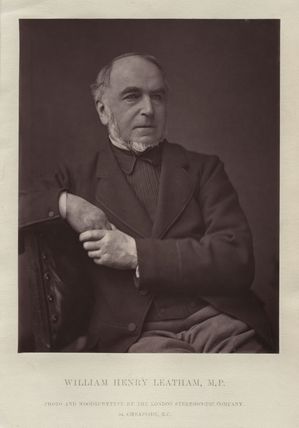
Who voted for the Liberal, Mr Leatham, who voted for the Tory, Sir J C D Hay and who did not vote.

Wm Henry Leatham
It was after the great Reform Bill of 1832 that Wakefield became entitled to send Member to Parliament. The first Member to be elected was Daniel Gaskell of Lupset Hall in December 1832. Gaskell was re-elected in 1835.
Have you ever wondered if your Wakefield ancestor voted and more to the point, who he voted for !
Well the scanned images of a small booklet can answer those questions.
Mr George Green Binns of Wood Street and Mr John Binns or Northgate both voted for Mr Leatham, as did Messrs., David, Edward, John, Robert Jefferson, Mr Robert Bownes Mackie all of Cliffe Field House.
While, Mr W H B Tomlinson of Calder House, Mr Alexander Mackie Child of Park Street, Charles Joseph Cambridge of Vicarage House and Benjamin Blackburn of the Fair Ground all voted for Sir J C D Hay.
But who didn’t vote – James Aspdin of St Johns, Guy David Fernandes of Sandal, Charles Roberts who had left the country, Thomas Giordani Wright of Westgate and Frederick Edert.
If you have family from Wakefield, take a look at the book, you never know what you may learn or who you may find.
To view the Poll book of the Wakefield Borough Election on Wednesday 12 June 1865 click here

Names, but this time Latin

I’ve just published a couple of Blogs on names and naming traditions and it seems logical to follow on that thread with a few names in Latin, after all, we all have to look at Latin registers or documents at some time – we don’t always want to………….. but needs must.

A few years ago I put together a list of Latin names with their modern equivalent i.e. Gualcherus – Walter; Guido – Guy; Jacobus – Jacub/James; Guliemus – William.

Go on, have a look or bookmark the site for future reference – click here

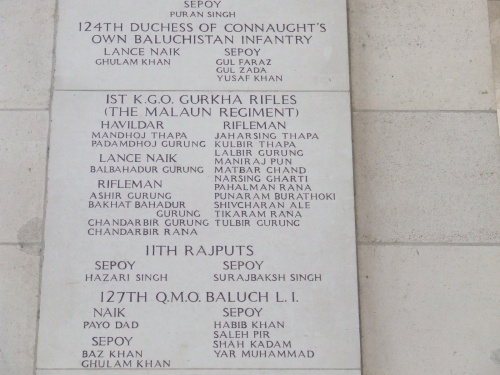
A guide to finding a Regiment on a large War Memorial

On many of the large memorials there is an order in which the names and Regiments are listed – I din’t know either until a fellow member of the NVA (Normandy Veterans Assoc.) passed on the information.
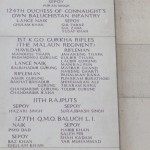
Take for example you have a relative on the Thiepval Memorial – he is one of over 72,000 other casualties who were KIA and their final resting place is not known, being only remembered on a memorial far from home.

Edmund Hilton Dadd, M.C., Capt, Royal Welsh Fusiliers  died 1916;  Edward Davy Pain, Capt., Somerset Light Infantry and Edward Aubrey Jackson, Rifleman, KRRC.  Which Regiment is listed first, do you know ?

Firstly, you need to understand that the Command Staff are always first, mostly General, Colonels etc., then the regiments, the regiments that traditionally guarded the King, so we have the Life Guards.   Followed by the Dragoon, Hussars and Lancers, then the Royal Horse and Field Artillery, the Guards in their various forms.  With the other regiments following on, again in a strict order.

Back to our young men who are on the Thiepval Memorial – ~The Somersetshire LI (Prince Albert’s) Regt., is first being 13th after the Guards and Household Regiments who are not numbered.  The Royal Welsh Fusiliers are 23rd on the list and the King’s Royal Rifle Corps., are following on in 60th position.

It dosn’t work out that if your regiment had a regal connection i.e. King’s, Prince or Princess in their name.  Putting it simply, as I like to do most of the time, the more traditionally connected to looking after the monarch the higher up the list you are.

Saying that, it is still confusing and sometimes you are best looking straight at a list of the regiments.  The Corps of Royal Engineers is listed after the Royal Horse and Field Artillery, but before the Grenadier Guards, Scots, Irish and Welsh Guards.  The listings don’t work on how new the regiments were i.e. the Welsh Guards were only formed in 1915.  The Guards Machine Gun Regiment raised in 1917 is listed after the Welsh Guards but the Machien Gun Corps raised in 1916 follows on near the end of the list.

Before you get totally confused and end up at a memorial looking for your great uncle take a look at the list, it may help shed a smattering of light on the subject.

Oh! before I forget, there is also within the Regimental order an order for the Commonwealth Forces – have fun !!

The Order of Regiments can be found by clicking here

Margaret – Maggie, Peggie or Daisy ?

The previous blog was about naming traditions, so I thought I would follow on with nicknames.

My aunty was called Dolly or Do-do, but it was not until I was nearly a teenager that I found out she was really called Frances – I still can’t work out why she was called Dolly. She was always a Dolly but to me she was aunty Do-do and very much loved.

So, why an I putting pen to paper or fingers to keyboard?  Well, to suggest a few other names that Margaret or Pauline or Caroline might have been known by and therefore found on documents, census etc.

Imagine, it is the night of the census in 1871 (UK) and the enumerator comes to your home – it’s a good job he came and did the writing as you can only ‘make your mark’.  He enters your house, your husband is out and there is you with your children and your grandchild.  Mr Jones, the enumerator, asks who lives here.  You say there is your husband Jack.  You come next as the wife, so you say Jane.  Your children are next, John, George, Rosie and ‘our Aggie’ and ‘little Isa’.

You answered the enumerator, he did his paperwork and off he went next door.  But who really lived in your house?

Here is where it gets tricky!  The husband Jack, was really John – Jack being a familiar for John in certain areas. Jane  and George are easy, but Rosie is Roseanna, ‘Our Aggie’ is really Agnes and ‘Little Isa’ is Isaiah – confused yet?

When searching for your family in the census and documents remember, not everyone used the name they were Registered with, or Christened/Baptised with.

Many years ago I put my Riach line on hold as I had a choice of fathers for one family – the dates were a year out, not too disasterous, the place was the same but the names were Patrick and Peter, until some kind person informed me that Patrick and Peter were one in the same, just like Jack and John – easy when you know!

To have a look at some name variations and nicknames  click here
(This link also includes the English Naming Traditions)

Naming Traditions or Following in Families Footsteps

In my research both North and South of the border I have found two naming traditions and both slightly different – the Scottish tradition being the stronger.

My Riach family were a follower of this tradition and certainly did follow in the ‘naming traditions’  into quite modern times.

If you are John and your father was John and guess what ? So was your grandfather and greatgrandfather, please tell me how you are supposed to know which John married who.  As a result of this tradition, in my family tree I have over 40 John’s born within a 10 year period with John being the father.  The majority of these John’s are descendants of a John.

So, you know that a Janet Grant for example, married a John Riach,  son of John but which John Riach.  I know a place is also a good help when trying to eliminate the wheat from the chaf but when the family are in such a close proximity to the other Riach lot – all related, you tend, well I tend to have a lot of John Riach’s with either no wife attached or a lot of notes saying ‘possible wife’.

In many cases a certificate is not always going to help as the fathers name is only listed, and a baptismal/christening entry in the Parish Registers may help a little by giving the mothers name.  But here we go again, as a lot of the mothers names are the same.

I seem to remember saying to one of my ladies on a help desk ‘it’s easy when you know how’ – I lied, big time!!

But, saying all this and moaning at the number of people with the same name born within a very short time of each other – cousins, 2nd cousins and so on, sometimes it does help – I promise.

To have a look at the Scottish Naming Traditions click here

To look at the English Naming Traditions click here

Who Are You ?

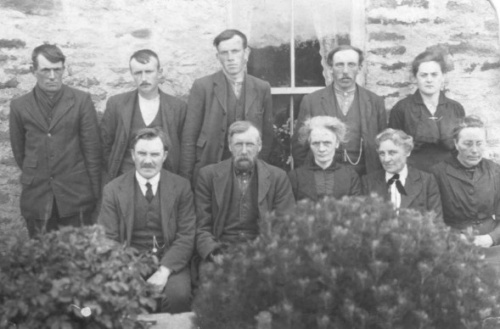
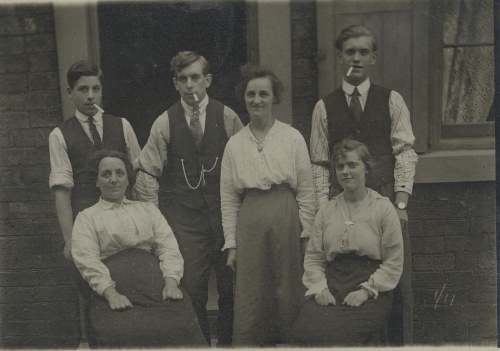
Who are You ? How many times have you looked at a photograph and asked that question ? From my experience I can say 100’s if not 1,000’s.

I’m not a betting person but I will guarantee that you will have gathered, inherited or bought photographs of people, not always related but you have wondered…. Who Are You?

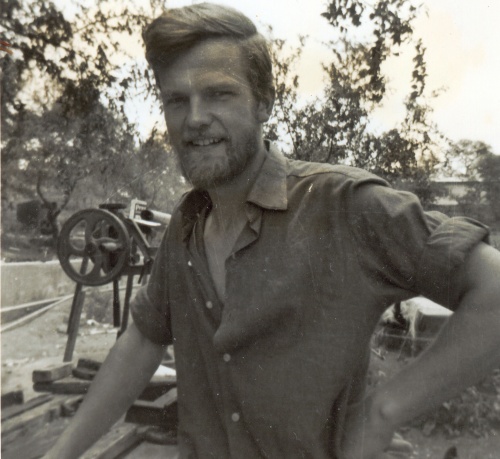
Donald Curtis, probably taken in Africa – the Curtis family new the Riach people from Urquhart and Lhanbryde, Moray.

My mum for instance, she served in the ATS during WW2, being posted to Nottingham and Burntisland just across the Firth of Forth from Edinburgh.  During her time in the ATS she collected lots of photographs of young men and women all serving their King & Country.  These wonderful pictures showing happy times during an unhappy period in our history are not only part of my family history but are important socially aswell.

These photographs, all in wonderful black and white, either have no information or simply ‘love Willie’ or ‘regards Joan’. But, who is Willie and who is Joan – mum knew who they were, where the photo was taken and when, so why would she bother to write names, places and dates on her ‘memory’ photograph?

So, what to do with all these photographs of her time in the ATS, her youth in the Urquhart area of Morayshire and her work as a housekeeper to Miss Kynoch in Fochabers, plus photographs of a friends son who was now married, had a son and lived somewhere in Africa, possibly South Africa.

A Gallery, a big gallery, that was the idea, with images scanned and questions posed on each picture.  Then I was given access to a local historians collection of photographs –  two very large shoe boxes to be precise, full of thick cards and some of the backs, beautifully decorated, were more interesting that the actual photograph on the front.  Some of these photographs had names and dates on the reverse.  The photographers studios were worldwide.

How to gather all these photographs in one place that seemed to make sense and make it easy for visitors to search and peruse.  I decided to divide in to areas i.e. Bradford, Leeds, Canada, Morayshire etc.

To view this collection of Who Are You’s visit WhoAreYou and enjoy !