Category Archives: General

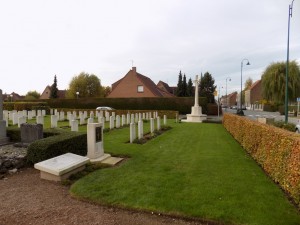
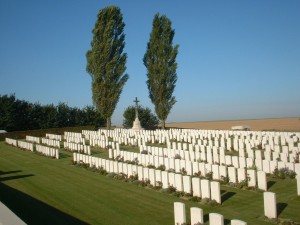
Fromelles CWGC Cemetery
Fromelles CWGC Cemetery

Fromelles © C Sklinar 2010

Fromelles © C Sklinar 2010

Years ago my husband and I was on an afternoon jaunt while on holiday in France and we happened upon the work in progress that was to become Fromelles Commonwealth War Graves Commission cemetery. Luckily there was someone walking about, he happened to be a very nice man who was one of the people in charge – don’t you love moments like that? Anyway, he told us a bit about what was going on and when the cemetery would be opened, but in the meantime we took interest in the information boards that had been put in place to inform visitors and passers by what had happened and what was happening.

In 2010 we visited Fromelle again, which just so happened was shortly after the cemetery had been officially opened, as the wreaths and wooden crosses filled the base of the Cross of Remembrance and were still pristine condition. While the fresh flowers and leaves that had been left at the graves of individuals were no longer fresh and vibrant in colour, they did show that someone had been and paid a visit.

Before I focus on one of the men remembered here, let me take you back in time……..

The Battle of Fromelles took place on the 19th -20th of July 1916 and was supposed to be a diversionary tactic, aimed at keeping the German reserves from joining the Somme battle, some 80 km away. Early on the 19th two divisions that had recently arrived on the Western Front, the 5th Australian and British 61st (South Midland)  attacked a strongly held section of the German front line.  The defenders were warned and ready for the allied attack.  Days before the attack a heavy bombardment had poured down the German lines, this was hugely ineffective.

Hours before the attack was due to start the bombardment intensified. The enemy retaliated pounding the waiting British and Australians who were packed into to their trenches. At 6pm the assault began, advancing in waves. The allied were cut down by machinegun fire with the survivors being forced back to their trenches.

The next morning when the assault was called off the Australians had lost over 5,500 men killed, wounded and missing, the heaviest losses for one assault in Australian history.  The British casualties numbed over 1,540.  These figures amount to over one third of the men who fought in the battle.

 In May 2008, six mass graves were accounted for and the CWGC were given the task by the Australian Government of overseeing the recovery and to create a new resting place for them. The bodies of 250 men were removed by a team of specialists who took DNA samples in the hope of trying to give these men back their names.  By the time the cemetery was complete all but one of these men had been identified.

In January and February of 2010 all but one of the men had been buried with full military honours.  The last soldier was to be laid to his final rest during the service to dedicate the cemetery on the 19th of July 2010 – the 94th anniversary of the Battle.

The cemetery, the first CWGC cemetery since the 1960’s and was designed to be more of a garden than cemetery, well I think it is a very calm and peaceful place.  A place befitting those who rest there.

Talking about resting there.  Who does rest within the walls of Fromelles Pheasant Wood Cemetery?
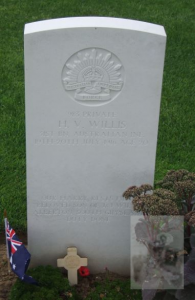
Pte Willis Frommelles CWGC ©  C Sklinar 2010

Pte Willis Fromelles CWGC © C Sklinar 2010

A few of the headstones had tokens placed at their bases. One headstone that had had a visitor was that of Henry Victor Willis, known as Harry to his friends and family.

The Attestation Papers for Australian and New Zealand soldiers are available via the National Archives of Australia and the records for Henry or Harry are there, all 36 pages of them.  Harry was born in Alberton and at the time of his attestation was employed as a farm labourer.  His mother Janet was given as his next of kin.

Harry, serving as 983 in the 31st Btn. Australian Infantry, enlisted on the 14th of July 1915 was 19 years old 10 months, 5′ 4¾” tall, weighed 155lb and had a fully expanded chest of 39″. He had a sallow complexion, blue eyes, brown hair and gave his religion as Presbyterian.  He had four vaccination marks on his left arm and had a mole on his left shoulder blade.

When going through his paperwork one entry tells that he was appointed Lance Corporal in March of 1916 but by May of the same year had reverted to Private, two months later he is one of many reported missing, amended to ‘now reported Killed in Action’.

A typed note dated 4th November 1916  tells ‘German List received by Wounded and Missing Enquiry Bureau, Australian Branch – Identification marks found on the Prisoner of War are inspected by the General War Bureau, and show in the list as under – DEAD.  Another note from 4th February 1917 reads: ‘Admin. Headquarters War Office Letter 21/1396 Accounts 4 – Identification disc received from Germany. No particulars were afforded except that soldier is deceased.  To be reported Killed in Action.’

On the 28th of October 1921 Janet Willis signed a receipt slip acknowledging receipt of Private 983, H W Willis’s Memorial Scroll and King’s Message, later in the year Janet signed again for the British War Medal, this time a witness was required so Marion Lang signed below Janet’s signature. The signing of receipts continued through 1922 and 1923.

Many of the papers in Harry’s file are out of date order.  One such letter is to Mrs Janet Willis saying that no letter had been received from Mrs Willis, but an account of Harry’s fate could be in a report.  The next piece of paper, tells all.

re Pte H V Willis, No. 983 31st Battn.
Private H  I Rogers, No. 1560, 31st Battn, has stated that on July 19th 1916 at Fleurbaix, Willis was shot through the jaw.  He was in the same Machine Gun Section as informant, but they were not together at that moment.  He thinks that Pte. Ellis (nicknamed Paddy) is likely to know particulars.  Ellis’ address is at present as under ‘8 Training Battn. A I F, Larkhill, Salisbury Plains.
Private A E Hickson, No 872, 31st Battn. states :- ‘ I knew Willis. He was in the same tent as myself.  He was a stout fair man about 21 years of age. He came from Yarran, Queensland, Victoria.  He was killed at Fleurbaix in ‘No man’s land’ I saw his body 13 hours later lying dead.  We had to retire and leave our dead there’
We have also to report that this soldier’s name appeared in the German death list dated 4th November 1916.
(Sgd) Beacham Kiddle.

One of the final letters, well not a letter, more like a quick note on a torn off sheet of lined paper, tells that Janet Willis, was ‘quite agreeable that my son may enlist for active service abroad’. That note was dated the 10th of July 1915 – just over a year later he would be lying in no man’s land with his fellow men.
Wakefield Express – Sgt Beetham

Wakefield Express – Sgt Beetham

Continuing from the previous entry, is another article from the Wakefield Express. In fact it is the article directly above Pte Webster’s entry in the paper.

Wakefield Express 19th October 1918
Sergeant Harry Beetham of the Essex Regiment has been killed in action in France. He belonged to Ossett and his widow lives at his parents’ home in Horbury Road. At the outbreak of war Sgt. Beetham was in the Territorial Battalion, and went out to France with his comrades. On his time expiring, he took his discharge, but after about a year at home he re-enlisted into the Army, that being in May 1917. His civilian occupation he was that of a fireman at a mill, and he worked at Dewsbury.

More about Harry and his live before his enlistment.  He was the son of Joseph and Clara Beetham who in 1901 were living at Manor Road, Ossett.  Joseph was an Ossett born man who worked as a painter, while his wife it seems was a Londoner. At the time of this census Joseph and Clara had three children – Harry aged 8, Rose Cordelia aged 6 and Bertha aged 2.

Ten years later, home for the family was 49 Manor Road, South Ossett – could this be the same address as in the previous census with the house number omitted? The 1911 census is a wonderful source and I praise the person who wanted the number of years married and the children included, even though more often than not, the person who completes the form gets it all wrong.  With these questions in mind, Joseph and Clara had been married 20 years and Clara had given birth to five children, with only three surviving to be included on the census sheet.  Joseph was still a painter, but now specified he was a house painter, Harry, was still a mill hand. Rose Cordelia, now included as Rosie was working as a rag sorter.

In the newspaper article, Harry enlisted, serving in the Territorial Battalion, his time being complete in 1916. There is a Medal Card for a Harry Beetham serving in the Y.L.I., could this be his.  Early the following year he married Edith Ellis in the Parish Church, Ossett, when Rose Cordelia Beetham and Willie Firth had been witnesses. The couple would bid a fond farewell to each other later that year when Harry re-enlisted in May.

Unicorn Cemetery via CWGC

Unicorn Cemetery via CWGC

Harry on his re-enlistment served in the Essex Regiment as Lance Sergeant 50006 and by the 21st of September the following year, 1918 he had been killed in action.  He rests in Unicorn Cemetery, Vendhuile, about 24 km south-east of Peronne. The cemetery is surrounded by trees and fields and is the final resting place for nearly 600 identified casualties.

The Register of Soldiers’ Effects tells that Harry was in the 10th Battalion of the Essex Regiment and that Edith was his sole heir to

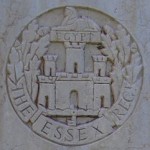
CWGC headstone to a fallen Essex soldier

CWGC headstone to a fallen Essex soldier

monies owed from the War Department – the monies being finally signed off on August of 1919.

Talking about money, Harry is recorded in the Probate Calendars for 1919, ‘Beetham Harry of 38 East View Horbury Road Ossett Yorkshire a lance-sergeant in the Essex regiment died 21 September 1918 in france Administration Wakefield 10 February to Edith Beetham widow.  Effects £26 17s 3d. It seems strange to read but the calendars are not punctuated.

Harry, as well as being next to Ernest Webster in the Wakefield Express, he is also on the same war memorial, Wesley Street Burial Ground. Ernest can be found by clicking the link on the left at the bottom of the page or following Ernest’s link above.

Wakefield Express – Pte Webster

Wakefield Express – Pte Webster

The Wakefield Express and other newspapers around the country are a full of articles and snippets of information relating to World War I and the men and women who fought, nursed, gave aid and comfort and who died, as many war memorials say ‘for their country’.

Another in the Wakefield Express series

Wakefield Express 19 October 1918
Private Ernest Webster, of the Mounted Brigade Field Ambulance, has been killed in action in France. He was unmarried, and his home was at Albert Street, Ossett, where his widowed mother lives. He joined up shortly after the outbreak of war, but was only sent out to France in December of that year. He was a prominent member of South Ossett Church Football Club and was also its secretary for several years, and its representative on the Ossett and District League Committee, this is about the fourth playing member of the club who has given his life for his country.

Ernest, was killed in action on the 8th of October 1918 aged 33, with the war only a few weeks to go until peace was declared.  He rests in Beaurevoir British Cemetery, some 25 km south of Cambrai, along with nearly 300 other casualties of war, of which 244 are identified.

Who was Ernest?

Ernest, was a local lad, born and bred in Osset, as had his father and mother, George and Eunice (nee Gunson). Home for the family in 1891 was The Green.  George worked in one of the local mills as a labourer, as did his son, Joshua, while his daughter, Elizabeth aged 22, was employed as a rag sorter.  Young Ernest was five years old and went to school.

Ernest was born on the 28th of May 1885, on the 27th of July, he was taken by his parents to St Peter’s church, Earlsheaton, where he was baptised – more than likely with family and friends in attendance.  George, when asked his occupation by Rev. Tunnicliffe, told he was a spinner and this information was included on the baptism record.

By 1901 Eunice and Ernest are the only two family members living together. Eunice works as a ‘knitting machinist’ on her own account, while Ernest is 15 years old and a rag sorter.  From the above newspaper article, it is known that Eunice is a widow.  When did George die?  There is a death entry for a George Webster aged 51 and registered in Dewsbury in 1892 – is this her husband?

Ten years later in 1911, Eunice and Ernest are living in three rooms at Willey Buildings, Manor Road, South Ossett.  Eunice has no occupation listed but did include how many children she had and now many were now living.  It appears that Ernest completed for form on behalf of his mother as he signed ‘Ernest Webster pp Eunice Webster’ – now-a-days, in this age of texting, emails and computer generated letters, you don’t tend to see ‘pp’ (per pro) do you?

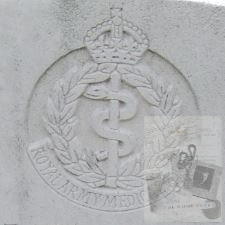
Royal Army Medical Corps headstone logo © C Sklinar 2015

Royal Army Medical Corps headstone logo © C Sklinar 2015

Ernest enlisted in Ossett shortly after the outbreak of war in 1914, joining the West Yorkshire Regiment and becoming Private 20735, later being transferred to the Royal Army Medical Corps and becoming Private 67765, serving with the 9th Cavalry Field Ambulance.  A Field Ambulance, for example an ‘A Section’ of a Field Ambulance Unit consisted of;-

  • 1 Lieutenant-Colonel, in command of the Ambulance and A Section
  • 1 Captain or Lieutenant in command of Stretcher Bearer subsection
  • 1 Sergeant and 1 Corporal
  • 1 Bugler
  • 3 Privates (wagon orderlies) and 36 Privates (bearers)
  • 1 Captain or Lieutenant in command of Tent subsection
  • 1 Quartermaster, 1 Sergeant-Major, 2 Sergeants, 2 Corporals
  • 15 Privates (including a cook, a washerman and 2 orderlies)An “A” Section also had a Sergeant, 10 Drivers and 4 officers batmen attached from the Army Service Corps.

while a B Section had

  • 1 Captain or Lieutenant in command of Stretcher Bearer subsection
  • 1 Sergeant and 1 Corporal
  • 1 Bugler
  • 2 Privates (wagon orderlies) and 36 Privates (bearers)
  • 1 Major, Captain or Lieutenant in command of Tent subsection
  • 1 Quartermaster, 1 Sergeant-Major, 4 Sergeants, 2 Corporals
  • 13 Privates (including a cook, a washerman and 2 orderlies)
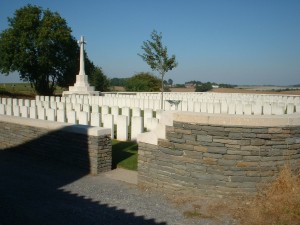
Beaurevoir cemetery via CWGC

Beaurevoir cemetery via CWGC

Ernest’s headstone in the Commonwealth War Graves Commission cemetery bears a cross, his name, service number and regiment.  One of the documents held by the CWGC inform that Mrs F Harrop, Horbury Road, South Ossett, was his next of kin. While his entry in the Register of Soldiers’ Effects tells that monies were paid to an Emma and later to Eunice, his mother.

Although Ernest rests in a foreign field, he is remembered in his hometown  along with many others.

Dewsbury Reporter, Wakefield and West Riding Herald – A F G Kilby V.C.

Dewsbury Reporter,  Wakefield and West Riding Herald –
A F G Kilby V.C.

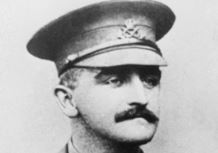
A F G Kilby

A F G Kilby

On the front page of the above newspaper dated 19th of August 1916 are a selection of pictures of officers from various regiments who had either been reported missing or killed, including:- Lieut. P E Melly, King’s Liverpool Regt., who was officially reported missing; 2nd Lieut. E Archer, Wakefield Territorials, who was also reported missing.  These men have a connection to Wakefield and the surrounding area, but one seems to have no connection whatsoever – Captain A F G Kilby, V.C., M.C., South Staffordshire Regt.  Why was he included?

Anyway, until I find out otherwise here is a little about A F G Kilby. Arthur Forbes Gordon Kilby was born in Cheltenham in 1885, the only son of Sandford and Alice Kilby, nee Scott.

Before I go any further, I clicked on a link the other day and it took me to a BBC page about a soldier who was classed as ‘Cheltenham’s forgotten VC hero’. I saved the page thinking one day I will have a closer look at who he was. While I was in France – holiday and time out to research, I went through a pile of Wakefield Express cuttings in readiness to blog about.  So today, I pick up the first cutting, start putting a few words down, then decide to Google Arthur. Well, blow me down, I came across the BBC page  I mentioned earlier.  What a coincidence! Or, more to the point how strange for me to chose Arthur out of all the articles I have.

Back to Arthur, his parents had married in India in 1878.  Sandford being at one time in the Bengal Preventive Service.  He had also been Assistant Collector of Customs in Chittagong, served in the Police department, worked on famine relief duty, 1873 and 1876.  He also worked in Madras as  Deputy Commander, abkari and salt departments and retired in 1892. He died in London in 1923 leaving over £11,000.

It seems that by looking into Arthur’s parents I think I have found why he is included in a Wakefield paper.  Alice Flora Scott was born in Wakefield in 1857, while her husband seems, according to various sources, been born at sea.  But with delving a little further I find that Sandford James Kilby was the son of George Henry Kilby (1820), George inturn was the son of John Kilby (1770) (who had been Lord Mayor of York), whose other son was Thomas Kilby, the Rev Thomas Kilby, whose parish was St John’s, Wakefield.  Thomas was also a renown local artist and painted many scenes from the area.  It seems that there was a connection to Wakefield afterall.

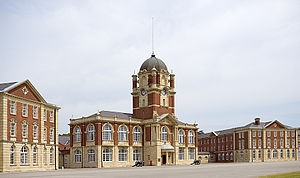
Sandhurst College via Wikipedia

Sandhurst College via Wikipedia

Arthur was educated at Bilton Grange, a preparatory school near Rugby followed by Winchester College.  He attended the Royal Military College, Sandhurst, graduating in 1905.  He is found in Forbes List of 1908 as a 2nd Lieutenant commissioned into the South Staffordshire Regiment. FindmyPast have a document online that confirms his graduation in 1905, giving his height as 6ft ½” and his father’s address as Skelton Hose, Leamington.  Promoted to a Captain in 1910, Arthur was fluent in Hungarian and German and could also speak French and Spanish fluently.  At the outbreak of war, Arthur was posted with the BEF to France and Belgium with the 2nd Battalion, arriving about two weeks after war was declared.  In February of 1915, he had been awarded the Military Cross and appears in the London Gazette for this award.

He was killed in action on 25th of September 1915 on the first day of the Battle of Loos, while leading his men on at on enemy positions near Cuinchy, on the Le Bassee Canal. During the first day of the  battle over 40 other men from Cheltenham also lost their lives.  It was what Arthur did during the attack that he was awarded a posthumous Victoria Cross .  His citation in the London Gazette dated 30th March 1916 reads :

“For most conspicuous gallantry. Captain Kilby was specially selected, at his own request, and on account of the gallantry which he had previously displayed on many occasions, to attack with his Company a strong enemy redoubt.

“The Company charged along the narrow towpath, headed by Captain Kilby, who, though wounded at the outset, continued to lead his men right up to the enemy wire under a devastating machine gun fire and a shower of bombs.

“Here he was shot down, but, although his foot had been blown off, he continued to cheer his men and to use a rifle.   Captain Kilby has been missing since the date of the performance of this great act of valour, and his death has now been presumed.”

Arthur has an entry in De Ruvigny’s Roll of Honour and his entry includes the following passages :

…being an interpreter in German, Hungarian, the only officer in the Army with the latter distinction, and could also speak French and Spanish fluently; transferred to the 2nd Battn. in 1910, which he joined in the winter of that year, and was put in charge of E Coy. In 1912 his tug-of-war team came out second in the Brigade Sports, and in the Regimental Sports at Lichfield in Sept. the men of his company entered most of the events, and won the shield, worth about 300 points.
When the European War broke out he was preparing for the Staff College; served with the Expeditionary Force in France and Flanders from 12 Aug 1914: took part in the retreat from Mons, the Battle of Aisne, and the First Battle of Ypres when he was severely wounded and invalided home. After six months in England, during the last two of which he was attached to the 8th Battn., he returned to the front in May, 1915, where he performed consistent good work during the months of Aug. and Sept. while the battalion was holding A 2 Section, making some very useful reconnaissances, imbuing ranks with keenness by his example, for which he was subsequently recommended for the D.S.O. and was killed in action near La Basse 25 Sept. 1915, while leading an attack on the strong Railway Triangle Redoubt.  He was buried where he fell, with Lieut. Williams and 13 men of his company, a cross being erected by the enemy.
Brigadier-General A C Daly wrote ‘ Capt. A F G Kilby, on the night of Sept. 5 – 6, went out along the Canal Towpath under cover of darkness, accompanied by a Lieut. (Thompson) of the 1st King’s, and closely reconnoitred the German position on the Embankment Redoubt, and brought back most useful information.  The Reconnaissance was a very dangerous one, as the canal bank is a hot-bed of snipers, and it required by the greatest skill and courage to get right up to the German position as Capt. Kilby did. This is only one specific instance.  this officer constantly made night reconnaissances of this nature,’ and again: ‘I had only the honour of knowing him for four months, but I formed a deep admiration and affection for him, and always said he was the best Company Commander in the Brigade.’
……He was wounded at the very start, but still insisted on cheering his men right up to the German wire, which our guns had been unable to destroy.   He was the best officer in the Regiment, beloved by his men and absolutely fearless…..The regiment received a message of congratulation on the gallantry of the attack under such conditions. Capt. Kilby was twice mentioned in Despatches………….

For his deeds during that day the German defenders erected a cross where he fell. His body was found in 1929 and interred at Arras Road Cemetery, Roclincourt.

The Register of Soldiers’ Effects tells that the War Office were to pay  over £40 to Arthur’s beneficiary, which according to the Probate Calendars, was his father, Sandford James Kilby, gentleman with effects of £849 10s 5d.

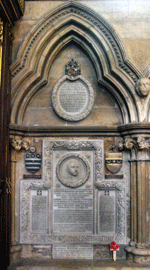
Memorial to Capt. A F G Kilby, V.C.

Memorial to Capt. A F G Kilby, V.C. source unknown but acknowledged.

A memorial to Arthur was placed in St Nicholas’s Chapel, York Minster by his family.  The memorial bears the inscription of his deeds and awards and contains the family coat-of-arms and a bust of Arthur.  St Cuthbert’s Church, Peasholme Green, York also has him listed on their war memorial.

In 2012, Kilby’s Victoria Cross, along with another awarded to Private Sidney Godley, the very first VC recipient of World War I, was sold at a London auction for £276,000 each to Lord Ashcroft. Captain Kilby’s medal are now part of the Lord Ashcroft Medal Collection in the Imperial War Museum in London.

 We know that Sandford died in 1923 and The Yorkshire Post and Leeds Intelligencer of 8th of March 1923 tells :

Bequest of a V.C. Decoration.      Mr Sandford James Kilby, of Leamington, son of a former Lord Mayor of York, left £11,902, net personalty being £9,14.  He gave the portrait of his late son, Captain Arthur Forbes Gordon Kilby, the tunic he wore when wounded at the Battle of Ypres, and his Victoria Cross and other decorations won by him to Mrs Kilby for life, and then for his daughter, Dorothy Alice Howlett, for her life, with remainder to her eldest son, who shall take the name Kilby.  In the event of the failure of these trusts, these articles are to be offered to the National Portrait Gallery.

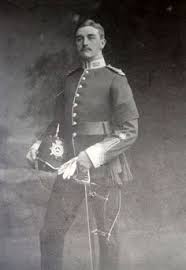
Arthur Forbes Gordon Kilby

Arthur Forbes Gordon Kilby

I have found over the past years, especially the past two weeks, that by just find a simple headstone, with only a name and an occupation or by just being given a name and very little else, what wonderful stories are to be found.  Arthur. started off as a photograph in a newspaper, a newspaper quite a distance from where he lived  – it seems that quite an interesting story came to light and answered the question, why he was in the Dewsbury Reporter,  Wakefield and West Riding Herald.  Here is the photograph that appeared in the paper and started the afternoons mystery – quite a distinguished looking man, isn’t he?

Sugar Lane Cemetery – Clayton family

Sugar Lane Cemetery – Clayton family

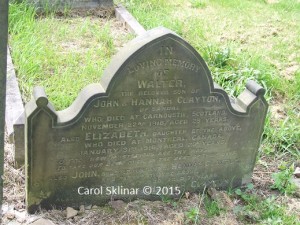
Walter Clayton & family headstone © C Sklinar 2015

Walter Clayton & family headstone © C Sklinar 2015

The Clayton family seemed to have liked to travel and it is families like this that can cause a little bit of uncertainty in people like us.  The more common a surname, the more difficult it is to confirm if someone found out of area is the one you are on a mission to find.  People with more unusual names have less confusion and uncertainty with relatives who ventured far and wide.

One family who ventured are remembered on a small but fully carved headstone which reads:-

In Loving Memory of Walter the beloved son of John & Hannah Clayton of Sandal who died at Carnoustie, Scotland, November 22nd 1918, aged 29 years.  Also Elizabeth, daughter of the above who died at Montreal, Canada, January 31st 1916, aged 29 years. O God, how mysterious are they ways to take our dear ones, in the best of their days. Also John, beloved husband of Hannah Clayton and father of the above, who died July 9th 1930, aged 71 years also the above named Hannah Clayton, who died February 15th 1940 aged 82 years.

Not only were John and Hannah’s children away from home when they died but they were both 29 years of age.

In 1891, John and Hannah were living in Great Oakley, Northamptonshire with their family: John H aged 11; William aged 9; Alice M aged 7; Elizabeth aged 5 and Walter aged 1.  All the children seemed to be born in Great Oakley.  John was aged 32 and working as a Railway Signalman.

By 1901, the family were living at St Catherine Street, Sandal and Walter had two younger siblings – Edith aged 9 and George E just four.  Edith like her older siblings had been born in Great Oakley, but George was born in Sandal, Wakefield. John, was still employed as a signalman.  Many of the other men living on St Catherine Street also worked for the railway.

It seems that this family just keeps on growing as by 1911, Earnest Clayton aged 15 days old is the newest addition to the family.  John H, William and Alice are no longer at home, just  leaving five children to look after, which must be something of a task for 53 year old Hannah. John and Hannah had been married for 35 years and between then had raised seven of their eight children. John was now working as a Railway Shunter and Walter was working as an Engine Fitter.

With Walter and Elizabeth being at home in 1911 when did they go away.  Walter worked as an engine fitter in 1911. The column next to the one describing his occupation the word AWAY has been struck through and Engineering Works added – could this be a clue as to why Walter was in Carnoustie?  Elizabeth on the other hand is classed as a domestic servant.   Did she move to Canada as an employee or did she marry and move across the Atlantic with her husband? Your guess is as good as mine………………

………………….Unless you know any better!

Wakefield Express – Bereaved Mother

Wakefield Express 6 June 1915

Bereaved Mother

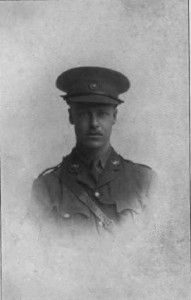
2nd Lieut. Christopher B Sugden via Old Savilian 1915

2nd Lieut. Christopher B Sugden via Old Savilian 1915

A bereaved mother has received the following sympathetic letter from Captain A C Chadwick concerning the death of her brave son :-

4th KOYLI, 148th Infantry Brigade 49th Division, Thursday May 27th 1915.

Dear Mrs Sugden, – it is with the deepest possible regret that I write to convey to you the sympathy of the whole of B Company in the sad loss which you have had to bear by poor Chris’ death. In him I have lost a true and staunch friend, a fine and fearless soldier, who was loved and adored by every man in the company. He could not have had a better or more peaceful end. At the time he, along with 12 other men of his platoon, were holding a ruined farm building which had been retaken, by the company the previous night. Having made certain by fortifying the place that it would not be retaken, he laid himself down to catch a moment’s rest. He must just have dozed off when he, along with Pte. W Smith were struck by a shell. He suffered no pain, death being instantaneous. His resting-place is in a pretty churchyard and is marked by a cross with his name an regiment on it. I promise you, his grave shall be well looked after and everything shall be done to make the spot worthy of the dear fellow who lies peacefully beneath.””

The following is an extract from a letter, dated May 27th from the Adjutant of the Battalion (Captain H S Kaye) to his wife:-

Poor Suggie – he was a splendid boy, as plucky as anything and as cool as a cucumber. When his company heard he had been killed they were back in the billets after having been relieved, and they were all going back and having it out with the Boches at once. It was with difficulty that they were restrained. They have been sharpening their bayonets ever since. It was a peaceful end anyway, as he was asleep when the shell got him. He was buried in the cemetery where all our fellows have been buried.”

Could you ask for a more wonderful tribute to your son?  Saddened by the loss but  glad in the knowledge that he was thought so much of by his fellow men.

Who was Chris or Suggie? Mrs Sugden’s came as a by chance, while researching for another project, with a few lines at the beginning and at the end missing.  But hey ho, the gist is there.

Christopher’s parents were Thomas Babington Sugden and Edith Constance nee Nicholson who had married in the Doncaster area in 1891. Three children followed their union – ~Edith Rebecca, Christopher Babington  and Constance Mary.

In 1901 the first census that Christopher could be included in, his family were living at 3 Regent Square, Doncaster. Thomas was aged 40 and employed as Solicitor, Town Clerk and Borough Coroner. As well as the family, the household included two servants, a cook and a nurse.

 By the 1911 census, Thomas and his family were living at St John’s Lodge, Wakefield- quite a large house in the Georgian square, having 12 rooms.  Thomas now was employed as a solicitor and Registrar of Deeds, just around the corner from home. By now Edith was 19, Christopher 18 and Constance 14, all still being classed as scholars.  One question arose from this census – where was a young man of Christopher’s upbringing educated?  Two choices sprung to mind. But it seems my first choice was correct.  I have copies of the Old Savilians and a quick look through the copy for the summer of 1915 came up trumps!

The Queen Elizabeth Grammar School or Quegs as it is known locally.  Christopher was a prominent member of the VI form and a prefect.  He was much respected by scholars and staff – we know that he was popular from the letter to his mother.  In 1912 he left school and went to Merton College, Oxford, where he joined the University OTC.  Soon after war was declared Christopher took a commission as a 2nd Lieutenant in the King’s Own Yorkshire Light Infantry.

The Old Savilian goes on to tell much that is already known from the above letter, but does go on to tell more about the young man himself.  An extract from the Old Savilian for 1915 tells “His nature was marked by instinctive dignity and modest reserve. To his many friends he was known as a man of flawless honour, a gentleman by soul as well as manner, and of deep religious feeling.  For music, literature and art he had a fine natural taste, and his promise of distinguished personality was already passing into fact.  All his soldier comrades bear testimony to his knightly character, and deplore his loss.  Of none can it be said more truly that his short life and early death made one perfect peace”

Following on are a few lines of verse found in Christopher’s papers – the last few lines seem so poignant

Deep in a longed-for sleep let them carry me into the woodland,
Leave me to rest there alone in silence—alone and in silence!
Deep in a fragrant grove of yew and cypress and cedar,
Knowing no anxious cares nor fears for a doubtful tomorrow,
Lost, in a dreamless slumber, till God in His own good season,
Out of His heaven above, to His blessed Presence shall call me !

Lieutenant Christopher Babington Sugden was the first Old Savilian to be a casualty of war.

Koyli CWGC headstone emblem

Koyli CWGC headstone emblem

Military records for Christopher – his medal card is full of information. The usual details: name, rank, date of death plus his father’s address (which is already known). There is also a note telling that Mr Sugden applies for the 1914-15 Star in respect of his late son, dated 26 June 1919.

Christopher, of St John’s Lodge, Wakefield died on the 25th of May 1915.  Probate for him was proven in London on the 24th of July of the same year, when his father Thomas Babington Sugden, Registrar of Deeds was to be his beneficiary, receiving £226 13s 5d.

Christopher rests in peace with over 120 other casualties of war in Bois-Grenier Communal Cemetery, just a few kilometers south of Armentieres.

Wakefield Express – Official Wounded List

Wakefield Express 2nd September 1916

Wounded King’s Own Yorkshire Light Infantrymen

As mentioned in an snippet earlier today, the Wakefield Express published a list of men from the King’s Own Yorkshire Light Infantry who had been placed on the official list of wounded.

One of your family members may be on this list:

Blankley G and Breakwell W (Normanton);
Cadman M (Ossett); Callighan R (Wakefield);
Carter, Corpl. P C (Horbury);
Chappel C (Wakefield); Clarke A E and Commons H (Wakefield);
Dobson J (Wakefield); Freeman H (Wakefield);
Garett R (Normanton); Hampson H (Normanton);
Hetherington J W (Streethouse); Jinks A (Normanton;
James A (Featherstone); Kilner S O and Lodge Lce Crpl. J (Wakefield);
McGowan H (Wakefield); Parker F (Ossett);
Poole S (Normanton); Sykes Sergt., G (Wakefield);
Thompson A (Wakefield); Waltham G (Wakefield);
Whitworth J W (Wakefield); Wicking S (Crofton);
Haigh W (Wakefield); Milthorpe H (Thornes).

Wakefield Express – Northumberland Fusilier

Wakefield Express – Northumberland Fusilier

 Killed in Action

News has been received that Sergeant Harold Newton, Northumberland Fusiliers nephew of Mr H C Newton, Peterson Road, Wakefield, and grandson of the late Mr Newton of Newmillerdam, was killed in action on July 14th.  Deceased who was 23 years of age was employed at Hemsworth Colliery, and was a prominent playing member of the colliery cricket team.

Koyli CWGC headstone emblem

Koyli CWGC headstone emblem

The above was an entry in the Wakefield Express on the 2nd of September 1916 and was one of many snippets and articles informing the community about the loss of friends, family and work mates.  One of the snippets is a list of local men from the K.O.Y.L.I.’s, who have been wounded. Names include: Kilner, Wicking, Cadman, Dobson, Lodge, Parker and Haigh.

If I had gone through my collection of newspapers clippings related to both wars earlier, I would have included Harold in my series ‘The Somme Remembered’, but better late than never!

Harold had been born in Painthorpe, nr Wakefield or Newmillerdam, Wakefield – depending on which source you view. In 1901 Harold was living with his grandparents Samuel Leake and his wife Sarah.  Samuel was as retired gamekeeper.  The family at the time were living at Game Keeper’s House, West Bretton .

Ten years later in 1911, Harold is living at No 4 Club Terrace, Fitzwilliam, Wakefield with his paternal uncle and aunt – Lionel and Verona Evelyn Newton. Both Harold and his uncle worked at the local colliery as electric motormen, his uncle underground and Harold on the surface. Harold is not found on any census living with his parents, what was the reason for this?  Had they died?  Did they have a large family and some of their children lived with relatives?  Who knows?

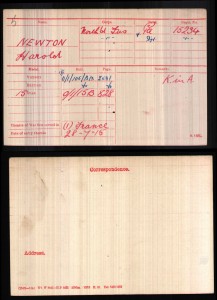
Medal card for Harold Newton KOYLI

Medal card for Harold Newton KOYLI

Harold, born in 1893, enlisted into the K.O.Y.L.I. as Private 15234, later being promoted to a Sergeant, evan at such a young age – had all his counterparts been killed? Or, was he respected by the men?  Anyway, his medal card tells that he entered France on the 28th of July 1915 and that he was killed in action – he had not even been in France for one year before he was killed in The Battle of The Somme.

Harold is remembered on the Thiepval Memorial to the Missing along with many others.

Poppy © Carol Sklinar 2014

Poppy © Carol Sklinar 2014

Wakefield Express WW1 – Fallen Comrade

Wakefield Express WW1 – Fallen Comrade

Normanton Terrier’s Tribute to Fallen Comrade

Private T Harthill, who is a stretcher bearer with the 1st 4th K.O.Y.L.I., writing to the steward of the Normanton Carlton Club (Mr H Fellows), after referring to the death of the four Normanton Territorials, which were reported in last week’s ‘Express’, says:-

“The whole battalion mourns the loss of three more who did not wait to be fetched, but were proud to give all in the cause of right against might.  I hear today that they are calling all single men to the colours, and to my mind it is a disgrace that young men, knowing the critical time the country is passing through, should have to be compelled to take up arms in the defence of Britain’s honour.  I can understand married men with  families not coming forward but not single men, and if conscription comes *** force it not the Government who will be to blame, but these stay-at-homes, who are content to read about the war, or who won’t let it trouble them at all.  I am pleased the club members have responded so well, but I feel sure there are a good number not yet, who ought to be serving.  England expects to-day, just as in Nelson’s day, that this day every man will do his duty, and our confidence in ultimate victory is not shaken in the least, but we must have men to fill the places of those lads who have given their lives for their country’s honour.”

While researching for an ongoing project I have come across a great number of articles related to WW1 and WW2.  The majority of the articles give an insight into how life was at the time of both wars.  The above article from the Wakefield Express issue of 27th of November 1915, tells of the feelings of the fighting soldier who sees war first hand.

We know the thoughts of the soldier and his comrades but who was Private T Hartill, stretcher bearer with the 1st 4th K.O.Y.L.I.’s?  The 1st 4th K.O.Y.L.I. are very close to my heart, as my great uncle served with them, but that is a story to be told later.

My first port of call was the CWGC website to see if a Private T Hartill died during the war, well he was not there, so that seemed to be a bonus – he could still have been entered using a variation of his surname.  But, I had still no idea what the ‘T’ stood for – possibly and more than likely, Thomas, but still holding out on that one for further evidence.

My next step was the Medal Card collection.  I knew he had been in France as he is described as ‘stretcher bearer’, you don’t need those ‘at home’ do you?  A search for ‘T Hartill’ came up with no results, but when just using the surname with variations there was one ‘T Hartill’.  The ‘T’ was for Thomas and he served with the K.O.Y.L.I. and Labour Corps, with the following service numbers- 250419, 478457 and 2330 – if this is our man.   Thomas entered France on 13th of April 1915 – which ties in with the date of the Wakefield Express. One item on the Medal Card was good news – in the remarks section, written in red ink is ‘Dis 6.3.19’, so it looks like Thomas did make it to the end of the war.

Now we have a possible man for the letter writer, there is a chance he could be found in the 1911 census and hopefully with a family.

Here we go!  Thomas Hartill, where do you start with only a name – well I’ve done it before, so why not again.  When was he born?  Where did he live?  Was he a Yorkshire man or had he just enlisted into the K.O.Y.L.I’s?  Starting with ‘Thomas Harthill’ and lived in ‘Yorkshire’, there were six to select from.  Three could be ruled out due to age, bringing the choice down to three. Those three all lived in Yorkshire, as I wanted, but one stood out a little more than the others – he was Thomas Hartill, born in Castleford and living, yes you have guessed, in Normanton…….could that be BINGO!

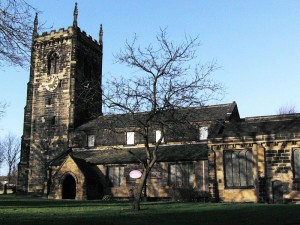
All Saint's Normanton via Wikipedia

All Saint’s Normanton via Wikipedia

Thomas and his wife, Martha (nee Morris) had been married 9 years in 1911, but had had no children. home for the couple was 34 Foxbridge Row, Normanton Common. The Thomas and Martha had married on the 25th of January 1902 in All Saints Church, Normanton.  At the time of their marriage, Thomas lived at Chapel Row, while Martha’s home was 21 Park Row.  Thomas and Harriet Gregory were witness on that happy day.

Work, what did Thomas do for a living, he was a miner – that also links in with the information in the newspaper.

In 1914 there is a FreeBMD entry  for a death of a Martha Hartill aged 35 and registered in the Wakefield area – could this be Thomas’ wife?  Did Thomas re-marry?

Let me take you a few decades forward in time, to 1939.  There is an entry for a Thomas Hartill living in Normanton.  Thomas is aged 79, which ties in with his year of birth picked out from the census.  He is living with the Holmes family: Walter Holmes, born in 18885, who is Incapacitated; Florence Holmes, born in1889, unpaid Domestic Duties; a closed record; Barbara Holmes, born 1933, at school – Barbara later changed her name to Hardy and finally, Thomas born on 27th of November 1879, classed as single, and working as a Building Labourer.

It looks like Thomas went on to live to see the next war begin – what must he have been thinking.  What memories would have been brought back?

Somme Centenary Commemoration – Guest Blogger

Somme Centenary Commemoration 

BARNSLEY AND BEYOND by Guest Blogger, Jane Ainsworth

I was inspired to organise a Somme Centenary Commemoration by the many Old Boys from Barnsley Holgate Grammar School who had served on the Somme in 1916:

one had died in the preparations for the Big Push
ten of them were killed in action on 1 July 1916 with others wounded that day
18 died during the rest of Somme Offensive in 1916
at least 12 survived fighting on the Somme to die later in the war.

Their individual stories are told in detail in my book Great Sacrifice: the Old Boys of Barnsley Holgate Grammar School (published by Helion & Company) and this also includes two accounts by men of their experiences (John Middleton Downend and Harold Marshall) and two poignant last letters (Francis John Potter’s to his parents and James Stuart Swift’s to his wife).

I had visited the outdoor chapel at Silverwood Scout Camp in Silkstone in 2013 while researching war memorials for the project I founded to create a Barnsley Roll of Honour. The site was originally called Newhall Camp, where the Barnsley Pals were billetted and trained, and there is a small sandbag memorial to the Pals in the chapel. As the Barnsley Pals had participated in the Somme Battles of 1916, this seemed the ideal venue for a centenary commemoration on 1 July 2016.

Although I wanted to remember all of the men who served in the two battalions of the Barnsley Pals (13th and 14th York and Lancaster Regiment), many of whom were killed in action on the First Day of the Somme, I did not want to limit my commemoration in any way. I invited people from Barnsley and surrounding areas to attend and to nominate relations they would like to have remembered at this event who had served on the Somme, wherever they had lived and whether they had died or survived. I publicized that:

The aim is to remember ALL those who participated in the Somme Battles of 1916, throughout 1916 and in whatever capacity.

We will pay special tribute to the massive number of troops who were killed in preparations for the ‘Big Push’, on the First Day of the Somme and the 140 days afterwards in many different Regiments, Battalions and other services.

However, we will not forget that many more men were wounded, some died later in the war and others survived, but all involved suffered psychological trauma from their experience.

I invited various people to be involved and I received invaluable support and practical help from the Scouting volunteers, Horizon Community College and Silkstone Primary School. I was extremely grateful to Paul Unsworth and team for allowing me to use the site free of charge as I was not obtaining any funding. (We held a collection towards the upkeep of this important site and, thanks to the generosity of those attending, I was able to donate over £80).

I was very lucky that the Scouts had erected a new building with kitchen facilities this spring so I was able to use the Billingham Centre for displays and refreshments. The event took place from 1pm to 3pm and displays included the history of the site (including the report and photographs from a survey carried out by Elmet Archaeological Services in 2015 with some new survey results from Master’s student Andrew Edwards plus details about its occupation by the Barnsley Pals), background to the Somme Battles and details of many men to be remembered. The DVD of original film footage taken on the Somme in 1916 was also available for people to watch.

Somme Centenary Commemoration © Barnsley chronicle

Somme Centenary Commemoration © Barnsley chronicle

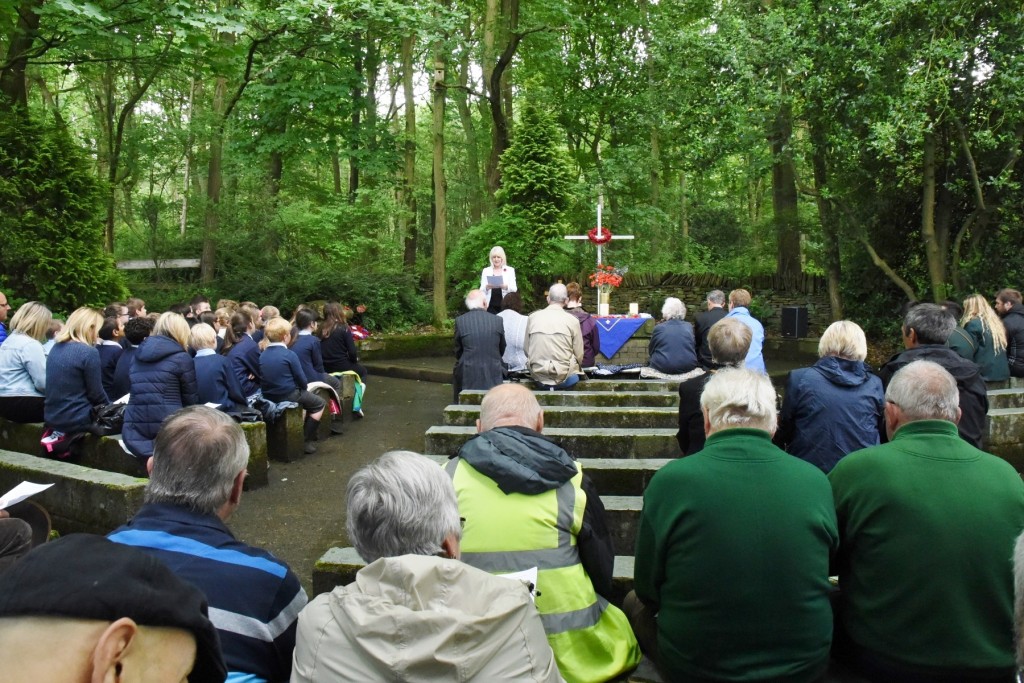
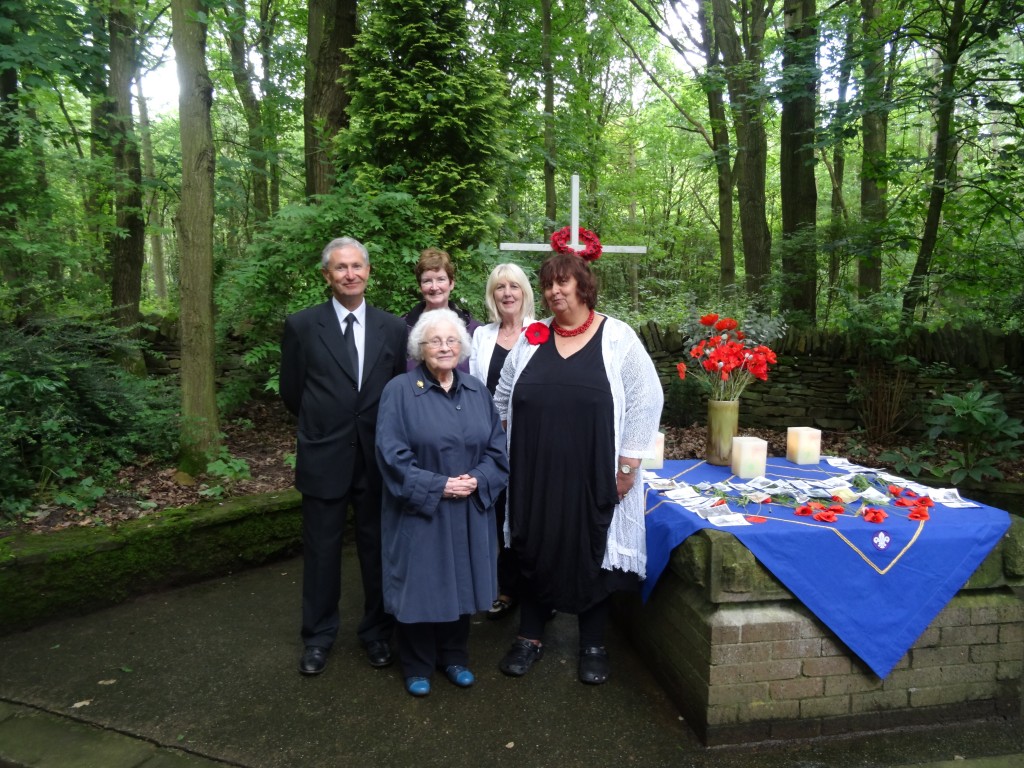
The secular Remembrance Service was in the outdoor chapel from 2pm until about 2.30pm and it involved readings interspersed with music. I placed a vase of poppies and three large candles on the altar, which was covered in a white cloth, poppies and photographs of men who served on the Somme. A CD of military bagpipe music was played as people assembled then, after welcoming everyone, a replica WW1 whistle was blown before background information was provided. As the number of men killed is too great to comprehend or remember everyone as individuals, the diverse and poignant stories of 12 families affected were read by three relations (Adrienne McEnhill, Deborah Toft and Ian Potter), Tom West and five students from Horizon – twins Lewis and Reece Smith (Marine Cadets, who also played bugles), Emily Linford (Army Cadet), Ethan Hepworth and Harry Houlston. Alex Simon’s Class 5 from Silkstone Primary School sang verses from two songs popular in the First World War: It’s A Long Way To Tipperary and Pack Up Your Troubles. Lewis and Reece sounded the Last Post then Reveille after a minute’s silence and the laying of two wreaths then my husband Paul had to thank everyone for participating and attending as my emotions had overwhelmed me. People were offered a Peace Baby as they left the chapel – after the war ended in 1918, Jelly Babies were packaged as Peace Babies.

The outdoor chapel was very atmospheric with the overhanging beech trees and very dark skies. We were fortunate that we only had a light shower but everyone had come prepared with waterproofs and umbrellas. Unfortunately, we were unable to video the service because of the wet conditions; we had hoped to show it to those relations who were unable to attend – several were actually visiting the Somme for 1 July.

The following men participated in the Somme Battles from the families remembered in the service; their dates of death are shown in brackets if they died during the First World War.

Arthur Almond (1 July 1916, aged 24)
Stanley Bell (8 August 1916, aged 26
John Middleton Downend (
24 November 1917, aged 29)
Christopher Gascoigne (1 July, aged 34)
Bertrand Harrison (15 September 1916, aged 33)
George Alfred Guest Hewitt (27 November 1917, aged 24)
Sidney Nicholson (
10 October 1916, aged 26) and Ernest Nicholson
Thomas William Penaluna
Francis John Potter (1 July 1916, aged 23)
Percy Sawyer and Francis Sawyer Harold Skelley (7 February 1919, aged 24)
Llewellyn Weigh and John Weigh (5 September 1917, aged 23)

It was an enormous amount of ‘work’ for me but very satisfying on a personal level. Despite not being able to rehearse together, the Remembrance Service went very smoothly and everyone was impressed with how all of the children performed.

I received a lot of very positive feedback about the whole event and one relation, John Camm, emailed me to say:

“Just wanted to say thank you for the Service on Friday. Listening to the stories of the local men who fought on the 1st July was very moving.

“I especially liked the fact that their stories were read out by the local school children. It was great to see them taking an active part in the commemorations. It gives us hope that the Somme and the First World War will be remembered for a very long time to come.

“I did have a look at the displays. They were excellent. When you read one soldier’s tragic story and then think that it was repeated 20,000 times in one day, it’s very powerful”.

Somme Centenary Commemoration © J Ainsworth

Somme Centenary Commemoration © J Ainsworth