Tag Archives: conflict

Unknown Soldier

Just over  a month ago I was given a framed picture, I say picture, as it is not truly a memorial.  Anyway, this picture was for a soldier who served in the King’s Own Yorkshire Light Infantry during WW1.

KOYLI Badge

It would have been quite colourful, with its curled horn with a central white rose surrounded by a horse shoe shaped wreath containing the Battle Honours of the Regiment.

The framed picture must have been on a family wall for many years as the soldiers number, rank and name are very faint and I do mean faint.

Armed with a good source of light, magnifying glass, large cup of tea and a couple of tried and trusted websites I set off on my quest.

The first two numbers and the last few numbers were easy to read, it was the ones in the middle that were the problem.  His regiment was clear, he was  a Private.  His initial was clear, an old fashioned L, you know the one, similar to a £ sign.  His name, well, I decided on M for the first letter, with a L in the middle.  Variations of the names first few letters went on for a while, varying from Mc, Ma, Me and Mo.

As you can guess one of my favourite websites was getting well and truly used and I was certainly making my subscription work.  The eyes of a neighbour and fellow family historian were also called upon and she achieved the same as me.

One thing that we both felt certain about was that he did not die as the CWGC and SWDTGW have no match for any permutation of his army number.

The frame was put on my desk and left in view, but it was certainly not forgotten.  Where else could I look? What else could I do? He was an army man.  He may not have volunteered but he was called to Serve King and Country in some way but where? Who would know the regiment better than the Regimental Museum?  The KOYLI museum is housed within Doncaster Museum, being moved from The Barracks at Pontefract.  I ‘phoned, spoke to a nice man who told me he would get someone to call me back as the person who I needed to speak to was on his holidays.  I didn’t have to wait long and Steve rang – I gave him the numbers, rank and what I thought was his name.  He’d ring me back.

Guess what ?  He rang and came up with the same as me – no trace of our man.  He did however, suggest that I go over and take the picture to the Museum, so that he could possibly, shed light on the matter.  Believe you me, it needs a lot of light !

Today was the day I ventured to South Yorkshire, that OK as it was once part of the West Riding before all that reorganisation stuff in the 1970’s.  The Museum is a nice place with nice helpful staff,  but parking is ‘iffy’ as you need a voucher from reception to say you are in the library and you need to sign in but that’s not a problem, but the car park is smallish.

Anyway, Steve looked at the picture and went on the web.  He put various variations of the army number into websites and the numbers came up but with nothing matching the Regiment of anything that even on a good day you could say was his name.

Steve, who works for the library, changes his ‘hat’ and does work for the KOYLI Museum one day a week  and he told me that he thought ‘our man’ did serve, we know that, but that he could have served and done his duty only in the UK and therefore would not get a medal.

What have we come up with in the past weeks :-

We know who gave/lent me the picture BUT NOT from where it came

We know ‘our man’ served in the King’s Own Yorkshire Light Infantry.

We know his rank.

We know his initial

We know that WW1 service records were damaged by the enemy in WW2 and are called ‘The Burnt Records’ for that very reason.  Some were partially  burnt,  some have water damage and others were totally destroyd.

We know that he survived the war.

We seem to know quite a lot don’t we?  But the important segments still remain a mystery.

What is his true army number?

What is his name? The surname that seems to start with an ‘M’.

Who does he belong to?

I think that this picture will be picked up and put down on my more occasions before I get totally exhausted from searching.

My thanks to Steve for his time and help and the fact that he like me, will keep looking.

King’s Own Yorkshire Light Infantry Museum Collection click here

National Archives – Looking for a person incl. Military, Police, Clergy, Migrants, Wills & much, much more click here
Riach family in Yorkshire

It is another rainy Bank Holiday so have changed my plans.  I was going to go get some chuck food then do some weeding……NO, its chucking it down and not with hens.  So instead have decided to see how Riach people in the Brighouse area link in with mine from good old Morayshire.

A few minutes after my search began I came across a few people researching the same line and started to verify their work by looking at census returns, BMD entries etc.  Well, the good news is, but some would say bad news, is that yes I am related to the Brighouse Riach’s.

A couple of cuppa’s and a very large bowl of strawberries and creme fraiche later I have the family linked in to mine up to and around the second world war.

One of the men   born around 1923 triggered the old brain cells and got me thinking.  Not a pretty site I might add!  Years ago I bought a book giving the names of men and women from the Spenborough area who died in WW2 and who served in that war.  There were a few Riach names and they will need further work.

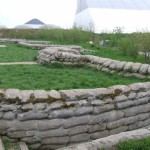
Yorkshire Trench, Boezinge. © C Sklinar 2009

There is however, a James Riach who lived in Brighouse.  So, who was James and how does he link into my tree ?  James is one of my 6th cousins.  He was born in May of 1871 in Bellie, Morayshire, the son of John Riach (1847) and Susan Goulder (1850).  John was a Police Constable in the 1881 census and by looking at the places his children were born, he seems to have come south of the border between May of 1871 and 1873 when he and his wife are having children in Fewston.  Susan according to the 1911 census wrote she had been married 41 years, given birth to 15 children and 11 of which were alive in 1911.  James had died a few years earlier so the entry had been crossed out by the enumerator.  Susan had answered the questions asked as there was no note saying that a widow/widower had no need to answer that section.  It is good to see those questions answered from a family history point of view.

Back to James, the 1911 census, the good old 1911 census has transcribed his place of birth as Forhibers, but Fochabers can be made out on the original document – it makes you wonder where the census was transcribed.  Anyway, James married Ada Louisa MacAulay in the Spring of 1894 in the Halifax Registration District.

James and Ada went on to have 3 children, Blanche, James and John.  Ada married William Sutcliffe ; James jnr married Elsie A Norcliffe and John married Doris Jackson and went to Australia after 1939.

On 24 July  1912 James signed papers to put him on the Special Reservists list for the Army.  He was found to be 5′  5″ tall with a 34 ” chest with a 2″ range of expansion. His physical development was ‘good’ and so was his vision He  gave his trade as that of Mechanic, employed by J Sharp and living at 35 Birkby St, Wilson Road, Wyke. He declared his age as 34 years.  He was given the no. 1442 and served as a Private in the West Riding Regt., Pioneer Corps being struck through and he signed his name in a good clear hand.  James on one of the forms gave details of his wife and children, his parents and siblings, including addresses for them all – what a fantastic piece of information.

James embarked from Folkestone on the SS Invicta on 14 April 1915.  By 10 July of the same he he was appointed unpaid L/Cpl and just over a month later on 15 August 1915 he was Killed In Action.

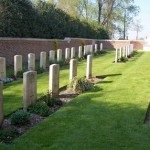
Colne Valley CWGC cemetery, Belgium from CWGC site

On the 14th of January 1916 the War Office, st James’s Park sent a memo to the Officer in charge of the Territorial Force Records, York ref: E/128920/1 (Accounts 4) requesting that the personal property in their possession belonging to No. 1442, Lance Corporal James Riach 1/4 Battalion West Riding Regiment be despatched to Mrs Ada Louisa Riach, 25 Birkly Street, Wilson Road, Wyke, Bradford.  The memo also requested that any medals in their possession now or at a later date also be despatched to Mrs Riach.

Ada L Riach was sent on 2 July 1919 a form requesting she complete and return so that the ‘Death Penny’ could be forward to her. Ada on September 25th 1919 signed a receipt for a medal, on  January 24th 1921 she signed another  receipt for medal awarded to her late husband. Ada was also eligible for a 21/- a week pension for herself and her two children with effect from 28 February 1916.

James served 3 years 52 days in the army and was awarded the 1914 – 1915 Star, The British War Medal and the Victory Medal.

L. Cpl 1442, Riach J, of the West Riding Regiment rests in peace with 47 Officers and Men in  Colne Valley Cemetery – 30 of those men are from the West Riding Regiment.

Colne Valley Cemetery is at Beozinge, just north of Ieper on the N369 towards Diksmuide.  For most of WW1 Beozinge faced the German front line.  The cemetery was begun in July/August of 1915 and was in use until around February of the following year.

Note:- Ada remained in the Bradford area and died in the June Qtr of 1958 aged 86.

Further information later came to light so you might want to visit this later blog

The War Memorial on the Green at Reeth

In May of 2008 we spent a day in North Yorkshire – I think I’d said something like, ‘do you fancy a day out on Sunday?’.  ‘Where?’ Would have been the answer and my reply would have been that I didn’t mind.  Ben, by now would have known the places I’d been and would certainly have known there would have been a war memorial or 10 involved, with the odd churchyard thrown in for very good measure.  It was a nice day but I seem to remember a little windy in Reeth.

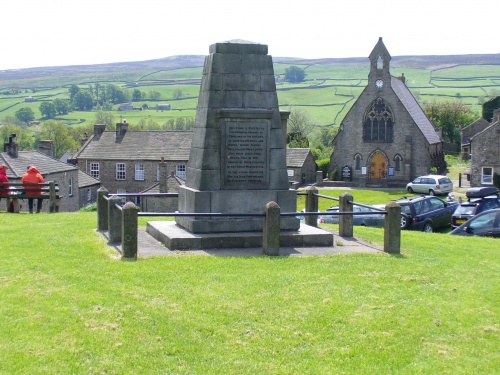
The War Memorial, The Green, Reeth, © C Sklinar 2008

The Green in Reeth is a very large open piece of ground in the centre of the village surrounded by houses and a few shops.  The War Memorial sits proud, high on The Green, protected by small posts and a rail.  Although the structure is large, it is simple in design and bears the names of 28 men from the Grinton, Reeth and Marrick areas.

The memorial seemed very much similar to others I’ve transcribed over the years – young men who were sons, brothers and husbands but each with a simple story to tell, until…….. It came to sort out the WW2 section.  The first name of the memorial is that of Major A K Charlesworth.  I found him on the CWGC and that gave me his full name, I then went onto look at the Army Roll of Honour 1939 – 1945 and confirmed information.

But when I googled him – he had a rank and a medal, so I thought there could be a little bit more about him on the great www. Yes, there was ! A connection to Wakefield. Albany Kennett had lived at Grinton Lodge and this had been purchased with its kennels and outbuildings by Col. Albany Hawke Charlesworth, born in Stanley, Wakefield,  who had been MP for Wakefield in the mid 1890’s, having purchased the hall in the 1880’s and becoming Lord of the Manor having purchased the rights from the Crown, using Grinton Lodge for shooting.

The census of 1891 has Albany Hawke with his family living at Chapelthorpe Hall, Wakefield.  He states he is  a ‘West Riding of York Colliery Proprietor’, born Chapelthorpe, West Riding of York – the transcription of that census is not correct. The family consists of Albany H aged 37, his wife Eleanor aged 24 and daughter Eleanor aged 21 months snf 15 servants including :- Housekeeper; Ladies maid; Housemaid; Laundress; Dairymaid; Grooms; Footmen, to name a few.

The census of 1901 has the family living in Portman Square, London with Albany Hawke living ‘on his own means’ with his family and 14 servants, including :- Governess x 2 ;  Housekeeper; Hospital Nurse; House and Kitchen Maids and Footman to name a few.  The nurse would have been for Albany Hawke as he had been injured in a hunting accident.  He had Grinton Lodge adapted to take his wheelchair.

Ten years late in 1911, we have Albany Hawke with his wife and two daughter living at Brockhurst, W Didsbury and a  mis-transcribed entry for places of birth.  A H is a Colliery Owner / Director and his wife is listed under occupation as Christian Science Practitioner, with two other people in the household giving their occupation as Christian Science Teacher or Practioner, aswell, as the usual amount of servants.

Albany Kennett, seems to be missing from the 1911 census or has been mis-transcribed and needs a little more time to find him.

Also mentioned on the WW1 section is Stanley H Moore.  Stanley Harding Moore had been born in 1898 in Reeth and in 1911 his father was  recorded as being Head Teacher of the Friends School, Reeth.

Tom Was, was the son of John Thomas Ward and Louise Alice.  Tom was 1 of 7 children and in 1911 was a Student Teacher – could he have been working under Mr Moore at the Friends School?  Tom’s father John Thomas Ward was noted as being the Registrar for BMD’s and a Mine Manager.

If you can help with further information or a photograph, please let me know.

To see Reeth War Memorial click here

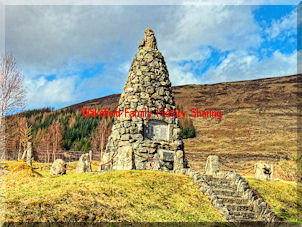
Glen Lyon War Memorial

A short while ago a friend sent me his pictures of Glen Lyon War Memorial.  He like many others, know I collect and transcribe them, and he kindly sent me a couple of pics taken on his adventures.

image by J Hall 2011

I can’t say what a beautiful place it is, as I don’t know, but from the picture it certainly looks a pleasant place and with the sun shining and a blue sky, even a cold day would be a pleasant day in Glen Lyon.  The glen is approx. 20 miles in length and stretches from Fortingall to Cashlie and from all accounts well worth a visit.

Who is mentioned on this very special memorial, special, you will see why shortly.  Firstly, and only because his name appears first on the memorial (all names are in rank order)  is Lieutenant Colonel John Robert Beech CMG, DSO who died in Lincolnshire while in command of his troops. Next on the list is Clyde, actually, Robert Clyde Beech, the 20 year old son of John Robert. Next comes Alan Tompson, a relative by marriage of John Robert’s wife, who was the widow of John Bullough or Meggernie Castle. Also on the memorial is Francis Cowie who was before the war was an asistant factor at the castle.  So all in all, the family from ‘the big house’ didn’t fair well from the war.

The last name I am mentioning in this ‘snippet’ is that of John Alexander McCallum of Camusvrachan, KIA in October of 1918 aged 23.  It was his father Alexander, who designed and built the Glen Lyon War Memorial.  What greater gift could a father give to his son, a splendid memorial built at the side of the road that all who pass by will see and hopefully more will now know of the great love and sadness with which it was built.

Where can you read about Alexander and his son and others from the area Click Here

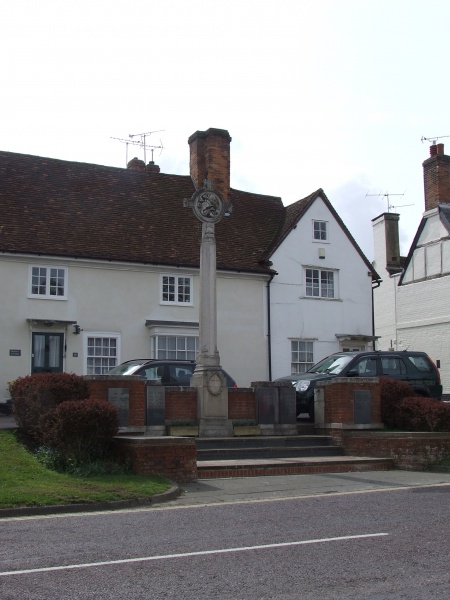
Odiham War Memorial – WW1 transcription

Just before Easter I spent a weekend with my daughter and her boyfriend.  The weekend started with my driving down to Ealing, meeting my daughter and visiting one of her friends and her new little one.  Then a drive to Basingstoke.

Saturday started with a yummy breakfast and then onto Winchester, lunch in Raymond le Blanc’s, a visit to the Cathedral (memorials to follow very soon ) and finally an interesting visit to see The Round Table.

So Sunday arrived and a visit to Odiham and lunch, but before lunch I was given a short tour of Odiham, including, yes, the war memorial and the church – nice village and nice company. Oh! by the way the church has a beautiful window relating to the local RAF station.  I’m not a great lover of modern stain glass but that was nice.  But, to my surprise it wasn’t even a window, but a very good deception – a light box, but it still looked impressive.

Odiham Memorial, Carol Sklinar 2011

Now to the village memorial to those who have fought and died in two world wars.

Who is mentioned on the memorial to the men and women of the Parish of Odiham ?  Geoffrey Harris Gotelee, the son of Arthur and Esther of The Old House.  Geoffrey in 1911 was a boarder at St Albans School, his parents at this time ran the Post Office.  Richard Elkanah Hownam Healy, the son of Randolph and Alice of Hownam Lodge.  1911 sees Richard living in Kensington Hall Gardens and working as a Reporter for a Daily Paper.  He is later mentioned in the London Gazette when he received his promotion.

Another young man from the area was Arthur Henry Pither, son of Stephan and Sophia.  Arthur worked in Quebec, arriving in 1908, but was back in the area by 1911.  He did however, enlist in the Canadian Army and from that we can get a fleeting glimse of what he looked like.

Guy Lutley Sclater, brother, son and husband. He served as a ~Captain in the Royal Navy and rests in Odiham Churchyard.

Now, W G Wooldridge, he was a little bit of a problem and has not been identified by others who have transcribed Odiham Memorial, but I think family history helps a great deal when transcribing and knowing people make errors and what type of error could occur – well, I found him – so visit the transcription and see who he is and where he rests.  In fact, if I had completed the transcription last week, I would have known where he was and could have visited, as I was only a matter of minutes away from him.

The last young man I am going to mention in this taster is Reginald James Moody, son of Charles and Ellen.  He served in the RFC and died on 4 March 1917 while flying with 2nd Lieut., Eric Edmund Horn.  Edmund had enlisted on his 17th birthday and died on his 19th, so, so young and very brave.  They both rest in the same cemetery.

There are still a few young men whose information needs adding to the transcription and they will be finished shortly, as will the WW2 transcript.

To read the transcription or see if your Odiham relative is there Click Here

Same name, same age but oh, so different lives

Tonight is census night and whoever is in your house tonight should be on your census form.  This decades census asks different questions to those in previous times and is based more on social and cultural subjects.  Some, sorry, many family historians question the use of this census in 100 years time.  Basic information is being left out, for example it is not asking for a middle name, yet this is now we distinguish a John Smith from a John W Smith.  Where were we born, again another question that could distinguish our John Smith from the other.  But who are we to argue ?

Yesterday I was thinking, I do that sometimes, about the 1911 census and wondered if I could find two people with the same name, born in the same year with two totally differing backgrounds and lifestyles.  I chose a family from one of my war memorial transcriptions but could not find the family on the 1911 census – foiled again! So this morning with a new vigour, 2 monitors (making life easier) and using the pc not the laptop I started my quest for these two people.  Who would they be, how old would they be and what would their every day life be like.  My challenge is on and a cuppa is called for.  Cuppa by my side and here we go !

Who are these young men? What name did I decide upon? How old are they? Questions hopefully we will all find the answers too.

The name – John Radcliffe.  The year of birth – 1886 (as per 1911 census).  Place of birth, well this is where the difference really starts.

Firstly, John Douglas Henderson Radcliffe was born in 1886, the summer of 1886 to Alexander Nelson Radcliffe and his wife Isabel Grace nee Henderson, whom he had married in the late spring of 1884 in Kensington.  Alexander was a solicitor and in the 1911 census he was living with his wife, 4 children, 2 visitors (Noel Burn Rosher b1876 Consulting Engineer born in Higham and Percy Otto St Clair Wilbraham Perryman b 1886 , Asst Dist Commt Uganda born Redhill) and 7 servants (incl cook, nurse, kitchen maid and house maid + butler and footman) all residing on the night of the census at 45 Kensington Square – in total 15 people in 20 rooms.

45 Kensington Sqr

Alexander of Bag Park  was born in Paddington in 1856 and died in Widecombe, Devon in March of 1944.  His wife Isabel was born in March of 1861 in Fremantle, Australia.

John Douglas Henderson Radcliffe had been a pupil at Eton College, leaving by 1904 and going on to Balliol, Oxford where he was known for his satirical humour and sense of fairness.  He rowed in the Eight and was Captain of the Boat Club and according to sources was a first rate coach and gave up his spare time to ‘the river’, being devoted to his College – Balliol. In 1911 he was elected was a Fellow of All Souls College and delighted in the traditions and atmosphere.

After Oxford he joined his father as a solicitor but it was politics that was his goal.  In 1913 he married Mary Augusta  Garlinda Bolitho and only too shortly after The Great War broke out.   John joined the KRRC, serving as a Captain. In July of 1915 there was desperate fighting near Hooge.  John  was KIA on 30 July 1915 aged 30 when the enemy over ran the trench held by Capt., Radcliffe and his men. John  is remembered on the Menin Gate Memorial, Ypres.  John had been living with Mary at 20 Craven Street, Charing Cross and he left over £1,500 pounds to her on his death.

So ended John’s life, a life of privilege and opportunities.  A life lived in Eton, Oxford and London.  Would he, had he had the chance, been able to influence the politics post war? Who knows, but one thing is certain, he left a small piece of himself with all whom he met and was certainly fondly remembered and loved.

Now, which John Radcliffe born in the same year, well we find him in Leeds, the son of John William and his wife Mary Ann.  One of 3 surviving children out of 8, John was also born in 1886 and in 1911 living at 36 Wellclose View, Leeds.  John W was a 61 year old Organ Builder born in Bolton and his wife was also 61 and hailed from Leeds. John jnr was aged 25 and a Textile Printers Foreign Correspondent and his sister Lilian aged 31 was a Co-op Stores Cash Clerk – 4 people living in 5 rooms.

30-36 Wellclose View, Leeds. Leodis Archive

The houses around Wellclose View were terraced, more than likely on a hill.  The terrace ends, those facing the next street had bay windows and attics with full  windows making use of the roof space.  The doors were straight onto the cobbled streets  and most of the houses had usable cellars.

Did our 2nd John fight in WW1, I don’t know.  I’ve looked on SWDTGW, Medal Cards, CWGC and Army Pension records and there is not one John Radcliffe that gives a clue to him being our John.  Let’s hope if he did go to foreign shores, he at least came home to his family.

Did John marry ? There is a marriage for  John Radcliffe in Leeds in the June ¼ of 1912, could this be him ? And there are no deaths that stand out any more than others.

I think it goes to show that if you fit into any of the following categories :- The Great, The Good or The Bad you are recorded very well in historical documents.  But, if like John, and his family, you went about your business, sometimes with a little to spare at the end of the week and others the week was longer than the money, records are limited.

If anyone knows of John Radcliffe of Leeds, please let me know I’d like to know what happened to him.

Iron Bridge War Memorial

Before I start this entry for Iron Bridge War Memorial I must just mention this in the hope that some people can make arrangements to visit the event listed below :-

Heroic Spitfire Veterans to Attend 75th Anniversary Event on 5th March 2011 at the RAF Museum, Cosford – to read more click here and scroll down to Latest News. At the event will be a number of Spitfire pilots including Margaret Frost, female pilot.  Margaret being one of only 15 women and 100 men to have a Special Merit Award for their service in the ATA flying replacement fighters to RAF bases during WW2.

image K Scarth 2010

Now back to Iron Bridge Memorial, but firstly a little bit about the bridge that the war memorial stands so close to.

Abraham Darby III in the late 1770’s was an ironmaster working at Coalbrookdale and was commissioned to cast and build a bridge to cross the gorge.  The bridge was opened in 1781 and today still remains a magnificent sample of how Britain was at the forefront of pioneering the way forward.  The gorge over which the bridge spans is a UNESCO World Heritage Site, with the bridge being Grade I listed and a Scheduled Ancient Monument – now isn’t that something for Abraham and his family to be proud of ?

The War Memorial to the men of Ironbridge stands proudly within feet of the bridge and visitors walking over the bridge will pass the memorial.  The soldier atop the memorial plinth stands with his back to the gorge, at ease, resting his hands on the  his rifle as he seems to be waiting, looking for his friends from Ironbridge to come into view and come home once more.

So, who is our soldier waiting for ?  John Wlliam Adams who died of wounds ; Cecil Davies, KIA ; Frederick ; Drewball ; William Onions, KIA ; John Steventon, KIA to name a few.

To visit the rest of the young men of  Ironbridge who never came back to their gorge click here

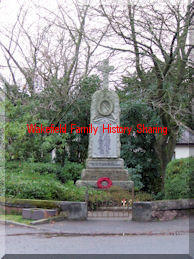
Buchlyvie War Memorial

Buchlyvie lies between the Highlands of Scotland and its more gentler Lowlands.  In years gone by the villagers would been wary of the ‘fowk from the Highlands’ who were known to come down and steal cattle from the local pastures.

Stirling, Glasgow and Edinburgh are within easy reach, as are the Trossochs and Aberfoyle.  Many inhabitants may commute to work but there are many who stay in the village and keep the services going i.e. The Buchlyvie Inn and the Rob Roy + the cafe, B & B, garage, shop, butchers and hairdresses to name but a few.

Buchlyvie War Memorial C Sklinar 2010

The War Memorial to remember  Buchlyvie men is situated on the edge of the village and sits proud in a small garden at a ‘T’ junction for all passers by to see.  The consists of a contrived rough cut stone set upon a few tiers with a wreath mounted above the names, surmounted by a cross.

So who is mentioned on the memorial ?  Robert Alexander ; Andrew McLaren (MacLaren) ; Willliam McLellan born in Huntingdon, Yorkshire and enlisted in Stirling ; Ronald J McOnie of Buchlyvie, with brown eyes and hair  and served with the Canadian Forces ; Archibald McVicar, son of Niven and Bessie and Alexander McIntyre who died of wounds and rests in one of France’s National Cemeteries.  I’ve only mentioned a few here but follow the link to read more.

Oh! and if you have any more information about these young men, please let me know and I’ll add it the the page.

To read more about Buchlyvie young men who fought and laid down their lives click here

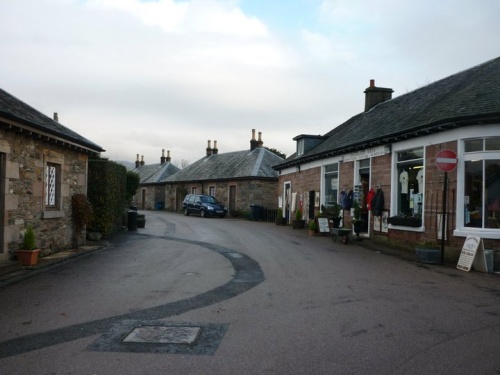
Luss War Memorial

The village of Luss is known to many of us as it was featured in the 1980’s TV Soap ‘Take the High Road’.

Luss 2010 by K M Sklinar

Luss, in early records was known as Clachan Dubh, the dark village due to its mountain setting.  Many of the village cottages were originally built to house workers in the cotton mill and slate quarries of the 18th and 19th centuries.  The homes have now been fully restored and Luss is  now a designated Conservation Village.

I am pleased to say that Luss is now by-passed by the A82 making the village a very nice place on the banks of Loch Lomond.

The War Memorial on School Road is set upon three tiers of stone with a simple cross bearing a sword, surrounded by a low dry stone wall.

Some of the names set in stone are :- Ludvic Colquhoun ; James Colquhoun ; Archibald McBeth and Robert T Hamilton to name just a few.

To see Luss War Memorial click here

Stow War Memorial

Stow, a village in the border region, a few miles from Galashiels.

The industrial revolution had a great impact on the area, changing the pace of life in Stow for ever.  Until the eighteenth century the area was a farming community, but the coming of the Turnpike road to the west of Gala Water in the 1750’s brought with it change and the village became industrious, mainly in the spinning and weaving sector. Following on in 1862 the railway came and made the area easier to get materials and people in and out.

The village has had a connection to the church since the 7th or 8th century with written records surviving and the Parish of Stow became one of three sactuaries in Scotland where there was safety from persicution.

The village war memorial is sited in the centre of the village and is a pleasing site with a small stone wall partially enclosing the memorial and has names of men from both wars carved upon it.

Who is mentioned on the memorial ? George Aitchison, born in Blackadder rests in Selkirk Shawfield Cemetery ; T E Thorburn Brown was mentioned in the London Gazette in 1914 and rests in Grevillers British Cemetery ; James Brydon served with the Canadians as he lived in Canada – a young man with blue eyes and brown hair ; Alexander and Archibald and Charles Chisholm, brothers who died months apart in 1915 ; James H Doig, also served with the Canadians and had gray eyes and black hair ; The Rev. J T C Ireland who died as a result of  HT ‘Transylvania’ being torpedoed  and many others who were sons, brothers, uncles and husbands.

To visit Stow War Memorial click here