Yearly Archives: 2012

Rhubarb Festival – Wakefield

This years Rhubarb Festival will be a 3-day event, running from from Friday 22nd to Sunday 24th February.  This year is going to be bigger and better than ever with a market in the Cathedral precinct, cookery demonstrations, walks and tours.

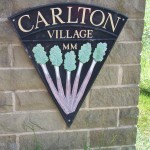
Wakefield was traditionally the centre of rhubarb growing with the Rhubarb Triangle covering the Wakefield, East Ardsley, Rothwell, Carlton and Morley areas.  For over 150 years the fruit has been growing here, as conditions were ideal. There was plenty of local fuel – coal, and a large number of market gardeners.

A large amount of rhubarb was grown in ‘forcing sheds’, they bring an early crop and some can still be seen locally.  It is said that in the sheds, lit only by candles you can hear the rhubarb growing and as candles are moved to keep the rhubarb straight the light green tops turn to face the light – this could be the noise heard by the growers as the leaves are still uncurling. themselves

Years ago rhubarb was sent to Leeds on overnight trains full of rhubarb for the London markets.  Along with Champagne, Parma Ham, Yorkshire Rhubarb has protected status and joins British foods such as the Melton Mowbray pork pie, Stilton cheese, Arbroath Smokies and Jersey Royal potatoes to name just a few.

p.s. keep the event quiet as I want to be able to get a parking space!!

Wakefield – history and heritage here

Facebook page

For information and tours visit here E Oldroyd & Sons

Who Are You?

A few years ago I sorted through all the family photographs and put them in family folders. There were lots of people I knew – aunt and uncles, family members, family friends and lots of people who were totally unknown to me.  Some of the photographs, mainly from my mum’s time in the war had a short sentiment followed by a single name, others bore no wording.  Why should mum right on the reverse who they were – she knew them!

My dad also had photographs, not so many, but they also had either a few words or nothing.

In a moment of frustration of trying to find out who these people were Who Are You? was born.

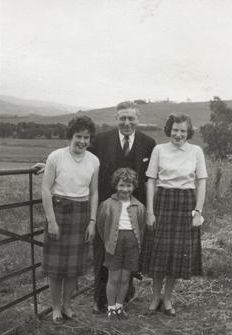
Taken by C. Wilkinson

The pictures were scanned and then put into an online photo album with as much information about the picture as I could find on the reverse or deduce from the image.  I was loaned pictures, begged pictures, scanned them all and indexed them – cross referencing them if I knew they were from one place but the photograph was taken elsewhere.

All in all there are pictures of unknown and known people from the British Isles, Canada, America, Ukrkaine, Africa and a section of WW1 & 2.

Just to give you an idea as to some of the pictures – there is a family photograph in the Morley section of a couple and a small child written on the reverse is ‘ Aunt Mary ‘ but, who was Aunt Mary ? Is she the lady or is she the child ? Other images from the Morley section include members of the Donkersley  Worrel, Kershaw families  – most of the Morley photographs were handed to me as one group, so therefore I have kept them together and linked to other sections, but a photograph of a young man taken by Chas. A. Saylon, photographer, S. E. cor. Sixth & Penn Sts, Reading, PA. ( or South East corner of Sixth & Penn Streets). Who is this young man ? Was he visiting family or did he live in Pennsylvania ?

This section of my site Wakefield Family History Sharing has not been available for a while, but is now available and shortly with have the addition of extra pages with a connection to Victorian and Edwardian photographers.

Wakefield Family History Sharing

Who Are You?

Christopher Saxton – Dunningley

Christopher Saxton – Dunningley

Extracted from The Registers of Topcliffe & Morley

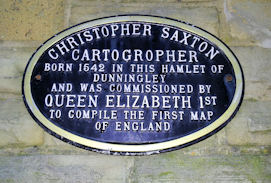
Dunningley, within half-a-mile due east of Topcliffe, is noted as being the birthplace of Christopher Saxton, an eminent cartographer, and also as containing the residence of a sweetheart of Nevison, the highwayman.  In Dr. John Dee’s Diary, 1596, appears this entry:- “July 10th, Manchester town described and measured by Mr Christopher Saxton.”  Mr. J. E. Bailey, writes of this as follows :- “This Manchester survey which would be a valuable addition to out local topography, is not now known to be in existence.  C. Saxton was the author of the first maps of Britain from actual survey.  The series of maps was nine years in preparation and was first issued as a complete atlas of maps in 1579.  Thoresby remarked that the maps had never been surpassed, scarcely equalled for exactness.  Each map contains the arms of the Queen, who gave Saxton a patent for publishing the charts for ten years, and of Thomas Sackford, Master of Requests, who was employment, Saxton was at the date of the patent. Saxton was encouraged by Sir William Cordel, Master of the Rolls.  His skill as a chorographer is set forth in his epitaph”.  Thoresby says that in all probability he was buried in Batley Church.** Dunningley at the present time, consists of a few farm-houses, not remarkable for theit antiquity of picturesqueness.

** In Dugdale’s “Visitation of Yorkshire,”1666, “Birkbeck of Sheffield and Castleford” – Christopher Saxton, the geographer, here called Surveyor and Compiler of Maps of England, is said to have been of Dunningley.  The Saxton’s were to be found at Mirfield, &c., a century afterwards.

Photo D Knowling 2012

Additional Saxton information – Saxton probably born c1540 in the parish of Dewsbury and grew up in the hamlet of Dunningley.  He, as a young man, was in the employ of John Rudd the vicar of Dewsbury and Thornhill, a keen cartographer who passed his skills on to Christopher.  In 1570 he started a commission from Lord Burghley to survey the whole of England and Wales.  He died after 1610 as he is named in the will of his elder brother Thomas and before 1626 when the will of his son, Robert, was proved.

Wakefield – Its History and People says that Saxton was educated in one of the chantry schools within the town (Wakefield), before furthering his education at Oxford.

Much of Saxton’s work was used for many years and his atlas published in the late 1500’s was continually being re-issued and adapted until the late 1700’s. The issues were : William Hole and William Kip re-engraved Saxton’s maps and reduced them in size for the early 1600’s edition – Saxton being given credit for most of the map work. Later editions followed in 1607, 1610 and 16378.   The Atlas – Atlas of the Counties of England & Wales is in the Special Collections Department of Glasgow University Library.

Christopher was granted arms and received lands from the crown, both showing how he was respected for his work.  His grant of arms refers to him as “Christopher Saxton of Dunningly, gentleman”.  But Wakefield has also laid claim to him.

Harry “Brusher”Mills

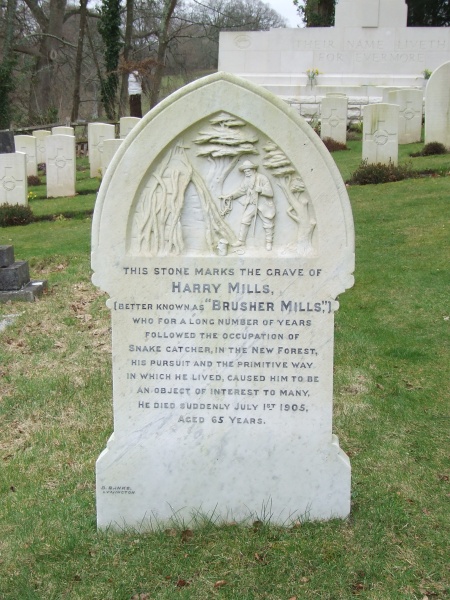
In the past we have made a couple of visits to the New Forest area including Brockenhurst, but earlier this year I spent time walking around the churchyard.  As most who know me will be aware I tend to home in on war memorials and CWGC headstones, so after photographing the CWGC memorials I continued walking around – it is amazing what you can find out on some headstones.

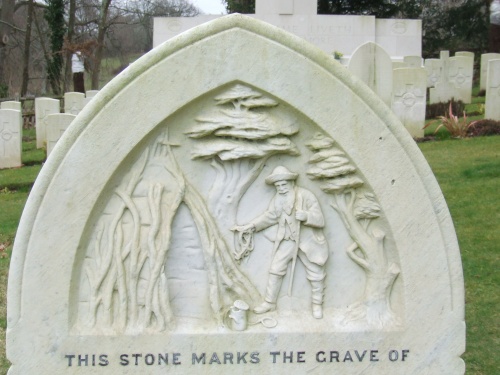
One in particular caught me attention, quite plain from behind and if I had walked the row behind this headstone would have missed its interesting front.  The stone is pale in colour and shaped like a medieval church window but the carving on the top is wonderful.

Who was this headstone remembering and why did they have such an elaborate memorial.  Were they much loved in the area or a character who would be sadly missed by the local people?

C Sklinar 2012

The headstone is to one Harry Mills born around 1840 in Emery Down, Hampshire. In the census of 1861  with his parents Thomas Mills aged 60 a gardener and his wife Ann aged 59.  There are other children including :- Sarah, 22 dressmaker, Lucy 18 ; George 14, scholar and Edward Mills, grandson aged 5.  There is an entry on the 1871 census for a Harry Mills b 1842 in Lyndhurst  with Thomas Mills aged 67 a general labourer and his wife Ann also aged 67 who works as a laundress.  Along with Harry there are 2 other children ; Lucy aged 26 a laundress and Ann who is aged 2 and classed as a daughter (is she the daughter of Thomas and Ann or of Lucy or of another child of Thomas and Ann?) all living at Clay Hill, Lyndhurst.

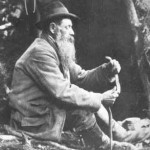
Harry was later to become well known as a hermit and snake-catcher – eradicating many local areas of their snakes.  He could be seen around the communities with his sack and a forked stick. Harry supplied snakes to London Zoo for their mammals, birds of prey and other snakes.  Harry was also said to have made potions, lotions and ointments from various parts of the snakes to help with rheumatism and boiled snakes to sell the skeletons. It is estimated that during his time as a snake-catcher he caught tens of thousands.

Harry, became a tourist attraction following an article in the national press and many curious tourists and visitors had their photographs taken with him and listed to his tales.

During this period Harry lived in an old charcoal burners hut near Brockenhurst but decided to build himself larger accomodation. The 1891 census has Harry as a single man born in Lyndhurst with his address as  ‘hut at Westly Wood’. One night his hut was vandelised, it was thought this could be to stop Harry claiming squatters rights on the land and claim ownership as he had lived their for so many years.  After his home was destroyed Harry lived in one of the outbuildings at the Railway Inn, Brockenhurst and died shortly after  on 1st July 1905 aged 65 years.

C Sklinar 2012

The inscription on the headstone that was paid for by the locals reads:

This stone marks the grave of Harry Mills, (better known as “Brusher Mills”,) who for a long number of years followed the

occupation of  Snake Catcher, in the New Forest. His pursuit and the primitive way in which he lived, caused him to be an object of interest to many.  He died suddenly July 1st 1905, aged 65 years.

After Harry’s death a friend of his, George Waterbridge took ofer the task of snake catching and it is said he inherited the famous sack and forked stick.

The New Forest today is protected by both the Wildlife Act and local bylaws, so Harry would not be able to live or ply his trade in the forest

War Resistance in the West Riding of Yorkshire

One of my distant cousins and her family were involved during WW1 in conspiracy after conspiracy, conscientiousness objectors and more……….but that is a different story.

Last week I attended a local family history talk by Cyril Pearce about pockets of resistance within the West Riding – wonderful as I have an interest in WW1 and in ‘conchies’.

Always one for learning some new snippet or piece of information, nobody knows everything, even though some think they do, I listened with interest.  Although, most of the talk was based around the Huddersfield areas, the information fitted in with other places in different counties.

My information has been gathered from around the Derby area, based on my family, but this opened my eyes to the people who were involved and how they were accepted and treated within their communities.  One of my questions at the end of the talk, based on a copy of an Attestation Paper was ‘did all concientious objectors have an army service number’, to my surprise the answer was yes, as they were called up and therefore were allocated a number.  Many refused to sign and had to follow the consequences of this by either doing non-combatant work i.e. being in a reserved profession, by being in an ambulance corps., or doing aid work of sorts.  The Friends Ambulance Corps is one of these groups (Quakers).  But, saying that, many still refused to do any work that would help the nation at this time, even being in a reserved occupation was too much, and they would have been sent to varioius prisons including Wakefield and Dartmoor.

For the first two years of the war over 3,000,000 volunteered (up to 1916 there had been no conscription) but due to such heavy losses it was decided to bring in conscription.  At first it was only single men had the call, then as time went on and 1918 came, married men and men up to 50 were also included. So, after the passing of various Military Service Acts the No-Conscription Fellowship mounted a campaign against the punishment of objectors and in total about 16,000 men refused to fight.  A  large number of these men were pacifists who believed that killing another human being was wrong, either for religious or conscientious reasons.  The No-Conscription Fellowship had support from many public figures of the time  including : Bertrand Russell, Arthur McManus, Alfred Mason to name a few.

The areas of objectors in the West Riding seemed to be mainly from the woollen areas which seemed to be mainly non-conformist, the mining areas, mainly the traditional church seemed to be lightly affected.  You would think that the mining areas would have the same feelings as there were many Socialist and Labour groups involved with the organisation of objector groups.

Over 120 Huddersfield men appeared before a tribunal for their beliefs, one conscientious objector was Arthur Gardiner.  He was a gifted talker and when attending the tribunal likened himself to German workers who he felt he had more in common with than the men in Westminster – he lost his appeal, was sent to France, leaving the station to waving supporters.  One would think that a C.O. would not blend well back into a community after so many families had lost fathers, brothers and sons, but no, Arthur went on to become Mayor of Huddersfield.

What did I learn from Cyril’s talk, well that the C.O’s had various degrees of how much or how little they would do, or how much they would disrupt the every day goings on ‘at home’. I knew  there were many National groups who were organising anti-war feelings, but I did not realise how many small, local groups including Friends Meetings and Sunday Schools were involved.  Also, I knew there were the ambulance and first aid non combatants but I found out that many went to France to dig trenches, give aid and hand out tea.

Further reading

http://reporter.leeds.ac.uk/472/s5.htm

http://reporter.leeds.ac.uk/472/hudders.htm

http://www.bbc.co.uk/bradford/sense_of_place/remembrance_huddersfield_co.shtml

http://www.spartacus.schoolnet.co.uk/FWWncf.htm

Cosens, H S F, KIA

I first came across the person above while photographing memorials in St Mary Abbotts church in Kensington.  I homed in on the war memorial outside after spending a wonderful time in Wholefoods – what a fantastic place and their cheese room is to die for!!

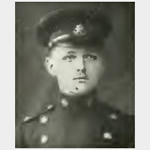
Cosens, H S F, who is he?

Harold Stanley Frederick Cosens, born 2 December 1889, the son of Frederick George Cosens and Fanny Louisa Ambrose who had married in Kensington in the spring of 1877.

Frederick was a Sherry Shipper born in Streatham in 1855, his wife was born in Marylebone in  the same year.

In the census of 1891 the family were living at 8 Airlie Gardens, Kensington – just off Campden Hill Road. Harold was the youngest of three children.  The family employed three staff, one of which was a nurse.

Ten years later in 1901, Frederick and Fanny still had three children but the number of staff had increased to four.

A further ten years on only one of the children is at home – 24 year old Winifred but now back to three servants.

Harold by the census of 1911 was a Second Lieutenant serving in the East Yorkshire Regiment and was one of 330 men and 80 women at Aldershot Barracks.  We now know he was a career soldier.  But his early had been at St Paul’s School and later Sandhurst Military College.

Harold was Killed In Action at Rue du Bois, Armentierre, on  27 October 1914, according to a number of sources,but the memorial in St Mary Abbots gives the date of 28 October 1914.

The medal card for Harold gives quite a lot of information. Firstly, his regiment and rank was confirmed.  His date of death is given as 27 October.  Other information is taken from Routine Orders, Staff Book, Disembarkation Returns and medals awarded.  In March of 1918 F L G Coens, Esq., applies for the 1914 star in respect of his late son.  Mr Cosens requested the medals address given 7 Observatory Gardens, Campden Hill.  There are a number of notes on the card and one says ‘medals to’ 15 Vicarage Gardens, Kensington.  One other adress is for F G Cosens, Esq., Beech Bough, Bacton, North Walsham, Norfolk.  Harold parents must have moved to Norfolk as he is remembered on the village war  memorial.

His Commanding Officer, Major M Boyle wrote of Harold  “He was my subaltern and I never want a better, always cheery and ready for any work that came in his way, and to take on any hard job, even when out of his turn, as so often happened when I wanted a man I could trust to do any difficult or jumpy piece of work. I could not want for a nicer, more cheery and hard working officer to soldier with……. The exact circumstances are these. He had led his men to retake some trenches from the Germans and had carried out his work successfully, and was actually in the trench, doing a kindly act to one of the enemy, who wanted to surrender, when a sniper shot him from another direction. It is extremely painful to write thus, as it was sheer bad luck! My company are very cut up indeed. He died a gallant gentleman.”

Harold rests in Ration Farm Military Cemetery, La Chapelle-D’Armentieres

Sources:

Ancestry ; Masonic Great War Project ; Freebmd ; CWGC

History in a Wardrobe

What a wonderful way to learn about capsules of time – through a wardrobe, or should I say what is kept in a wardrobe.  But Lucy Adlington has a unique, informative and enjoyable way of bringing history alive through her History Wardrobe talks.

A friend of mine has known Lucy for many years, becoming friends by attending  one of Lucy’s talks and asking questions afterwards.  Talk, does not seem the right word as the events are more than that – more like a walk through a period of time with the audience being a friend or someone to have a conversation and a joke with.

I met Lucy earlier this year when my friend suggested I go to one of her events – that didn’t go to plan as the traffic was terrible and I arrived a little late. Lucy had started and  was all decked out (ouch!) in her finery as a first class passenger on the Titanic with her ‘husband’.

The changing of costumes during a day onboard the Titanic was wonderful, interspersed with jovial banter from the pair and was a delight – just like being party to their private jokes.  Then sadly the news of the iceberg reached the passengers and we follow the couple as they tell what happened to them – I won’t give away who their characters are as that would give away the ending!!

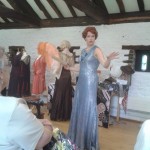
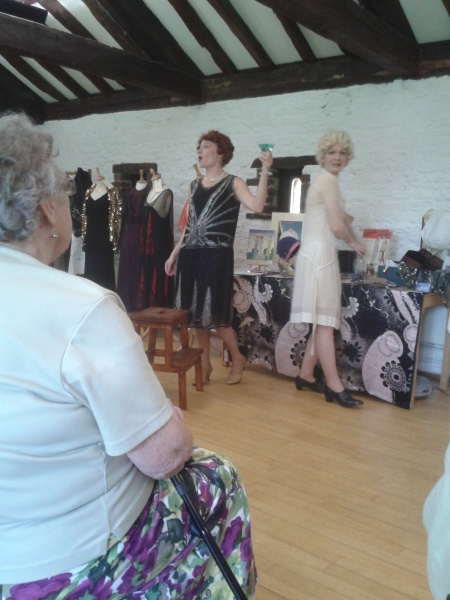
I next saw History Wardrobe when Lucy was in Agatha Christie mode during the 1920’s onwards and with the help of Merry wore some wonderful and original costumes from morning attire, day wear to an evening dress that would not be out of place on the red carpet today.  The duo worked off each other with quips and remarks flying fast and furious.

But seriously, the costumes together with snippets of Agatha’s novels went down a treat.  As with most of Lucy’s talks there are extra costumes on mannikins and memorabilia from the  period.

My latest show was ‘A woman of a certain age’, about Jane Austen and women in various times of there life in Jane’s  novels – the girl, the spinster, the married woman, the dowager, the widow and the ‘lady of a certain age’.  The costume worn by Lucy was simple but very striking.  Lucy de-constructed the dress, which in some places was held together with pins.  Hats were worn, flouncy capes worn, sections of Jane’s novels were read as examples of the times in a woman’s   life. An enjoyable time was had by all and many in the audience have been to more than one talk.

So, who is this lady that travels the country doing what women like doing – dressing up and talking?  Lucy is a graduate of both Cambridge and York Universities with degrees in English and Medieval Studies.

Cocktail anyone?

She has run workshops, given presentations and with her hands-on approach  is always in demand.  As well as all this Lucy is an accomplished author of childrens and young adult books.

A full diary of events can be found on the History Wardrobe website, so where ever you are in the country you will be able to see an event……………BUT !!!  keep it a secret, as I want to be able to get a seat!!!

Lijssenthoek Military Cemetery – Who is resting in peace

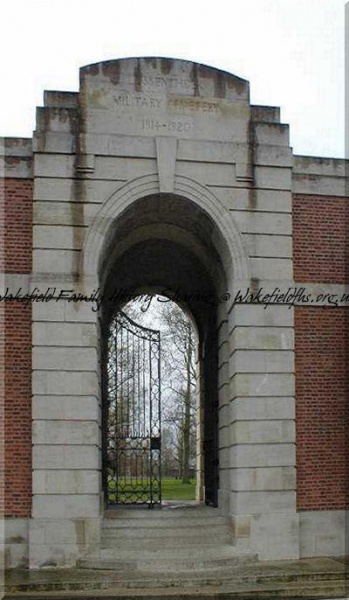
Lijssenthoek Military Cemetery nr Poperinge has a very special place in my heart, not only does my great uncle rest there but Nellie Spindler from my home town also calls Lijssenthoek ‘home’.  But recently while doing a bit of research I came across another man whose final resting place is also Lijssenthoek – Conrad Hugh Dinwiddy.
I think his name sounded similar to a place we used to stay on our way up to Lhangbryde when I was a child, so what do you do, or should I say ‘I do’ but find out a little about him………you know the thing, who were his parents, where did he live and what did he do before joining the forces and who survived him.     Here goes….

While waiting for a website to open I thought I’d try Wikipedia – lots of info there, not always correct but is somewhere to start and to my surprise there was not an established page for Conrad, there is an opening if any one wishes to start a page for him.

Here we go !  Conrad was born early in 1881 to Thomas Dinwiddy and his wife Eliza Charlotte nee Rooke (b. 1845 Marylebone).  In the census shortly after Conrad’s birth Thomas was aged 37 and was working as an Architect and Surveyor (b 1844 Bristol).  The family lived at 12 Croom’s Hill, Greenwich (now the London Fan Museum)– the road was home to other professionals and retired servicemen incl. William Rivers Retd., RN; Gay Shute, Surgeon; Thomas Creed(?), General Practioner MRCSE St Andrews Uni.; others include Stationers, Annuitants.

Thomas Dinwiddy is noted for having designed the main administration block (Grove Park Workhouse) of what was Grove Park Hospital. The plans were approved in 1897 and the foundation stone put in place 2 years later.  The plans were presented at the Paris International Exhibition in 1900 and won a Diploma of Merit. One of the local roads is named after Thomas.  In the early 1990’s the site was sold for housing development but Thomas’s administration block and a some of the original workhouse buildings survived.  The site had not been listed by the local authorities.  One of the buildings designed by Thomas did manage to get a listed status – Laurie Grove Baths including : swimming baths, slipper baths and launderies were designed in the mid 1890’s commissioned by the Vestry Board of St Paul’s Deptford under the Public Baths and Wash-houses Act of 1846.  The building is of Jacobean style and still has many of its original features.  A few other buildings by Thomas were Greenwich Board of Works Offices and Roans Girl’s College, Greenwich.

Ten years later, 1891, Conrad was hard to find on the census but eventually by just putting his year of birth +/- 2 and Greenwich as his place of birth he is found. He is at a school with some of his brothers in Walmer, Kent.

Another ten years on in 1901 the family are at The Manor House (?), Croom’s Hill – Eliza with her children, Conrad by now is classed as a student, and four servants but no Thomas.  Thomas was in fact staying at the Adelphi Hotel, Ranelagh Place, Liverpool with people from all walks of life incl. George Herbert Lindsay of Edinburgh a Distiller; Daniel Shurmann a Merchant  born in Russia.  That solved that problem, so now forward a few years.

On 27 September 1909, Conrad’s elder brother Malcolm, Capt., Royal West Kent Regt., who had served in Singapore, married  married Miss Laura de Satge, dau. of the late Mr Ocar de Satge, late member of the Upper House of Queensland.  The wedding took place in Folkstone and Conrad was the Best Man with various cousins from both sides being bridesmaids.  Guests included Lords and Knights of the realm and serving regimental Officers

The 1911 census finds that Conrad is now a newly married man.  He had married Winifred O Pochin in the Autumn of the previous year.  Conrad worked as a Surveyor employing a number of people and they lived at 76 Warwick Gardens, Kensington, a nine roomed house, with a number of servants and was a member of the RICS, which held a portrait of him.

Conrad served in the military and various entries in The London Gazette have him serving in various ranks incl. Temp Captain.  But it is The Medal Rolls Index Cards that tell a better story.

Conrad initially served in the RFA as 157860.  Later serving in the RGA as a 2/Lt., and now has no service number as Officers were not issued with a number at this time.  He is later in the 13/Siege Bty, RGA as an A/Major, then Major, with a medal entitlement of The Victory Medal and The British Medal.

Conrad was the inventor of the ‘Dinwiddy’ Range-finder for detecting enemy aircraft – this was adopted by the War Office. He was also a Councillor for the Borough of Kensington and a known mountaineer.

C H was one of five children and had three brothers in the services.

Conrad Died of Wounds received on 27 September 1917 aged 35, leaving Winifred and a young son, Hugh P Dinwiddy born in 1912.

Conrads brothers – Major Malcolm J Dinwiddy, as we have already said he married in 1909.  He served in  the Royal West Kents  and applied for his service medals in June of 1920.  He died on 19 November 1925 aged 46 and had at least one child. Probate was granted to Laura Emily Dinwiddy, widow or Fairview, Osborne Road, South Farnborough.

Donald Dinwiddy, married Ella May Jones in 1909.   He died on 19 February 1937.  Probate was granted to Ella Mary Dinwiddy of Red Cottage, 54a Parliament St, London

Harry L Dinwiddy. Harry Lurwyche Dunwiddy  married Ethel Maud MacArthur in 1903 and by 1911 they were living at 13 Pond Road, Blackheath with their son Thomas Lurwyche and a number of servants – Harry working as a solicitor.  He was living at Little Paddock, White Beam Way, Tadworth when he died on 21 April 1950.  Probate was granted to Thomas Lutwyche Dinwiddy, solicitor on 8 June of that year.

Conrad also had a sister – Dora, she married Stanton Freeland Card, a Royal Navy Instructor, in 1902 and by 1911 they were living with their three children and a few servants at Parkhurst, Westcombe Park Road, London.  Stanton of 24 Crown Lane Gardens, Streatham died at Putney General Hospital on 6 October 1940 with probate granted in Llandudno on 2 July to Westminster Bank Ltd.  Dora of Lawrence Road, Hove died on 24 March 1945 with Probate being granted in Llandudno on 20 December of the same year to Harry Lutwyche Dinwiddy, Solicitor.

Sources :

Singapore Free Press and Mercantile Advertiser. Issue 29 Mar 1909, page 5

Ancestry.com.

Freebmd

The Fan Museum

Heritage-explorer.co.uk

Archiseek

Lost Hospitals of London

Flight Global

Wakefield voices from the Crimea

Crimera War Musings – Wakefield Voices from the Crimea.  Anthony Dawson will be at Westgate Chapel on Wednesday 27 June with a 7:30pm start.

The talk based on letters from young men give an insight into navy and army lives at the battles of Alma and Inkerman and the fall of Sebastopol.

The Crimean War was the first war to be photographed – Roger Fenton a pioneering photographer ventured far to photograph this event in world history.  His reports were widely published, as were his photographs, but many seem staged and orchestrated.

Now letters from the soldiers, that’s real!   Life as it was happening.

Entrance is FREE.

Tedbah Siddle ??

I started my family history nearly 30 years ago.  I had no grandparents and only one parent.  After my Scottish grandfathers death that side of the family seemed to drift off a little – as families do when the hub goes away.  That has, I am very pleased to say been rectified.

But, back locally, my grandmothers maiden name was Agnes Siddle and she married Ernest Wilkinson.  My aunt was born in 1907 before grannies marriage to Ernest.  I remember asking her as a child ‘why does daddy have a different name to you?’  I was told that grandma married twice – a plausible answer and as a youngster it shut me up.  Oh, aunty, if you knew what I knew now!!!!

While looking though Ancestry for any trace of my great uncles military service – 4 of my grandma’s brothers fought in the Great War, with 3 coming home again to their family, I kept coming across this young man – Tedbah Siddle.  Who is he ? And does he link into my Siddle line?  Tedbah can sometimes be found with the spelling, Tedbak and Tedbor.

Anyway, who is he?

Well, I know he has a service record, so I’ll come back to that later but starting with the census, 1911 as I know he served in WW1 and that’s the nearest census to that milestone in his life.

The 1911 census has Tedbah aged 28, being born in Heckmondwike, a worsted spinner, living with his mother and 4 siblings at Walker St, Littletown, Liversedge.  Tedban’s mother was either very formal or chose to be a rebel as she wrote in red and her entry reads:- Mrs Siddle, head, aged 50, married 29 years, 10 children with 8 surviving to the census, works at home and was born in Gildersome.  But she signed Mrs E A Siddle – a small clue there.

Tedbor Siddle, according to Freebmd was registered in Dewsbury in the September Quarter of 1881 and this was confirmed by looking at the GRO Indexes.

Back to the census – I thought Tedbor or the variations in his name would be the stumbling block in this trail.  I searched the census for all the ways his name had been found – Tedbor, Tecbak and Tedbah and still none of his family could be found.  A search for his mother would be very long and hard as all I had found in the 1911 census was her as Mrs E A Siddle.  A sibling, that would be the way to go, try and find one of Tedbor’s siblings who was a similar age and hopefully pick up the man himself.

One of Tedbor’s siblings, Amanda was born in 1892, therefore she should be in the 1901 census.  Amanda Siddle born 1892 +/- 5 years found nothing.  So in for the long haul – a search for an Amanda born around 1892 in Yorkshire that could take time.  But, not as hard as I thought just around 460 entries and I quickly started at the last page and worked back, came to the s’s and there she was Amanda Siddal and I thought Tedbor would be the stumbling block.  So 1901 who were this family and were was Tedbor.   Well, Mrs Siddal was there and her name was Emma, she was aged 40 and a cloth weaver born in Gildersome.  Tedbor was there now entered as Ted aged 18 and a woollen twister.  There was a Jane aged 16 and a worsted spinner.  Alonzo aged 13 also a worsted spinner.  Robert aged 7 ; Ada 5 ; Norah 3 and Amanda aged 9 – no idea why she is out of age order.  But where is Mr Siddal as Emma states she was married.  Back another 10 years to find out as he must have been around within the last 3 years at least – well according to the ages of the children !

What I find in the 1891 census, I did not expect.  We have Emma A Siddal, giving her status as mother, aged 30 and still a cloth weaver.  We have Clara E Haigh, daughter aged 11 a scholar born in Dewsbury. There is, what looks like, Delert Siddal (our

Carol Sklinar 2010

Carol Sklinar 2010

Tedbor) aged 8. Jane A is there aged 6, along with Alonzo C aged 3 and Olive C aged 1.  But, as the head of the household is one Joseph Crawshaw aged 40 a warp dresser born in Dewsbury.

Tedbah Siddle was in a marriage entry for the December Quarter of 1911 in North Bierley to Gertrude Wooller the exact date being 11 December 1911.

Back to the service record, where I initially found Tedbah – There are four entries for Tedbah with the first being dated 1905 when he is Attesting for the Militia or Reserve Div.,   He  joined the 3rd West Riding Regt., no. 14948.  He was single and aged 22 years 6 months and a millhand – all this we know from census and birth entries.  He said that he had served/ was a currently serving with the Volunteers 1st Bn W R Regt., and that he had purchased his discharge.  Further paperwork goes on to bring him more to life – he was 5′ 3″ tall, weighing 113lbs, with a fresh complexion, brown eyes and hair and worshipped within the Church of England and had no distinguishing marks. The Army Recruiting Office wrote to the local police to enquire about Tedbah, the reply came back that they knew him to be of good character.  A reference from Joseph Armitage, Manager stated that he had know Tedbah for over 12 years and last saw him 3-4 days ago (from date of signing Jan 13 1905) – Joseph commented that Tedbah was sober, honest and respectable.  Tedbah attending various training sessions.

In 1913 he re-enlisted after notice, by now he was a married man, his writing had become a more confident hand.  He was part of the B.E.F and rose through the ranks becoming a  Company Sgt., Major.  He ceased to be a CSM when he was transferred to the Heavy Branch – M.G.C and now his army number changes to  7870644.  He was wounded  and a letter from Mrs G Siddle of 4 New Brighton, Oakenshaw, Bradford dated July 14th 1921 asks  if she could be supplied with the following information.

“Is 14948/7807

644 Sgt T Siddle MGC yet demobilised or is he yet serving in the H M Forces.  He has been in India for the last two years (or there abouts) and is at present in this district, and is reported to be on six months leave prior to been transferred to South Africa.  I was given to understand that in July 1919 he had re-enlsited for a period of four years.  I am his lawful wife and am curious to get correct information on the matter and herby appeal to you for such. Thanking you in antisipation for an early reply.  I am Sirs, yours truly, Mrs G Siddle”

A reference in his army records gives the answer to Mrs Siddles question.  A margin note for Tedbak said that he was placed on the married establishment list, in view of the fact that he is separated from his wife by mutual consent.  There was a type written reference to this by his Commanding Officer, basically saying that as he had entered a status of married on the Attestation that had stood as there had been no update to this saying he was now separated.  The regarding his marital status would be altered and that ‘the soldier’ would proceed to Deolali enroute to the UK.

Note – Deolali – a town in India where the Deolali transit camp was based.  It was known for being an unpleasant environment and boredom and many soldiers with psychological problems pass through its portals – hence the terms ‘gone doolally’ and ‘doolally tap’ – terms for someone who  has ‘lost their mind’ possibly due to the stresses of war.  In Urdu the word tap meals a malarial fever.

One part of his service records was an award for the D.C.M. and he should be presented with such in accordance with the Northern Command Authority.  His citation reads “For conspicuous gallantry and resource at Ypres on the 20.3.1915 when he held on to a position with his section, although the trench was destroyed by the enemy;s shell fire, throughout the day until relief arrived.  During the defence of his post he managed to take back a report to his company, from whic

h he was cut off, under heavy shell fire, and then returned to his section. He was wounded during the day. “ This report answers an earlier entry in his records.

Further information gives information that Mrs Siddle was requesting that her husband acknowledge that he is the father of at least one child, a child that will come into the world very soon. He acknowledge two children, Gladys Irene born 15 April 1912 and Mabel born 12 October 1916 (Mabel is the unborn child referred to)

I’ve done a potted history of Tedbor and his siblings, found out his mother’s name and eventually his father’s.  But I still don’t know where his name comes from – is it a family name ? A search of Freebmd only lists one Tedbor and the Army Records, as we already know, shows up Tedbah, while the GRO gives a zero result.  I am no nearer to know where nor why he was given that name………………May be someone reading this knows !

Addendum – Cleckheaton Advertiser and Spen Valley Times Page 2 July 1st 1915 has an interview with Tedbah about his exploits – he was in line for a V.C. but received the D.C.M. instead.