Category Archives: General

Who Do You Think You Are – a Wakefieldfhs Road Trip!

Thursday morning bright and early – well, early, but not necessarily bright, my two friends and I set off for the NEC at Birmingham.  The 7am start set us in good stead as the roads were not all that bad, even though we were travelling in the commuter hours – luckily the traffic queues were all heading north.

20150416_095805We arrived slightly after 9:30am, parked the car and after my friend said goodbye to her ‘hubby’, who had been out driver, we caught the shuttle bus to arena 2.  So, after a committee meeting to decide whether to have a coffee of not.  It was a very short meeting with a unanimous decision – yes, a cuppa was in order.

I was very surprised that there was no queue of people waiting to show their tickets and enter the arena.  Once inside we decided we would go our own ways, but meet at 12:30 for lunch and fresh air.

20150416_10520720150416_105215As we entered the stand that was prominent was Ancestry, well they had a couple of stands – one with people using the free access to find their long lost family, another had a bank of three laptops for membership questions, discounts and offers.  A membership discount was available but the laptops seemed to be having problems and we had to go back again – infact we went back a few times, but the problems seemed to be all day.  Behind the laptops was a nice man who was the the technical side of the company and offered help on searching techniques.  There was also the Ancestry DNA stand.  After the Ancestry section I decided on a  system so as not to miss anything.  Row by row, I progressed down the area one side and up the other – it worked.

The night before our visit I had made a very rough list, and I mean rough list, of people I had wanted to ask questions about, that was if there was any stand that fitted my needs. The list consisted of :-

John Kaye, a Home Child, who later became a regular soldier.  A divorcee, who married my aunt.   John Younie, who died while in a court in India in the war. How could I get a copy of a death certificate and where would he be buried?  Relatives from Germany.  Members of the Grace family, carvers, gilders and one an artist (a friend of Whistler) who lived in Wakefield and Chiswick.  PLUS two distant relatives who had been awarded the Victoria Cross.

Aswell as the professional associations i.e. AGRA, ASGRA etc., there were a plethora  of Family History Societies and Groups, quite a few companies wanting you to have your DNA tested, a few software companies, research supply companies and other companies that had no connection to our subject at all but seemed to need ‘footfall’.

I was surprised at a few well known companies i.e. online research and software companies that had staff manning their expensive stands, and whose staff on Thursday stood around talking to each other, while customers, prospective customers, waited for help. The staff at one particular stand not only had staff stood in a huddle, but they either did not care about the product they were trying to get you to purchase or had not been trained.    Saying that there were a couple of other stands, non-family history stands, whose pressure selling would have been welcomed by the  aforementioned companies.  Apart from this negative bit, the rest of my day was a pleasure.

Some of the stands I will tell you about individually, while others will be mentioned here.

Who did I talk to and why was I impressed enough to tell you about them!
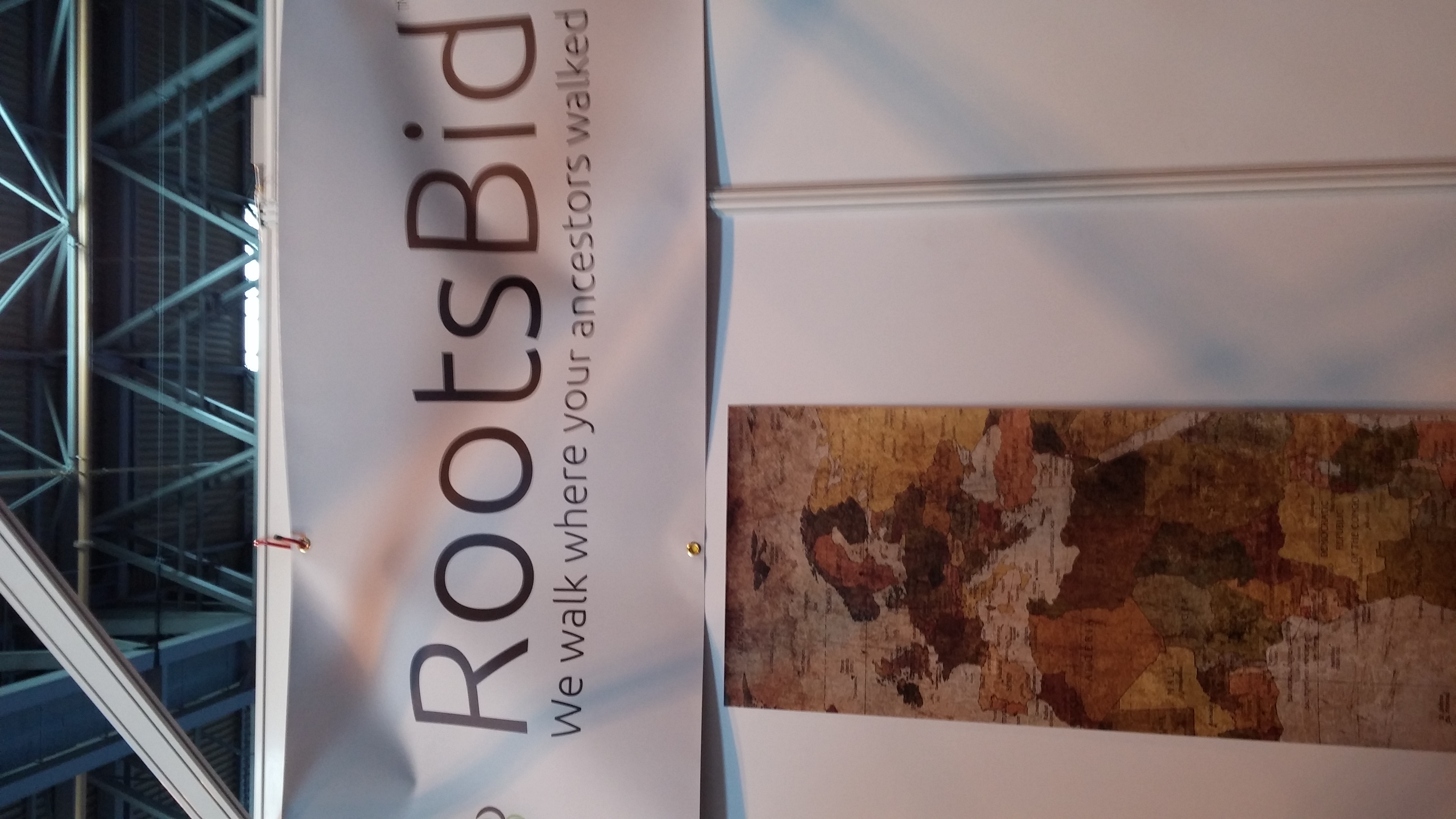
20150416_105743………with my leaflets and brochures sorted and besides me, lets work through them. Firstly, I met a very nice lady from Rootsbid, an online company where you place a request for help, a photograph etc., and people place their bid for the request.  You simply then chose the person you wish to do the job, pay and upon completion the monies are passed over.  Seems a good idea but I would have liked the option of having more than one area where you are willing to help.  But other than that, take a look – could be an idea for out of area or out of country photographs and archive work.

I had a nice chat with a man from the Guild of One Name Studies, who nearly persuaded me to join and register  one or two unusual names – that may have to wait as too much on at the moment…………but maybe one day!  But after a look at their website and searched a few of my family names, it seems I may have to register a lot of names, sometime,  as no one at the moment seems to be specialising in them.

20150416_161715FIBIS – Families in British India Society, seemed like a stop to ask about John Younie.  The stand was well presented and manned with lots of friendly and willing people.  One of the ladies showed me their website and we looked for him.  A few with the same surname were there but not him.  I was however, given a few hints and tips and suggestions of where to look next.  I was given a few hints and tips on where to go and what to ask for.

We, as family  historians research and record information about people who have gone before, but sometimes we forget that there are living relatives.  These family members may be older in years but hold such a vast amount of information.  There were two companies at the exhibition who specialised in recording memories.  Both companies were manned by nice people who knew their product. One was Speaking Lives and the other was Love Your Stories.

cardsThe previous companies were for the recording of history, but there was a stand, promoting Family Legacy Cards. Wonderfully designed cards with a suitable sentiment, covering a variety of occasions.  Set up by two friends, whose children both suffered with Autism and Learning Difficulties.  The cards, each with a thought provoking cover,  can either be sent to an older relative for them to write their memories or stories,  or they can be filled in by parents, grandparents or other relatives to children and kept until an appropriate time to be read.

My attention was caught by a banner advertising Surrey in the Great War – the county are looking to record how the Great War affected those within the area and are asking for volunteers – they say unlike 1914 enlistment, they have no age, height or medical restrictions, all are welcome.  They are also wanting school, college and community group involvement, including family and local history societies.

The Belgian Tourist Board had a small but impressive stand.  They had available wonderful brochures which gave wonderful information about places with WW1 connections.  Their Trade Manager, was a very nice man and promised to post a brochure for around the Ypres area.

In a small corner of one stand were a few people representing F G Marshall Ltd., The skill shown on the stand was amazing and the patience these artists must have, could put us all to shame.

A number of stands were promoting education i.e. courses on family history, heraldry, military subjects.  Some of the courses were complete in a matter of weeks, while others, could take a year or two. Some of the courses were organised by –  University of Oxford Dept., for Continuing Education; University of Dundee, Centre for Archive and Information Studies; Strathclyde University, genealogical studies.  Finally, Pharos Teaching and Tutoring Ltd., 
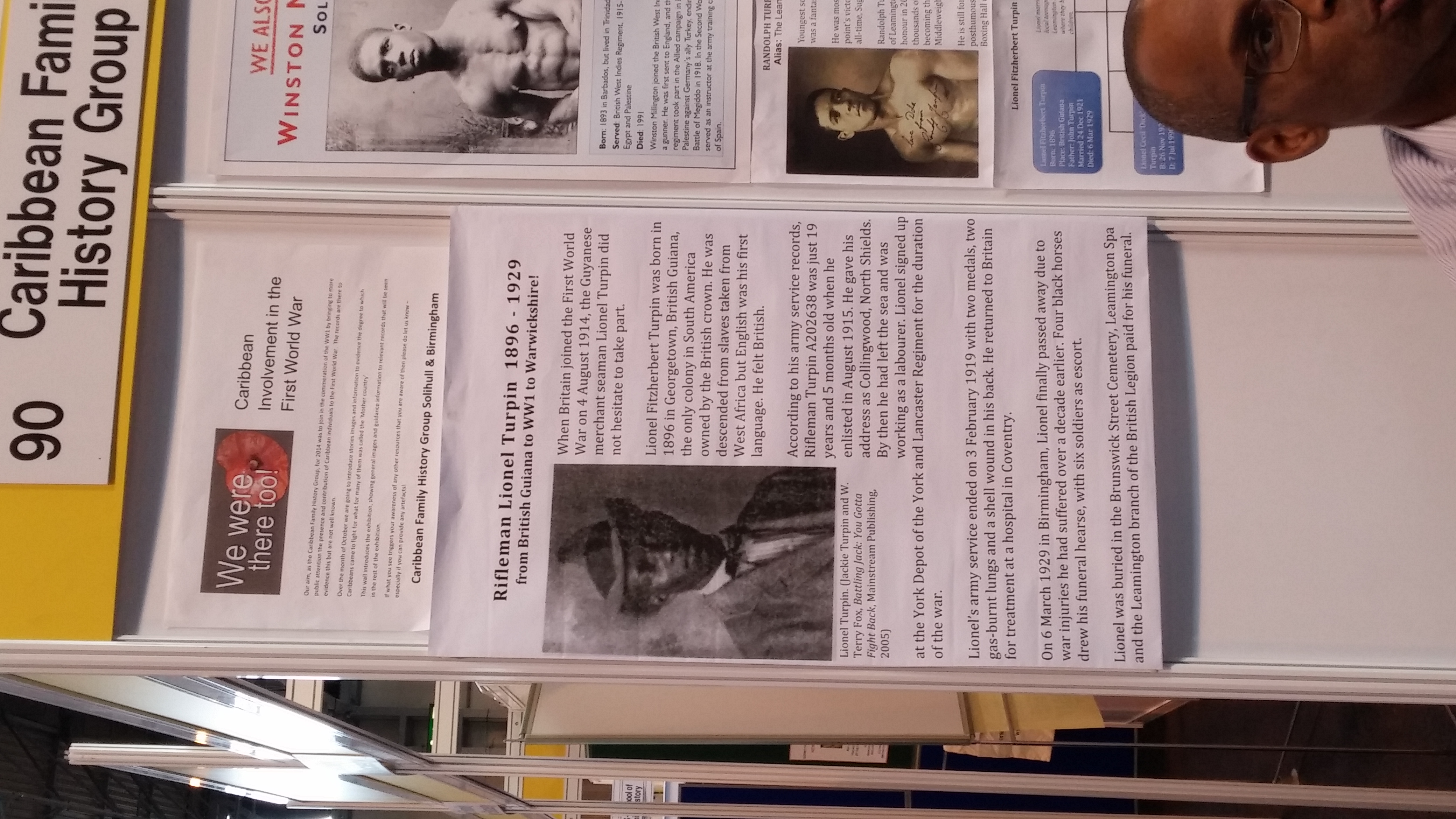
20150416_155732If you had Caribbean roots, there was a stand that catered for your needs – the Caribbean Family History Group.  The leaflet I collected proved very informative about what is available in the UK, the link take you to Solihull Council website, which give more pointers.

The Imperial War Museum, had a large stand promoting their20150416_145524 website Lives of the First World War.  The site aims to add life events to the men and women who played a part in the Great War.  You can simply remember a person or add facts, pop along and see who is there.

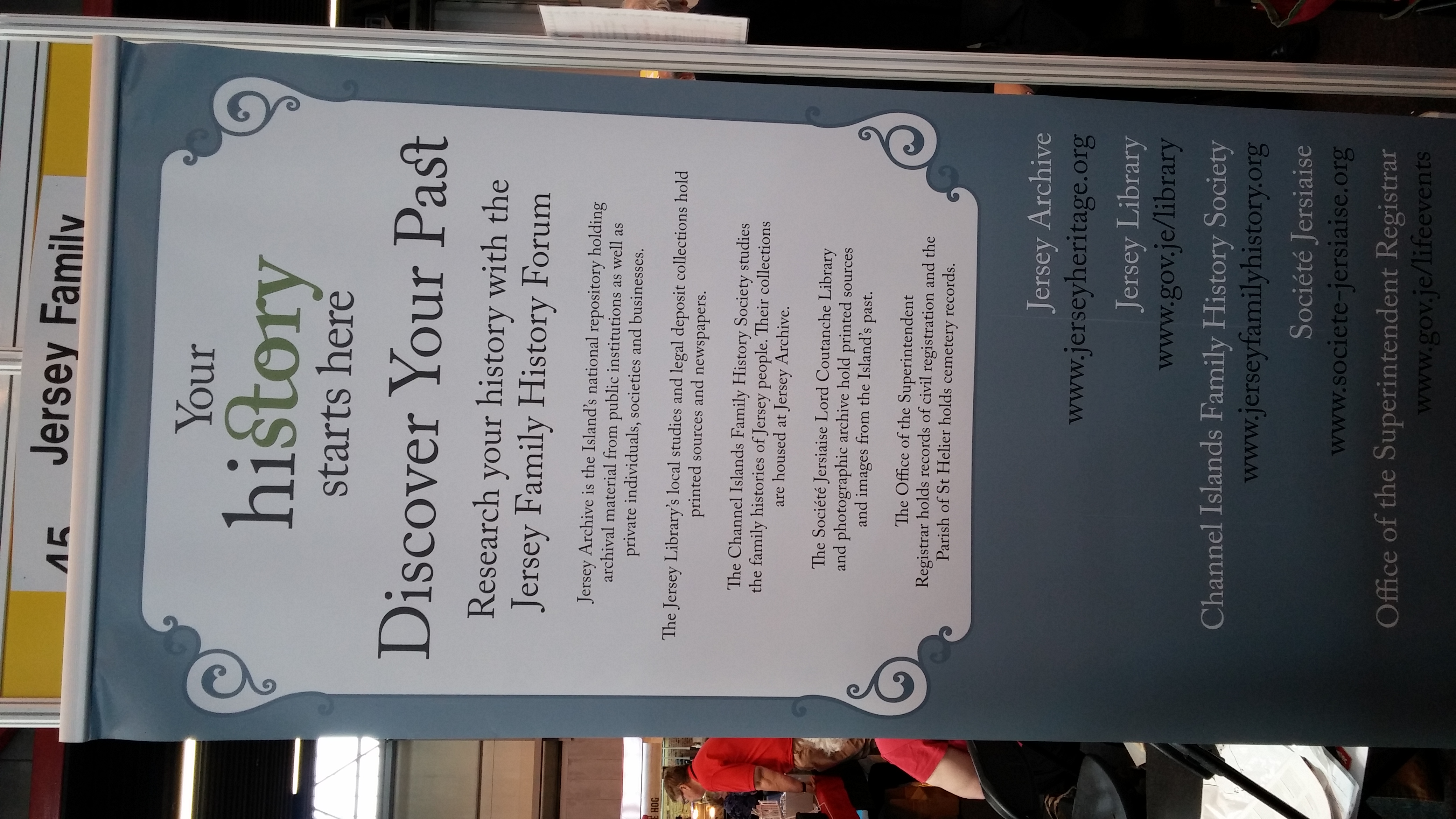
20150416_155527The Jersey Archives had a stand and I met a lovely young lady, who was pleased and surprised when I told her of a connection between Wakefield and the Channel Islands.  The General Register Office were also there armed with facts, information and leaflets to aid research.20150416_115114
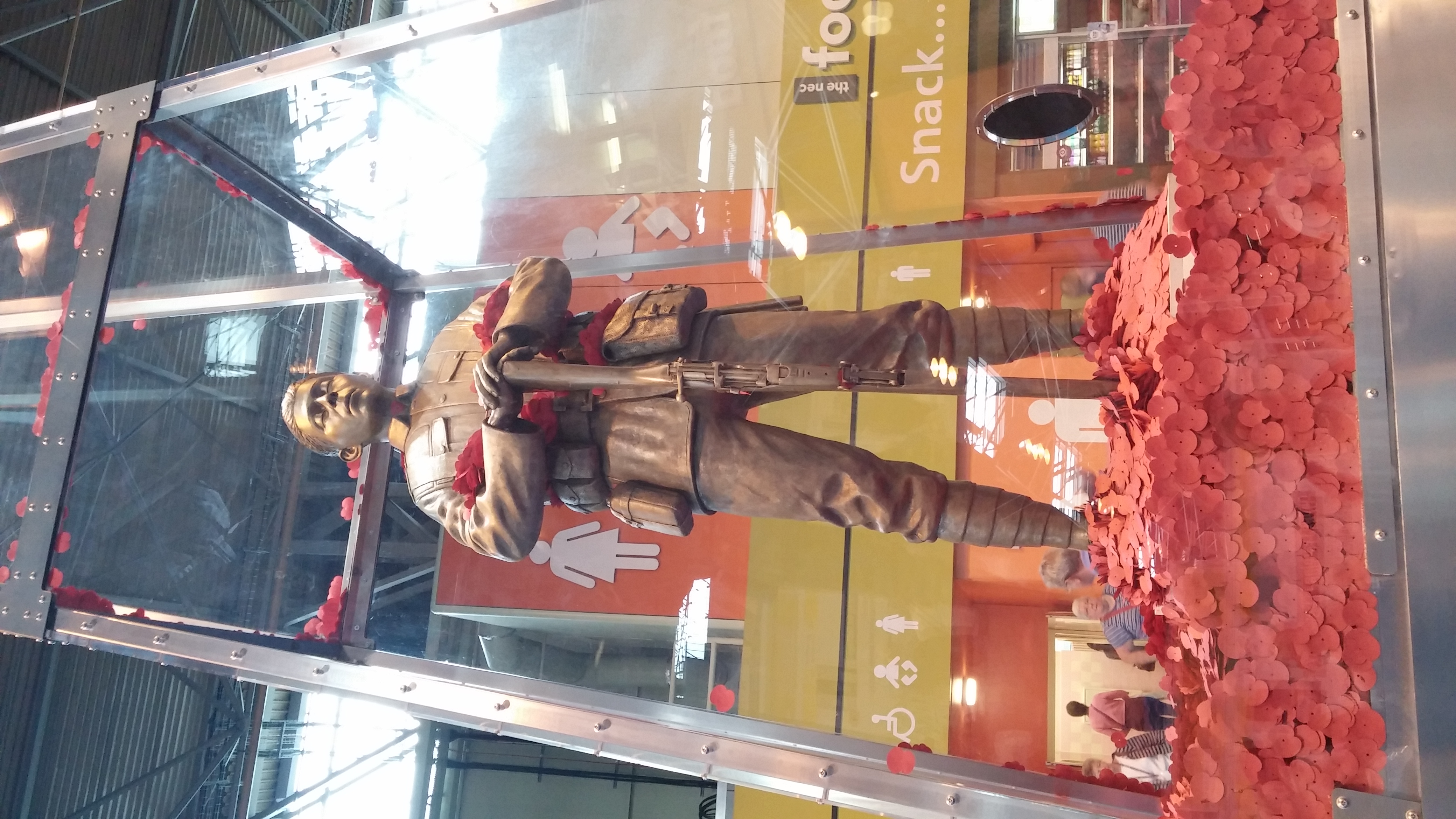
I was drawn to a very large dome, 20150416_114048enclosing a statue of a soldier standing at ease, with his rifle barrel down.  On regular invervals hundreds of poppies were blown around.  The Royal British Legion were promoting their site Every Man Remembered at Who Do You think You Are this year.  Met a couple of nice men, one of them gave me a quick tour of the site – he made it look easier than it actually is, but I got there in the end and remembered my Great Uncle Herbert Siddle.
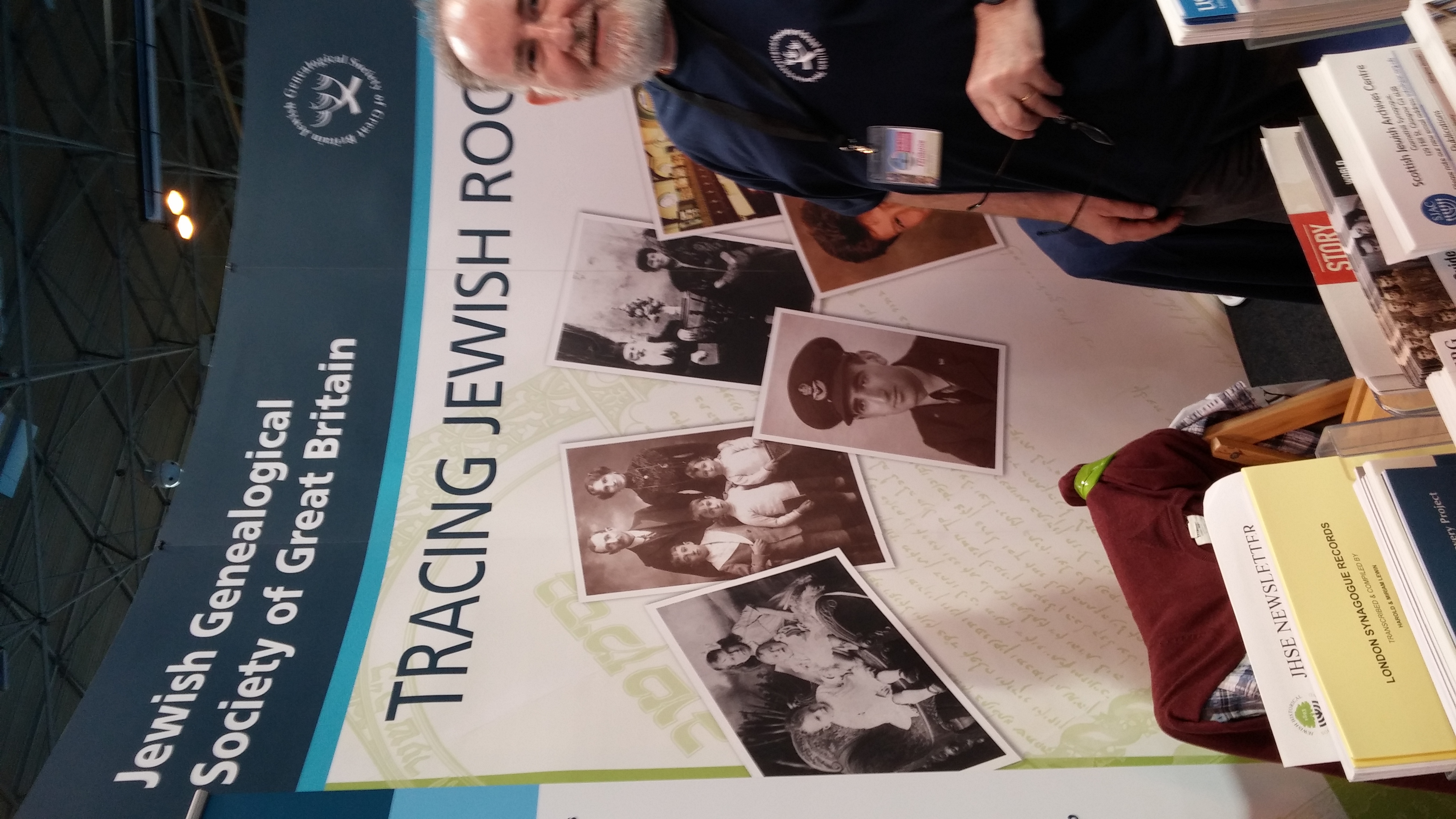
20150416_163456I picked up a few leaflets from the Jewish Genealogical Society of GB – one for a friend who has researched a cabin trunk owned by a lady who managed to get out of Germany a short while before war was declared, I thought they may be of interest to her.   I also picked up a leaflet or two from the Ministry of Defence20150416_142920 stand.  The leaflets were guides to WW2 Casualty Packs, Medal Office Guide, Personnel and Record Guides – all very interesting and useful.  They also had on display a collection of medals, including the V.C., which a couple of my family members were awarded.  I was also told to take the A3 prints they had of all the medals, nice things to keep for reference.
If you do family history you will know of the next stand that caught my attention, the stand of the Jesus Christ of the Latter Day Saints, namely Family Search, who have been the forerunners in family history research for decades. I don’t need to say anymore about this site, just to to the website and lose an afternoon or a weekend looking for your family.

Another site I stopped at was manned by Chris Patton for Unlock the Past Guidebooks.  Chris has written quite a number of books but all with the family history link. All of the publications can either be purchased in book form or available as an e-book as a PDF document, well worth a look as some of the titles look very interesting.

Another large stand, this time belonging to Find My Past – not only did they have laptops available for look-ups, very helpful staff, they also had a series of free talks during the show.  They were also promoting the 1939 Register.  All making a very busy stand.

The National Army Museum had another good stand packed with very useful information leaflets giving information on events, the study and research centre etc., and again, manned by very nice and helpful staff.
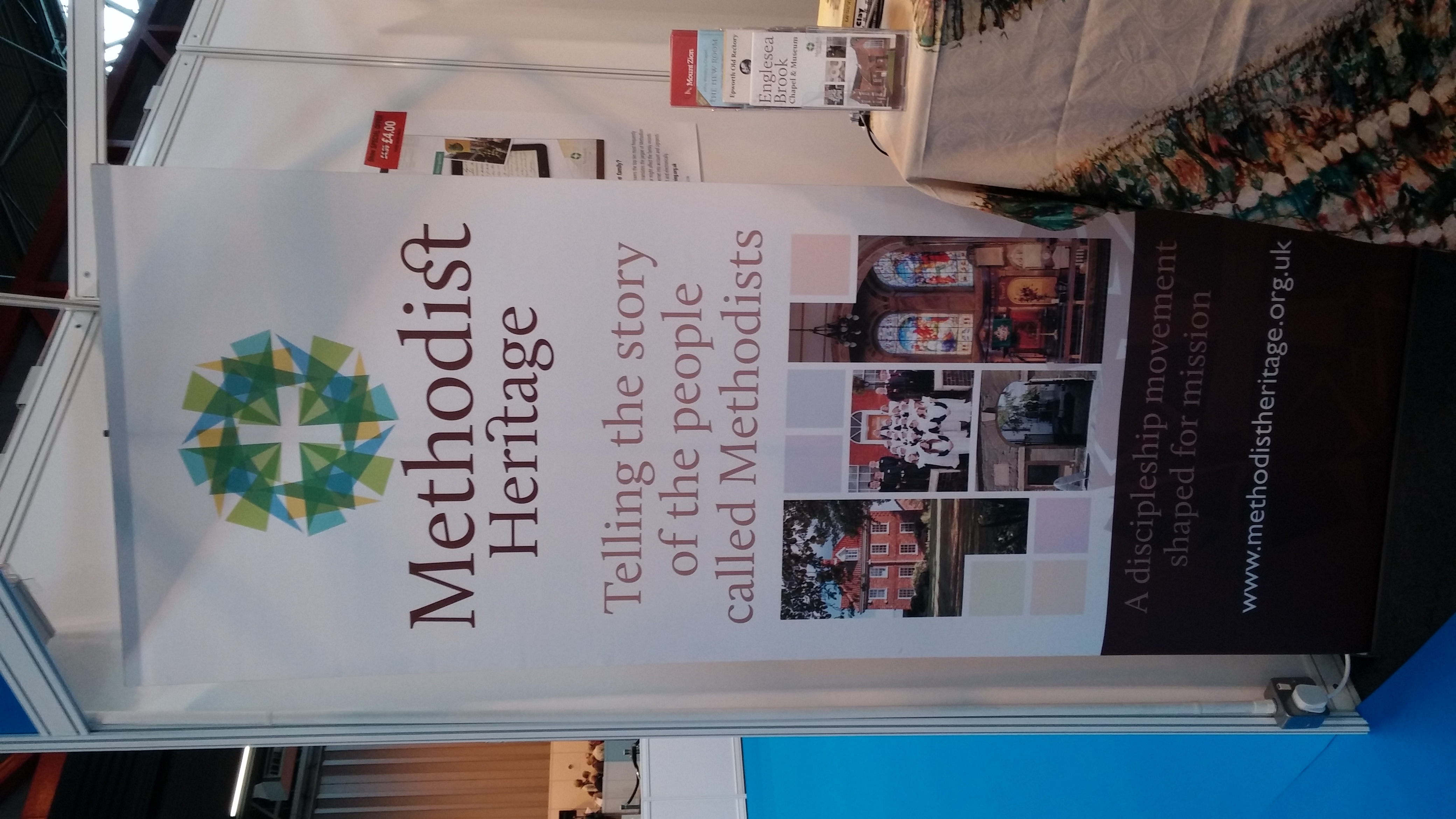
20150416_120926As one of the groups I am a member of is within a non-conformist area, so it seemed natural that I should pay a visit to the Methodist Heritage stand.  Leaflets packed with the history of Methodism plus places to visit that have a Methodist connection.

Just taking a final look through my collection of leaflets and I have very nearly forgotten to mention Forces War Rec20150416_152149ords.  It is a site that I have found when googling the name of many soldiers who were KIA or DofW during the Great War.  While I was chatting to a couple of the people on the stall I mentioned my two V.C. awardees. So, they set too to find them, and show me what the site could do.  Well initially, they could not be found, but eventually we found one and I sneakily took down the edition of The Gazette – tell me you haven’t done the same!  While we were looking for the other elusive VC recipient, other staff members came and started chatting, laughing and joking.  I said that if you can find them, I would join  but would want a discount to do so – I was given a discount code. A few Tweets went back and forth and one told me the elusive man had been found.  A Tweet said, looks like I should join……………I did and used the discount code.    Thank you very much.
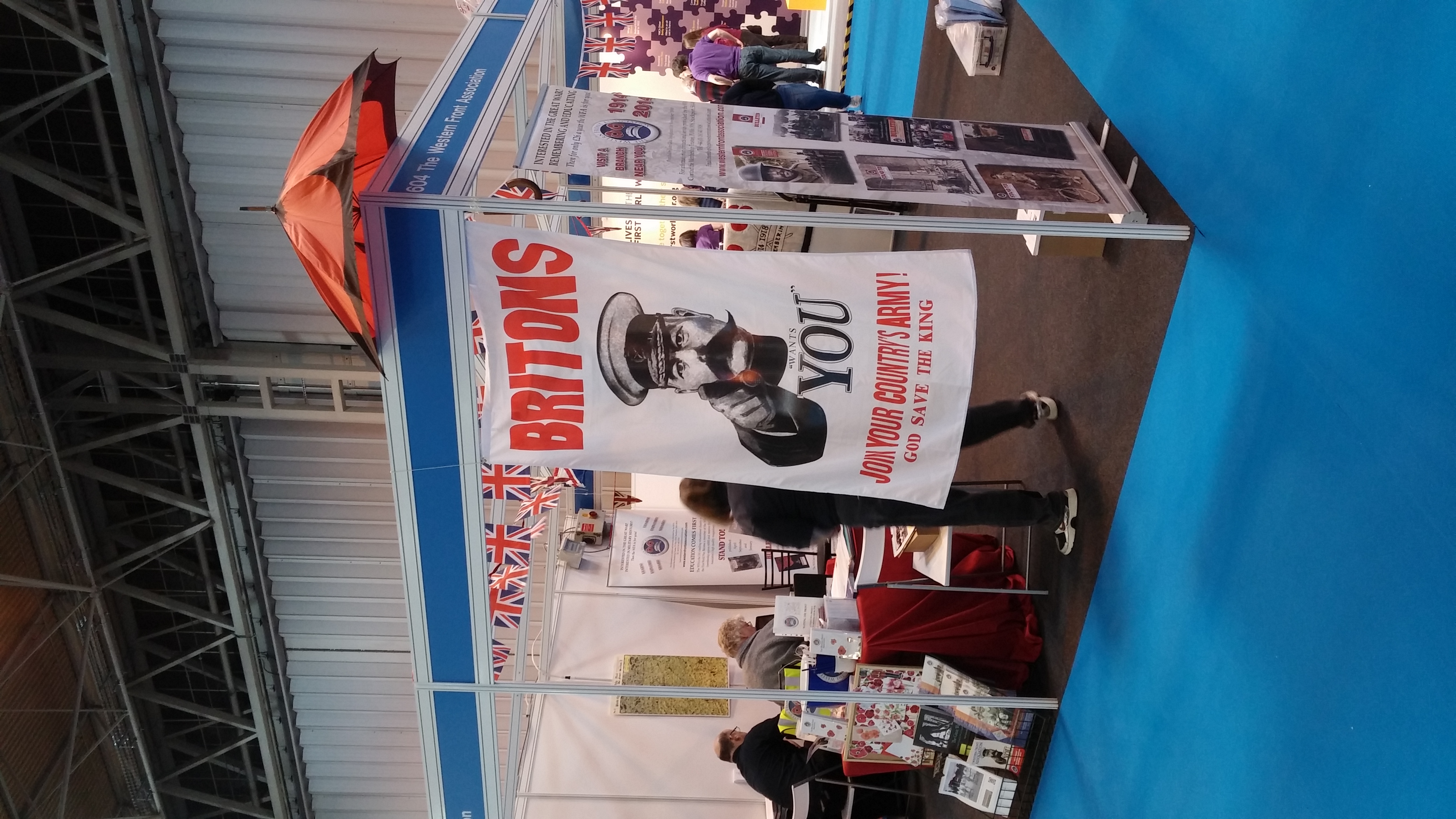
20150416_145105I also paid a quick visit to the Western Front Association while wandering around, such a nice set of people and very knowledgeable on their subject.

Lastly, but my no means least, was the stand of The Commonwealth War Graves Commission. Again a wonderful stand packed with information and resource material.  Over the years I have acquired a few of their booklets and pamphlets, now it was time to add some more to the collection.  Some of the booklets would be wonderful as information fillers in a book that I am researching for.  One of the staff was very helpful when I mentioned an error on a headstone – so to gather the evidence and forward to them.
Should you trust a transcript – a cautionary tale

wakefieldfhsResearch.

We research for various reasons – to research our family history; to research a soldier, a battle or a war; to research a building or local area.  Our focus may differ but we have one thing in common – we need material to research.    Too many researchers means only one thing – the original documents get damaged, and many of them were in a delicate state before we started to research.

If the originals become too damaged they could end up being lost for the future and that is not what we want.  As you know family history associations, military groups and local history groups have, over the years been tackling this problem by painstakingly transcribing original documents.   There are many of these associations and groups that take time with their transcripts and have various checking procedures in place, but is still always good practice to have a look at the original document, if at all possible.

With today’s technology at our fingertips, looking at the original could just mean logging on to a couple of websites and viewing a scanned version of the original document to confirm or discard your theories.  As we know the original paperwork on these websites have been transcribed for an index – and these indexes have many flaws. By just looking at the scanned versions an obvious name or place can be seen but totally differs from what has been indexed.

None of us are perfect and we all know that sometimes we see what is not there.  Many years ago I photographed a CWGC memorial for a friend – her relative was commemorated there.  When I sent over the picture she noticed the surname was incorrectly spelt.  After communicating with the CWGC, this was rectified.

I think the following lighthearted snipped about a young monk says it all!

What the young monk found!

A young monk was assigned to help other monks copy out the old canons and laws of the church by hand. On his very first day he noticed that all the monks were copying from copies, not from the original. So, the new monk went to the head abbot to question this. He pointed out that if someone had made even a small error in the first copy, it would never be picked up! In fact, that error would be continued in all of the subsequent copies.

The head monk said ‘We have been copying from the copies for centuries, but you make a good point, my son’. So he went down into the dark caves underneath the monastery where the original manuscript were held in a locked vault that had not been opened for hundreds of years. Hours went by and nobody saw the old abbot.

Finally, the young monk got worried and went down to look for him. He found the old monk banging his head against the wall and wailing. ‘We missed the ‘R’! We missed the ‘R’! We missed the ‘R’!’

C E L E B   ‘R ‘  A T E 

Take care while transcribing as it could mean a world of difference !!

Frederick Cooke and the Gyme

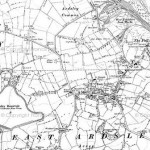
east ardsley mapFrederick Cooke was born in East Ardsley in 1880/2 as when looking at documents there is a slight variation, but there is an entry on Freebmd for a birth registration for a Frederick Cook in the March Quarter (January, February, March) of 1881 in Wakefield – so that looks like him but with a spelling variation in his name.
He was born to Arthur William Cooke and Martha Hardaker along with two other children between 1879 and 1883.  Arthur William was originally from Cheverell in Wiltshire, while Martha was from Bishop Auckland – I bet that was a fun household with the variation in accents!  The couple married in St Michaels church, East Ardsley on  the 15th of September 1877.  Sadly, Martha died in the spring on 1890 and with young children to look after Arthur William remarried Emma Wright, when on the 3rd of February 1891, he again walked down the aisle of St Michaels church.  The couple went on to have more children.

But, back to Frederick – In the census of 1891 Frederick is living at Allinsons Buildings, East Ardsley, with his father, a furnace keeper;  his step-mother, Emma; his brother George;  sister Margaret and Emma’s nine month old baby boy – written in the census as ‘William Wright, son of wife’.

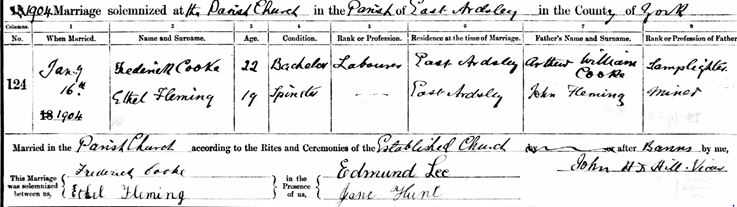
The Christmas of 1903 must have been a busy and exciting time in the Cooke household as within the next few weeks a family event was to take place.  On the 16th of January 1904 cook fleming marriageFrederick would be found standing with his family and friends in St Michael’s church, East Ardsley, waiting for Ethel Fleming to walk down the aisle and become his wife. Fred’s father, Arthur William, was now a lamplighter, while John Fleming, Ethel’s father was a miner.  The two witnesses to this event were Edmund Lee and Jane Hunt.
Life, does not always deal the cards we would wish, and like many others Frederick, seemed to have been given a few ‘duff’ cards.  He had already seen his mother die, his father re-marry and the 1911 census told of another ‘duff’ card.  The census shows the couple living at 6 Mary Street, The Falls, East Ardsley, a house with 3 rooms.  It tells that he was 30 years old and Ethel was 26; that they had bee married 7 years – we know that from the Parish Register entry, but the paper from 100 years ago also tells that the couple had had one child, and that it had died – died between their marriage and the date of the census.

Before I continue with Fred’s life, curiosity was getting the better of me, and it dosn’t take a lot for me to go off on a tangent looking for another story…………..here I go again!

Who was this child? When was ‘it’ born?  Was it a boy or a girl? How old was he/she when it died?  Questions, lots of them, and they seem easier to come up with than answer.  Let the questions stop and the answering begin.

What do I know, not a lot really apart from his surname would be cook(e) and death occurred between 1904 and 1911, which is too early for a mother’s maiden name to be entered.  A search of Freebmd with the search criteria being  Cooke and West Riding, brings up a lot of entries  – do you know how many there is to search through?  A lot!  I need to lessen the number of entries.  The Ancestry website has very considerately scanned West Yorkshire Parish Registers for certain periods, what can that come up with?  Straight to the West Yorkshire section for deaths and burials using just Cooke and East Ardsley came up wit five possibilities, but by the dates of burials I could eliminate three straight away, leaving two to have a look at.  After viewing the first I could also now eliminate that entry as the address was Morley.  One remaining, a John Arthur Cooke.

John Arthur Cooke was buried on the 23rd of March 1904, his address was given as Whitaker’s Fold, he was five days old and the entry states there was no service.   Without purchasing a birth certificate and death certificate John Arthur seems to be the most likely candidate, along with  both his grandfathers being Arthur and John.

Back to Fred.  Life carried on for him and Ethel until 1914 when events took place that would not only shock the world for years to come but would also impact greatly on East Ardsley. But the passing of time and the generations that followed would mean that events locally, would be forgotten sooner within the community.  The Great War, the war to end all wars, had begun and men were enlisting inn villages, towns and cities all over Great Britain.  Fred enlisted

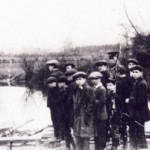
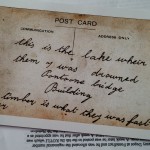
Fred, platelayer, on the Great Northern Railway and  being an old Territorial, re-enlisted, some sources say August, while other state September and November, but all agree on the year of 1914.  He became Pte., 2425, F. Cooke, in the 1/4th King’s Own Yorkshire Light Infantry (KOYLI).  The 1/4th’s were training near Malton, but bad weather was continuing they, (about 4000 of them) were moved to Gainsborough and be billeted within the community.  Training continued while some of the men moved to the coast, other stayed and on one particular day, the 19th of February, 1915, they were in the village of Moreton at a place called the Gymes.  The men were training on an enclosed pond to build rafts, readying themselves for crossing the Belgian canals. A Dewsbury man, Captain Harold Hirst, was in charge of the operation.  The rafts were constructed from rope, straw, tarpaulins and a wooden platform.

The Gyme, with the remains of the pontoon

The Gyme, with the remains of the pontoon

20150226_125332

Reverse of the Gyme photo


It was at 12:10 on Friday the 19th of February 1915, that as men from ‘D’ Company boarded their raft. As the raft started to leave the bank, their ‘vessel’ crowded with soldiers (some say up to 40) in their heavy kit and boots seemed stable for a while, but Pte., Punyer, who was in charge of a very long pole to push the raft forward, was soon, even with his arm fully in the water, could not reach the bottom of the gyme with his pole.  The raft was beginning to become unstable and tragedy soon struck and the men were very quickly fighting for their lives.  Those who were closer to the bank dragged men out of the water, others gave artifical respiration.  Higher ranking officers were called for, Field Ambulances were on their way and a roll call was sounded but seven were unaccounted for.  Five men were found and later in the afternoon, the final two soldiers were accounted for.

Their bodies were taken to stables behind the Crooked Billet pub in Morton.  An inquest was held the following day in Morton School, presided over by Philip Gamble, a local solicitor with a local builder, Mr Fox, being the foreman of the jury.  The jury viewed the bodies and visited the Gyme.  After the jury had viewed the bodies they were placed in coffins and taken by Army Ambulance to Holy Trinity Church Hall, Gainsborough, from where they would be taken the next day for their journeys home.  Some of the families of the seven men made the journey to Morton for the inquest, where after hearing various statements a verdict of Accidental Death was given but the Officer was criticised for his lack of experience and the lack of adequate safety precautions i.e. life buoys and trained first aid staff.

Within days the regiment had been moved to York and were sent to France on the 13th of April and were soon in the trenches at Bois Grenier.

The seven soldiers were all given full military funerals in their own villages, towns or cities, where family, friends, neighbours and many others paid their respects.

And it was that on 23rd February 1915, from 23 Cardigan Terrace, Frederick made his final journey carried aloft the shoulders of his fellow soldiers and followed by many more, with many carrying floral tributes.  The streets were lined as the courtage walked slowly passed, up the hill on its way to St Michael’s church.   The party would have been met by the Rev. John H D Hill, who years before had married Frederick and Ethel  in happier times, but today was a very sombre occasion as over 2000 from the military and surrounding area paid their respects.  The Rev. Hill in his parish register wrote the required information in the set columns and lines but he also added ‘military funeral drowned on pontoon’.

We now know how the Fred’s life ended and where he rests, but what happened to Ethel, well, early in 1918 she married Peter Humberstone.  She died on 29th of November 1947 and rests within the walls of St Michael’s Parish Church, East Ardsley, along with her first husband and her son.

Batley Cemetery 100 years on

Batley Cemetery 100 years on

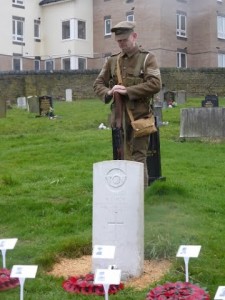
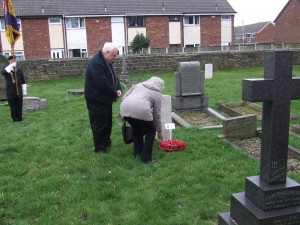
100 years on to the day …………. a  group of people gathered at the graveside of Private Batty, one of the 7.  They were there to remember the tragedy by laying a wreath for each one of those men an eighth wreath was laid by people from Gainborough.  The following Sunday over 20 people travelled from Yorkshire to Morton for a service and plaque unveiling.  It was a wonderful service and a visit to the Gyme followed, braving the wind, rain, bitter cold and the mud, where the wreath laid in Batley,  was laid in what remains of a now filled in Gyme.  I can’t say that walk was pleasant but having gone that far it seemed only fitting to go and complete the circle.

Tony Dunlop, PROJECT BUGLE and D Bedford, great niece of Fred Cooke lays a wreath

Tony Dunlop, PROJECT BUGLE and D Bedford, great niece of Fred Cooke lays a wreath

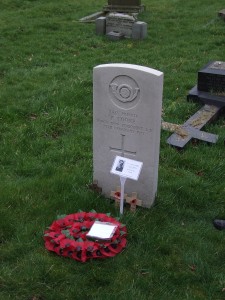
During the following day and weeks, the wreaths to the 7 have now been laid at the foot of each DSCF4764of their


headstones with a small information plaque.

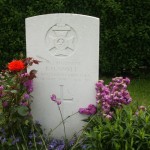
The names on the Commonwealth War Graves Commission headstones in most cases bare the name, regiment, service number and age of the casualty, but what they do not tell is the story, so when you see one of those headstones, stop and think if only you could tell your tale.

We Will Remember Them

Additional information :-  Captain Harold Hirst was the youngest of the officers within the regiment.  He was the son of Mr & Mrs Joseph Hirst of Ravensleigh, Dewsbury and a member of the firm of Messrs. G H Hirst and Co., Ltd., woollen manufacturers of Dewsbury and Batley.  He was an ‘old boy’ of Rugby School and it was on 24th of June 1915 that Harold was killed by a German sniper. He had previously killed two or three German snipers and this had been mentioned in dispatches.  He left a widow and a child which had been born two weeks after he left for the front.

So, it was that during the the war many of the men who were at the Gyme on that fateful day also lost their lives.

There has been an 8 page booklet produced as a joint project by various local and Lincolnshire groups – if anyone wishes a copy the cost is £2 plus postage – email gyme @ wakefieldfhs.org.uk

Sources :-

Ancestry, Find My Past, Freebmd,

Gainsborough’s War Years early 1914 – mid 1915 by P Bradshaw

Tony Dunlop

Guest Blogger

compilation logo in frameIf you don’t want the hassle of running and maintaining your own blog, but you like the idea of informing like minded people. You may be one of the people I am looking for.

Have you an interesting story to tell about a a member of your family.  Tell about the trials and tribulations of family historians or a local history  snippet on people or places; someone involved in WWI, WWII or other conflicts, a man or woman who stayed at home to do ‘war work’ or even a someone who objected to war.

You could tell how to research in a specific place i.e. the National Archives.  It could be an historical event that you would like to tell about – something that happened in your locale.

Do you have first hand experience of research in America, Canada, Australia or Europe and can give advice on where to look, with a few hints and tips that someone with local knowledge has learnt over the years.

Have you any tips on how to store your family history.  Do you have any suggestions for storing photographs or other research materials.

Or have you been on a visit to another country to do some family history ‘stuff’,  to a war cemetery, a battlefield or some other interesting place – let me know.

The blog can be short, long or something in between but it must be your own work.

Contact me at    –    guestblogger@wakefieldfhs.org.uk

Looking forward to hearing from you.

Old Etonian Killed in Action WW2

Eton College, Old Etonian served in the King’s Royal Rifle Corps

KRRC War Memorial Eton College

KRRC War Memorial Eton College

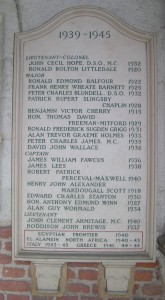
It was Eton College War Memorial, many years ago,  that started me transcribing war memorials and I seem to have gathered a vast collection of photographs along the way – I hate to say that many still need transcribing, but at the moment another project has to take priority.

But in the meantime, I will venture back to Eton College and a young man who I met (virtually) along the way.

When I transcribed the Eton College War Memorial, all those years ago, I was fortunate enough to be contacted by a relative of one of the men whose name is carved in………….. I was going to say stone but I think it is in fact marble.  A few emails went back and forth, with little bits of extra information and a photograph – it is so nice to know who you are writing about and it was my pleasure to be able to visit the grave, photograph the headstone and send over to the family.

It also appears, that when doing a little research for the young man concerned I found out that his grandfather Hugh Scott 8th of Gala)  was born in Bellie nr Elgin and his grandmother (Elizabeth Isabella Gordon) hailed from St Andrews, also in Elgin – small world as my mothers family also come from that area of Morayshire.

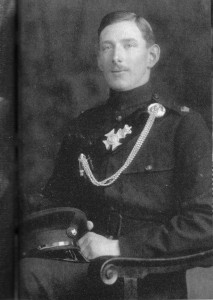
Who am I talking about, well it’s Henry John Alexander Scott Makdougall who born on 6th February 1901, the son of Hugh James Elibank Scott-Makdougall of Makerstoun and his wife Agnes Jenkinson.

Henry was educated at Eton College, leaving in November 1918.  He sat exams for Sandhurst College on 11th November 1918.  Henry was commissioned into the King’s Royal Rifle Corps with the serial number 12838, gaining the rank of Captain in the 60th Rifles (KRRC) in 1930.

In 1934 his father, Hugh died and on 2nd April 1935. Henry legally changed his name to Henry John Alexander Scott Makdougall, becoming Henry John Alexander Makdougall Scott, 11th of Gala.  This was recognised by the Lord Lyon King of Arms  and on 2nd April of the same year his arms were matriculated.

Henry served in WWII and I was told by a family member that  it was on a visit back to his family home, Gala House, with his mother, other family members and staff stood outside,  that he got in his car and drove off.  His mother waved him away and said that would be the last time she would see her son.

Eton College, Old Etonian, who served in World War 1 and World War 2. Served in the Kings Royal Rifle Corps., killed in action in Calais

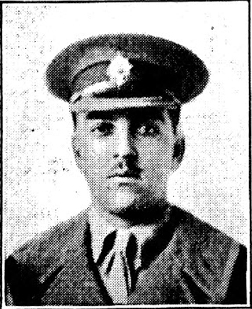
Major Scott of Gala courtesy of his family

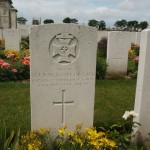
Captain Scott and one Second Lieutenant Scott were involved in fighting the enemy on the streets of Calais during May of 1940.  The story goes that one was on one side of the street and the other was across the road.  Both were killed on the same day and there seemed to be some confusion about who was where and what they were doing.  These details don’t seem to matter.  But what does matter is the men – Henry was 39 years old when he was killed on 26th May 1940 and his comrade was only 20 years old and both lie within the walls of Calais Southern Cemetery and rest a distance, probably, as wide as a street from each other.

So it looks like a mother’s premonitions came true!

Eton College, Old Etonian, who served in World War 1 and World War 2. Served in the Kings Royal Rifle Corps., killed in action in Calais

Major Scott of Gala C Sklinar©

The Probate Calender for England and Wales reads :- SCOTT Henry John Alexander MakDougall of Gala House, Galashiels died 26 May 1940.  Confirmation of Francis Gillies Sutherland writer to the Signet Philip Beaumont Frere solicitor and John Douglas Hamilton Dickson writer to the Signet,  Sealed Llandudno 28 July 1941.

Eton College, Old Etonian, who served in World War 1 and World War 2. Served in the Kings Royal Rifle Corps., killed in action in Calais

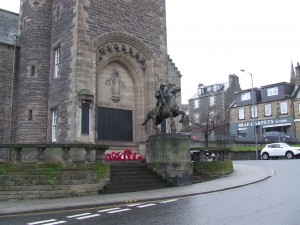
Galashiels War Memorial C Sklinar ©

Henry, as well as being mentioned on the Eton King’s Royal Rifle Corps memorial, Henry also has his name on the Galashiels memorial to the fallen.

As I mentioned another Scott, it seems only fair and right to see who he is too.  Richard Oswald Scott, was the son of Oswald Arthur Scott, DSO (1918) and his wife Hermione Monica, whom he later divorced.  Here it seems there is another local, well reasonably local, connection – Oswald Arthur married Hermione Monica Ferrand on the 19th of May 1917 in All Saints Church, Bingley.  Hermione’s father was William Ferrand, Esquire, living at St Ives, Bingley.  Oswald Arthur was 23 years old and a Captain in the Hampshire Regiment, living at Rotherfield Park, Alton. Witnesses to the union were W Ferrand, Patricia M Scott, Geoffrey T Scott and William Harris(?) Scott.   Oswald, served as 1st Secretary, Counsellor, Ambassador in Madrid, Baghdad, Lisbon, Finland and in the Foreign Office.  In 1951 he was Knighted (KCMG)

Richard, their son,  was born in the St Georges Hanover Square Registration District of London in the June Quarter of 1920 – one of four children.

Eton College, Old Etonian, who served in World War 1 and World War 2. Served in the Kings Royal Rifle Corps., killed in action in Calais

Lieut R O Scott C Sklinar ©

During WWII he, like Henry, served in the King’s Royal Rifle Corps and became known as 95645, 2nd Lieutenant R O Scott.  The men a few connections, both came from landed families and both had links to Eton College.  While looking for snippets of information about Richard, I came across his brother – Thomas Roland Scott 4th April 1923 also served during the war.  Thomas served as Flying Officer, 115515 in the Royal Air Force Volunteer Reserve.  On 22nd of October 1942, he too was killed and he rests in Porthmadog Public Cemetery, Caernarvonshire, with 17 other casualties from both wars.

King’s Royal Rifle Corp Eton Memorial can be found here

A letter of Thanks dated 1916

Some of you that know me will be aware that I have a box that  has a lot of newspaper snippets and notes all ready for the day when I will get around to telling the world their story. I also have a folder in my email and a file on my laptop that has something similar, but sometimes the donor of photographs after being saved to the laptop gets separated and I am unable to acknowledge the sender or owner of the photographs…………yes, I know, but none of us are perfect!

A while ago I was sent a set of three pictures – one was of an envelope, and the other two were pages of a letter.

The letter, by a little ragged, was franked and had two one penny stamps on the top right hand corner. It was not written in a style I would have thought was used in that time but a style that was more rounded and with rounded loops on the high letters. The envelope was addressed to Nurse Howell, The Asylum, Wakefield – followed by a full stop and a confidently underscored stroke. I will leave Nurse Howell for a while and concentrate on the sender, one Elizabeth Rudd.

Elizabeth Rudd on the top right of her letter gave her address as 32, Westcliffe Terrace, Harrogate and dated it March 5th 1916. Who was Elizabeth and why was she writing to Nurse Howell?

To find who Elizabeth was we have to pry into her life by reading her words of thanks. Elizabeth was thanking Nurse Howell for looking after her sister during her last hours of life, which as she says ‘I did not know the end was quit so near….’ The nurse was thanked for her kindness for being at her patients side while her sister was not. But Elizabeth was glad that the nurse had been spared any painful suffering – Elizabeth’s sister having a peaceful end. Elizabeth went on to say that Nurse Howell was doing ‘noble work, one which required much patience and endurance…..’

Let’s go and find these two ladies!

Firstly, Elizabeth. We know where she lived in 1916, so a look at the 1911 gave an Elizabeth Rudd living at 81 Skipton Road, Harrogate, who was 28 years old and working as a draper’s clerk. Her parents were John William Rudd, a joiner and Mary Ann, and five other children in the house. Elizabeth had one sister, Maud Mary aged 23 – could this be the sister whose life had ended with Nurse Howell by her bedside?

Back in time 10 years to 1901 the family have now swelled their ranks and are living at 4 possibly Ashworth or Charlesworth Place, Harrogate. But there are still no clues as to the missing sister.

Back to the drawing board and a cleared Ancestry. I have set up the quick links and one of the links is directly into the UK Collections, but could not find the collection I wanted. So back to the home page and ‘see all new records’ Bingo, there it was, the UK, Lunacy Patients Admission Registers, 1846 1912. My main fear was that the date of the letter was just four years after the collection date, but hey-ho, in for a penny!

I did not know Elizabeth’s sisters name therefore a general search for Rudd and Wakefield. One entry stuck out and that was for a young lady called Hannah Jane Rudd. Hannah had been admitted on the 16th of September to the W. Yorks Asylum with no year given at the top of the page and no years on the previous pages, but her date of discharge of death on 14th February 1916, does seem to lend itself to being the lady we need.

So, if Hannah Jane is Elizabeth’s sister and she is not on the 1901 of the 1911 census, will she be on the 1891 and link her to her sister? Let’s go see!

The Rudd family in 1891 were living off Grove Road, Harrogate. John William was a joiner and builder and there was a Jane A Rudd, in the house. Could this be our Hannah Jane, who was three years older than Elizabeth?

Do you know any different?

Nurse Howell, now this could be a little trickier! Presuming, a thing I know you should never do, but where needs must…………as a nurse I presume she would have been a mature person, so over 21. I know during 1916 she was working in the Asylum, and possibly living in the Wakefield area. But, was Nurse Howell, 21ish in 1916 or older?

Back again to the 1911 census and a very, very broad search for Howell, Wakefield and female………and more ladies to search through than I cared for. I selected the search to about 1870 to 1895. I hate the new search on Ancestry, the searching does not hold the same ‘chase effect’ that it used to, but we got there after what seemed like an age – I could have made a Christmas cake quicker, or it felt that way!

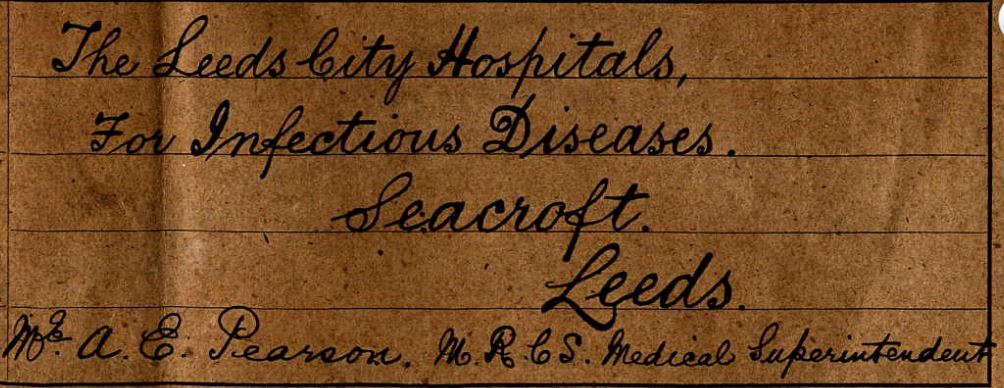
One entry out of all of them stood out! Harriet Margaret Howell, aged 21, giving her year of birth around 1890. She was born at Bowes Park, Middlesex but was living in Seacroft seacroft hospitaland her occupation was Hospital Nurse. Harriet was one of many nurses and ancillary staff working at Leeds City Hospitals for Infectious Diseases, Seacroft, Leeds, Mr A E Pearson, MRCS, Medical Superintendent was in charge. The hospital cared for patients with scarlet fever and diphtheria and provided care for 482. When the need for isolation hospitals lessened Seacroft was changed to a children’s hospital.

Harriet  must have moved to work in the Asylum by 1915/16 to have nursed Miss Rudd. 

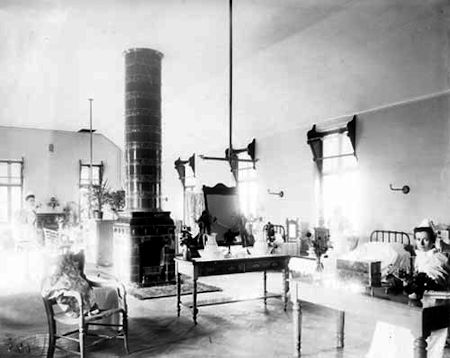
Seacroft Infectious Disease ward c1900

Is the Nurse Howell I am looking for or do you know better!

Sources:-

Leodis

Ancestry

Find My Past

Pte., Gault, John Scott

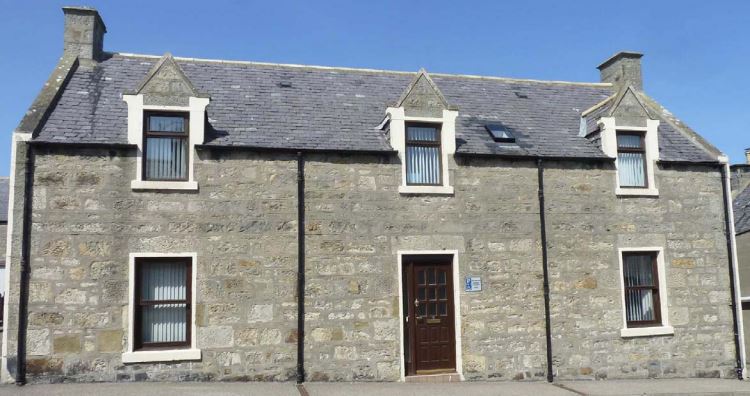
John Gault Scott, was born in Drainie, the son of James and Maggie Gault. At the time of the 1901 census the family of James and Maggie was living at 8 Argyle Street, Lossiemouth.  The family consisted of  8 children, the eldest being 17 and the youngest was just one – John Scott was the third youngest aged 5.  James earned his living as a fisherman.

John served in the Seafoforth Highlanders as pte.,1849, 6th Btn,after enlisting in Elgin.  The 6th Batt. served as the 51st Highland Division and was a Territorial Force division. The divisions insignia was a H D in a red circle – giving the batt. the nickname of Harpers Duds after Major General Harper, or Highway Decorators.  The division served in the Battles of The Somme, Arras and Cambrai.

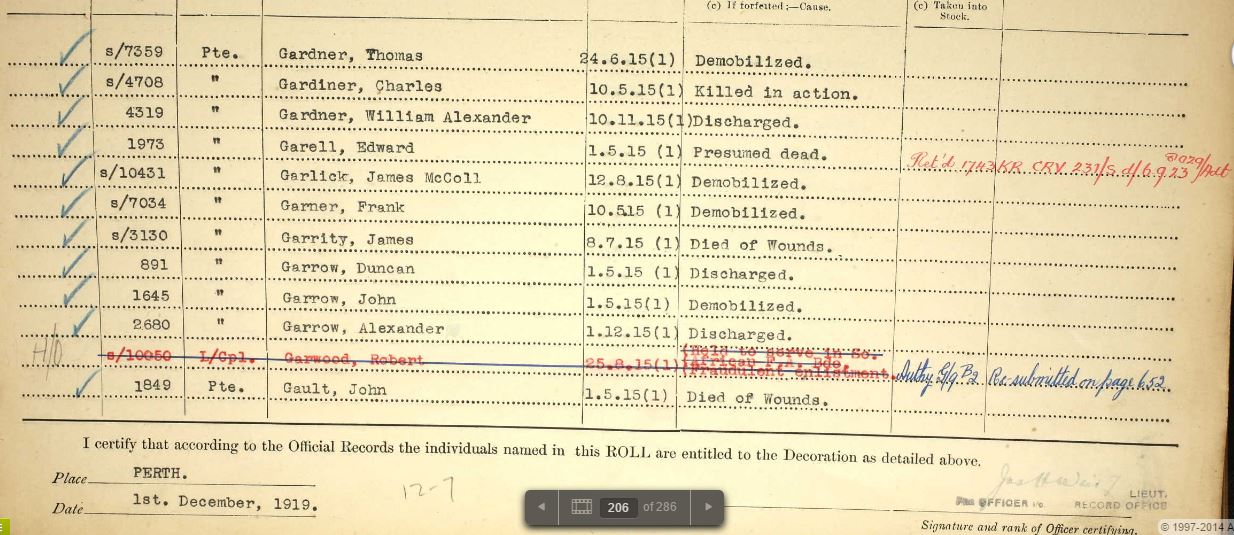
John Scott Gault D of W on 6 June 1916 aged 20 years.  John was eligible for the 1915 Star, the Victory and British Medals and served in France.

gault john scott

8 argyle st lossiemouth

8 Argyle Street,

At the time of James and Maggie, giving information about their son they were still  living at  8 Argyle Street, Lossiemouth, Morayshire.

John and other young men from Lossiemouth can be found on the Lossiemouth War Memorial

http://wakefieldfhs.org.uk/genealogyjunction/Morayshire/Lossiemouth%20War%20Mem.htm  The transcription is a work in progress so if you know any histories of these men who gave their life for King and Country, please let me know.

Sources:-

http://wakefieldfhs.org.uk/genealogyjunction/Morayshire/Lossiemouth%20War%20Mem.htm

Ancestry

Soldiers who died in the Great War

CWGC.org

A Boy Named Sue or Any Other Name That Fits!

As usual I start off doing a little project and then I go off on a tangent – I was looking for someone on a war memorial, a local one, that had a surname that I knew one of my friends was researching – I sent her a message and while waiting for the reply, the whole blog went belly up and did a full 180 ° turn – so you will have to wait for that blog.

But, while I was waiting for a reply, someone on one of my facebook groups placed a request for information on a lady who died in Egypt in 1918 – well what was I to do?  Leave her question unanswered, or go for it!  A quick search of Probate came up with nothing, a search of passenger lists came up with a few but none that I could say 100% without further information.  So the good old 1901 was consulted, but not to sure about the entries, therefore, forward 10 years to 1911 and this is where it went all wrong!!

I had been looking for ‘Abbie Garner’, she may have been known as Abbie and everyone called her Abbie, and it stuck but I checked Abigail and I should not have done……………..as one entry, an entry very near the top of the list in the 1911 census was for a George Abigail Garner – a transcription error on the index I thought, but no, it was his name, he wrote it clearly on the census and I was totally and utterly distracted from both the war memorial and Abbie.

Now I am hooked, who was George Abigail Garner and why the unusual middle name for a man and why did he give his son the same name?  Starting where I found him in 1911, we have George snr, head of the house aged 38 and working as a cooper, born in Lowestoft.  His wife, Mary Elizabeth aged 34, stated she had been married 10 years, given birth to 4 children, with 3 surviving to the 1911 census. Elizabeth Shepherd Garner is aged 10 and born in North Shields, next is George Abigail jnr, and then Helen aged 5. Finally, Robert Stephenson Garner aged 7 months.  Why does Helen have only one name when her siblings have an extra ?

A change of websites and a hit for G A in Lowestoft comes up in 1901 where Nathan Garner aged 55 is the head of the house, a town crier, with his wife Martha and 5 children aged between 20 and George, the youngest on the census aged 8. But still not a hint of a clue as to why Abigail was used as a middle name – George is not even entered with this name on the census.  Think we may have to back a generation to see what lies there.

So to Google, a wonderful too, but don’t believe all you read – verify and check with original sources where possible but if that is not possible make a note of the source and where you found the information.  A search for Nathan Garner took me to a site listing all Town Criers world wide, very interesting but I am confused as to why it had an piper playing over the page and even turning my sound off, still the sound could be heard when mousing over the information – why it was not Scottish and had no reason to be there.  I like a good tune played on bag pipes, in tune and in the right place – rant over, now back to Nathan.  Well, the site did tell me he was working as a crier in 1891.  Another link took me to a page full of Suffolk family names – this should be interesting and was.  The Nathan Garner I had been looking at on the previous site was born, as we know from the census in 1901, around 1845, but the list of names goes back one more generation, as I said I needed to do.  Nathan Garner, yes another, was born around 1829.  Back to the census.

The 1871 census has Nathan living next door to his brother, William, at 7 Nobbs(?) Buildings, Lowestoft and is a tailor, brother William is a basket maker.  Nathan jnr is 16 and working as a shoemaker.  I now know Nathan snr’s wifes name – Martha, obtained from an original document.  Next stop was to find who Martha was. A visit to Freebmd and a quick search came up with just one entry – Nathan Garner + Martha = Martha Abigaill……………..Fantastic.  So, it looks like that George Abigail Garner, even though there is a spelling variation, has the maiden name of his grandmother as his middle name – not unusual but sometimes it may raise a few questions.

George Abigail Garner had a son in 1903 and like generations before gave his son his name – George Abigail Garner.

Problem solved and back to the blog I was going to start earlier!

The Eton Rifles

It was Eton College that gave me the WW1 bug and one friend in particular imparts me with newspaper cuttings and snippets.  One such newspaper cutting was given to me a few days ago and again has an Eton College link. It is a known fact that many of the young men from Eton College and other Public Schools left school in the spring and summer and by the autumn and winter had joined the the ranks of ‘the fallen’.  One in five young men from these schools did not return. Information from a new book tells that King Edward School, Lytham was the hardest hit public school with a third of ex-pupils who went to war being killed.  The National Archives has a graph detailing six public schools, the numbers serving, numbers killed and a percentage.  Eton College had 5650 young men serving with over 1100 being killed.  While Sedbergh had 1250 serving with losses of 251.  Eton in this graph seemed to come off the worst.  But saying that Eton seemed to fair very well when it came to The Old Etonians being awarded the Victoria Cross followed close by Harrow. Anyway, back to my newspaper article that features Eton’s first viii rowing team for 1913. Namely, Lindsay Campbell ; Charles Rowlatt ; Sigurd MacCulloch ; Ronald Backus ; Augustus Dilberoglue ; Richard Buckley ; Ian Napier ; Stephen Fairbairn ; Edmond Elliott. Only three of the first viii team for 1913 died in The Great War, firstly –

Dilberoglue AugustusAugustus Dilberoglue – he was born on 13th January 1894, he was the son of Planton and Julia Dilberoglue who around the time of their sons death were living at The Lodge, 19 Southfields Road, Eastbourne.  The family had previously been living in Cairo as Planton had been a Judge of the Native Court of Appeal.  He was educated at Summerfields, Eton and Christ Church, Oxford, where he was when war broke out.  He obtained a commission and later attended Sandhurst.  1915 saw him being gazetted to the 3rd King’s Own Hussars.  Augustus served with his regiment in Shorncliffe, Ireland, with the BEF in France and Flanders and was KIA on 1 April 1918 nr Domart.  He rests in Hourges Orchard Cemetery Domart-Sur-La-Luce CWGC cemetery. His Commanding Officer wrote that he had a very high opinion of him, he was a fine young man and would be a great loss.  A fellow officer said he was of the finest character and a good friend.  He went on to say that he did not think he had ever met a more morally fearless character and that his squadron and troop fellow officers all loved him. While at Eton he had been captain of his house and in his last year captain of boars.  He rowed bow in the vii in 1912 and no 5 in the vii in 1913.  During that year he also won the School Pulling with G W Withington.  In 1914 he rowed no 7 in the Christ Church boat First Torpids.  He was a member of the Cavalry Club, the Vikings Club and of the Leander Club. Dilberoglue richardPlanton and Julia lost another of their sons – Richard Nicholas Dilberoglue who was also educated at Southfield and Eton and Sandhurst and joined the Coldstream Guards.  He was KIA when a shell exploded at his feet and he rests in Ginchy.  He also had wonderful tributes paid to him. Richard’s medal card, like his brother’s give their parents address in Eastbourne, but Richards gives a previous address of Buckingham Gate SW1. Richard and Augustus also had another brother serving in the Welsh Guards, Pandeli Dilberoglue who survived The Great War and lived until 1952.  

Sigurd MacCulloch (MacCullock) – Sigurd Harold MacCulloch was the son of John J and Matilda J MacCullochserved as a 2/Lieutenant  in the Seaforth Highlanders and died of wounds near Albert in 20 December 1915 aged 21.  He rests in Mailly-Maillet Communal Cemetery Extension.  An address on his medal card tells that the family lived at 8 Caurtfield Gardens, SW7.  The London Gazette for 4 March 1915 states that “The undermentioned Second Lieutenants to be Lieutenants” Sigurd H Macculloch’s entry had a note in brackets ‘(since died of wounds received in action)’. Sources:-De Ruvigny’s Roll of Honour Ancestry CWGC Christ Church, Oxford.

elliot esmond

Esmond Elliot –  Was born on 25 September 1895, to Gilbert John Elliot-Murray-Kynynmound, Earl of Minto and his wife Mary Caroline Grey.  Esmond like the other young men in this entry he attended Eton College and was coxwain in the Eton College eight in 1911,12,13.  During the Coronatian year he was Page of Honour when the new King and Queen went to Holyrood.  He served in the Scots’ Guards with a rank of Lieutenant and acted as A.D,C, to the Major General commanding the Guards Division in France.  He Died of Wounds on 6 Aug 1917.  A note on his Medal Card dated 7 February 1922 has his mother, The Rt. Hon. Mary, Countess of Minto, of 48 Chelsea Park Gardens,  SW3, applying for her dead sons medals.on year, he was Page of Honour when the King and Queen  were at Holyrood.

Sources:-
Ancestry.co.uk
The London Gazette
The Sunday Times


Aunty Dolly’s little brown book

Why is it that the things you grow up with, and the people, you take so much for granted, never stopping to ask or question why, what, who and when!

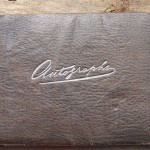
My mum left me her handwritten recipe books from which I am now writing a book with the proceeds going to charity, aunty Dolly also gave me a book, about 7” x 5” and in dark brown mock leather.  As a child I just looked and thought no more about this little insignificant, slightly ragged, or well worn little book.

Before I tell you about the book I would like to tell you about my beloved aunt Dolly. She was born Frances Siddle on 16 September 1907 in Wakefield  to Agnes Siddle.  There was no father named Aunty Dolly's little brown bookon her birth certificate.  In April 1911 her mother married Ernest Wilkinson and later in the year she was Christened and between 1913 and 1929 three half siblings followed.  By 1950 she had met and married John C Kaye, a professional soldier, now he’s another interesting story.

Frances by now was known as Dolly or Do-Do and in her early 20’s worked as a barmaid in a public house at the Westgate end of Dewsbury Road.  Later, she trained as a nurse and later undertook extra training to become a mental nurse – Frances Siddle, R.C.N., R.M.N. abbreviations of which she was very proud.  In my lifetime aunty Dolly worked at Stanley Royd and was one of the shift Sisters in charge of Ward 18.  She was immaculate in her navy uniform with a starched white apron, starched cap, and when working on the ward she had her cuffs turned up with frilly white covers or when doing her office work she had her sleeves turned down with stiff white cuffs and always had her keys very close at hand.  When I, as a child, used to go with my uncle John to collect her.  We used to drive passed the gate house, where at the end of a shift aunty Dolly or Sister Kaye, would deposit her keys.  Go up the drive and then turn down towards Ward 18 under a small arch and uncle John would wait in the car while I would run to the large door and ring the bell and await the clunking of the key in the door.  Once inside I would either go into aunties office or go and sit with the ladies who lived behind the large locked door.

Aunt Dolly and uncle John became my second set of parents as I lived with them for many months while mum was in hospital with an injured leg – what more can you ask for –  one set of wonderful parents and then two others who dote on you.

Anyway, on my many visits to their house my aunt showed me the little book, I looked at the pages, thought how nice the pictures were and how I wish I could draw and paint like that, and that was that.  Now, many years later the little book has once again grabbed my attention, but as well as thinking how nice the pictures are I also wonder who wrote the words, drew the flowers and did the wonderful ink pen drawings.  How many times have I looked at the little book and never notice other

Edwin Siddle

Edwin Siddle

people with the name Siddle. Two of my great uncles have written and signed in the book along with many other peoples ditiities.  My aunts Autograph Book is full of her friends.

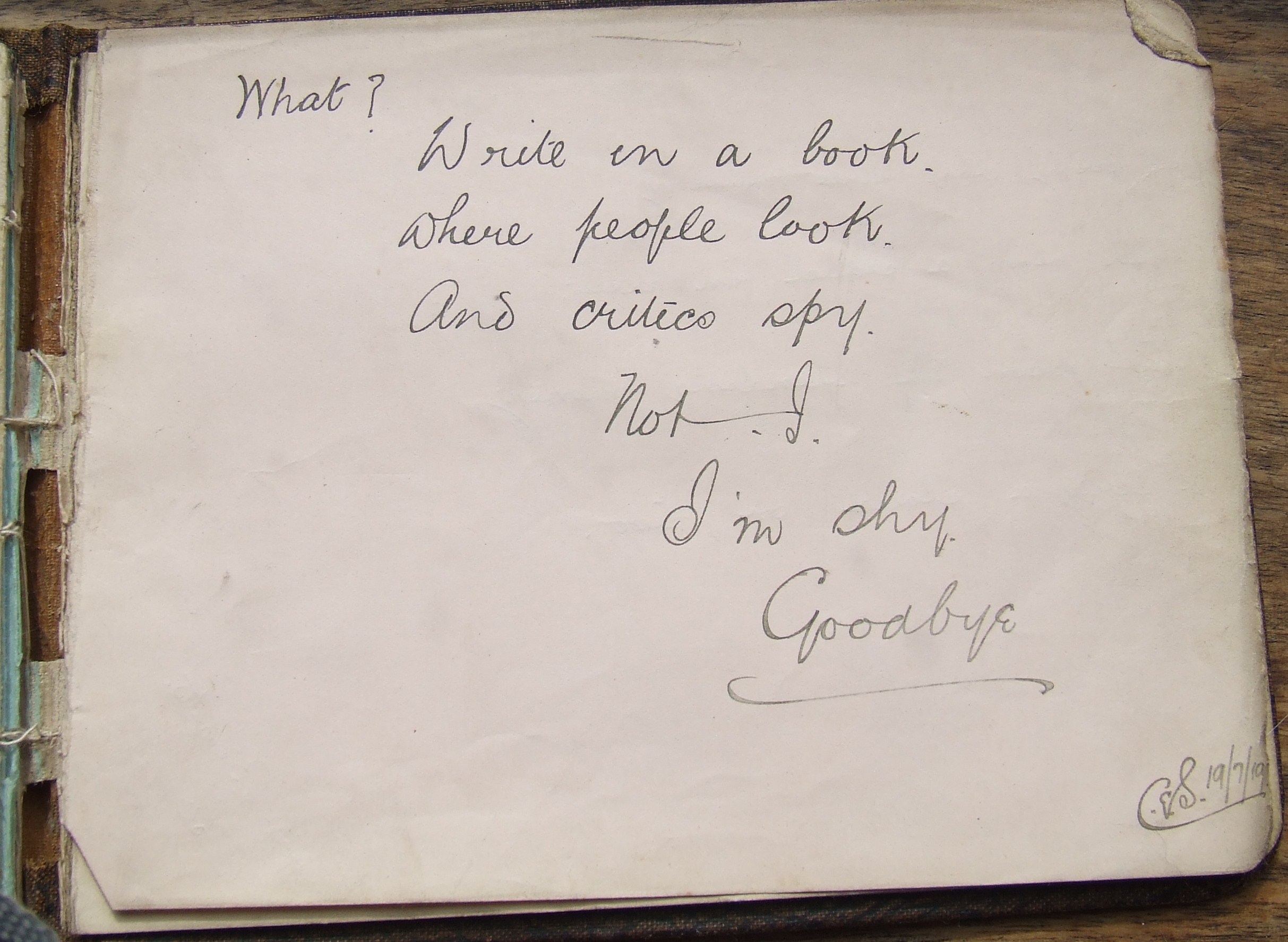
Charles Ernest Siddle

Charles Ernest Siddle

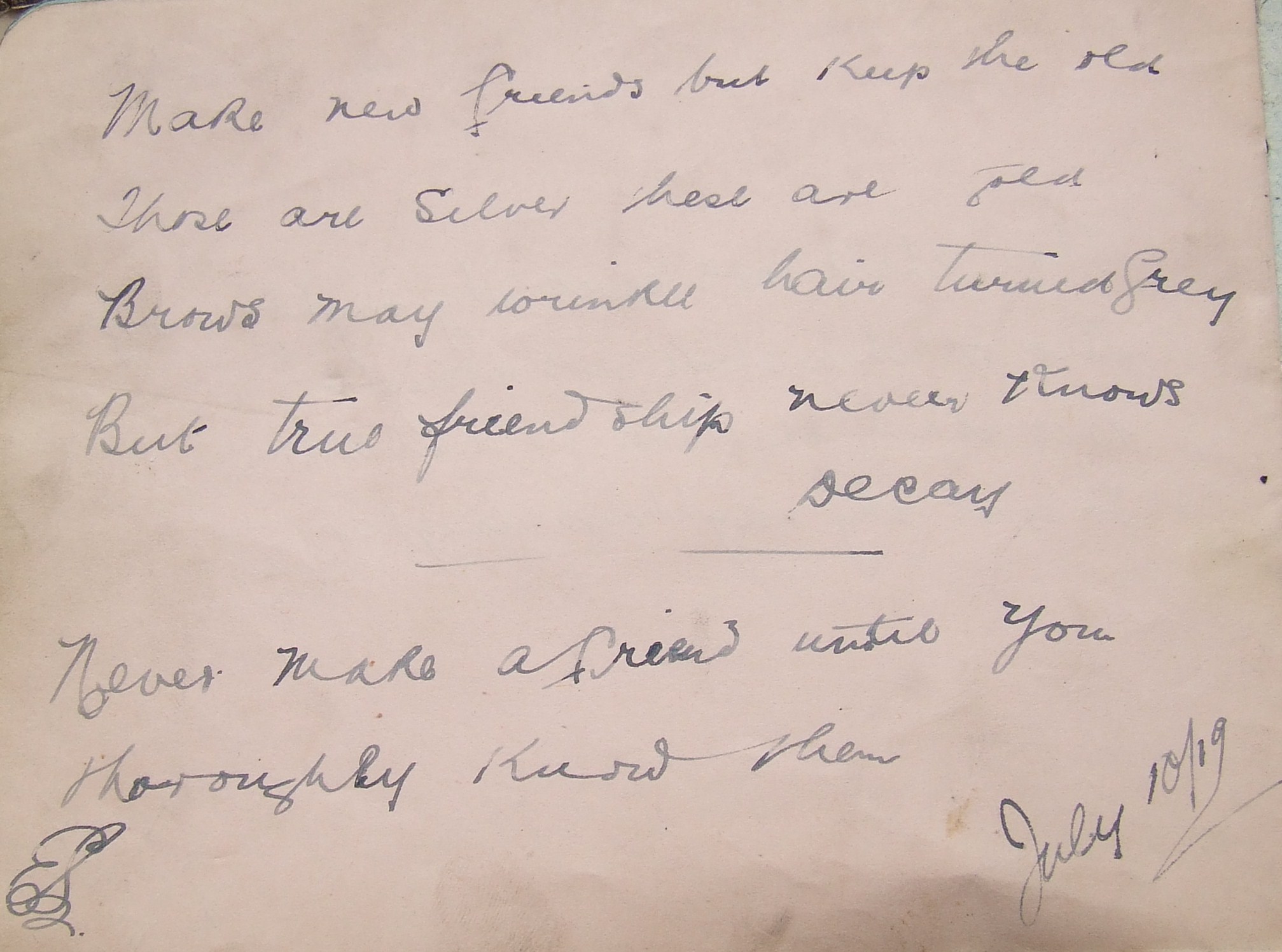
Charles Ernest Siddle on 19 July 1919 wrote ‘What ? Write in a book, where people look, and critics spy, not I, I’m shy, Goodbye’  A few short years later he had died.  His brother Edwin wrote multiple entries but one that makes me smile is this ‘God made the bees, the bees make honey, the infantry fill the sandbags, the R.E’s get the money’.

Edwin Siddle

Edwin Siddle

Others who have graced the pages include Nellie Winterbottom who on 22 March 1922 wrote ‘ Mary had a little watch, she swallowed it one day, now she’s taking Epson Salts to pass the time away’.  Gladys Bennett on 6 October 1922 wrote ‘ If every day was sunny, with ne’er a cloud in view, we’d soon be spending money to buy a cloud or two’.  Marjorie Holmes wrote ‘The happiest moments of all my life were in the arms of another man’s wife – my mother’.  M Harrison on 6 October 1922 wrote ‘ The butterfly has wings of gold, the firefly has wings of flame. The flea it as no wings at all, but it gets there just the same’.  I think M Harrison could have also have worked on Ward 18 at Stanley Royd.

C E B

C E B

Edwin Siddle

Edwin Siddle

G Moxon

Names and initials on the pages are :- R W, M Brear, G C Moxon, E J Tingle, A Murgatroyd, NellieWinterbottom, Irene Stevenson, A Hutchinson, M Harrison, E Morton, Annie Fraser, Ethel Oxley, M Sykes, D M Meek, E Hemingway, H Asquith, Mary Murgatroyd, Gladys Asquith, C E B, Violet, V Bell, M Garrison, Marjorie Holmes, K Hudson M Brear(beautiful pen drawing), M Johnson, Gladys Bennett and finally, G F Smith B.A., L.L.B., L.L.D., A.C.P. who wrote ‘ England has saved herself by her bravery may she now save Europe by her example’.
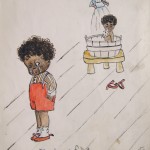
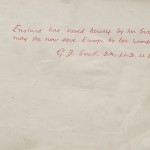
One of the entries is a poem of sorts and covers three pages entitled The Barnsley Disaster.  At first I thought this was just a story but that proved to be wrong.

Barnsley Public Hall on Saturday 11 January 1908 was the setting for a tragedy when 16 children mainly under 10 years old lost their lives and 40 others were seriously injured. That will be another tale but what interests me at this time are the names.  Family history does after all starts with names.

Ethel Oxley for instance was born in 1908, the daughter of Henry and Ethel Oxley who at the time lived at 19 Pilkington Street, Thornes Lane, Wakefield. Ethel at the time being the youngest of four children.

Gladys Asquith was not a local girl being born in Hereford.  Her grandfather, Benjamin Asquith was a market gardener born in Carr Gate, his wife Elizabeth was also a local girl and their son Walter.  But somewhere along the line they moved to Hereford where Walter met his wife Lily and Gladys was born in 1908 but in the next couple of years they moved back ‘home’ and Evelyn came into the world.  The census of 1911 index gives the impression that Benjamin and Elizabeth are the parents of the two young children, but I think otherwise and am taking Walter and Lily as their parents.  The family lived in a four roomed dwelling at 21 Carter Street, Wakefield.

Mary Murgatroyd – there are two Mary Murgatroyds that are within a decent age range but for some reason, call it gut instinct I am going with the younger of the two as her father was a Law Clerk for the County Council.  As you have previously read one of the entries in the book has legal initials after his name (maybe not a good enough reason but seems to fit better than the other entry).  The family were also living only a few streets away on Johnston Street.

Annie Fraser

Annie Fraser

Annie (Ann) Fraser, another writer in aunt Dolly’s little brown book was born in Wakefield along with her brother William, while the rest of the family were from Forfar, Paisley and Glasgow.  Annie’s father James was a boat builder, building seamless steel boats.  The family lived at 12 Caldervale Road, so James would have been very close to work.

Violet (Victoria) Bell was one of five children in the 1911 census to Ernest Edward Bell and his wife Lillian Gertrude – the couple being married thirteen years and he worked as an iron roller at Horbury Junction.  Again, a family that came into Wakefield.  Ernest was born in Louth, his wife in Tipton, Staffordshire  and their two eldest children hailed from Carlisle.  The family lived in three rooms at 14 Wellington St, Thornes Lane.

Nellie Winterburn was the daughter of George and Emma who lived at 3 Wellington Street, Thornes Lane.  George worked as a cloth scourer to feed his family in 1911.

I have now found out who some of the entries were written by but not how they are connected to my aunt – more research to be done. But one of the few names that evade me is G. F. Smith B.A., L.L.B., L.L.D., A.C.P – who is he and what connection did he have to my aunt.  Was the connection her friend whose father was a Law Clerk or what it a nursing connection?

Mr Smith's entry

Mr Smith’s entry

A quick search of the 1911 census has four entries for a Smith who is a solicitor, but none with the initials C. F. There is, unlike other entries, no date for Mr Smith’s entry but going by the others the dates are between 1918 and 1922.

Still more looking around to try and find the threads that crossed these peoples lives in the few years following World War one.  But as I write this something has just dawned on me.  Something I knew, but never thought of.  My aunt was almost a generation older than my father, being born in 1908 and my father in 1923.  I knew all about her but never until today did it click she lived through WW1 – she would have been there when my great grandma received ‘that telegram’ regarding her son Herbert.  There when my great aunt also received ‘that telegram’ regarding her husband George Albert Wheeldon. There when my great grandma lost another son Charles in 1926.  It sometimes takes writing things down to realise how the generations blend into one family.

So that’s the story of Aunt Dolly’s little brown book so far.

To be continued……….